

A startup doesn’t need to reach a certain turnover or headcount before it needs senior finance leadership. The right time to ask when to hire a finance director for a startup is when important decisions are moving faster than your financial visibility. Cash forecasts feel unreliable, growth plans are difficult to test, or the numbers aren’t giving you clear answers.
It’s understandable to wonder whether these problems signal growth or are temporary growing pains. You may be managing bookkeeping, tax and reporting well, yet still lack the insight to plan cash needs, assess risks or make confident strategic decisions. Compliance support and finance leadership serve different purposes. One doesn’t automatically replace the other.
This guide will help you recognise practical readiness signals beyond turnover, understand what a finance director can add, and compare a full-time hire with flexible outsourced support. You’ll also see how strategic guidance can work alongside day-to-day finance operations, so you can choose a sensible next step without committing to a bigger role before you’re ready.
Key Takeaways
- To judge when to hire a finance director for a startup, assess the decisions and risks your current finance setup can support, not turnover alone.
- Separate strategic finance needs from bookkeeping, payroll and statutory filing, then identify which tasks or decisions lack clear ownership.
- Before hiring, check whether unreliable figures stem from delayed bookkeeping or poor-quality data rather than a gap in senior finance skills.
- Compare full-time, fractional and outsourced support by the continuity, scope and internal capacity your startup needs.
- Consider how outsourced finance director guidance can work alongside bookkeeping, payroll and a broader outsourced finance function.
When should a startup hire a finance director? Look for complexity, not a revenue milestone
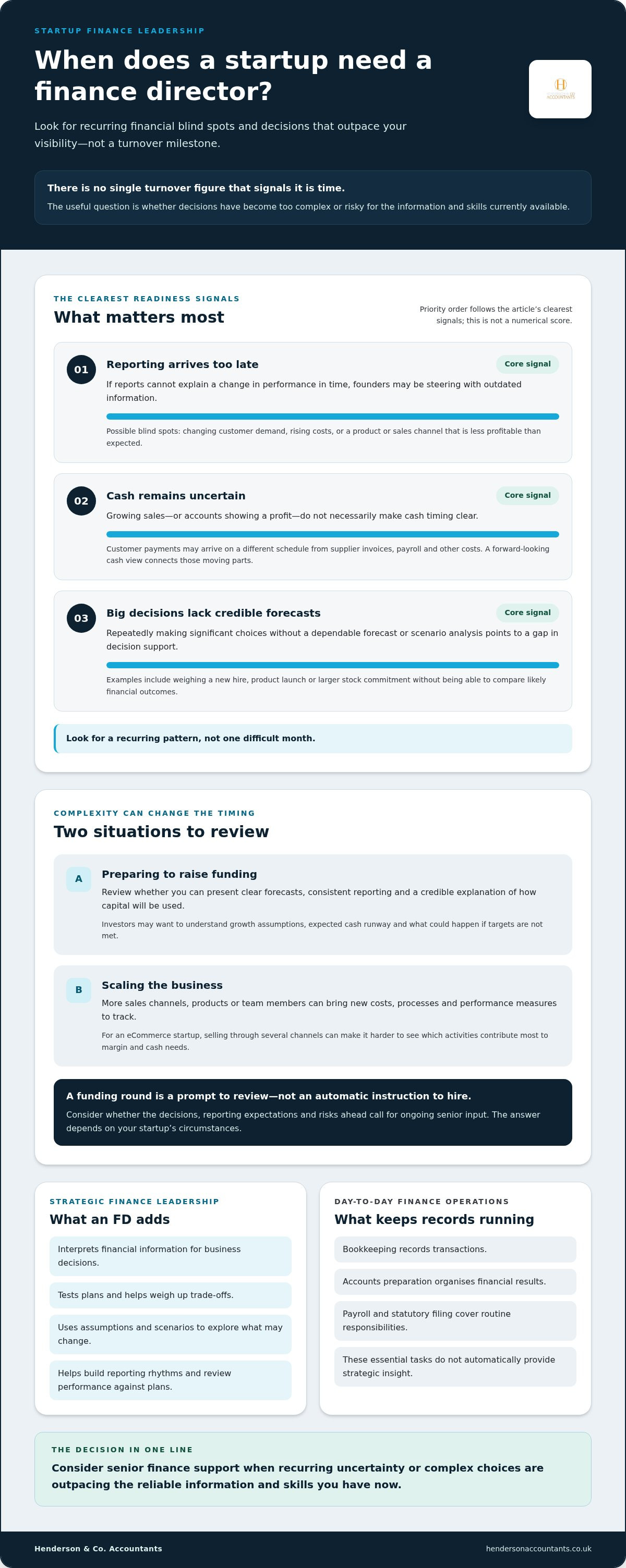
There’s no single turnover figure that means a startup needs a finance director. A more useful question is whether your financial decisions have become too complex or risky to manage with the information and skills you currently have. That point may arrive early in a startup’s life or much later, depending on its business model, pace of change and plans.
A finance director (FD) is a senior leader who connects financial information to business decisions. They help founders understand what the numbers mean, test plans and weigh up trade-offs. This differs from bookkeeping, accounts preparation and routine compliance work, which focus on accurate records and reporting responsibilities. Those tasks are essential, but they don’t necessarily provide the strategic insight needed to decide whether to expand, recruit or change direction.
The clearest readiness signals are unreliable reporting, recurring cash uncertainty and high-stakes decisions made without credible forecasts. If these issues regularly affect your choices, it may be time to explore when to hire a finance director for a startup.
Startup signals that financial leadership may be needed
Look for recurring problems, not one difficult month. If financial reports arrive too late to explain a change in performance, founders may be steering the business using outdated information. This can mean missing a shift in customer demand, overlooking rising costs or failing to spot that a product or sales channel is less profitable than expected.
Cash uncertainty is another useful signal, even when sales are growing or the accounts show a profit. A business can have strong sales and still struggle to predict when customer payments will arrive or when supplier, payroll and other costs will fall due. An FD can help connect those moving parts in a forward-looking cash view, rather than leaving founders to rely on the bank balance alone.
Consider the decisions on your desk. If you’re weighing a new hire, product launch or larger stock commitment, can you compare the likely financial outcomes of different options? Repeatedly making significant choices without a dependable forecast or scenario analysis suggests a gap in decision support, not simply a need for more historic reports.
Why fundraising and scaling can change the timing
Preparing to raise funding can increase the need for clear forecasts, consistent reporting and a credible explanation of how the business will use capital. Investors may want to understand the assumptions behind growth plans, the expected cash runway and what could happen if targets aren’t met. A finance leader can help founders organise this financial picture and assess whether a proposed plan is realistic.
Growth can also add complexity without an immediate funding round. Selling through more channels, introducing products or building a team creates new costs, processes and performance measures to track. For an eCommerce startup, sales across several channels can make it harder to see which activities contribute most to margin and cash needs.
A funding round is a prompt to review your finance needs, not an automatic instruction to hire an FD. Ask whether the decisions, reporting expectations and risks ahead require ongoing senior input. The answer depends on your startup’s circumstances, not the funding milestone alone.
What a startup finance director does beyond accounting and compliance
A startup finance director (FD) turns financial information into useful guidance for the people making business decisions. Their value isn’t just in producing figures. It’s in explaining what those figures mean, what could change them and which trade-offs deserve attention. That gives founders a clearer basis for setting priorities and reviewing plans.
Finance director, defined: A senior finance leader who interprets a business’s financial position and helps its leadership team make informed commercial decisions.
This strategic role is distinct from the work that keeps financial operations running. Bookkeeping records transactions; accounts preparation organises financial results; payroll and statutory filing handle important routine responsibilities. An FD can work alongside these functions, using reliable information from them to support planning and oversight rather than duplicating the tasks.
Good finance leadership can also build financial discipline through clearer reporting rhythms, explicit assumptions and regular reviews of performance against plans. These practices help a team spot questions earlier and make decisions with more context. They don’t guarantee a particular result, but they can make the reasoning behind choices more visible.
From historical accounts to forward-looking decisions
Past results show what has happened. Forecasts help founders consider what might happen next. An FD can help turn a business plan into a set of assumptions, then test how changes in sales, costs or timing could affect the picture. Scenarios are useful when a plan depends on uncertain factors, because they let the team compare options before committing resources.
Cash flow planning adds a timing view. A company may record a sale before receiving payment, whilst wages or supplier invoices fall due on a different schedule. Mapping expected cash in and out can help founders anticipate pressure points and understand when additional funding might need to be considered.
Management information makes performance easier to interpret. Rather than reviewing a total in isolation, the team can examine relevant measures, such as revenue by product, spending against budget or changes in margins. The right view depends on the business model. The aim is to connect results to the questions leaders need to answer.
How finance leadership works with the founder and existing team
An FD can act as a sounding board, asking what must be true for a commercial decision to work and how the business will recognise if assumptions change. They can also help set priorities for the finance function and guide bookkeepers, accountants or finance staff, so operational records and strategic reporting support one another.
For example, suppose a startup is considering hiring a salesperson. The FD could help the founder compare salary and related costs with expected sales, consider how long it may take for new revenue to arrive, and model a slower-than-planned start. The founder still owns the decision. The FD helps make the financial trade-offs clearer.
If your team needs strategic input alongside day-to-day finance operations, outsourced finance director support can provide a flexible way to add senior guidance.
Full-time, fractional or outsourced finance director: which fits a startup?
The right arrangement depends on how much senior finance input your startup needs, how closely it must be involved in everyday decisions, and whether operational finance support is already in place. A full-time appointment, fractional FD and outsourced service can all provide leadership, but they differ in continuity, scope and how they connect with your existing team. They’re options to assess against your needs, not steps every startup must follow in order.
Fractional describes the level or pattern of involvement: senior expertise is engaged for part of the time rather than as a full-time employee. Outsourced describes how the service is provided externally. The terms can overlap, so focus on the responsibilities covered and the access your team needs, rather than the label alone.
| Model | May suit a startup that… | Consider |
|---|---|---|
| Full-time FD | Has a sustained need for close, ongoing finance leadership across the business. | Whether the work requires a dedicated leader immersed in regular commercial and team decisions. |
| Fractional FD | Needs senior input at key points, but not a full-time leadership presence. | Which decisions or planning cycles need the FD’s involvement, and how continuity will be maintained between them. |
| Outsourced FD support | Wants external strategic guidance, potentially alongside wider finance operations. | Whether leadership input should connect with bookkeeping, payroll, reporting or other day-to-day finance work. |
When a full-time finance director may make sense
A full-time FD may fit when finance leadership is a consistent, substantial part of running the business. For example, several teams may rely on frequent financial input, or the company may have complex activity across funding, entities, products or sales channels. The key test is whether the ongoing scope calls for a dedicated leader, not whether the startup has reached a particular turnover or headcount.
Look at the work itself. If senior financial decisions arise regularly and need close coordination with founders and teams, a full-time role may provide the continuity the business needs. If those demands are concentrated around planning, funding or review periods, a different arrangement may be more proportionate.
When fractional or outsourced FD support may be more practical
Flexible involvement can give founders access to strategic finance input without creating a full-time position. A fractional FD might focus on recurring priorities such as forecasts and decision reviews. Outsourced FD support can also sit within a broader outsourced finance department, linking leadership with operational support such as bookkeeping and payroll. This can help ensure that the people maintaining finance processes and the person guiding decisions work towards a coherent view.
To assess when to hire a finance director for a startup, map the decisions ahead, the level of continuity they need and the finance capacity already in place. Henderson & Co.’s outsourced finance director support offers a flexible route to senior guidance. For a wider view of how outsourced support can be structured, explore the guide to outsourced finance for SMEs.
Is Your Startup Ready to Hire a Finance Director?
A short readiness review can help you decide whether your startup needs senior finance leadership now, or whether the underlying issue is more practical, such as late bookkeeping or unclear ownership. Work through the questions with your leadership team and focus on examples from recent decisions, not just general impressions.
Run a finance readiness review before committing
- Check how quickly reliable information reaches decision-makers. Note when you receive current figures, whether key transactions are recorded accurately and whether reports arrive in time to influence decisions. If information is delayed or incomplete, identify where the reporting process breaks down.
- Test the usefulness of your cash forecast. Compare expected cash movements with upcoming commitments and business plans. Can you see when customer receipts are likely to arrive and whether planned spending is manageable? A forecast that isn’t updated as assumptions change may point to a process gap as well as a need for senior oversight.
- List decisions without financial analysis. Record upcoming or recent choices, such as hiring, changing prices or expanding into a new sales channel. For each one, note what financial information was available, what assumptions were made and who was responsible for reviewing the numbers.
- Separate the skills gap from the data gap. Ask whether the team has accurate, timely records but lacks the experience to interpret them. If information is missing, bookkeeping is delayed or responsibilities are unclear, address those foundations too. A finance director can guide the finance function, but strategic advice is harder to use when the underlying data is unreliable.
- Map what is changing next. Consider planned funding activity, new products, additional teams or changes to how you sell. Identify the financial decisions these changes will create and whether your current team has the capacity and expertise to support them.
Leadership-team checklist: “We’re ready to consider an FD when reliable information, cash planning or financial analysis can’t keep pace with the decisions and risks ahead.”
Set clear outcomes for the first stage of support
Before bringing in an FD, agree on the problem you want them to solve and how they’ll work with the founders and finance team. Is the priority a dependable forecasting process, a regular reporting rhythm, preparation for funding discussions or clearer financial analysis of business plans? Define the working relationship too, including who provides information, who owns routine finance tasks and which decisions need senior input.
Choose measures that show whether the work is helping. You might review whether reports arrive when leadership needs them, whether forecasts are updated as plans change, or whether key decisions have documented assumptions. The measures should fit your priorities rather than rely on a generic target. Reviewing management accounts can also help clarify what timely reporting should give your team.
If your review points to a need for strategic guidance, explore outsourced finance director support as a practical next step. It can bring senior input into focus alongside the finance processes your startup relies on.
How Henderson & Co. can provide startup finance director support
If your startup needs strategic finance input but a full-time appointment doesn’t feel proportionate, outsourced finance director support can be a practical next step. Henderson & Co. provides outsourced finance director services to help businesses manage growth and financial strategy. The focus is on making financial information useful to leadership, with support shaped around the business’s current complexity and priorities.
That guidance can sit alongside the operational work that keeps finance organised. Bookkeeping helps maintain accurate records, whilst payroll supports the regular administration of paying your team. An outsourced finance department can bring these activities together with finance leadership, giving founders access to day-to-day support and a more strategic view. The roles are complementary: operational processes produce and organise information, while senior input helps interpret it and consider what to do next.
Combine strategic finance input with operational support
For online startups, a clear view across sales channels can make financial information more useful. Revenue may come through different platforms, each with its own costs, payment timing and reporting. Specialist eCommerce accounting can help organise this activity, so founders can make better sense of how sales and related costs appear in their financial records. That context can inform conversations about cash, margins and business priorities.
Xero cloud accounting setup can provide an organised foundation for financial information in the cloud. Clear processes for recording and reviewing transactions can help the people responsible for bookkeeping and reporting work from consistent information. The aim is to make useful figures easier to access and discuss, not to suggest software alone replaces financial judgement or leadership.
When operational finance work and strategic oversight connect, founders can see where information comes from, who is responsible for maintaining it and how it supports decisions. For example, accurate records of multi-channel sales can give the finance leader a more useful starting point when reviewing performance or assessing a planned change to the business.
Choose a proportionate next step for your startup
Start by writing down the finance questions you need help answering. Perhaps you need clearer forecasts, more useful reporting, a better view of cash timing or support preparing information for a funding discussion. Note which records and processes are already in place, and where the gaps remain. This makes it easier to identify whether you need strategic guidance, operational help or a combination of both.
The right level of support should fit your startup now and remain relevant as its needs change. You don’t have to choose between managing everything internally and making a full-time hire. An outsourced arrangement can provide a flexible route to senior input, with finance operations considered alongside it.
If you’re ready to explore a practical next step, talk to Henderson & Co. about outsourced finance support. A clear picture of the decisions and information gaps you want to address is a helpful place to begin.
Choose a finance next step that fits your startup
The question of when to hire a finance director for a startup becomes easier to answer when you treat it as a decision to review, not a permanent verdict on your business. Set a clear priority for the next stage, whether that’s preparing for a funding conversation or understanding performance across sales channels, and choose support that fits that need.
Henderson & Co. provides specialist eCommerce accounting and Xero cloud accounting support across the United Kingdom, alongside outsourced finance director and outsourced finance department services. These can help connect your finance processes with the insight your leadership team needs as the business changes.
Ready to take a practical next step? Explore outsourced finance director support for your startup and consider which decisions would benefit from clearer financial guidance. Build the right level of support around where your startup is now, then adapt it as your priorities evolve.
Frequently Asked Questions
Is a finance director necessary for an early-stage startup?
No, there’s no universal point for when to hire a finance director for a startup. A founder-led business with straightforward activity may initially need accurate records and dependable compliance support rather than senior strategic input. Reassess as funding plans develop, the business adds operational complexity or decisions become harder to make with the information available. The useful test is whether current finance support can meet the work and decision needs ahead.
Can a startup hire a finance director part-time?
Yes, part-time or fractional support can give a startup access to senior financial guidance without a full-time appointment. It may fit if the business needs help with defined priorities, such as reviewing a forecast or preparing for a planning cycle, but doesn’t require daily involvement. Agree what the role covers, how it works with the founder and finance team, and when you’ll review whether the scope still fits.
What is the difference between a finance director and a CFO in a startup?
There’s no universal distinction: titles and responsibilities can overlap, especially in smaller businesses. One startup’s CFO may lead funding relationships, whilst another’s finance director may take on a similar remit. Compare the actual responsibilities rather than the title. Does the role cover strategic planning, cash oversight, reporting, fundraising or leadership input? Define the decisions and working relationships your business needs, then use that remit to assess the role.
Should a startup hire a finance director before raising investment?
Not automatically. Preparing to raise investment can reveal whether your forecasts, reporting and explanations of financial performance are clear enough for the process. Before deciding, list the information you expect to present and identify who can prepare and explain it. Requirements can differ between investors and funding processes, so establish what the process requires rather than assuming one standard applies. The gaps you find can help determine whether senior finance support is needed.
What qualifications should a startup finance director have?
Relevant financial training and senior experience are useful, but qualifications alone don’t establish whether someone is right for your startup. Look for evidence they can explain financial issues clearly to non-finance founders, build and challenge forecasts, and make sound judgements under uncertainty. Experience with a similar growth stage, funding approach or operating model may be particularly relevant. Ask how they’ve handled comparable decisions and what they learned from them.
How can a founder tell whether they need an FD or better bookkeeping?
Start by checking whether the underlying transaction records are complete and accurate. If invoices, expenses or sales entries are missing or late, improving bookkeeping may be the immediate need. If records are dependable but the team still can’t assess a proposed hire, price change or spending plan, the gap may be strategic interpretation. Both needs can exist together, so identify whether the issue is data, analysis or finance responsibilities before choosing support.
What should a startup prepare before working with a finance director?
Gather what you have: recent financial reports, available cash information, budgets or forecasts, funding plans and a short list of decisions causing concern. You don’t need a perfect finance pack. A draft forecast with uncertain assumptions can be more useful than leaving those uncertainties unspoken. Add context about upcoming changes, such as a planned launch or recruitment, so early discussions can focus on the business’s real priorities and where financial support may help.


