

A company can report a profit without having the same amount of cash available to spend. Retained profits in a limited company are the after-tax profits kept in the business rather than paid out to shareholders. Calculate them by adding the current period’s net profit to the retained profit brought forward, then subtracting dividends paid.
It’s easy to assume that money left in a business works the same way for every business structure. The key difference is that a limited company is legally separate from its owners, while a sole trader pays tax on business profits whether the money is withdrawn or left in the business.
This guide explains what retained profit means, how to calculate it and what the figure can tell you about a company’s finances. It also compares retained profits with a sole trader’s business funds, so you can understand what the figures mean for your business.
Key Takeaways
- Learn how to work out the closing balance by accounting for opening reserves, after-tax profit and dividends.
- Understand why a company’s retained profit and its available cash can be different figures.
- See what needs to be in place before a company can pay dividends from its profits.
- Compare how business profits are treated for limited companies and sole traders.
- Find out how company secretarial and accounting support can help keep business records organised.
Is Retained Profit Internal or External Finance?
Retained profit is a source of internal finance because it comes from profits kept within the company. It can support future spending, but it does not automatically mean cash is available.
Retained profit and cash balances
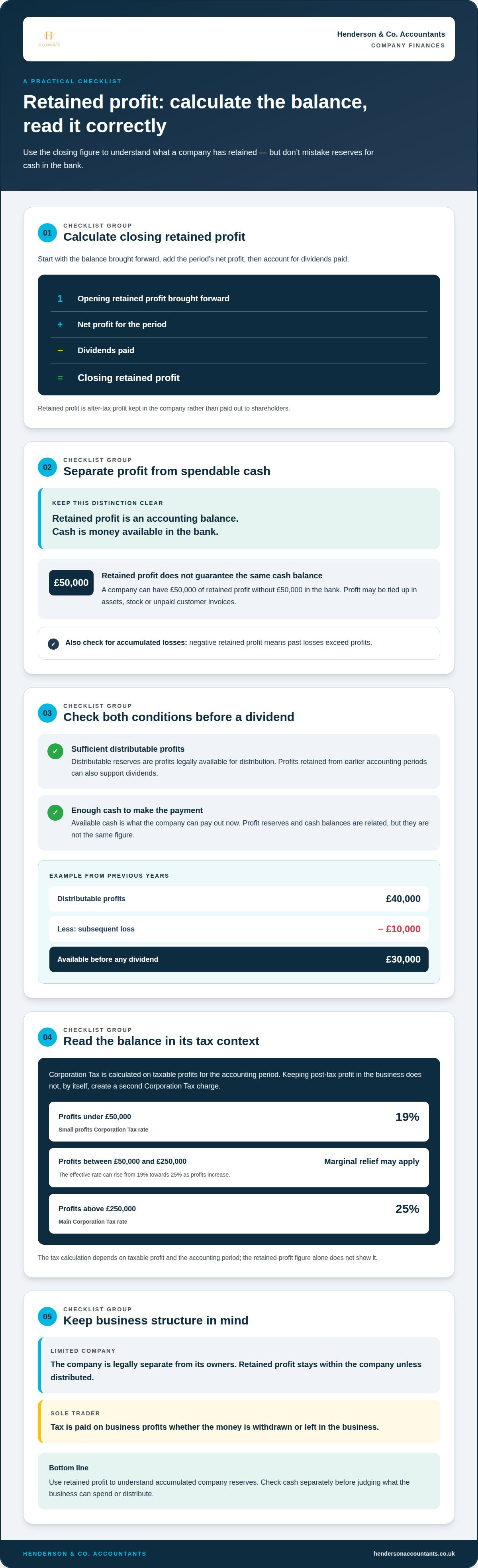
Retained profit records accumulated profits kept in the company, while cash is money available in its bank accounts. A company can have £50,000 of retained profit without having £50,000 in the bank. Profit may be tied up in assets, stock or unpaid customer invoices. Negative retained profit, also called accumulated losses, means past losses exceed profits. This distinction helps directors assess financial strength without mistaking accounting reserves for spendable cash.
Distributable reserves and available cash
Distributable reserves are profits legally available for distribution, while available cash is money the company can pay out now. A dividend must be supported by sufficient distributable profits, but the company also needs cash to make payment. For example, £40,000 of distributable profits from previous years, followed by a £10,000 loss, leaves £30,000 available before any dividend. Profits retained from earlier accounting periods can also support dividends.
Directors can use company cash to pay salaries or bonuses for their work. These payments are employment income, subject to income tax and National Insurance, while the company can deduct salary or bonus expenses when calculating Corporation Tax. The payment needs to be recorded through payroll, and available cash must cover it. The £500 dividend allowance for the 2026/27 tax year is confirmed by HM Revenue & Customs, but it does not turn salary into a dividend.
Before distributing profits or reinvesting cash, directors can compare short-term forecasts covering days and weeks with longer-term forecasts covering 6 to 12 months. These reveal whether expected receipts can cover payroll, suppliers, tax and other commitments. A company might show positive reserves yet face a cash shortfall if customers pay late. Liquidity planning helps directors decide what can safely remain in the business.
Surplus cash that a business does not need may not qualify for Inheritance Tax exemptions. Relief for qualifying business or business property can be 100% or 50%, depending on the company’s nature. For a solvent company closure, a Members’ Voluntary Liquidation (MVL) can distribute retained profits to shareholders. In an MVL, the declaration of solvency confirms that the company can pay all its debts in full within 12 months, according to Companies House. HM Revenue & Customs says Business Asset Disposal Relief may reduce Capital Gains Tax on qualifying gains of up to £1 million, subject to a £1 million lifetime allowance per individual.
What is retained profit in a limited company?
Retained profit is the accumulated net income a company keeps rather than distributes to shareholders. It remains part of the company’s reserves and contributes to shareholders’ equity. The balance changes as profits or losses are recorded and dividends are paid. A profitable accounting period can increase reserves, while a loss or distribution can reduce them.
Corporation Tax is calculated on a company’s taxable profits for its accounting period. Keeping post-tax profits in the business does not change the Corporation Tax due on those profits. Tax is applied before the remaining profit becomes available to retain or distribute. Retaining profit does not, by itself, create a second Corporation Tax charge.
HM Revenue & Customs says companies with profits under £50,000 pay the small profits Corporation Tax rate of 19%. For company profits above £250,000, the main Corporation Tax rate is 25%, according to HM Revenue & Customs. These thresholds help explain why a company’s Corporation Tax calculation depends on taxable profits, not simply on how much it chooses to retain.
Companies with profits between £50,000 and £250,000 may receive marginal rate relief. This can make the effective Corporation Tax rate rise from 19% towards 25% as profits increase. The company’s accounting period and taxable profit determine how the rules apply. As a result, a retained-profit figure alone cannot show the tax calculation: it records what remains after the relevant profit and tax entries.
Once Corporation Tax has been accounted for, retained profit is not taxed again simply because it stays in the company. Personal tax may arise when shareholders take money out as dividends or salary. Dividends are subject to dividend tax, while salary is treated as employment income. The payment route affects how money reaches an individual, so directors should distinguish company reserves from personal take-home funds.
Retained profits in a limited company also affect the equity shown in its accounts. A higher reserve balance can increase reported shareholders’ equity, but it does not guarantee a higher sale value. A valuation also considers assets, liabilities, earnings and future prospects. For example, substantial reserves alongside heavy liabilities present a different picture from the same reserves in a business with fewer obligations.
Clear records help connect taxable profit, Corporation Tax and closing reserves. The company’s profit and loss account shows its result for the accounting period, while the balance sheet shows reserves within equity. If the tax calculation or retained balance needs attention, Corporation Tax Returns support can help keep the reporting aligned with the company’s accounts.
Retained profit calculation and examples
To calculate closing retained profit, start with the opening balance, add net profit and subtract dividends paid. The result is the amount carried forward in the company’s accounts.
Retained profit calculation formula
Opening retained profit + net profit for the period − dividends paid = closing retained profit. Opening retained profit is the balance brought forward from earlier accounting periods. Net profit increases that balance, while dividends distribute part of it to shareholders.
Use figures from the same accounting period, and distinguish net profit from income received or cash held. This keeps the calculation consistent for reporting. If the company records a loss, treat it as a reduction rather than an addition.
Calculating closing retained profit
Begin with the retained profit brought forward, then add the period’s net profit. Subtract dividends paid during that period to arrive at closing retained profit. For example, an opening balance of £200,000, net profit of £50,000 and dividends of £10,000 produce £240,000 in closing retained profit.
The closing balance becomes the opening balance for the next accounting period. Align the entries with the company’s accounts: a dividend reduces retained profit, while a profit increases it. This makes the balance sheet’s equity figure easier to reconcile with the calculation.
Retained profit calculation examples
Consider a company with £15,000 brought forward, £80,000 net profit for the year and £20,000 paid in dividends. The calculation is £15,000 + £80,000 − £20,000, leaving £75,000 in retained profit. That £75,000 is recorded in the equity section of the balance sheet.
A second example starts with £30,000 brought forward, adds £50,000 of after-tax profit and subtracts £35,000 in dividends. The closing figure is £45,000. In each example, the calculation tracks accumulated profit after distributions, rather than the company’s bank balance.
A further example starts with no opening balance, earns £100,000 in profit and pays £25,000 in dividends. The retained amount is £75,000. These examples show why the opening balance matters: the current period’s profit alone does not reveal the total retained amount.
For a reliable accounting figure, use the final net profit for the period and include dividends actually paid in the calculation. Recording those movements clearly helps explain how the closing balance was reached and carried forward.
Definition of retained profit
Retained profit is the net income a business keeps in its accounts instead of distributing it to shareholders. In a limited company, it builds up across accounting periods and forms part of the company’s reserves. You may also see the term “retained earnings”, particularly in accounting software or financial explanations. Both terms describe accumulated profits left in the business.
“Retained” describes what happens to earnings after the company records its profit and considers distributions. If a company earns a profit and pays no dividend, that profit adds to its retained balance. If shareholders receive a dividend, the distribution reduces the amount kept. Retained profit is therefore a record of past results and decisions, not just one period’s income.
That accumulated balance gives directors and shareholders context when reviewing the accounts. A single year’s earnings show how the company performed during that period; retained profit reflects the combined effect of profits kept and distributions made over time. A company may report modest current earnings but still have reserves built up during stronger earlier periods. The retained figure helps explain that longer financial history.
Retained profit also contributes to shareholders’ equity in the balance sheet. Equity represents the company’s net position after considering its assets and liabilities. A positive retained balance can support the company’s capital position, but it does not, by itself, show the company’s overall value or its ability to fund every plan. Directors should read it alongside other figures, including debts, assets and current performance.
Retained profit can help frame decisions about growth. A director considering new equipment, product development or hiring can review the company’s accumulated results as part of the decision. The figure alone cannot determine whether spending is sensible. Planned investment may compete with supplier payments or other commitments, so directors need a broader view of the company’s position before acting.
Accounting software can make retained profit easier to track by organising income, expenses and distributions into records used to prepare accounts. Reconcile those records with the final accounts so reported earnings and dividends flow into the correct balance. If an entry is missing or misclassified, the retained figure may not accurately reflect the company’s recorded history.
Think of retained profit as a running record, not a pot set aside for a particular purpose. It shows what the company has accumulated after its trading results and shareholder distributions. Reviewing it alongside the profit and loss account and balance sheet helps directors understand how earlier earnings shape the company’s current financial position.
Retained profit for sole traders and limited companies
The key difference is who owns the business’s profits. A sole trader and their business are not separate legal entities, so the owner is taxed on total business profits, not simply on the amount withdrawn. A limited company is legally separate from its shareholders. Its profits belong to the company until they are paid out or used for another purpose.
For a sole trader, money taken from the business for personal use is usually recorded as drawings. Drawings are not a business expense and do not reduce the profit on which the owner is taxed. Leaving earnings in the business bank account does not change the sole trader’s taxable profit. The amount retained can help with cash planning, but it is not a separate company reserve.
A limited company records its own income, expenses, profit and distributions. Profit left after the company’s accounting and tax obligations contributes to its reserves. Shareholders do not own company cash directly, even if they are also directors. A dividend is a distribution to shareholders, while a salary is payment for work and is treated as employment income.
This distinction affects how owners plan withdrawals. A sole trader can take drawings without changing the business’s taxable profit, but must still account for total profit. In a limited company, paying a dividend reduces retained reserves and requires sufficient distributable profits. A director’s salary involves payroll and affects the company’s expenses. Each route has different accounting and personal tax consequences.
Consider an owner who needs money for personal bills and wants to keep funds available for future costs. As a sole trader, they should distinguish personal drawings from business expenses, then plan around the business’s total profit and cash needs. As a company director, they must consider the company’s records, available reserves and payment route. The same bank balance can therefore receive different accounting treatment.
There is also a difference in how retained amounts appear in the accounts. A sole trader’s business funds remain the owner’s assets, and drawings reduce the funds left in the business. A limited company’s retained profit forms part of company equity. It can show accumulated results, but it does not show the company’s available cash or guarantee that money can be distributed.
For a useful comparison, identify the legal structure first, then trace how profit is recorded, taxed and withdrawn. This prevents drawings from being confused with company dividends, or a director’s salary from being treated like a sole trader’s personal withdrawal. If you need help keeping company records and formal decisions organised, arrange Company Secretarial Services.
Henderson & Co. Accountants: Company Secretarial Services
Henderson & Co. Accountants provides Company Secretarial Services to help keep company administration organised as you manage retained profits and consider distributions. This support can help your company maintain consistent records of its decisions and responsibilities, alongside a clear view of its accounts.
For connected financial support, Henderson & Co. also offers eCommerce Accounting, Xero Cloud Accounting Setup and VAT Return Preparation. These services help bring day-to-day financial records and reporting together, giving you a clearer basis for understanding company performance.
If you’re reviewing retained profits or planning how your company manages its records, contact Henderson & Co. Accountants to discuss the support you need.
Put your company’s retained profits to work
Understanding retained profits in a limited company can help you make deliberate choices about what the business should fund next. Rather than leaving reserves untouched or withdrawing them automatically, connect your plans to reliable records and a clear view of the company’s priorities. You might be preparing for investment, improving transaction tracking or ensuring routine reporting keeps pace with trading activity.
Henderson & Co. Accountants supports these needs through eCommerce Accounting, Xero Cloud Accounting Setup and VAT Return Preparation. With your records and reporting organised, you can assess business decisions with a firmer grasp of the information behind them.
Take the next step at a pace that suits your business. Contact Henderson & Co. Accountants to discuss the accounting support that fits your plans and keep moving forward with clarity.
Henderson & Co. Accountants can help you manage retained profits
Henderson & Co. Accountants supports limited companies with bookkeeping, annual accounts and corporation tax returns, helping you track profits retained in the business. Its services also include VAT return preparation and company secretarial services.
If you need help understanding how retained profits fit into your company’s accounts or tax reporting, Henderson & Co. Accountants provides accounting support. For wider finance needs, its services include an outsourced finance director or outsourced finance department.
Frequently Asked Questions
Can you pay dividends if the company makes a loss?
Yes, a company may pay dividends during a loss-making period if it still has sufficient distributable profits. The current loss reduces those profits, so directors need to consider its effect before approving a payment. Previous reserves may remain available after a loss, but the loss could reduce the amount that can be distributed. Cash in the bank alone does not justify a dividend.
How does retained profit differ from gross or net profit?
Gross profit measures sales income after the direct costs of producing or buying what was sold. Net profit reflects the result after further business expenses are accounted for. Retained profit, by contrast, is a cumulative balance that includes profits kept from earlier periods and is reduced by distributions. A company can report a profit for the current period while having a different retained balance based on its trading history.
Is retained profit the same as money in the bank?
No. Retained profit is an accounting balance, while a bank balance records cash held at a particular time. A company may have used profit to buy equipment or stock, or may still be waiting for customers to pay invoices. A business could show positive retained profits while its cash is committed to supplier bills. Review bank transactions and outstanding payments separately from reserves.
What is the most tax-efficient way to extract retained profits?
There is no single withdrawal method that is most tax-efficient for every director. Compare dividends with salary or bonuses, taking into account the company’s distributable profits, payroll costs and your other income. Employer pension contributions are another option: they can qualify for Corporation Tax relief, but the funds cannot be accessed until retirement. A planned combination can help align company finances with personal income needs.
What happens to retained earnings when a company closes?
Remaining funds are dealt with as part of the company’s closure and distributed after its liabilities are addressed. The route matters: a solvent company may use a Members’ Voluntary Liquidation, which formally closes the company and distributes assets to shareholders. Companies House says the declaration of solvency confirms that all debts can be paid in full within 12 months. Tax treatment depends on how the closure distribution is made.
What are retained profits in a UK limited company?
Retained profits are accumulated profits a company has kept rather than distributed to shareholders. The balance reflects results over time, not just the latest accounting period. It can increase when profits are added and decrease through losses or dividends. In the accounts, this accumulated amount contributes to company reserves and shareholders’ equity. It belongs to the company, not directly to its directors or shareholders.
How are retained profits calculated in company accounts?
Company accounts calculate the closing balance by adding the period’s net profit to the opening retained balance, then deducting dividends paid. A loss reduces the balance instead of increasing it. If the accounts show an opening reserve, a current-period loss and a dividend, each movement must be reflected in the closing figure. That balance is carried into the next accounting period.
Are retained profits the same as cash in a UK company bank account?
No. A company’s retained profits and bank cash measure different things, so their balances can differ substantially. Retained profits track accumulated accounting results; bank statements show cash movements and the amount held. If the company has unpaid invoices, stock or equipment, some value may sit outside its bank account. Directors should consider upcoming payments and cash-flow forecasts before committing funds to spending or distributions.


