

A company’s retained profits aren’t automatically your personal income. Extracting profits from a limited company means choosing how to take value out, commonly through salary, dividends or employer pension contributions. Dividends can only be paid from distributable reserves, and HMRC sets the dividend nil-rate allowance at £500 per annum for 2026/27.
It’s understandable to want a clear answer about which option leaves you with the most money to use personally. The right choice depends on more than the amount you withdraw: tax, National Insurance, pension access and the company’s cash needs all matter.
This guide explains retained profits and how salary, dividends and pension contributions affect your finances. It also covers directors’ loans and how planning withdrawals throughout the year can support informed decisions.
Key Takeaways
- Compare salary, dividends and employer pension contributions by their effect on your personal finances and the company’s cash. HM Revenue & Customs states UK dividend tax rates of 10.75%, 35.75% and 39.35% for basic-, higher- and additional-rate taxpayers, respectively.
- HM Revenue & Customs sets the UK dividend nil-rate allowance at £500 per annum. Dividends must also be considered alongside the company’s available distributable profits.
- Understand how directors’ loans differ from salary and dividends, and why repayment timing and accurate records matter.
- Plan withdrawals around your income, company finances and tax-year timing rather than treating each payment in isolation.
- See where Company Secretarial Services can support the company’s administrative responsibilities as you manage profit extraction.
Comparing take-home amounts from salary, dividends and pensions
Salary, dividends and employer pension contributions move company funds into your personal finances in different ways. Compare immediate income, tax treatment and access before deciding how much profit to extract.
Dividend reserves and legality
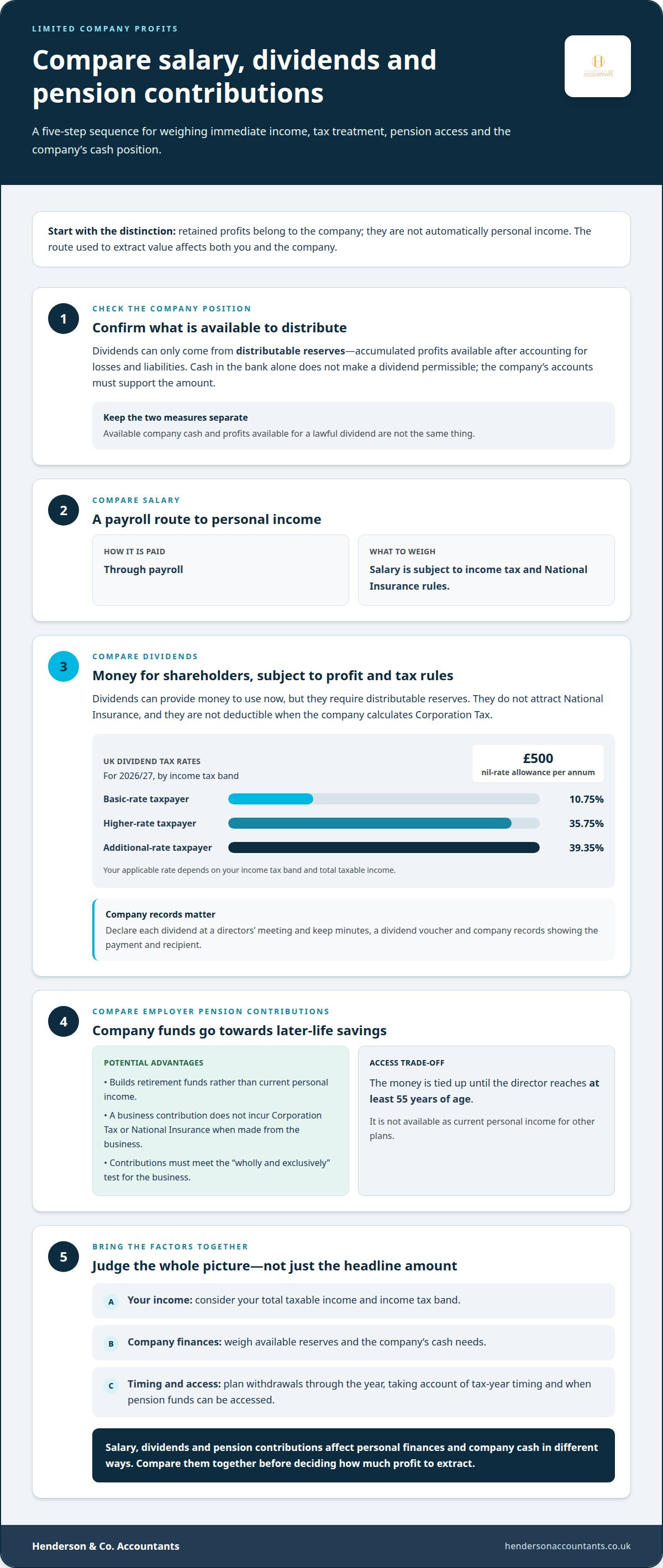
Distributable reserves are accumulated profits available for lawful shareholder dividends after accounting for losses and liabilities. They matter because cash in the company’s bank account alone does not make a dividend permissible. The company’s accounts must support the amount declared. If reserves are insufficient, a dividend can create financial and compliance problems, even when the business has enough cash.
A dividend is a payment of profit to shareholders, not salary for work. A UK company usually pays dividends to all shareholders according to their share rights. Directors should hold a meeting to declare each dividend and keep minutes, even if there is only one director. A dividend voucher and the company’s records should also document the payment and recipient.
For 2026/27, HM Revenue & Customs states UK dividend tax rates of 10.75% for basic-rate taxpayers, 35.75% for higher-rate taxpayers and 39.35% for additional-rate taxpayers. Your applicable rate depends on your income tax band and total taxable income. Dividends do not attract National Insurance, but they are not deductible when the company calculates Corporation Tax. That means the company’s profits are taxed before a dividend reaches you.
Pension saving versus dividend extraction
An employer pension contribution moves company funds into a pension rather than into your available personal income. It can be tax efficient because the company contribution does not incur Corporation Tax or National Insurance when made from the business. Contributions must meet the “wholly and exclusively” test for the business. The trade-off is access: pension money is tied up until the director reaches at least 55 years of age.
A dividend gives you money to use now, but personal dividend tax may apply above the allowance. Pension saving instead builds retirement funds and may provide tax relief, while reducing cash available for other plans. Compare your income tax band, the company’s reserves and when you can access the money. Neither option should be judged by its headline amount alone.
The main ways to extract profits from a UK limited company are salary, dividends and employer pension contributions. Salary is paid through payroll and is subject to income tax and National Insurance rules. Dividends require distributable reserves and proper company records. Pension contributions are invested for later use, rather than paid as current personal income.
When closing a company, shareholders may receive remaining value through a distribution as part of the closure process. Qualifying gains under Business Asset Disposal Relief are subject to Capital Gains Tax at 14% from 6 April 2025, according to HM Revenue & Customs. HM Revenue & Customs states that the rate is 18% from 6 April 2026. These rates apply to qualifying gains, not automatically to every company distribution; the route and eligibility affect the tax treatment.
Director’s loans
A director’s loan is money taken from the company beyond what the director has put in, when it isn’t salary or a dividend. The balance, repayment date and purpose can affect personal tax and the company’s Corporation Tax position.
Keep these categories distinct. If you take money that isn’t salary or a declared dividend, record it as a loan rather than ordinary income. A director’s loan account tracks amounts advanced by the company and repayments made. If you previously lent money to the company, repayment of that amount is described as tax-free.
Repayment timing matters. A director’s loan is usually expected to be repaid within nine months of the end of the company’s accounting period. Section 455 does not apply if the loan is repaid within 9 months and 1 day of the company’s year end. For example, borrowing £8,000 in February and repaying it with a dividend after 6 April crosses a tax-year boundary, but the loan and dividend still need accurate recording.
National Insurance and Corporation Tax on loans
National Insurance and Corporation Tax can arise from a loan’s amount, status and repayment rather than its label alone. Director’s loans of £10,000 or more are classed as benefits in kind, and Class 1 National Insurance Contributions are due. A company loan over £10,000 may also have personal tax implications at the recipient’s marginal rate, so the balance can affect both company and personal finances.
A loan exceeding £15,000 to a director with a material interest in a close company may be subject to Corporation Tax. If a loan remains unpaid beyond the relevant deadline, a company tax charge may also apply. Interest on a shareholder loan has a separate Corporation Tax relief condition: it must be paid within 12 months of the period end. These are distinct rules, so assess the loan and any interest separately.
Director’s loan records
Good record-keeping means tracking advances, repayments, interest and the outstanding balance. UK companies must keep records of directors’ loans they make. Reconcile each transaction against the company’s books, noting whether it is a loan, salary, dividend or repayment of money previously lent.
Clear records help establish the balance at the accounting period end and whether repayment deadlines were met. Keep supporting entries for a dividend used to repay a loan, including the date and amount. If a director’s loan is written off, it must be reported through Self Assessment. A written record also helps explain the tax treatment applied.
Where loan balances, interest and company tax reporting interact, Corporation Tax Returns can support accurate reporting of the company’s tax position.
Salary extraction for company directors
A director’s salary is pay for work, processed through the company’s payroll. Its effect on take-home income depends on National Insurance, the Personal Allowance and the company’s circumstances.
Salary and National Insurance
National Insurance applies to salary at thresholds that affect both the employer and employee. For category A earnings above £96.01 a week, the employer rate is 15% in 2026/27. Employee contributions are 8.0% on weekly earnings between £242 and £967, then 2.0% above £967.01.
For a salary between £5,000 and £12,570, employer National Insurance is 15%, with no income tax or employee National Insurance. The company can deduct gross salary and employer National Insurance contributions when calculating Corporation Tax. Employment Allowance can reduce a company’s National Insurance bill by up to £10,500 a year, depending on eligibility and circumstances.
Salary and the Personal Allowance
The Personal Allowance is the amount of income an individual can receive before paying income tax. It is usually £12,570 per annum in the current tax year, and the allowance and income tax bands are frozen until at least 2031. A director’s salary can use some or all of that allowance, but other income also affects how much remains available.
Consider salary alongside income from other sources before setting payroll amounts. A salary that uses the full allowance may leave less allowance for other taxable income. The company’s National Insurance cost matters too, so the highest salary that fits the allowance isn’t automatically the most tax-efficient choice.
Salaries, expenses and benefits
Paying a salary requires the company to register as an employer. Payroll records then show the salary and deductions, helping both the director and company track income and reporting. A company can pay salary even when it has no profits, although the payment can create a loss.
Expenses and benefits need separate treatment from salary. Personal use by a director or employee of something owned by the business must be reported as a benefit, with any tax due paid. Clear records help distinguish salary, business expenses and benefits, rather than treating every company payment as take-home pay.
Planning salary before dividends
There’s no single salary amount that suits every director before dividends. Work out how the Personal Allowance, other income, employer National Insurance and available company profits interact. A salary may also support qualifying years for the UK State Pension, adding a personal consideration beyond its immediate tax cost.
For a typical low-salary, high-dividend strategy, the right salary depends on the director’s circumstances and the company’s payroll costs. Dividends can only be paid from distributable profits, so a salary decision should account for what remains in the business. Review the figures across the tax year, especially if income or company profits change.
Tailored annual extraction planning
Plan salary, dividends and pension contributions around your company’s cash needs and personal income. Reviewing the figures throughout the year lets you adjust as trading results and circumstances change.
Planning across tax years
Tax-year planning means considering when income and contributions fall, rather than viewing each payment in isolation. Deferring income by taking time off only works as a UK tax strategy when the deferral crosses two tax years. A delay within one tax year does not achieve that timing effect.
Start with a forecast of company profit, expected cash commitments and personal income. Then compare the timing of salary, available dividends and employer pension contributions. This helps show whether taking money now could affect income available in the following tax year. It also helps shareholders plan distributions around company cash flow.
Pension contributions need a separate accounting check. Employer contributions must be paid before the end of the accounting period to obtain a tax deduction in that period. The accounting period and tax year may end at different times, so include both dates in your annual plan. This distinction can affect when a contribution is paid and when its relief is claimed.
Revisit the forecast when sales, costs or planned purchases change. For example, if a large customer payment arrives later than expected, the company may need to retain more cash. Revising the plan lets you adjust proposed dividends or pension contributions before they put pressure on operating funds.
Tax planning and IR35 status
IR35 status is a planning input to consider alongside income, company profits and payment timing. Include it in the annual review before settling a salary, dividend or pension contribution mix. This keeps the extraction plan connected to the way your work and income are organised.
For a contractor, record expected contract income and any changes to working arrangements in the forecast. Review how these affect the funds available for company commitments and personal withdrawals. Then assess the extraction options against the updated figures, rather than relying on the previous year’s payment pattern.
Keep a clear record of the reasoning behind planned contributions and distributions. If the company’s income changes, revisit the forecast and update the plan for the remaining period. This gives shareholders a consistent basis for deciding what can be taken, what should remain in the business and whether pension contributions still fit the company’s cash position.
Limited company profits and personal finances
Company profit and personal income are different. Retained profit belongs to the company until it is paid out or used for business purposes. This matters when planning personal spending: a healthy bank balance doesn’t mean the same amount is available to withdraw. The company must still meet its commitments and follow the rules for each type of payment.
Dividends can help turn available company profits into personal income, but they affect your finances differently from salary. They don’t attract National Insurance contributions and aren’t deductible when calculating Corporation Tax. The company pays tax on its profits before distributing dividends, then you may have personal tax to consider. HM Revenue & Customs sets the UK dividend nil-rate allowance at £500 per annum. Dividend income above that allowance may therefore affect your personal tax bill.
For example, if a company earns £10,000, the supplied example calculates £2,000 of Corporation Tax before any dividend is paid. The remaining profit isn’t automatically your personal take-home amount: the company’s reserves, the dividend payment and your personal tax position all matter. Thinking through each stage helps you distinguish company profit from the amount you can actually spend.
Your Personal Allowance also belongs in the wider calculation. Salary and other taxable income can use it, while dividends are taxed under their own rates. Consider your other income before deciding what a dividend means for your household budget. A payment that looks tax-efficient in isolation may produce a different result when combined with salary or other income.
Keeping profits in the company can support planned costs, investment or working capital. The balance should reflect what the business needs, rather than simply what you hope to take home. There’s also an estate-planning consideration: excess cash not required for business purposes may not qualify for Inheritance Tax exemptions. The purpose of retained funds can therefore matter beyond your next withdrawal.
Build a personal cash-flow view alongside the company’s accounts. Separate expected salary, dividend payments, personal tax and business funds that must remain available. Revisit the figures when company income or personal circumstances change. Annual Accounts can provide a structured view of company performance and retained profits, helping you consider business and personal finances together.
For a clearer picture of how company performance connects to your personal finances, discuss your profit planning.
Henderson & Co. Accountants: Company Secretarial Services
Henderson & Co. Accountants provides Company Secretarial Services to help keep company administration organised alongside profit-distribution decisions. This support is useful when dividend decisions involve shareholder records, formal documentation or other company secretarial responsibilities. Keeping these matters in order helps directors maintain a clear record of company decisions.
For businesses managing online sales, eCommerce Accounting and Xero Cloud Accounting Setup can help organise financial information for wider planning. VAT Return Preparation also supports the company’s compliance work. These services complement your decisions about how much profit to retain, distribute or contribute to a pension.
For support with your company’s administration, contact Henderson & Co. Accountants.
Make your next financial decision with clarity
Use your next planning review to connect the company’s financial records with your personal decisions. A clear view of expected income, business commitments and future priorities can help you decide what to do next, rather than relying on last year’s approach. That’s the practical value of extracting profits from a limited company thoughtfully: decisions can reflect both your personal plans and the business’s needs.
Henderson & Co. Accountants supports the financial detail through eCommerce Accounting, Xero Cloud Accounting Setup and VAT Return Preparation. These services help organise trading information as you assess the company’s position and plan ahead.
Start a conversation about the support that fits your business. Contact Henderson & Co. Accountants to discuss your next steps and move forward with a clearer view.
How Henderson & Co. Accountants can help
Henderson & Co. Accountants can support the practical work involved in extracting profits from a limited company, including Annual Accounts, Corporation Tax Returns, VAT Return Preparation and bookkeeping.
When you’re deciding how to take money from your company or need help managing the related finances, Henderson & Co. Accountants also offers payroll and CIS management, Company Secretarial Services, Xero Cloud Accounting Setup, eCommerce Accounting, an Outsourced Finance Director and an Outsourced Finance Department.
Frequently Asked Questions
First: What Are Retained Profits?
Retained profits are the company’s accumulated profits that haven’t been distributed to shareholders. They are measured through the company’s financial records, not simply by checking its bank balance. For example, cash may be needed for unpaid bills or planned business costs, even when the accounts show profits. Reviewing the accounts helps distinguish profits available for future decisions from money already committed elsewhere.
So What Is the “Best” Method?
There’s no single best option for every director. A practical way to approach extracting profits from a limited company is to start with what you need the money for. Salary provides earnings through payroll, dividends may provide personal income from available profits, and pension contributions are intended for later life. Compare each option with your other income, company cash requirements and personal priorities before choosing a mix.
Why put the money away for the future if you are happy paying the dividend tax?
Because paying dividend tax isn’t the only consideration: you may value retirement saving, or the company may have funds it can contribute as an employer pension payment. Pension money is not available for everyday spending and is tied up until the director reaches at least 55 years of age. If you need accessible income now, a dividend may suit that need better; if future provision matters more, pension saving has a different purpose.
What are the UK corporation tax rates and how do they affect profit extraction?
For 2026/27, Corporation Tax is 19% on profits up to £50,000 and 25% on profits above £250,000. The lower threshold assumes the company has no associated companies. Profits below £250,000 may receive marginal rate relief, so the effective rate can increase between the small profits and main rates. Corporation Tax reduces company profits before distributions, affecting how much remains available to consider extracting.
How do employer and employee National Insurance apply to director salary?
Both employer and employee National Insurance can apply to a director’s salary, using separate thresholds and rates. In 2026/27, the employer rate for category A earnings above £96.01 a week is 15%. Employee contributions are 8.0% on weekly earnings between £242 and £967, then 2.0% above £967.01. These deductions mean the gross salary, the company’s payroll cost and the director’s take-home pay differ.
Can a director use employer pension contributions to extract company profits tax-efficiently?
Yes, a company can contribute to a director’s pension, subject to the business-purpose test. The contribution doesn’t incur Corporation Tax or National Insurance when made from the business, and it must meet the “wholly and exclusively” test. To obtain a Corporation Tax deduction in that accounting period, the contribution must be paid before the period ends. The director should also consider losing access to that money until pension benefits can be taken.
What are the rules for declaring and paying dividends from a UK limited company?
A dividend must be supported by distributable reserves, and the company should formally record the decision. A directors’ meeting must be held to declare a dividend, with minutes kept even if the company has only one director. A company usually pays dividends to all shareholders, so share rights and company records matter. Confirm the amount against the accounts before recording and paying it.
How do dividends compare with salary and bonuses for a company director?
Salary and bonuses are payments for work, while dividends are distributions to shareholders. Salary and bonuses go through payroll and can involve employer and employee National Insurance; gross salary and employer National Insurance are deductible for Corporation Tax purposes. Dividends don’t attract National Insurance, but they aren’t deductible as company costs. Compare payroll deductions, company tax treatment and the director’s personal income needs.


