

Could handing over your VAT return give you more control, not less? For online businesses, the challenge often starts well before filing: sales sit across marketplaces, webshops and payment providers, while VAT records compete with the daily work of running the business. Outsourced VAT return services can bring those details into a clearer process. Reliable returns start with reconciled information and agreed responsibilities, not submission alone.
It’s understandable to wonder what an accountant will take off your hands, what you’ll still need to do and whether outsourcing will create more admin. A well-organised handover makes each step clear: which records you provide, how figures are reviewed, who submits the return and how questions are handled.
This guide explains what outsourced VAT return services can cover, how eCommerce-aware accounting can help organise information from multiple sales channels and what to prepare before handing over your records. You’ll also learn how bookkeeping and cloud accounting workflows can support the process, so you can make an informed decision and spend less time pulling figures together.
Key Takeaways
- Outsourced VAT return services can cover distinct steps, from gathering records to preparing and submitting a return, with responsibilities agreed in advance.
- Marketplace payouts may not match gross sales. Reconciling fees, refunds and other adjustments helps explain the difference and build a clearer picture of your VAT figures.
- Software can organise financial information, but accurate source records and informed review remain important whether you file in-house or outsource.
- Prepare relevant sales, purchase and payment records, along with system access, to make the handover more organised. The checklist depends on your channels and transactions.
- Specialist eCommerce accounting and Xero cloud accounting setup can support clearer records and more structured VAT workflows for online businesses.
What do outsourced VAT return services include for a UK business?
Outsourced VAT return services delegate some or all of the work involved in preparing and submitting a VAT return. The agreed scope sets out who gathers and organises records, checks figures against the accounting records, prepares the return and submits it. You still need to provide complete information, respond to queries and keep track of your VAT affairs, including payment arrangements.
A VAT return service isn’t automatically the same as ongoing bookkeeping, tailored tax advice or broader outsourced finance support. Bookkeeping keeps financial records up to date; VAT return preparation uses relevant records to compile the return. Broader finance support can cover wider reporting and planning. For background on how VAT works in the UK, see this overview of Value-added tax (VAT) in the United Kingdom.
What tasks can an outsourced VAT return service cover?
A clear process separates the work into stages, so you know what’s being handled and what’s expected from you:
- Record gathering: You provide the relevant sales, purchase and other VAT records in the agreed format.
- Organisation and checks: The accountant organises the information, compares figures with your accounting records and raises missing or inconsistent items for clarification.
- Return preparation: The figures are reviewed and used to prepare the VAT return.
- Review and submission: You and your accountant follow the agreed approval and filing process. Agree who reviews the figures and who submits the return.
- Follow-up: You receive relevant return information and respond to any questions. You remain responsible for understanding payment amounts and meeting your obligations.
Outsourcing doesn’t make the business’s responsibilities disappear. Accurate records and timely responses still matter. Agreeing who reviews, approves and submits the return helps avoid uncertainty and gives you a clear view of what’s happening throughout the process.
Who can benefit from outsourcing VAT returns?
For an owner-managed business, recurring VAT administration can take time away from customers, operations and growth. Outsourcing the preparation can create a steadier routine, while leaving you with visibility over the figures and decisions that need your attention.
It can be especially useful for online sellers whose sales information comes from several marketplaces, webshops and payment providers. As transaction volumes grow, consistent records and a review process make it easier to spot gaps and understand how the return figures have been assembled. eCommerce-aware accounting can bring those different records into a more coherent picture. The specific support needed depends on how your business sells and records its transactions.
How outsourced VAT return services handle eCommerce sales data
Online sales records rarely arrive in one neat report. A retailer might sell through its own webshop and marketplaces, take payments through separate providers, then process refunds after the original sale. Outsourced VAT return services bring these sources into a structured workflow, so figures can be checked against the underlying records rather than relying on a payout total in isolation.
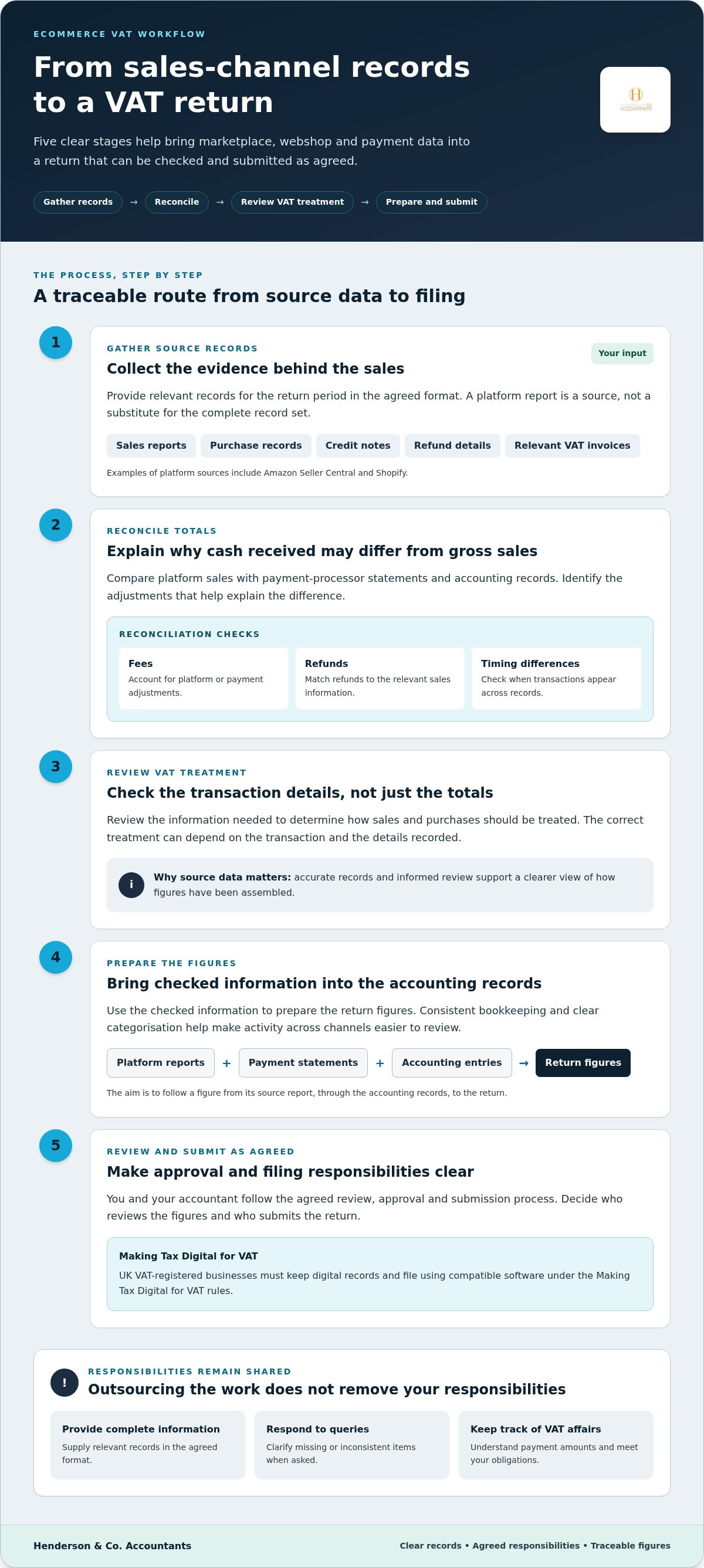
- Gather source records: Collect sales reports, purchase records, credit notes, refund details and relevant VAT invoices for the return period. Reports from platforms such as Amazon Seller Central or Shopify are examples of source information, not a substitute for the full record set.
- Reconcile totals: Compare platform sales with payment processor statements and accounting records. Identify fees, refunds and timing differences that explain why cash received may not equal gross sales.
- Review VAT treatment: Check the transaction details needed to determine how sales and purchases should be treated. The correct treatment can depend on the transaction and the information recorded, so accurate source data and professional review matter.
- Prepare the figures: Bring the checked information together in the accounting records and use it to prepare the return figures.
- Submit as agreed: Follow the agreed review, approval and submission process. UK VAT-registered businesses must keep digital records and file using compatible software under the Making Tax Digital for VAT rules.
Which eCommerce records support VAT return preparation?
Useful records include channel-level sales reports, purchase records, credit notes, refund information and relevant VAT invoices. Matching platform reports to payment processor statements and accounting entries helps show how sales totals become cash received. Consistent bookkeeping gives each figure a traceable place in the records.
Xero can support an organised accounting workflow, while clear categorisation makes activity across channels easier to review. A platform report alone may not show every detail needed for the return, so keep the underlying records complete and make sure adjustments and refunds are accounted for. The aim is to be able to follow a figure from the source report through the accounting records to the return.
Why reconciliation matters before a VAT return is prepared
A marketplace payout may be lower than gross sales because the platform has deducted fees, processed refunds or included adjustments. Timing can also affect when a sale, refund or payment appears in different records. If those differences remain unexplained, it’s harder to tell whether the return figures reflect the underlying activity.
A reliable VAT return starts with reconciled source data, because each reported figure should be traceable to the sales and purchase records behind it.
Henderson & Co. provides specialist eCommerce accounting and VAT return preparation to help organise multi-channel records into a clearer reporting workflow. Explore eCommerce accounting support for an approach that connects bookkeeping and VAT preparation.
Outsourced VAT returns vs in-house filing: control, accuracy and effort
Choosing how to prepare a VAT return means weighing the time available in-house, the complexity of your records and the level of support you want. In-house filing keeps the work close to your day-to-day operations. Software can organise transactions and calculate figures from the information entered. Outsourced support adds an accountant’s preparation and review process, which can help when records span several sales channels. None of these approaches guarantees accuracy: complete records and careful checks matter in each case.
- In-house filing: You retain direct oversight and business knowledge, but your team must make time for record checks, preparation and submission.
- Software-led preparation: Digital tools can help organise records and produce figures, but they rely on accurate inputs and don’t replace informed review.
- Outsourced support: An accountant takes on the preparation tasks agreed with you, bringing VAT and accounting expertise. You still need to provide records, respond to queries and take part in the agreed review process.
VAT-registered businesses must keep digital records and use compatible software to file returns. The Association of Taxation Technicians provides professional guidance on Making Tax Digital for VAT. Outsourcing can fit into a digital process, but it doesn’t remove the need for organised records or clear access arrangements.
Does outsourcing VAT returns mean losing control?
Not if visibility is built into the working arrangement. Agree what records will be shared, how questions will be raised, what return information you’ll receive and whether you review or approve figures before submission. These checkpoints let you follow the process without carrying out every preparation task yourself. Your business remains responsible for its VAT affairs, even when an accountant handles agreed parts of the work.
Outsourcing changes who performs VAT return tasks, not the need for business oversight.
When does a business benefit from external VAT support?
External support may be useful if transaction volumes are growing, reconciliations regularly run late or nobody in the business has enough capacity to manage recurring VAT work. A business with straightforward, well-maintained records may find its existing process works well. By contrast, sales spread across marketplaces, a webshop and payment providers can take more effort to bring together and review consistently.
There’s no single approach that suits every business. Consider where delays or uncertainty arise, how much time filing takes and whether your current process gives you a clear view of the figures. That assessment can help you decide whether to keep preparation in-house, use software with internal checks or delegate agreed tasks through outsourced VAT return services.
How to prepare for an outsourced VAT return service
A smooth handover starts with records that are easy to follow and a shared understanding of who does what. Before work begins, gather information for the relevant VAT period and note any unusual transactions or gaps. The checklist depends on your sales channels, transaction types and agreed service scope, so tailor it to the records your business actually uses.
What information should you organise before handing over?
Use this checklist as a starting point. Keep records together by VAT period where practical, and include explanations for unusual items.
- Sales: Reports from each marketplace or webshop, plus records of sales made through other channels.
- Purchases: Supplier invoices and other purchase records relevant to the return.
- Adjustments: Refund details, credit notes and records of cancellations or corrections.
- Payment information: Payment processor statements and payout reports that help explain differences between sales totals and cash received.
- Accounting records: Relevant bookkeeping entries and VAT documentation held in your accounting system.
Share access to accounting systems and source records securely, using the agreed systems and processes. Avoid relying on scattered email attachments or informal notes when you can maintain a consistent record instead. If you use Xero, organised records and a clear setup can make information easier to review. Consistent eCommerce bookkeeping habits also help you keep records ready between VAT periods.
What does a clear working relationship look like?
Agree the practical steps before the first return is due: when records should be supplied, who responds to questions, whether you review or approve the prepared figures, and who submits the return. Set a timetable around your VAT periods and the applicable HMRC deadlines, allowing time to resolve missing information rather than leaving queries until the last moment.
Clear communication keeps the process visible. Decide how outstanding records, unusual transactions and potential discrepancies will be flagged, and how you’ll receive progress updates. This helps you stay involved without managing every preparation task yourself. Keep responsibility for monitoring your VAT affairs and payment arrangements clear as part of the handover.
Preparing these records and agreeing the workflow can make outsourced VAT return services easier to manage from the outset. Henderson & Co. provides VAT return preparation alongside specialist eCommerce accounting and Xero cloud accounting setup. Arrange VAT return support that fits your business records and working process.
Henderson & Co. outsourced VAT return services for online businesses
Online businesses often need to bring sales and payment information together from several places before VAT figures are ready to review. Henderson & Co. supports businesses across the UK with specialist eCommerce accounting and VAT return preparation and submission, helping connect day-to-day records with recurring compliance. The aim is an organised process with responsibilities understood, not simply a return prepared in isolation.
VAT return support built around online business records
For a seller using a webshop alongside marketplaces and payment providers, information behind a VAT return can be spread across different reports and accounting entries. eCommerce-aware accounting helps make sense of those records as part of the wider business picture. Accurate preparation still depends on usable source information, consistent bookkeeping and timely answers to questions about missing or unusual transactions.
Xero cloud accounting setup can help establish a structured place for financial records and support clearer workflows. It doesn’t make the records complete by itself. Sales, refunds, purchases and adjustments still need to be recorded in a way that can be reviewed.
VAT return preparation can sit alongside bookkeeping and broader compliance support where that fits the business’s needs. Keeping these activities connected can help maintain records between VAT periods and understand how return figures relate to the accounts. The scope should reflect your business, transaction types and the tasks you want to delegate.
A practical next step for businesses considering outsourcing
Before discussing support, map how your current VAT process works. Note where sales information comes from, who gathers and checks it, and which steps regularly cause delays or uncertainty. Include how records are maintained in your accounting system and how outstanding questions are handled. This gives you a useful starting point for discussing the preparation work, your responsibilities and the visibility you want throughout the process.
A clear conversation can define the working scope: what information you’ll provide, how queries and review will work, and whether bookkeeping or Xero setup should support the VAT workflow. You don’t need to have every answer prepared. An outline of your channels and current process is a practical starting point for discussing a clearer handover.
If you’re considering outsourced VAT return services, get in touch with Henderson & Co. to discuss your VAT workflow and the accounting support that could suit your online business.
Make your VAT process clearer and easier to manage
Reliable VAT returns depend on organised records, clear responsibilities and a review process that suits your business. For online sellers, bringing information together across sales channels is a key part of preparing figures that can be understood and checked. Outsourcing can take agreed preparation tasks off your hands while you stay informed and involved in your VAT responsibilities.
The right level of support depends on your records, transaction mix and internal capacity. Henderson & Co. combines VAT return preparation with specialist eCommerce accounting for online retailers and digital businesses. Bookkeeping and Xero cloud accounting support can also help create more structured records and financial workflows.
If you’re considering outsourced VAT return services, start by looking at where your current process takes time or creates uncertainty. A conversation can clarify the records, review points and responsibilities involved. Explore outsourced VAT return support for your business and take a practical step towards a more organised process.
With a clear handover and the right support, you can spend less time pulling figures together and more time moving your business forward.
Frequently Asked Questions
What do outsourced VAT return services include?
Outsourced VAT return services cover agreed tasks such as organising VAT records, checking figures against accounting records, preparing the return and submitting it. The business still supplies complete information, responds to queries and monitors its VAT responsibilities. VAT return preparation doesn’t automatically include ongoing bookkeeping or wider tax and finance support, so agree which services you need.
Are outsourced VAT return services suitable for eCommerce businesses?
Yes, they can suit online sellers, particularly where sales information comes from several marketplaces, a webshop and payment providers. An accountant with eCommerce experience can help organise channel reports and reconcile them with payment and accounting records before preparing return figures. The process relies on accurate, timely information from the business, and the support needed depends on its sales channels and transaction types.
Can I outsource VAT return preparation but keep my bookkeeping in-house?
Yes. You can maintain your bookkeeping internally and delegate VAT return preparation as a separate task. Keep records up to date and provide the information needed for the return, such as sales, purchase and adjustment records. Agree how questions, review and submission will work. If bookkeeping records are incomplete or difficult to follow, resolving gaps may take extra time before the figures can be prepared.
How much do outsourced VAT return services cost?
The cost depends on the agreed scope and the work involved, including transaction volume, the number of sales channels, record quality and whether bookkeeping is included alongside VAT return preparation. There isn’t one fee that applies to every business. To discuss the support you need, outline your VAT process, records and recurring challenges, then agree how the service responsibilities will be divided.
What records do I need to provide for a VAT return?
Typically, you’ll provide sales reports for each channel, purchase records, relevant VAT invoices, credit notes and details of refunds or other adjustments. Payment processor statements and accounting records can help explain differences between gross sales and payouts. The precise information depends on your transactions and the agreed service scope. Keep records organised by VAT period and share them through the agreed secure process.
Who is responsible for a VAT return when it is outsourced?
Outsourcing delegates agreed preparation or submission tasks, but it doesn’t remove the business’s responsibility for its VAT affairs. You need to provide accurate records, respond to questions and understand the review and approval process. Agree who prepares the return, who checks or approves it, who submits it and who monitors payment arrangements. Clear responsibilities help you stay informed without managing every task yourself.
Can an accountant submit a VAT return through Making Tax Digital?
Yes. An accountant can submit a VAT return for a business through Making Tax Digital when submission is part of the agreed service and the necessary arrangements are in place. VAT returns must be filed using compatible software, and digital records are required for VAT-registered businesses. Agree how information will be shared and how you’ll review the return, so you remain aware of the figures submitted.


