

What if your bank payout is the least reliable place to judge how your online shop is performing? A marketplace deposit rarely matches your order total neatly. Platform fees, refunds, payment-provider charges and stock movements all affect the true picture. That’s why accounting for online sellers starts with the full transaction trail, not just the money arriving in your account.
If you’re finding it hard to reconcile sales across channels or work out what you’ve actually made, you’re not alone. As order volumes grow, spreadsheets can become difficult to maintain, while uncertainty around VAT, tax records and reporting can add pressure.
This practical UK guide explains how to build reliable records, bring channel and payment data together, and get a clearer view of cash flow, costs and trading performance. You’ll learn how to account for fees, refunds and stock, which compliance areas to keep in view, and how bookkeeping, Xero setup and specialist eCommerce accounting can support your business as it grows.
Key Takeaways
- Reliable accounting for online sellers looks beyond bank deposits to make sense of activity across sales channels.
- Following an order through channel reports, payment providers and payouts helps you spot gaps and understand what needs reconciling.
- Assess whether your accounting setup covers your channels, reporting needs and current stage of growth.
- A repeatable routine for collecting reports and reviewing exceptions makes online-shop accounts easier to maintain.
- Bookkeeping, Xero setup and specialist eCommerce accounting can help connect channel data with financial reporting and compliance.
Why accounting for online sellers needs more than a sales total
Accounting for online sellers means recording, checking and interpreting the transactions that move through every sales channel and payment provider. The aim is not simply to count orders. It’s to understand how each order, adjustment and payment contributes to your business’s financial position.
An online sale can appear in several systems, each showing a different part of the transaction. A marketplace report may record the order, a payment provider may show when the funds were processed, and your bank account records when a settlement arrived. As part of e-commerce, sales can involve several connected platforms and payment steps, so you need to read these records together.
Bookkeeping is the organised recording and categorising of transactions. Accounting uses those records to prepare reports, assess trading performance and support relevant compliance work. Consistent records give you a dependable basis for decisions, rather than leaving you to judge performance from deposits alone.
What makes online-selling finances different from a single shopfront?
A physical shop may take payment directly at the till. An online order can pass through a sales channel and a separate payment provider before the money reaches your bank. Fees, refunds and settlement timing affect when the activity appears in each record. For example, the channel records an order, the provider processes payment, and a settlement reaches your account later.
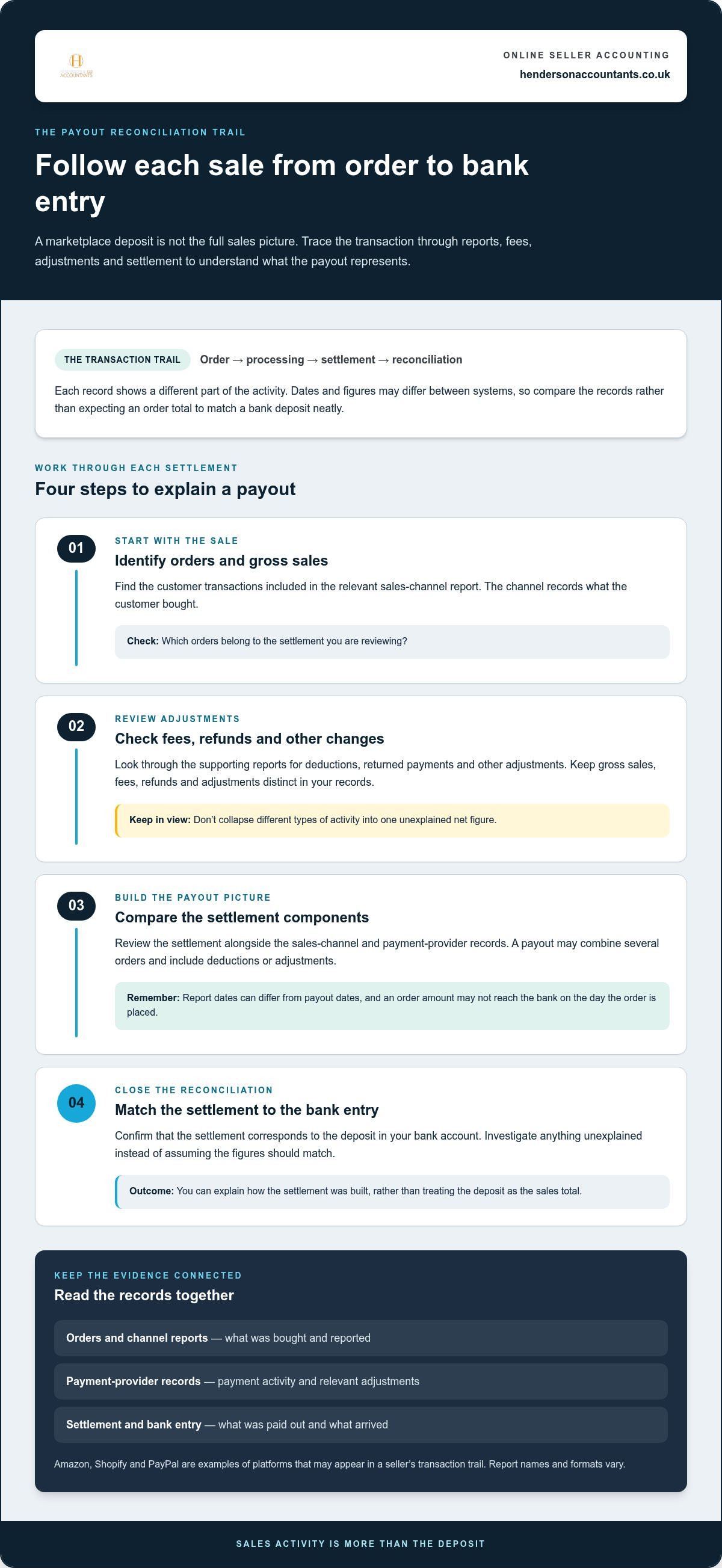
- Order: The sales channel records what the customer bought.
- Processing: The payment provider records payment activity and relevant adjustments.
- Settlement: Funds are paid out, potentially on a different date from the order.
- Reconciliation: Compare the reports and settlement with the bank entry. Investigate differences rather than assuming the figures should match.
This transaction trail explains why a deposit cannot, by itself, show the full sales activity. The figures may relate to different dates or represent different stages, so interpret each record in context.
What should useful seller accounts help you understand?
Well-organised accounts show sales alongside operating costs, stock movements and cash coming in and going out. This helps you understand what is driving results and where money is tied up. Consistent categorisation makes comparisons meaningful, while regular reconciliation helps you identify and review mismatches.
Good bookkeeping creates the evidence; wider reporting turns it into insight. Together, they help you make decisions with a clearer view of the business and support the preparation of accounts and relevant tax reporting. An e-commerce accounting guide can help connect these practical records with the accounting processes behind a growing online shop.
How online-seller accounting follows orders, fees and payouts
A reliable reconciliation follows a transaction from the original order to the amount shown on your bank statement. Each record answers a different question: what was sold, what the sales channel reported, what the payment provider processed, what adjustments were made and what was eventually paid out.
Reconcile the components of a payout, not just the deposit, so you can explain how the settlement was built and investigate any difference. A payout may combine several orders and include deductions or adjustments. Treating the deposit as the sales total can hide activity that matters for understanding performance and preparing accurate reports.
Which records help explain a marketplace payout?
Keep order, channel, payment, settlement and bank records as complementary evidence. Amazon, Shopify and PayPal are familiar examples of platforms that may feature in a seller’s transaction trail, but report names and formats vary. Report dates may also differ from payout dates, so an order amount will not necessarily appear in the bank on the day the order is placed.
Work through each settlement in a consistent order:
- Start with orders and gross sales: Identify the customer transactions included in the relevant channel report.
- Check fees and refunds: Find deductions, returned payments and other adjustments in the supporting reports.
- Review the settlement: Compare its components with the channel and payment-provider records.
- Match the bank entry: Confirm that the settlement corresponds to the deposit, then investigate anything unexplained.
Keep categories distinct in your records. Gross sales, fees, refunds and other adjustments describe different types of activity; don’t collapse them into one unexplained net figure. Their accounting treatment can depend on the transaction and your circumstances, so record them using the treatment that applies to your business rather than assuming every platform works the same way.
If you’re VAT-registered, digital records and submissions may also form part of your process. GOV.UK explains Making Tax Digital for VAT; use current guidance to understand how it applies to your business.
Where do stock and cost records fit into the picture?
Sales reports show what customers ordered and what payments were processed. Inventory records show what stock is available and how it moves through the business. These records answer related but different questions, so a sales total alone won’t tell you how stock affects trading performance.
Cost of goods sold is a reporting concept describing the cost associated with goods sold during a period. How stock costs and related transactions should be recorded depends on your circumstances. Keep supporting records and include their treatment in your accounting process. A detailed e-commerce bookkeeping guide can help you build a consistent record-keeping routine.
Henderson & Co. provides support connecting channel records with bookkeeping and reporting through eCommerce accounting.
How to assess whether your online-seller accounting setup is fit for growth
A setup that works for a small shop may need adjusting as you add sales channels, payment routes or more complex stock arrangements. To assess whether accounting for online sellers is giving you dependable figures, look at how information moves from each channel into your records, how you check differences and whether your reports help you make informed decisions.
Use this comparison to identify what your current process covers. A single-channel setup isn’t automatically inadequate, and a multi-channel operation doesn’t automatically need the most complex system. The right level of support depends on how your business trades.
| Area to assess | Basic single-channel setup | Multi-channel operation |
|---|---|---|
| Channel coverage | Records activity from one sales channel and its payment route. | Brings together reports from each channel and payment route. |
| Payout reconciliation | Matches the channel’s settlements to bank entries. | Tracks settlements from multiple sources and follows up differences. |
| Reporting | Provides a view of sales, costs and cash movement for the channel. | Uses consistent categories to compare performance across channels. |
| Compliance support | Organises the records needed for relevant reporting and obligations. | Coordinates information from several channels for reporting and compliance work. |
| Ability to scale | Has a clear process that can be reviewed as activity grows. | Can accommodate more data and review steps as operations become more involved. |
Which accounting setup suits a single-channel or multi-channel seller?
Start with the shape of your operation, not a software feature list. Consider how many channels and payment routes you use, how many orders need processing, and whether stock is held or managed across different locations. Each added channel can make it harder to apply consistent categories and reconcile settlements. Compare Xero and QuickBooks against your needs in this Xero vs QuickBooks e-commerce comparison.
Accounting software helps organise records, process transactions and produce reports. Professional accounting support adds oversight by connecting channel data with accurate reporting and compliance work. Henderson & Co. provides Xero cloud accounting setup and specialist eCommerce accounting, alongside bookkeeping and compliance support as your business develops.
What signals that your current figures need closer attention?
Review your process if payout differences remain unexplained, reconciliations are repeatedly delayed, or reports from different channels are difficult to compare. Repeated manual corrections are another reason to examine how information enters your accounts. These signs don’t prove non-compliance, but they may point to a process or categorisation that needs attention.
Set a review rhythm that reflects your trading volume and operational complexity. Check that reports are complete, differences have an explanation, and the figures are current enough for the decisions you need to make. Address gaps before relying on incomplete reports, and you’ll be better placed to recognise when your setup needs to change.
How to organise a practical accounting routine for an online shop
A steady routine keeps records usable and avoids having to rebuild the picture at year end. The right rhythm depends on how often you trade, how many channels you use and how complicated your stock and payment arrangements are. Higher volumes or frequent changes may call for more regular checks; simpler operations may need a different cadence.
Use this repeatable sequence as a starting point for accounting for online sellers:
- Collect: Save channel, payment-provider and bank reports for the period you’re reviewing.
- Match: Compare settlements with supporting reports and identify anything that needs follow-up.
- Categorise: Record sales, fees, refunds, supplier costs and other activity consistently.
- Review exceptions: Note missing reports, unexplained differences, unusual adjustments or incomplete information, then track each item until it’s resolved.
- Assess results: Review sales, costs, stock information and cash movement together to understand what the figures show.
Routine record maintenance keeps the underlying information orderly. Questions about how a transaction should be treated for tax or compliance purposes are different and may need advice tailored to your business and circumstances. A checklist alone cannot settle a specialist accounting question.
What information should you keep organised?
Group records by reporting period so it’s clear which activity they relate to. Keep sales and settlement reports alongside fee and refund details, supplier information, stock records and business bank entries. Use consistent file names that identify the source and period, such as the channel name and month. Retain original reports so you can trace figures back to their source when reviewing a transaction or preparing year-end information.
For a limited company, organised records can make year-end reporting easier to prepare. The annual accounts for UK limited companies guide is relevant when you’re bringing routine records together for that stage.
When might you need more than a DIY process?
Review your process if new channels or payment routes make records harder to bring together, reconciliations repeatedly fall behind, or you don’t feel confident using reports to guide decisions. These are practical prompts to reassess how work is organised, not automatic evidence that something is wrong.
Support can cover bookkeeping and Xero setup as well as VAT returns, corporation tax returns and annual accounts. As your business develops, outsourced finance support can provide broader oversight. Henderson & Co. connects specialist eCommerce accounting with bookkeeping and reporting support for online businesses across the UK.
Explore eCommerce accounting support to make your accounting routine more manageable.
How Henderson & Co. supports accounting for online sellers
Henderson & Co. Accountants provides specialist eCommerce accounting and Xero cloud accounting setup for online businesses across the UK. The firm connects sales activity across channels with organised bookkeeping and useful financial reporting, giving business owners a clearer view of their figures when making decisions.
Support can develop alongside your business. You may need help organising channel data and recording day-to-day transactions, while a growing operation may also need regular reporting, compliance support or broader financial oversight. Henderson & Co. builds a practical accounting process around your operations and needs.
What can eCommerce accounting support cover?
Multi-channel businesses receive reports and payments from several sources. Xero setup helps organise how financial information flows into your accounting records, while bookkeeping keeps transactions categorised and up to date. Together, these processes give you a consistent basis for reviewing performance and preparing financial reports.
Accurate channel data and bookkeeping also support compliance work. Henderson & Co. provides VAT return preparation, corporation tax returns and annual accounts. Reliable underlying records help bring the relevant financial information together for these tasks. The support can be shaped around how your business sells and its current accounting needs.
For owners who need broader input, an outsourced finance department supports ongoing financial operations, while outsourced finance director services provide a wider strategic perspective. These options extend beyond routine transaction recording, giving owners access to financial oversight suited to the demands of the business.
What is a sensible next step for your business?
Before discussing support, write down how your finances work today. A simple summary will help keep the conversation focused and practical:
- Sales channels: Note where you sell and which reports each channel provides.
- Payment routes: List the providers and bank accounts involved in receiving funds.
- Reporting concerns: Identify figures or reconciliations that are difficult to understand.
- Plans for growth: Consider changes that may affect your accounting, such as adding a channel or increasing order volumes.
You don’t need to arrive with every answer. Describing the challenge in everyday terms is a useful starting point. Henderson & Co. can discuss your online business accounts in plain English and explain how eCommerce accounting, Xero setup, bookkeeping and compliance support fit together.
Talk to Henderson & Co. about your online business accounts to discuss a practical approach to your accounting needs.
Build a clearer foundation for your next stage
Your accounts should do more than document what has already happened. Dependable records help you test plans, spot pressure points and decide where to focus as your online business develops. Accounting for online sellers is an ongoing part of running your business, not simply a task to revisit at reporting time.
If your current process is becoming difficult to keep up with, you don’t have to solve every system or reporting question at once. Henderson & Co. combines specialist eCommerce accounting with Xero cloud accounting setup, bookkeeping, tax compliance and outsourced finance support for businesses across the UK. A practical starting point might be organising channel data more clearly, improving the reports you use or adding broader financial oversight as your needs change. Build on what already works while addressing the areas that need attention.
Think about what you want your accounts to help you understand next. Talk to Henderson & Co. about accounting for your online business and take a practical step towards financial processes that support confident, sustainable growth.
Frequently Asked Questions
Do online sellers need a separate business bank account?
Not always; the right arrangement depends on your business structure and banking terms. A sole trader may use a personal account, but a dedicated business account can make it easier to separate business spending and organise records. A limited company should keep company money distinct from an owner’s personal finances. Check your bank’s account conditions too, as providers may set rules about business use.
What records should an online seller keep for HMRC?
Keep records that explain income and expenses, including sales invoices or order reports, purchase invoices and receipts, bank statements, platform payout statements, fee and refund details, and stock purchase records. If you’re VAT-registered, keep the VAT records relevant to your returns. Organise source documents by period and retain them in line with current HMRC rules; the required retention period can vary with your circumstances.
Can I use one accounting system for sales from multiple online platforms?
Yes, one accounting system can act as a central ledger for several platforms if it can receive and organise each channel’s data in a way you can review. Test whether imports preserve useful transaction references, separate channel totals and capture adjustments. Keep the original platform reports as supporting records. A single system doesn’t remove the need to check data feeds and follow up incomplete imports.
How much detail should online sellers record about fees and refunds?
Keep enough detail to trace a fee or refund to its source and understand its link to an order or settlement. Record the date, platform or provider, transaction reference, amount, reason or category, and supporting report where available. If you summarise items in a batch, retain a breakdown so you can inspect them later. Include VAT information where relevant, using the treatment that applies to your circumstances.
Is accounting software enough for a growing online shop?
Not on its own. Software can organise transactions and produce reports, but it can’t take responsibility for deciding whether data is complete or how an unusual item should be treated. Accounting for online sellers may also involve reviewing inventory information, reporting categories and compliance questions. Software works best within a process that includes regular checks, with bookkeeping or accounting support added as your operations become more complex.
What happens if my marketplace report and bank payout do not match?
A mismatch doesn’t automatically mean money is missing. Compare the payout reference and covered dates with the marketplace or payment-provider statement, then check for pending adjustments, refunds, reserve movements or a settlement split across deposits. Note the amount and evidence for any remaining difference, and flag it for follow-up rather than changing figures just to make them agree. A clear investigation trail helps with later review.


