

What if outsourcing your VAT return gave you more visibility, not less? Preparing and reconciling records takes time, and incomplete sales or bookkeeping data can make it difficult to trust the figures. For UK businesses considering outsourced vat return services uk, the key is a clear process: who provides the records, who prepares the return and how you review the figures before submission.
Outsourcing can take VAT preparation and submission off your team’s hands without leaving you in the dark. Clear responsibilities help you stay informed and involved. This guide explains what outsourced VAT return support covers, how it fits alongside bookkeeping and what to expect from Henderson & Co. Accountants. For online sellers, eCommerce accounting expertise and Xero cloud accounting setup can help organise information from multiple sales channels as the business grows. A well-defined hand-off makes VAT reporting more manageable while keeping the records connected to the wider picture of your business.
Key Takeaways
- Understand which tasks outsourced VAT return support covers, and how it differs from bookkeeping and wider finance support.
- Follow the process from agreeing responsibilities to reviewing records and submitting the return, using reconciliation to help identify gaps.
- Compare software-only, in-house and accountant-supported approaches to assess your team’s workload and review process.
- Use a practical preparation checklist to organise accounting access, sales-channel records and key contacts before the hand-off.
- See how outsourced vat return services uk can support reporting for businesses managing complex, multi-channel sales data.
What outsourced VAT return services in the UK actually cover
Outsourced VAT return support is an agreed service in which an accountant reviews relevant records, checks how transactions have been treated, prepares the return figures and submits the return on your behalf. At the outset, agree which records your team supplies and which tasks the accountant handles. Value-added tax in the United Kingdom provides background on how the tax operates; outsourcing applies the reporting process to your business records.
An accountant can organise and report the VAT information you provide, but your business remains responsible for keeping complete records and meeting its VAT obligations. Using an agent for return tasks does not transfer that responsibility. Complete records and a defined review process help you retain oversight of the figures being submitted.
Which VAT return tasks can an accountant take on?
Within the agreed scope, an accountant can review your accounting records, check VAT coding, prepare the return figures and submit the completed return. If information appears missing or inconsistent, they can raise a query for you to resolve. Agree how corrections will be handled and whether you will review or approve the figures before submission.
VAT return preparation is not automatically the same as ongoing bookkeeping. Bookkeeping records and maintains transactions; VAT preparation uses those records to report VAT for an accounting period. Nor does preparing a return necessarily include tax planning or broader finance department support. Henderson & Co. provides VAT return preparation and submission, alongside bookkeeping and wider outsourced finance support.
Who is outsourced VAT return support suited to?
It can suit a growing SME that wants help with recurring VAT reporting, or an online seller whose records come from several sales channels. For example, orders, refunds and fees recorded across a website and online marketplaces may need to be brought together and checked before the figures are ready for a return. Consistent source records make it easier to trace how reported totals were built.
For online businesses, eCommerce accounting can help make sales-channel information more manageable for VAT reporting. Henderson & Co. works with online retailers handling complex, multi-channel financial data, and Xero cloud accounting setup can support connected records and a smoother hand-off. The practical details of organising platform sales and bookkeeping are explored in this eCommerce accounting guide.
When comparing outsourced vat return services uk, look beyond who presses “submit”. Establish what the accountant will review, what your team must provide and when you can raise questions. That clarity keeps the service focused on VAT reporting and distinguishes it from bookkeeping or wider financial management.
How outsourced VAT return preparation works from records to submission
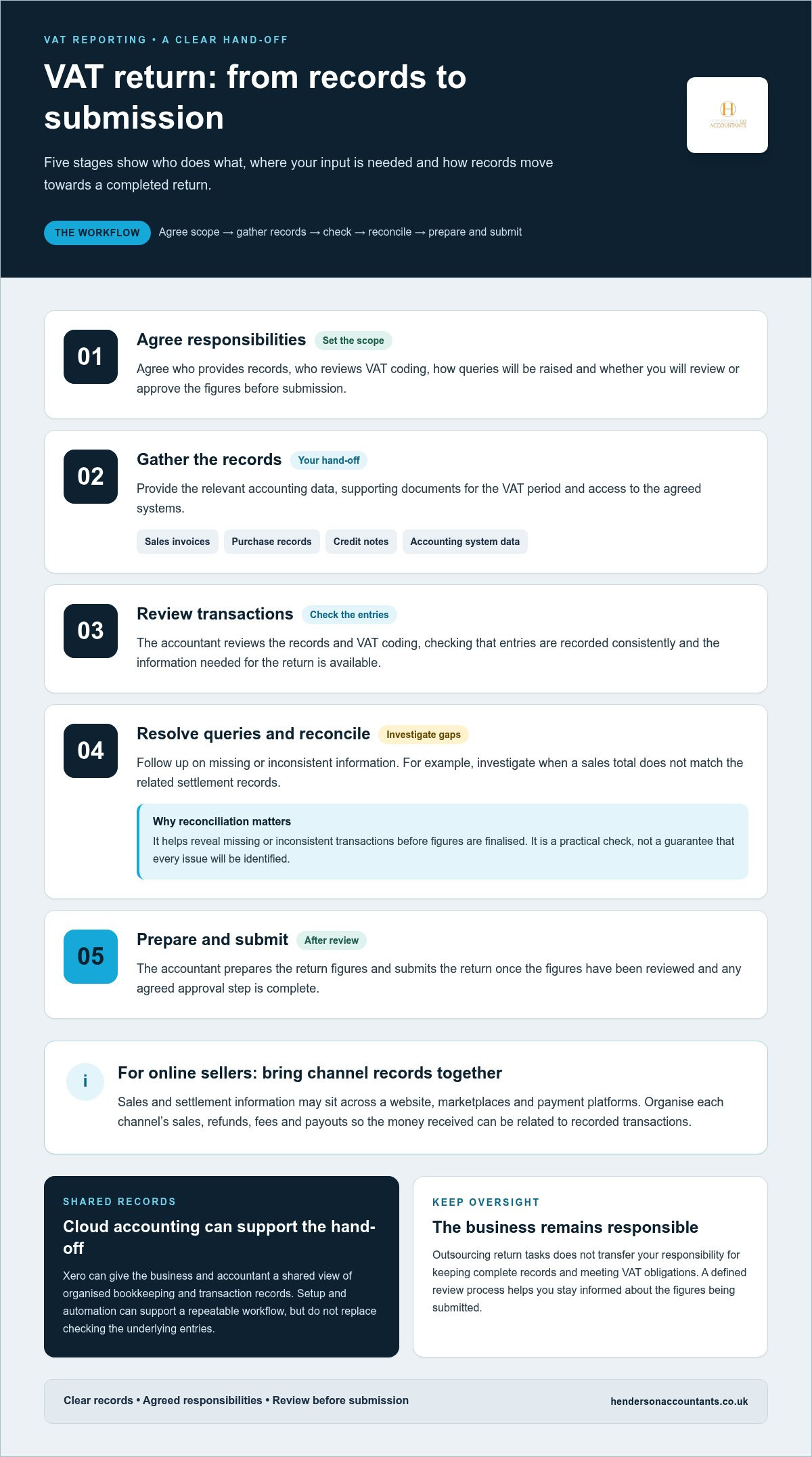
A clear workflow shows what is happening with your VAT return and where your input is needed. The process usually moves from agreeing responsibilities to gathering records, checking transactions, preparing the figures and submitting the return. The hand-off depends on the agreed scope, but each stage should make clear what is outstanding and who is dealing with it.
- Agree responsibilities. Set out who provides records, who reviews VAT coding, how queries will be raised and whether you will review the figures before submission.
- Gather the records. Provide the relevant accounting data and supporting documents for the VAT period, along with access to the agreed systems.
- Review transactions. Check that entries are recorded consistently and that the information needed to prepare the return is available.
- Resolve queries and reconcile. Investigate differences or gaps, such as a sales total that does not match the related settlement records.
- Prepare and submit. Once the figures have been reviewed and any agreed approval step completed, the return can be submitted. Official guidance on VAT returns from GOV.UK explains submission and payment requirements.
Reconciling source data helps reveal missing or inconsistent transactions before the figures are finalised. It is a practical check, not a guarantee that every issue will be identified. If a record is unclear, a query gives you and the accountant a chance to establish what happened before it affects the return.
What records and information support VAT preparation?
Useful records typically include sales invoices, purchase records, credit notes and relevant data from your accounting system. Organise documents by period and check that they correspond with the transactions entered in the accounts. This gives the accountant a clearer basis for reviewing the figures and following up on specific entries.
For an online seller, sales and settlement information may sit across a website, marketplaces and payment platforms. Organising each channel’s sales, refunds, fees and payouts helps explain how the money received relates to recorded transactions. Consistent bookkeeping makes that information easier to review, as explored in this eCommerce bookkeeping guide.
How cloud accounting can support the process
Xero can give the business and accountant a shared view of organised bookkeeping and transaction records, making the hand-off easier to manage. Xero setup and automation can support a repeatable workflow, but they do not replace checking the underlying entries. VAT-registered businesses within Making Tax Digital for VAT rules must keep digital records and submit returns using compatible software. A sound process therefore needs both a suitable digital workflow and a review of the data behind the return.
If you want to connect bookkeeping with VAT return preparation, Henderson & Co.’s VAT return support can bring those steps together.
Outsourced VAT returns vs handling them in-house or with software
There is no single right way to manage a VAT return. The best fit depends on transaction complexity, the time your team can commit and the level of review you need. Software can support digital records and submission, but it does not make every judgement about VAT treatment for you. For background on the tax and how it operates, see GOV.UK’s overview of how VAT works in the UK.
| Approach | Data entry and records | Review and submission | Internal time |
|---|---|---|---|
| Software-only | Your team records transactions and maintains supporting information. | Software supports calculations and filing, but your team checks treatments and completes submission tasks. | Time is needed to keep records current, investigate exceptions and review the return. |
| In-house preparation | Employees record and organise transactions, often alongside other finance duties. | An internal team member prepares and checks the figures, then handles submission. | Workload sits with your business, and knowledge may rest with a small number of people. |
| Accountant-supported outsourcing | Your team supplies records, unless bookkeeping is separately included in the agreed scope. | An accountant can review records, prepare figures and submit the return as agreed, with queries or review points built into the process. | Some time remains for providing information, answering queries and any agreed approval step. |
Outsourcing delegates agreed tasks, not accountability. Your business remains responsible for its VAT obligations and for providing complete, accurate information. Before choosing an approach, decide who will enter transactions, review VAT treatments and monitor submission tasks. This can expose gaps, such as relying on one busy employee to prepare and check every figure.
When can software-only filing be enough?
Software-only filing may suit a business with straightforward transactions, organised records and someone in-house who understands the workflow and has time to review it. Software can help maintain digital records and submit the return, but it cannot resolve every uncertainty about how a transaction should be treated. Consider both the complexity of your sales and purchases and the capacity available to check unusual items.
When might outsourced support add value?
As transaction volumes rise or sales spread across a website and marketplaces, bringing records together can take more effort. Accountant-supported preparation may help when recurring VAT work competes with other finance priorities, or when your team needs a defined review process and accounting expertise. It is not automatically cheaper or more suitable. Weigh the time saved against the work and oversight your business still needs to provide.
If VAT work is part of a wider need for finance support, an outsourced finance guide for SMEs can help you consider how broader support differs from a focused VAT arrangement. Henderson & Co. provides VAT return preparation and submission, with eCommerce accounting and bookkeeping support for businesses managing growing records. Henderson & Co.’s VAT return support can connect those needs.
How to prepare your business for outsourced VAT return services
Preparation makes it easier to agree a useful working arrangement and gives your accountant a clear starting point. Before onboarding, identify where your records sit, how sales information reaches your accounts and who can answer questions about unusual transactions. This helps outsourced vat return services uk fit your finance workflow rather than becoming another disconnected task.
What should you organise before onboarding?
Gather recent VAT and bookkeeping records, and identify the finance systems the accountant will need to access. For online sales, map each platform and payment processor to the records it produces. Note known gaps, such as a channel that is not yet reconciled to your accounts. A short contact list is useful too: identify the person who understands the transactions and the person authorised to review return information.
- Accounting access: identify the software and records needed for the agreed work.
- Supporting information: bring together VAT records, bookkeeping data and relevant sales or purchase documents.
- Sales channels: list websites, marketplaces and payment processors, and explain how their data is recorded.
- Key contacts: decide who can respond to transaction queries and who can review the figures.
Share information consistently and in good time. If records arrive in different formats or a sales channel is missing, the accountant may need to ask follow-up questions before preparing the return. Flagging known gaps early makes those questions easier to investigate and helps both sides plan the hand-off around your reporting responsibilities.
How can a clear working arrangement protect visibility?
At onboarding, agree who maintains bookkeeping records, who supplies documents, who responds to queries and which return tasks the accountant handles. Set expectations for how records are handed over, how progress is communicated and whether you will review the prepared figures before submission. Clear checkpoints keep you informed without requiring you to manage every preparation task yourself.
Keep a brief record of decisions and unanswered VAT questions. If a transaction needs further information, note what is outstanding and who will follow it up. This gives the next reporting period a useful reference and reduces the risk of revisiting the same query without its background.
Include timing in the arrangement. Agree when information should be supplied and how late or incomplete records will be raised, leaving time to address gaps before the relevant filing and payment deadlines. Check those deadlines against your VAT accounting period and obligations, and review current HMRC guidance on Making Tax Digital for VAT, including digital record-keeping, compatible software and any applicable exceptions.
These details provide a practical basis for agreeing the scope and review points for VAT return preparation. Henderson & Co. can also support connected bookkeeping and Xero workflows, helping organise information as your business grows. Discuss VAT return preparation with Henderson & Co.
Henderson & Co. outsourced VAT return support for UK businesses
Henderson & Co. provides VAT return preparation and submission for UK businesses. The service turns your accounting records into a prepared return and handles submission within the agreed scope. Your business remains responsible for its VAT obligations and for providing complete information. Clear responsibilities and review points help you stay informed throughout the process.
For online businesses, VAT reporting may draw on information from several sales platforms, payment processors and accounting records. Henderson & Co.’s eCommerce accounting expertise helps organise this multi-channel financial data for VAT preparation. This is useful as sales activity grows and more records need to fit together consistently.
VAT and eCommerce accounting in one connected workflow
Online sales data needs to be understood alongside refunds, fees, settlements and bookkeeping entries. An organised workflow makes it easier to see how platform information relates to the figures in your accounts, and where a question needs attention before the VAT return is completed.
Xero cloud accounting setup can support accessible, consistent records and a smoother hand-off between your business and its accountant. Bookkeeping support can help maintain the underlying transaction information. Software and automation assist the workflow, but do not replace good record-keeping or a review of how transactions have been recorded. You retain visibility of your records and remain involved in resolving questions about your business activity.
VAT return support can sit alongside bookkeeping or broader outsourced finance support where those services fit your needs. VAT preparation focuses on reporting VAT from relevant records; bookkeeping maintains the underlying transactions, while wider finance support may cover broader responsibilities. Agreeing the boundaries helps you understand what Henderson & Co. will handle and what your team needs to provide.
What happens when you discuss your VAT support needs?
A useful discussion starts with how your business operates. Outline your business structure, VAT reporting responsibilities, sales channels, accounting system and current bookkeeping process. For an online seller, that might include how website and marketplace sales are recorded, where settlement information is held and who can answer transaction questions.
From there, the service scope can be shaped around your requirements. Establish which records need to be supplied, how queries will be raised and what review or approval point you want before submission. This connects the workflow to your business rather than assuming every company has the same records or sales process.
For outsourced vat return services uk, Henderson & Co. provides VAT return preparation and submission alongside relevant eCommerce accounting, Xero setup and bookkeeping support. Discuss outsourced VAT return support to define a scope that fits your business and its records.
Build a VAT process that can grow with your business
Your finance processes need to keep pace as your business changes. New sales channels, higher transaction volumes or changes to your team can affect how information moves from day-to-day bookkeeping into VAT reporting. Review your arrangements when these changes happen, and check that you still have a clear view of records, responsibilities and review points.
If you are considering outsourced vat return services uk, start by identifying which parts of the process would make the biggest practical difference. Henderson & Co. can combine VAT return preparation and submission with specialist eCommerce accounting, Xero cloud accounting setup and bookkeeping support. The aim is a connected workflow that supports growth while keeping you involved in your business’s VAT responsibilities.
Discuss outsourced VAT return support with Henderson & Co. to take a clear next step towards a process that works for your business.
Frequently Asked Questions
Is a business still responsible for its VAT return when an accountant prepares it?
Yes. Using an accountant to prepare or submit a VAT return does not transfer your business’s underlying VAT responsibilities. You need to provide complete, accurate records and explain transactions the accountant asks about. The accountant can carry out agreed checks and filing tasks, but relies on information from your business. For example, clarify a purchase that appears unusual rather than expecting the accountant to infer its purpose.
Can an accountant submit a VAT return on my behalf?
Yes. An accountant can submit a return if the service scope includes submission and the necessary HMRC authorisation and access arrangements are in place. Access is not automatic: your business must follow HMRC’s current process to authorise the agent. You will still need to supply relevant records and answer questions about your transactions. Agree who will arrange access and who will review the return information before submission.
How much do outsourced VAT return services cost in the UK?
There is no single standard fee for outsourced vat return services uk. The work can vary with transaction volumes, record quality, the number of sales channels, accounting software and whether the agreed scope includes tasks beyond return preparation. A business with tidy records in one system may need a different level of support from an online seller consolidating several data sources. Henderson & Co. can discuss your reporting needs and the relevant scope of work.
What happens if VAT records are incomplete before a return is due?
Incomplete records can make it harder to establish which figures belong on a return and may prompt further questions. Identify missing items, locate supporting documents and tell your accountant what remains unavailable. The accountant can review the information you have and explain which points need attention, but should not guess figures to fill gaps. Keep track of your filing and payment obligations while resolving issues, and use current HMRC guidance for your circumstances.
Do outsourced VAT return services work with Xero?
Yes. VAT return support can work alongside Xero where the accounting setup and records suit the business’s workflow. Xero cloud accounting setup can help organise transaction information and make records accessible for review. However, software will not automatically settle every VAT treatment or repair incomplete bookkeeping. Your team still needs to record transactions correctly and provide context for unclear entries. The workflow depends on your systems and how information reaches the accounts.
How often does a UK business need to submit a VAT return?
It depends on the reporting arrangement HMRC has set for your business. Quarterly returns are common, but other reporting frequencies can apply, so do not assume every VAT-registered business follows the same timetable. Check your VAT account for your reporting periods and individual deadlines, then compare these with your internal records calendar. If the dates or arrangement are unclear, consult current HMRC guidance before planning your submission workflow.
Can outsourced VAT support help an online seller with multiple sales channels?
Yes. Specialist eCommerce accounting can help organise transaction information from different sales channels for VAT review. For example, an online retailer may need to understand how orders, refunds and settlement records relate across its channels. The value of support depends on usable records and a clear process for resolving differences. Henderson & Co. supports online retailers with complex, multi-channel financial data.


