

Could the same construction payment leave one subcontractor with 20% deducted and another with 30%? Under CIS, the deduction depends on the subcontractor’s registration and verification status. Knowing which status applies helps you calculate payments correctly and understand how much money will reach your account.
If you’re unsure whether your work falls within the scheme, or whether you’re acting as a contractor or subcontractor for a particular job, you’re not alone. Deductions, monthly returns and incomplete records can make CIS feel harder to manage than it needs to be.
This guide explains who CIS applies to in 2026, how contractor and subcontractor responsibilities fit together, and what to organise at each stage of the payment process. You’ll also find the key return deadlines, including the monthly return due by the 19th, and the records that help keep your administration clear. A consistent workflow can make CIS easier to manage, while payroll and CIS support can take routine administration off your plate.
Key Takeaways
- Learn which types of construction work may fall within the scheme and how to identify whether CIS applies to your business.
- Follow the contractor’s process for checking a subcontractor’s status before payment and recording any deductions.
- Understand how registration and gross payment status affect deductions, and what eligibility rules to consider.
- Build a practical routine for keeping payment records, preparing returns and reviewing your CIS responsibilities.
- See how organised payroll and CIS administration can help reduce the pressure of managing construction business finances.
What is CIS, and who does the Construction Industry Scheme apply to?
CIS means the Construction Industry Scheme. It’s a tax-deduction scheme for certain payments between construction businesses. When a contractor pays a subcontractor for construction work, the contractor may need to deduct tax from the payment and pass it to HM Revenue & Customs (HMRC). The deductions count as advance payments towards the subcontractor’s tax and National Insurance bill. They aren’t a separate charge for the work.
The scheme covers much of the UK construction industry, but your role depends on the arrangement and the work involved. A business might pay subcontractors on one project and carry out work for another contractor on a different project, so it may have responsibilities in both roles.
How to tell whether your business is a contractor or subcontractor
Start with who pays whom for the work. If your business pays another business to carry out construction work, you may be acting as a contractor for that payment. If your business carries out construction work for a contractor and receives payment, you may be acting as a subcontractor.
These roles aren’t necessarily fixed to one business. For example, a construction company might hire a specialist firm for part of a project, then take on work as a subcontractor for a larger contractor elsewhere. Assess each arrangement separately and identify the obligations that apply to your role in it. The contract label alone may not determine whether the scheme applies. The type of work and payment arrangement matter too.
Which construction work may fall within CIS?
HMRC examples include building work, alterations, repairs, demolition and preparing a site for construction. The scheme can cover a broad range of work, so don’t assume that only building a new structure is relevant. If your business carries out different types of work, consider what each specific job involves before deciding whether the scheme applies.
Some activities are generally outside the scheme. For example, architects’ and surveyors’ professional services are generally exempt. That doesn’t automatically settle the position for every arrangement involving those professions, so check HMRC guidance where professional services are combined with construction operations.
There’s also a construction-spend test for some businesses that don’t operate in the construction sector. Under the current guidance, a business may need to register if its average annual expenditure on construction operations exceeds £3 million over a rolling 12-month period. Review the current HMRC wording and how it applies to your business before relying on the threshold. Considering the work, payment arrangement and any relevant exception early gives you a clearer basis for deciding what to do next.
How CIS works from subcontractor verification to payment
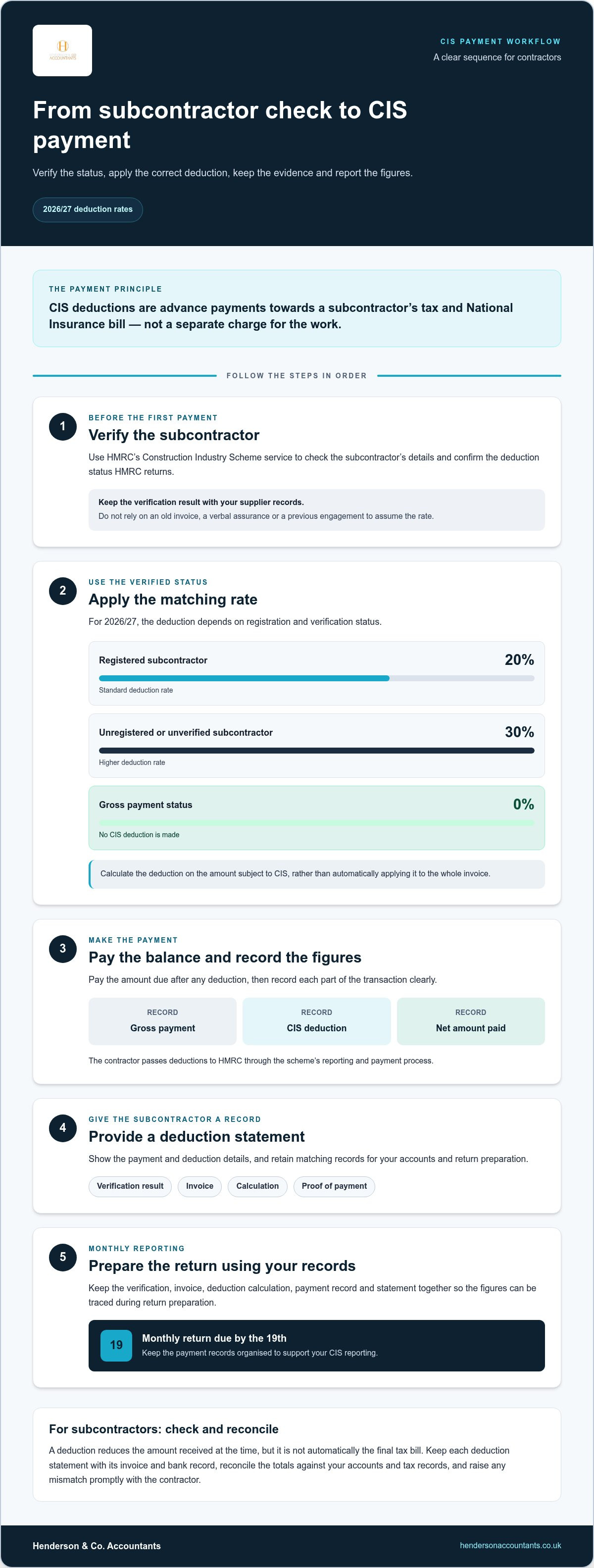
For a contractor, the payment process starts before money changes hands. Check the subcontractor’s status with HMRC, work out whether a deduction applies, pay the balance and keep a clear record of the transaction. Following the same steps each time helps you link the verification result to the amount paid and the figures reported later.
- Verify the subcontractor. Before making a first payment, use HMRC’s Construction Industry Scheme service to check their details and confirm the deduction status HMRC returns. Save the result with your supplier records.
- Calculate the payment. Apply the rate that matches the verified status to the amount subject to deduction. For 2026/27, the standard rate is 20% for registered subcontractors, the higher rate is 30% for unregistered or unverified subcontractors, and gross payment status means no CIS deduction is made.
- Pay and record the transaction. Pay the subcontractor the amount due after any deduction, then record the gross payment, deduction and net amount paid. The contractor passes deductions to HMRC through the scheme’s reporting and payment process.
- Provide a deduction statement. Give the subcontractor a statement showing the payment and deduction details, and retain matching records for your accounts and return preparation.
What contractors do before making a CIS payment
Verification matters because you shouldn’t assume a subcontractor’s rate from an old invoice, a verbal assurance or a previous engagement. HMRC’s response determines the status to use for the payment. Verify each new subcontractor before their first payment and follow HMRC’s instructions if their details can’t be matched. Revisit the current rules if the circumstances change.
Calculate the deduction using the verified rate and the amount subject to CIS, rather than applying it automatically to the whole invoice. The amount the subcontractor receives can therefore differ from the invoice total. Keep the verification result, invoice, calculation and proof of payment together so you can trace the figures later. Use HMRC’s online CIS service and official guidance for the latest steps.
What subcontractors should expect from a CIS payment
A deduction reduces the amount paid to you at the time, but it isn’t automatically your final tax bill. It counts towards your tax and National Insurance, which are settled through your tax position. Keep each deduction statement with the corresponding invoice and bank record, then reconcile the totals against your accounts and tax records.
Check that the statement reflects the payment and deduction you expected. If a figure doesn’t match, raise the discrepancy promptly with the contractor and note how it was resolved. HMRC guidance for CIS subcontractors explains the subcontractor’s responsibilities, including records and gross payment status. Henderson & Co. also provides payroll and CIS management support as part of a wider outsourced finance process.
CIS deductions, registration and gross payment status: what changes?
Your status affects how much a contractor pays you at the time, but it doesn’t determine your final tax bill. For 2026/27, a contractor generally deducts 20% from payments to a registered subcontractor, or 30% if the subcontractor is unregistered or can’t be verified. The deduction is an advance payment towards tax and National Insurance, not an extra tax added on top of your final liability. Gross payment status is different: the contractor pays you without making a CIS deduction.
These are different payment arrangements, not a simple ranking from best to worst. A deduction means less money reaches your account straight away, while gross payment status can improve cash flow but leaves you responsible for setting money aside for tax. Consider your business finances as well as your eligibility.
What CIS registration changes for a subcontractor
Contractors who pay subcontractors for construction work have their own registration and reporting responsibilities. For a subcontractor, registration affects the deduction rate. Not registering doesn’t necessarily prevent you from being paid, but it can mean a higher deduction. The right position depends on your role, legal structure and the work you undertake, so check current HMRC rules rather than assuming another business’s status applies to you.
How gross payment status differs from standard CIS deductions
With gross payment status, contractors pay you without deducting under the scheme. You still need to meet your tax obligations and maintain clear business records. Gross payment status doesn’t remove your tax bill. HMRC’s turnover test is one eligibility condition, alongside other requirements. Check the current rules for your business structure before applying, and weigh the cash-flow benefit against the need to manage tax payments yourself.
As at April 2026, the turnover test is based on net construction turnover during the 12 months before applying:
- Sole traders: £30,000.
- Partnerships: £30,000 per partner, or £100,000 for the whole partnership.
- Companies: £30,000 per director, or £100,000 for the whole company.
Meeting the turnover test alone doesn’t establish eligibility. HMRC also applies other conditions, so review the current criteria before making an application. A subcontractor’s status can affect the contractor’s payment calculation, which is why accurate records of applications, verification results and deductions matter.
Keep deduction statements and payment records together, then reconcile deductions against your tax records. This helps you understand what has already been paid towards your tax and National Insurance and supports clearer cash-flow planning. If your business structure or construction work changes, revisit which registration and status rules apply rather than relying on an old assumption.
A practical CIS compliance routine for contractors and subcontractors
A dependable routine helps you spot missing details before they affect a payment or return. Set a regular time to update records, reconcile payments and review the next reporting deadline. Contractors and subcontractors have different tasks, but both benefit from keeping each transaction supported by clear evidence.
Records to keep organised for CIS
Contractors should retain subcontractor details and verification results, invoices, payment calculations, proof of payment, deduction statements and copies of submitted returns. Subcontractors should keep contracts or work records, invoices, payment statements, bank records and details of deductions. File documents consistently by tax month and subcontractor, using secure digital folders or another organised system that suits your business.
Clear records make it easier to compare what was invoiced with what was paid and deducted. They also provide useful evidence for bookkeeping and year-end tax preparation. If you find a mismatch, you can trace the transaction without relying on memory or searching through unrelated files.
Monthly checks that help prevent avoidable errors
Before submitting a return, contractors can check that each payment is recorded against the correct subcontractor, deductions match the applicable status, and the return agrees with invoices and payment records. Resolve differences before filing where possible, and retain evidence of any correction made through HMRC’s current process.
For 2026, contractors must submit a monthly CIS return by the 19th, covering the previous tax month. A return is still required when no subcontractors were paid, as a nil return. Electronic payment of deductions to HMRC is typically due by the 22nd. Put these dates in your finance calendar and check HMRC guidance for current rules on nil returns, amendments and payments.
Subcontractors can use the same monthly review to match deduction statements against invoices and money received. If a statement or payment doesn’t agree with your records, raise the discrepancy with the contractor promptly and note the outcome. This helps maintain an accurate picture of deductions already made towards your tax and National Insurance.
Make record checks part of your ordinary bookkeeping rather than leaving them until a return is due. A simple month-end folder can bring verification evidence, invoices, payment records, statements and return confirmations together. If your business has both contractor and subcontractor arrangements, keep the records for each role distinct so amounts paid to others aren’t confused with deductions from your own income.
Consistent administration can take pressure off a busy construction business. Henderson & Co.’s payroll and CIS management support can sit alongside bookkeeping and payroll as part of an organised finance process.
How Henderson & Co. supports payroll and CIS management
Once you’ve mapped out your responsibilities and records, the next challenge is keeping the process going alongside the day-to-day demands of a construction business. Payment details, payroll information and bookkeeping all contribute to the overall picture of your finances. Keeping them organised together can make it easier to see what has been recorded and where administrative work is building up.
Henderson & Co. provides payroll and CIS management as part of its outsourced finance support, alongside bookkeeping and wider compliance services. This gives construction businesses a practical way to bring routine finance administration into a more coordinated process. Support can ease the administrative load, while business owners remain responsible for understanding their obligations and providing accurate information.
When outsourced CIS and payroll support can help
As payment volumes grow, keeping subcontractor details, payroll information and payment records in order can take more time. Records can also become fragmented when different tasks are handled separately, making it harder to connect a payment with its supporting information. These are useful prompts to review how your finance administration is organised.
Coordinating payroll, CIS management and bookkeeping can bring related records into a clearer structure. For example, payment information and supporting documents can be managed alongside the bookkeeping process rather than treated as disconnected tasks. This makes it easier to maintain a consistent view of business activity and prepare for regular reporting and year-end work.
Outsourcing doesn’t mean stepping away from oversight. You’ll still need to share complete, timely information and stay aware of decisions and responsibilities that belong to your business. A clear working process defines what information needs to be supplied, how it fits into the finance records and what activity you need to review.
A clear next step for your construction business
If your current process feels difficult to keep on top of, start by identifying where the pressure sits. Are records spread across different places? Is it taking time to keep payroll and subcontractor payment information aligned? Are routine finance tasks competing with the work of running the business? Pinpointing the pressure points gives you a practical starting point for deciding what support could help.
Henderson & Co. can discuss your finance support needs in the context of your current processes and operational pressures. Outline how payroll, CIS administration and bookkeeping are handled now, then consider what kind of ongoing support would fit your business. The aim is to make the finance workload more manageable and keep relevant information organised, while you retain responsibility for your business decisions and obligations.
Explore payroll and CIS management support as a step towards a more organised finance process.
Make your next finance step a manageable one
A useful next step is to choose a small improvement you can maintain consistently, such as bringing payment paperwork together or setting aside time to review your finance records. A clear process can make the administration around CIS more manageable as your construction business develops.
Henderson & Co. offers payroll and CIS management within its outsourced finance support, alongside bookkeeping. This can help organise the finance work behind your process, while you stay involved in the decisions and responsibilities that belong to your business.
To make your finance workload more manageable, explore Henderson & Co.’s payroll and CIS management support.
Frequently Asked Questions
Does CIS apply to materials as well as labour?
Usually, CIS deductions are calculated on the labour element, not the cost of materials, if material costs are separately identified and meet HMRC’s rules. A contractor may need evidence of the subcontractor’s actual material costs, such as receipts or supplier invoices. Don’t treat the full invoice as labour if it includes materials. Keep a clear breakdown and check current HMRC guidance on which costs can be excluded.
What is a nil CIS return?
A nil return tells HMRC that a contractor made no payments to subcontractors subject to CIS during the tax month. It isn’t the same as forgetting to file. Under the 2026 rules described in this guide, contractors must submit a monthly return even when there were no relevant payments. Check HMRC’s current instructions for reporting a nil month, the filing deadline and any applicable exceptions.
Can a subcontractor work under CIS through a limited company?
Yes. A limited company can work as a subcontractor under CIS if its work and payment arrangements fall within the scheme. The contractor verifies the company using its business details, and the deduction status applies to the company rather than its director personally. Keep company invoices, payment statements and deduction records separate from personal finances, and check the registration and gross payment status requirements that apply to companies.
Is CIS the same as the VAT domestic reverse charge?
No. CIS concerns deductions from certain construction payments and reporting those deductions to HMRC. The VAT domestic reverse charge changes how VAT is accounted for on qualifying construction services: the customer accounts for the VAT instead of paying it to the supplier in the usual way. A transaction may fall under both sets of rules, so check each separately and show the treatment correctly on invoices and records.
What should I do if the CIS deduction on a statement looks wrong?
Compare the statement with your invoice, payment received and the contractor’s verification details. Raise the specific difference promptly with the contractor, such as an unexpected deduction or a missing payment, and keep copies of the correspondence and any revised statement. Don’t alter your own records to force a match. If the contractor confirms an error, ask how it will be corrected in the relevant CIS reporting and payment records.
How are CIS deductions treated on a subcontractor’s tax return?
For a sole trader, report construction income before CIS deductions and enter deductions suffered as tax already paid, following the return’s instructions. They’re taken into account when HMRC calculates the final tax and National Insurance position. A limited company has different accounting and tax reporting arrangements, so it should record deductions against the company’s CIS income and follow HMRC guidance for claiming or setting off the amounts.


