

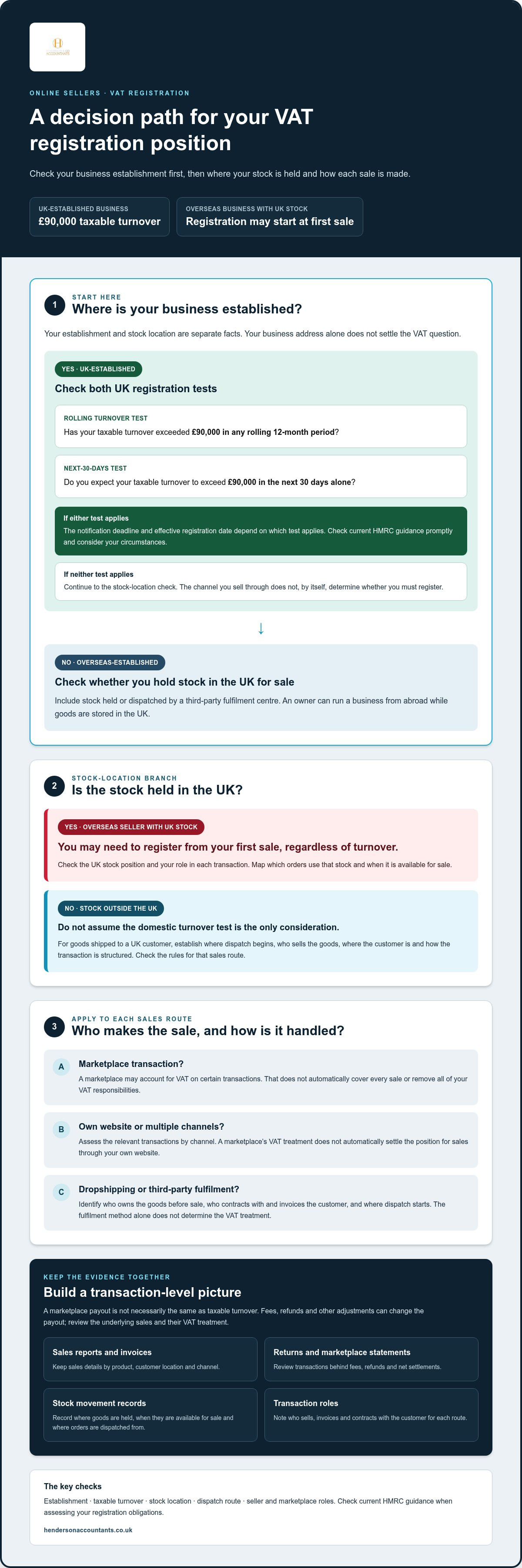
Could your online shop need VAT registration before its sales reach £90,000? For UK-established businesses, that is the taxable turnover threshold. But vat registration for online sellers can also depend on where the business is established, where its stock is held and how it makes sales. An overseas seller storing goods in the UK may need to register from its first sale, regardless of turnover.
It can be confusing, particularly if you sell through both a marketplace and your own website. A marketplace may handle VAT on some transactions, but that does not automatically cover every sale or remove your own responsibilities.
This guide explains the details that affect your registration position and what to do next. You will learn how the rules differ for UK and overseas sellers, how stock location and sales channels can affect your obligations, and which records help you report accurately. Organised cloud accounting and professional VAT support can also make multi-channel sales easier to manage.
Key Takeaways
- For vat registration for online sellers, assess your business establishment, taxable turnover, stock location and sales channel together.
- Map where your goods are stored and dispatched from. Overseas sellers holding stock in the UK may have registration duties from their first sale.
- A marketplace may account for VAT on certain transactions, but selling through one does not automatically cover every VAT responsibility.
- Gather sales reports, invoices, returns, stock movement records and marketplace statements to build a clearer picture of your position.
- When transactions span several channels or involve overseas stock, joined-up eCommerce accounting and VAT support can help you manage registration and reporting.
VAT registration for online sellers: what determines whether you need it?
VAT registration means signing up with HMRC to account for VAT on relevant sales and meet related reporting duties. Selling online does not, by itself, determine whether you must register. Your position depends on the nature and value of your taxable sales, where your business is established, where your goods are held and how each sale is made.
For a UK-established business, the current compulsory registration threshold is £90,000 of taxable turnover. The test looks at any rolling 12-month period. A separate test applies if you expect taxable turnover to exceed £90,000 in the next 30 days alone. The notification deadline and effective registration date depend on which test applies. If you approach either trigger, check current HMRC guidance promptly and consider your specific circumstances. This overview of VAT in the United Kingdom explains the wider system, but use HMRC guidance when deciding your registration obligations.
Which online sales count towards taxable turnover?
Taxable turnover is the value of sales that count towards the VAT registration test. It is not necessarily the same as the cash paid into your bank account or the net payout shown by a marketplace. Fees, refunds and other adjustments can change the payout, while the VAT treatment depends on what you supplied and the circumstances of the transaction.
Some transactions may be exempt or outside the scope of UK VAT. Do not assume that a product or sale falls into either category without checking its treatment. Keep sales details by product, customer location and channel rather than relying on a single payout total.
Hypothetical example: A seller lists several types of goods through a marketplace. Its settlement statement shows one net payment after fees and refunds. To assess taxable turnover, the seller needs to review the underlying transactions and their VAT treatment, not simply use the settlement amount as the total.
Why the seller’s business and stock location matter
UK-established and overseas sellers can face different registration considerations. An overseas business storing goods in the UK for sale may have to register from its first sale, regardless of turnover. Check where stock is held before it reaches the customer, including when a third party stores or dispatches it.
Goods dispatched from abroad can require a different analysis. The customer’s location, the seller’s establishment and the route the goods take all help determine how a transaction is treated. A marketplace may account for VAT on certain sales, but that does not resolve every registration question. Map these details for each sales route before deciding whether the domestic threshold is the only test relevant to your business.
How stock location and fulfilment change VAT registration for online sellers
Your fulfilment model can change the VAT picture even if your shopfront, products and customers stay the same. For vat registration for online sellers, assess where goods are held and dispatched, where the seller is established and who makes the supply to the customer. These details work together. A warehouse address alone does not explain the VAT treatment of every transaction.
UK stock | UK-established seller | Marketplace or own website: Identify whether the sales count towards the seller’s UK taxable turnover and whether a registration trigger applies.
UK stock | Overseas-established seller | Direct or marketplace sale: Check the UK stock position and the seller’s role in the transaction. An overseas business storing goods in the UK for sale may need to register from its first sale, regardless of turnover.
Stock outside the UK | UK or overseas seller | Goods shipped to a UK customer: Establish where dispatch begins, who sells the goods and how the transaction is structured. Check the rules for that route rather than assuming the domestic turnover test is the only consideration.
Selling goods stored or fulfilled in the UK
Business establishment and stock location are separate facts. An owner can run a business from abroad while goods are stored in a UK fulfilment centre, so the owner’s address does not settle the registration question. Record which stock is held in the UK, when it is available for sale and which transactions involve it. Then check the specific trigger and current requirements in Official UK Government VAT Registration Guidance.
Do not treat every fulfilment arrangement as identical. A third-party warehouse may store and dispatch your inventory, but you still need to identify the seller, customer and sales route. Keeping fulfilment records alongside sales data helps link each order to the relevant stock location.
Dropshipping and goods dispatched from outside the UK
Dropshipping describes how goods reach the customer, not a single VAT category. Before assessing the treatment, map the transaction: who owns the goods before sale, which business contracts with the customer, who invoices them and where dispatch starts. Distinguish the supplier’s role from the seller’s and the marketplace’s role.
For example, a supplier might send an order directly to a customer, but that alone does not show who made the retail sale or how the supply should be treated. Cross-border chains can involve several parties and need transaction-specific review. Avoid applying one rule to every dropshipping arrangement.
As a practical first step, keep a stock-location record by product or fulfilment location, then match it to order and marketplace reports. If your business combines UK-held inventory, overseas dispatch or dropshipping, eCommerce accounting support can help organise multi-channel records alongside VAT registration and returns.
Marketplace or own website: who accounts for VAT on online sales?
Selling through a marketplace does not automatically mean the platform accounts for VAT on every order. The answer depends on the transaction, including who sells to the customer, where the goods are when sold, where the seller is established and whether the platform meets HMRC’s definition of an online marketplace. Your sales channel affects the analysis, but does not replace it.
Use this comparison as a starting point, not a blanket rule. Marketplace VAT collection applies to defined transactions, and you still need to consider your wider registration and record-keeping position.
| Sales route | Transaction facts | Who may account for VAT? |
|---|---|---|
| Own website | You sell directly; check stock location and customer location. | Usually the seller, subject to the transaction’s VAT treatment and applicable rules. |
| Marketplace, UK stock | Goods are in the UK at the point of sale; check whether the seller is based outside the UK. | The marketplace may account for VAT on qualifying sales by overseas sellers. |
| Marketplace, imported goods | Goods are sold to a consumer in consignments valued at £135 or less. | The marketplace may be responsible for VAT on qualifying sales. |
What changes when a marketplace is involved?
HMRC’s rules focus on the platform’s role in the sale. A platform may fall within the marketplace definition if it is involved in setting the terms and conditions, taking or handling payment, or placing or delivering the order. A payment processor, or a site that only advertises or lists products, is not automatically an online marketplace for VAT purposes.
If a marketplace is responsible for VAT on a particular transaction, that does not mean it has taken over all your VAT duties. You may still need to assess whether you must register, account for other sales, keep suitable records and submit accurate returns. Separate the platform’s VAT treatment of individual orders from your overall business position.
What to check when selling through your own website
For a direct website sale, identify your business as the seller, then record where the goods were located when sold and where the customer is based. Check the type of supply and the route the goods take. These details help establish whether UK VAT applies and how to report the sale.
If you also sell through marketplaces, reconcile each channel’s order data, refunds and VAT information instead of combining net payouts into one figure. Well-organised eCommerce bookkeeping makes it easier to trace sales by channel and compare platform statements with your website records. For multi-channel sellers, eCommerce accounting and VAT support can help bring registration, records and returns into a clearer process.
How online sellers can prepare for VAT registration
Organising your records before applying can make it easier to understand your position and support accurate reporting later. For vat registration for online sellers, connect sales figures with the stock, customer and sales route behind each transaction. Do not rely on a single marketplace payout or bank total.
A practical VAT registration preparation checklist
- Map your sales routes. For each channel, note the legal seller, where the customer is based, where the goods are located when sold and how the order is fulfilled. Record marketplace and own-website sales separately.
- Build a stock-location picture. List where inventory is stored and dispatched from, including third-party fulfilment locations. Keep stock movement records so you can link each order to the goods’ location.
- Reconcile the sales figures. Compare channel reports with invoices and payment records. Separate gross sales, refunds, fees and VAT information, and identify transactions where a marketplace has accounted for VAT. Do not assume platform-collected VAT represents the VAT treatment of every sale.
- Review taxable turnover and key dates. Keep the workings behind your turnover calculation, including how you treated different sales. Note when a possible registration trigger arose and retain evidence for that assessment.
- Check the current rules and application process. Registration tests, procedures and notification deadlines can depend on your circumstances. Confirm the requirements in HMRC’s VAT registration guidance before acting, particularly if you sell from overseas or use several fulfilment routes.
Useful records include invoices, website order reports, marketplace statements, returns and refund data, payment summaries and evidence of stock movements. Keep enough detail to explain how you compiled your figures. A clear audit trail helps distinguish your own sales and VAT accounting from amounts a platform reports or handles for specific transactions.
After registration: organise records and VAT reporting
Registration brings ongoing record-keeping and VAT return responsibilities. VAT-registered businesses must keep digital VAT records and submit returns using compatible software under Making Tax Digital for VAT. Set up a consistent process for recording sales, adjustments and relevant VAT information across each channel, then reconcile those records regularly.
Cloud accounting can bring multi-channel information together, but the reports still need to show what each figure represents. An eCommerce accounting approach can support wider finance processes as your sales routes grow. Henderson & Co. Accountants can help organise VAT registration, accounting records and VAT return preparation as part of joined-up support for online businesses. Get support with VAT registration and eCommerce accounting.
VAT registration support for online sellers: a clear next step
Some VAT questions are straightforward. Others need a closer look at how your business sells. Bespoke advice can be useful if you hold stock in the UK while based overseas, use dropshipping, sell across several channels or are unsure which business is responsible for a transaction. The aim is to connect those details with your registration position and ongoing reporting, rather than treating each sales channel in isolation.
Henderson & Co. supports online businesses with VAT registration, VAT Returns and eCommerce accounting. This joined-up approach can help organise your sales information and carry it through from registration considerations to regular reporting. It is especially relevant when marketplace statements, website orders and fulfilment records need to be understood together.
How tailored eCommerce accounting can support VAT processes
Clear channel records help you see how sales, refunds and platform-reported VAT fit into your wider accounts. Bespoke cloud accounting can organise information from multiple sales routes, giving you a more useful view of day-to-day finances and supporting accurate VAT reporting. Henderson & Co. can also integrate your chosen bookkeeping software at no charge, bringing bookkeeping information into your accounting process.
Support is tailored to your business, with a dedicated specialist assigned to each client. A dedicated bookkeeper is available 24/7. This availability applies to the bookkeeper, not every service. If you are building a broader finance process alongside VAT management, eCommerce accounting support can help connect bookkeeping and reporting with the needs of an online business.
Taking the next step with Henderson & Co. Accountants
Before discussing vat registration for online sellers, gather a clear outline of your sales channels, stock locations, fulfilment arrangements and each platform’s role in a sale. Bring the reports and records you already use, along with questions about how marketplace-collected VAT relates to your own responsibilities. These details provide a practical starting point.
Henderson & Co. can support you with your registration position, VAT Returns and the accounting processes that follow. If you already work with an accountant, switching does not have to wait for a particular point in the year: clients can switch accountants at any time, with no tax implications.
If you would like tailored support for your sales model, talk to Henderson & Co. about eCommerce accounting.
Build VAT confidence into your next stage of growth
Your VAT position can change as your online business evolves. Adding a sales channel, changing fulfilment arrangements or entering a new market is a good prompt to review how you record transactions and who accounts for VAT. Make that review part of planning for growth, not just a task for registration day.
Henderson & Co. provides specialist eCommerce accounting for online retailers and digital businesses, with bespoke cloud accounting and VAT Return support. A dedicated bookkeeper is available 24/7. If you are considering a change in accounting support, clients can switch accountants at any time of the year with no tax implications.
For vat registration for online sellers, clarity comes from matching your records to how your business actually operates. A tailored approach can help you make informed decisions as that model develops.
Talk to Henderson & Co. about eCommerce accounting and take a confident next step with your online business.
Frequently Asked Questions
Do online sellers have to register for VAT as soon as they start selling?
No, not usually. For many UK-established sellers, compulsory registration depends on taxable turnover reaching the relevant threshold, rather than on the first sale. However, vat registration for online sellers can also depend on establishment, stock location and transaction type. For example, an overseas business storing goods in the UK for sale may have a registration obligation from its first sale. Check current HMRC rules for your circumstances before relying on the general threshold.
Does selling through Amazon or another marketplace mean I do not need to register for VAT?
No. A marketplace may account for VAT on certain transactions, including some sales by overseas sellers and some low-value imported goods sold to consumers. That does not automatically cover your other sales or settle whether your business must register. Keep marketplace VAT reports separate from your own sales records, and compare them with website orders and invoices to identify which transactions the platform has handled.
Do overseas online sellers need to register for UK VAT if they store goods in the UK?
They may need to register from their first sale of goods stored in the UK for sale, regardless of turnover. The precise position depends on the seller’s role and the transactions involved, so do not assume a marketplace’s VAT treatment removes the seller’s own registration duties. Keep evidence of where stock is held and how orders are fulfilled, then check the relevant HMRC guidance for the arrangement.
Can an online seller register for VAT voluntarily before reaching the threshold?
Yes, a business making taxable supplies can generally apply to register voluntarily before reaching the compulsory threshold, subject to HMRC’s requirements. Voluntary registration can affect how you charge VAT and may allow recovery of eligible VAT on business costs, but it also brings ongoing returns and record-keeping duties. Consider your customer mix, prices and input VAT before deciding, and check the current application rules with HMRC.
What records should an online seller keep for VAT registration?
Keep sales and purchase invoices, order-level exports, marketplace statements, refund records and evidence of stock movements. Save the workings behind your taxable turnover calculation too, including the dates and treatment used for unusual transactions. If a platform reports VAT it has collected, retain that report against the related orders. Linking source records to your totals makes it easier to explain how you reached your registration decision.
What should I do if I think I registered for VAT late?
Review your sales records and identify when a registration trigger may have occurred. Then check HMRC’s current late-registration guidance and contact HMRC promptly to discuss the correct effective date and next steps. Do not guess at a backdated date or ignore the issue while you continue trading. If the timeline or sales treatment is unclear, an accountant can help organise the evidence and assess the figures for your circumstances.
Does VAT registration apply differently to goods sold to customers in Northern Ireland?
The UK registration threshold generally applies, but VAT treatment can differ for goods transactions involving Northern Ireland, depending on where goods are located and where they move from and to. A sale from Great Britain to a Northern Ireland customer may need different treatment from goods moving between Northern Ireland and an EU country. Check HMRC guidance for the specific route, and keep dispatch and customer-location evidence with your sales records.


