

A low quote isn’t always the least expensive choice. If VAT returns, payroll or year-end accounts are charged separately, the final bill may look very different from the headline figure. Comparing accountant fees means checking what the price covers, not just looking at the monthly cost.
It’s understandable to want a clear, predictable price and confidence that important work won’t come with unexpected extras. The right support depends on your business structure, records and workload, so one package won’t suit everyone. This guide explains what can affect accountant fees, how to compare quotes for the same scope of work, and how to weigh practical support against price. It also covers how bookkeeping, cloud-based accounting and specialist advice fit into the picture.
At Henderson & Co. Accountants, support is tailored to your circumstances, with simple, cost-effective plans and a fixed monthly fee. Your dedicated bookkeeper is available 24/7, and you can switch accountants at any time of year with no tax implications.
Key Takeaways
- Accountant fees depend on the agreed work, your business structure and the quality of your records, so compare the scope as well as the price.
- Separate routine bookkeeping from annual accounts, tax returns and optional advice to see what a quote covers and where extra charges may arise.
- Use the same business details and service list when comparing proposals, and note each service’s frequency, deliverable and billing basis.
- Henderson & Co. tailors cloud-based accounting support to your circumstances, with a dedicated specialist and free integration with your chosen bookkeeping software.
- Your dedicated bookkeeper is available 24/7, and clients can switch accountants at any time of year with no tax implications.
What do accountant fees usually cover for a UK business?
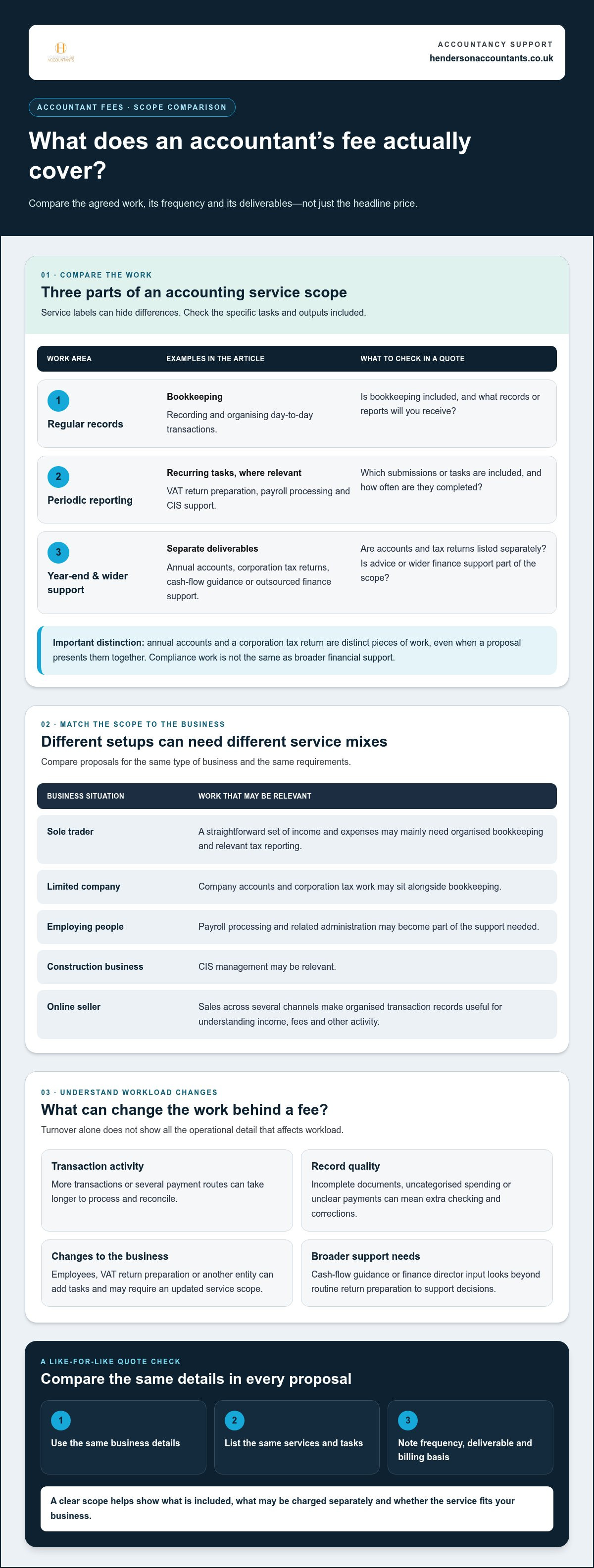
Accountant fees pay for an agreed scope of accounting, reporting and compliance work. That scope might include regular bookkeeping, periodic reporting, annual accounts or tax returns, but these tasks are different. Bookkeeping records and organises day-to-day transactions. Accounts and tax returns use financial records to prepare specific year-end reports and submissions. Advice on cash flow or business decisions is a separate type of support and may sit outside routine compliance.
Start a fee comparison by listing the work you need. The role of an accountant can span different types of work, but service labels alone don’t show exactly what a firm will deliver. Check the tasks, how often they’ll be done and what records or reports you’ll receive.
Which services might appear in an accountant’s scope?
Review each deliverable separately. Annual accounts and a corporation tax return are distinct pieces of work, even if a proposal presents them together. Bookkeeping, VAT return preparation, payroll and CIS support may also be relevant, depending on how your business operates. The scope should say whether each task is ongoing or completed at particular points in the year.
Compliance work is different from broader financial support. Preparing a return or producing accounts focuses on records and reporting. Cash-flow support or an outsourced finance function can take a wider view of the business. Don’t assume that a list of service names means every task, review or conversation is included. Look for the specific outputs the engagement covers.
Why one business may need a different service mix
A sole trader with a straightforward set of income and expenses may mainly need organised bookkeeping and support with relevant tax reporting. A limited company may need company accounts and corporation tax work alongside bookkeeping and corporate secretarial support—services that cloud-focused providers like countonme.biz typically bundle for small and medium-sized businesses. The business structure affects the work involved, so compare proposals for the same type of business rather than treating two headline service lists as equivalent.
Staff can add another layer. If you employ people, payroll processing and related administration may become part of the support you need. If you work in construction, CIS management may also be relevant. Online sellers can have sales across several channels, making organised transaction records useful for understanding income, fees and other activity.
For a practical scope check, group possible work into three areas:
- Regular records: bookkeeping and organising transaction information.
- Periodic reporting: VAT returns, payroll processing and other recurring submissions, where relevant.
- Year-end and wider support: annual accounts, corporation tax returns, cash-flow guidance or outsourced finance support.
This breakdown helps you spot gaps between a basic compliance arrangement and a broader service relationship. It also gives you a clear starting point for matching the work to your business today, without paying for a service mix that doesn’t fit.
What makes accountant fees change as a business grows?
As your business changes, the work behind its accounts can change too. More transactions, several payment routes or records that need correcting can take longer to process. New employees, VAT return preparation or another business entity can also add tasks to the agreed scope. Turnover alone won’t show all the operational detail that affects the workload.
Clear records and a clearly defined service scope make accounting work easier to plan and help you budget with greater predictability. The Institute of Chartered Accountants in England and Wales (ICAEW) provides information about the accountancy profession, but the practical workload still depends on how your particular business operates.
How transaction volume and record quality shape the workload
Regular, well-organised records help an accountant follow transactions and understand how they fit together. Incomplete documents, uncategorised spending or unclear payments can mean extra time is needed to identify what happened and correct the records before bookkeeping or reporting can be completed. The workload depends not only on the number of transactions, but also on how clearly they’re recorded.
For example, an online retailer might sell through its own website and a marketplace, with payments arriving through more than one platform. Sales, refunds, platform fees and deposits need to be reconciled so the records reflect the underlying activity. If information is spread across systems or doesn’t match, it can take additional checking to bring it together. Keeping statements and sales records organised gives the accountant a clearer starting point.
How staffing, VAT and growth can change the scope
Employing people can add payroll processing and related administration to the work. VAT return preparation is another distinct, recurring task for businesses that need it. If a company adds an entity, that may bring separate records and reporting into the picture. Each change can require an update to the service scope, rather than simply more time on the same routine task.
Growth can also change the kind of support you need. A business focused on day-to-day compliance may later want help understanding cash flow or making financial decisions. That could mean broader outsourced finance support or finance director input—firms such as sdmayer.com, for example, provide specialised client accounting advisory and outsourced controller solutions. Unlike return preparation, this work involves looking ahead and using financial information to support the business.
- More activity: additional sales channels and payment platforms can mean more reconciliation.
- More people: hiring staff can introduce payroll work.
- More reporting: VAT and additional entities may expand recurring or year-end tasks.
- New priorities: growth may lead to requests for cash-flow or finance director support.
Henderson & Co. tailors cloud-based accounting and bookkeeping support to each business’s circumstances. A dedicated bookkeeper is available 24/7, and clients can switch accountants at any time of year with no tax implications. If your operations are changing, explore tailored accounting support as part of planning the scope you need.
How to compare accountant fees without missing exclusions
A headline fee only tells you what you’ll pay for the work it covers. If one proposal includes bookkeeping and VAT return preparation, whilst another covers year-end accounts alone, comparing their totals won’t give you a fair picture. Compare what each accountant will do, not just how they bill.
Give each firm the same business details and service list. For example, compare limited-company quotes with limited-company quotes, and include the same expected needs, such as payroll or VAT. This helps you see whether a price difference reflects similar work or a difference in scope.
What to check in a written fee proposal
Look for an itemised description of bookkeeping, annual accounts, tax returns, VAT and payroll. For each service, note how often it happens and what you’ll receive. A proposal should also explain what records you’re expected to provide, how regularly they’re needed, and how additional work is handled. If a task isn’t mentioned, don’t assume it’s included.
| Service | Frequency | Deliverable | Exclusions | Billing basis |
|---|---|---|---|---|
| Bookkeeping | As agreed | Records of business transactions | Corrections or missing-record work, if excluded | Fixed fee, hourly or separate service |
| Annual accounts | Yearly | Company accounts | Tax return preparation, if separate | Fixed fee, hourly or separate service |
| Tax returns | As applicable | Specified return prepared | Other tax work or advice, if excluded | Fixed fee, hourly or separate service |
| VAT and payroll | As applicable | Returns or payroll processing | Extra submissions or related administration, if excluded | Fixed fee, hourly or separate service |
Use the table as a prompt, not a standard package. Ask what “bookkeeping” or “accounts” means in each proposal, and note any stated limits. For instance, a quote might name annual accounts but list the corporation tax return separately. Also record what information you must supply and when. If additional work is needed, the proposal should explain how it will be identified and billed, rather than leaving you to guess.
Fixed monthly fee, hourly billing or separate services?
A fixed monthly fee can spread agreed work across regular payments and make budgeting simpler. Hourly billing links charges to time spent, so the amount may vary with the work required. Separate-service billing can suit a business that needs a narrower scope, but costs can change if it later adds tasks. No billing model is automatically the cheapest or best choice. Check which work is covered, how changes are handled and whether the arrangement still fits as your business develops.
Once the proposals are side by side, compare the work, frequency, deliverables, exclusions and billing basis. That gives you a clearer view of value than the headline figure alone.
How to prepare for an accountant-fee discussion
A little preparation can make a conversation about accountant fees more useful. You don’t need a perfect forecast or a technical understanding of accounting. A clear picture of how your business works, what support you need now and what may change soon gives an accountant a practical starting point for setting the scope.
Create a clear brief for your business
Before discussing support, collect a few details about your business and how you manage its finances. Note whether you’re a sole trader, partnership or limited company, what you sell, how you take payments and how you currently organise your records. Include the accounting software you use, any sales channels or payment platforms, whether you employ staff, and the filings or regular tasks you already handle.
Then separate essential compliance work from support you’d value but don’t necessarily need every month. For example, you might need bookkeeping and accounts as core tasks, with cash-flow guidance as a separate request. Mention likely near-term changes, such as planning to hire, without assuming how quickly growth will happen or what it will mean for your finances.
- Describe your business: Set out its structure, trading activity, sales routes and how money moves through it.
- Explain your current process: Note your software, record-keeping habits, who handles bookkeeping and where information is stored.
- List the work you need: Include recurring compliance tasks, such as accounts, tax returns, VAT or payroll where relevant, and distinguish them from optional finance support.
- Flag possible changes: Identify realistic developments you’re considering, such as employing staff or adding a sales channel, so the proposed support can take them into account.
Review the proposed scope before deciding
Once you receive a proposal, match each need in your brief to a named task and a clear frequency. If you’ve requested bookkeeping, for instance, look for how often it will be carried out and what information you’ll need to provide. Check that the proposal reflects your business structure and current processes, rather than relying on broad labels that could mean different things.
Consider how the arrangement could adapt if your activity changes. Ask how a new employee, extra sales channel or additional reporting task would be handled, and how changes to the scope would be communicated. This sets expectations early and keeps the conversation focused on clarity, communication and fit, not just the headline cost.
Henderson & Co. tailors cloud-based accounting and bookkeeping support to each client’s circumstances, with a fixed monthly fee and free integration with your chosen bookkeeping software. The dedicated bookkeeper is available 24/7, and clients can switch accountants at any time of the year with no tax implications. Explore bespoke cloud accounting support to see how a tailored approach can fit your business.
How Henderson & Co. makes accountant fees clearer
Accounting support should reflect the way your business works, not force you into a standard package that doesn’t fit. Henderson & Co. tailors cloud-based accounting and tax support to each client’s circumstances. The proposed scope can be shaped around the work your business needs, from bookkeeping and VAT returns to annual accounts, corporation tax and payroll support.
A bespoke cloud accountant for changing business needs
Cloud-only working gives you a practical way to manage accounting information and business records online. Henderson & Co. provides free integration with your chosen bookkeeping software, helping connect your existing records with the accounting process. You can work entirely through the cloud, with a dedicated specialist assigned to your business.
Your needs may shift as you take on staff, change how you sell or require different finance support. The service scope can be tailored to your circumstances as they change, so review the work included as part of the relationship. A clear scope helps you understand what support is being provided without assuming that every business needs the same services.
What to expect when working with Henderson & Co.
You’ll have a dedicated accountant, bookkeeper or payroll clerk assigned to your business, depending on the support you need. Your dedicated bookkeeper is available 24/7. This availability applies to the dedicated bookkeeper, not to every service. Having a named specialist gives you a consistent point of contact for the work they handle.
Henderson & Co. offers simple and cost-effective plans with a fixed monthly fee. The fee is shaped around the agreed support, rather than presented as a universal amount for every business. As you review the scope, consider how your bookkeeping, accounts, tax or payroll needs fit together and whether broader outsourced finance support is relevant.
A clear working arrangement also gives you room to reassess the relationship if your circumstances change. Clients can switch accountants at any time of the year with no tax implications. This can offer reassurance if your business’s needs evolve or you decide a different support arrangement would suit you better.
For a clearer view of support shaped around your business, talk to Henderson & Co. about your accounting needs.
Choose support that can grow with your business
Look beyond the quote in front of you. The right accountant relationship should make it easier to review your needs as your business changes, so the agreed work continues to fit rather than becoming a source of uncertainty. A clear conversation about scope now can help you plan for the next stage with greater confidence.
Henderson & Co. provides bespoke cloud-based accounting and bookkeeping, with free integration with your chosen bookkeeping software. Your dedicated bookkeeper is available 24/7, and clients can switch accountants at any time of the year with no tax implications. This gives you flexibility to choose support that suits your circumstances, without treating accountant fees as the only measure of value.
Use the business details and service priorities you’ve gathered to start a practical conversation about the support you need. Talk to Henderson & Co. about your accounting needs and take a confident next step towards accounting support that fits.
Frequently Asked Questions
What do accountant fees usually include?
Accountant fees cover the work agreed with your business, which might include bookkeeping, annual accounts, tax returns, VAT returns or payroll. To make the scope clear, look for the specific output and how often it will be provided. For example, a proposal might include preparing a return but expect you to supply organised records. Check who is responsible for submitting filings and whether questions or extra requests are treated as separate work.
Why do accountant fees vary between businesses?
They vary because the work depends on how each business operates. A retailer selling through a website and marketplaces, for example, may have several payment reports to reconcile, whilst a business with one sales route may have a different record-keeping process. Staff, VAT needs and business structure can also change the scope. Describe your current processes and ask how the proposed service would be adjusted if your activity changes.
Are accountant fees tax deductible for a UK business?
The tax treatment depends on the type of accounting work and your business circumstances, so don’t assume every charge is treated in the same way. Keep the invoice and supporting records, and make sure the description shows which services were provided. If a bill covers both business accounting and personal tax work, ask how each part should be recorded. Check the latest HMRC guidance or seek advice specific to your situation.
Is a fixed monthly accountant fee better than hourly billing?
Neither is automatically better. A fixed monthly arrangement can help you plan for recurring work if the agreed scope is clear. Hourly billing links charges to time spent and may suit work that is occasional or difficult to define in advance. Before choosing, consider how often you need support, how extra tasks are handled and when the arrangement can be reviewed. The best fit is the one whose terms match your needs.
Can I change accountants at any time of the year?
Yes. Henderson & Co. clients can switch accountants at any time of the year with no tax implications. A smooth handover still benefits from planning: list upcoming submissions, outstanding queries and the records the incoming accountant will need. Agree who is handling each open task and when records will be transferred. This helps keep responsibilities clear during the changeover and reduces the risk of work being overlooked.
How can I compare accountant fees fairly?
Give each firm the same description of your business and request a written breakdown using the same service list. For instance, if you need payroll, include it in every proposal rather than comparing one quote with it and another without it. Note the deliverables, timing, filing responsibilities and exclusions. This makes it easier to see whether different totals reflect a different scope or simply a different way of billing.
Do online accountants charge less than traditional accountants?
Online delivery alone doesn’t determine the price or quality of accounting support. Compare the service itself: how you share records, whether your software can be integrated, how you communicate with your accountant and who handles your work. Henderson & Co. offers cloud-based accounting, including cloud-only working for clients who prefer it, with support tailored to each business. Focus on whether that approach suits your processes, not the online label alone.


