

Imagine it’s a Saturday afternoon in May 2026. Instead of enjoying the sun, you’re hunched over a laptop, cross-referencing Shopify reports with bank statements and praying you haven't missed a stray import VAT invoice. For many UK entrepreneurs, VAT return preparation is a source of genuine dread, often leading to a frantic rush to meet HMRC deadlines. It's exhausting to spend your limited free time on manual data entry whilst worrying that a single mistake could trigger a £200 penalty.
We believe that managing your taxes should be a silent, automated background process rather than a quarterly hurdle. This guide will show you how to master your compliance and use modern tools to automate your data flows. You'll learn how to manage the £90,000 registration threshold with confidence and gain clear visibility over your liabilities for better cash flow management. We will walk through the essential 2026 filing dates and digital record-keeping rules, giving you the tools to replace compliance anxiety with total peace of mind.
Key Takeaways
- Learn why accuracy is your best defence against HMRC penalties and how to avoid the common "careless error" trap.
- Discover how transitioning to Xero cloud accounting replaces vulnerable manual spreadsheets with a reliable digital audit trail.
- Understand the specific requirements for eCommerce sellers, including how to handle multi-channel data and Postponed VAT Accounting.
- Master the core components of VAT return preparation to gain better visibility over your cash flow and tax liabilities.
- Find out how professional oversight can turn a standard compliance task into a proactive way to identify tax-saving opportunities.
Navigating the Complexity of VAT Return Preparation
At its core, VAT return preparation is the methodical process of calculating and reporting your business’s VAT-related activity to HMRC. It's not just about filling in boxes; it's about ensuring every transaction is categorised correctly according to the rules of Value-added tax in the United Kingdom. Since April 2022, Making Tax Digital (MTD) has made digital record-keeping a legal requirement for all VAT-registered businesses. This shift means manual ledgers are a thing of the past. You now need a digital audit trail that links your invoices directly to your submission software.
Accuracy isn't just about being tidy. HMRC uses a "careless error" penalty framework that can turn a simple mistake into a costly liability. When you treat compliance as a proactive strategy rather than a chore, it becomes a powerful cash flow tool. By maintaining precise records, you'll know exactly what you owe and when, allowing you to manage your working capital without nasty surprises or last-minute panics.
The Real Cost of Getting VAT Wrong
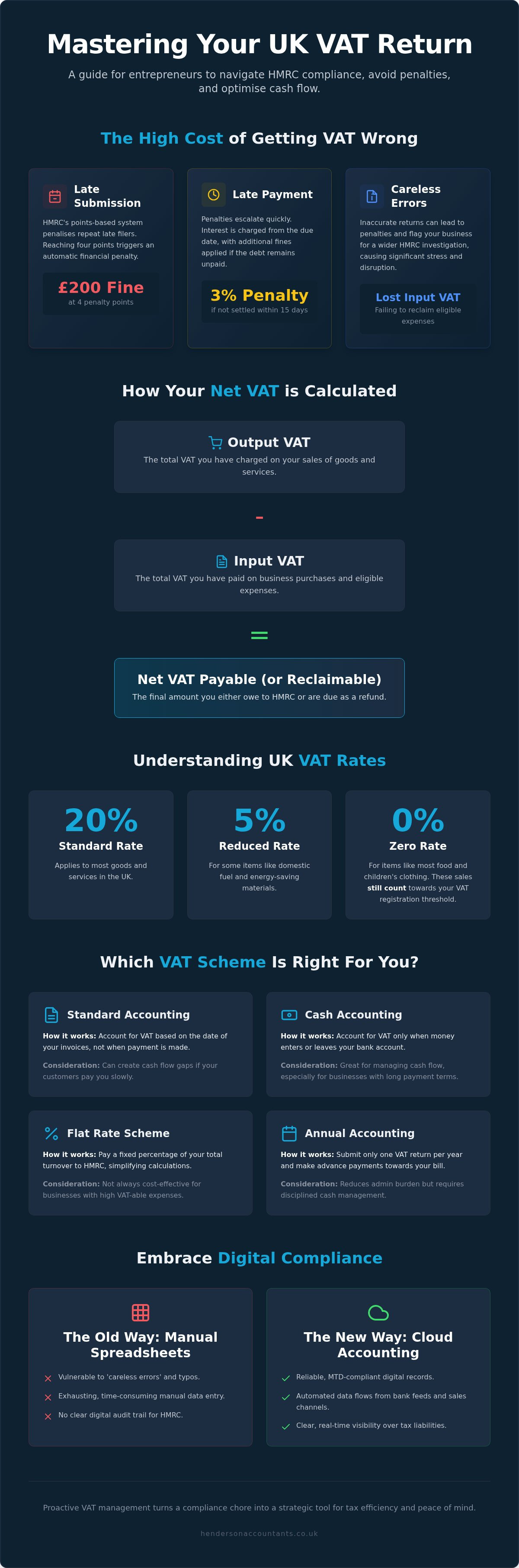
Getting your figures wrong or missing a deadline carries consequences beyond a simple slap on the wrist. HMRC operates a points-based penalty system where quarterly filers who hit four points receive an automatic £200 fine. Late payments are even more punitive. Interest is charged from day one, and additional penalties of 3% kick in if the debt isn't settled within 15 days. There's also the invisible cost of "lost" input VAT. If you aren't thorough in your VAT return preparation, you might miss out on reclaiming tax on legitimate business expenses. This is essentially leaving your own money on the table. Beyond the financial cost, repeated errors can flag your business for a wider HMRC investigation, which is a stressful experience for any entrepreneur.
VAT Schemes: Which One Is Right for Your Business?
Choosing the right scheme can significantly impact your monthly bank balance. Most businesses start with Standard Accounting, where you record VAT based on the date of the invoice. However, this can create cash flow gaps if you're paying tax to HMRC before your customers have settled their bills. Cash Accounting solves this by letting you account for VAT only when money actually enters your bank account. Other options include:
- Flat Rate Scheme: You pay a fixed percentage of your gross turnover. It's designed to simplify record-keeping, but it isn't always the most cost-effective choice for modern SMEs with high expenses.
- Annual Accounting: You make advance payments towards your bill and file just one return a year. This reduces your administrative burden but requires very disciplined cash management throughout the year.
Core Components: What Must Your VAT Return Include?
Your quarterly report rests on four main pillars: total sales, total purchases, the tax you've collected, and the tax you've paid. The final figure, known as your Net VAT, is simply the difference between your output and input tax. If you've collected more than you've spent, you'll owe the balance to HMRC. Conversely, if your business expenses carry more VAT than your sales, you're due a refund. For a granular look at the technical requirements for each of the nine boxes on the form, you can consult the official government guidance on completing your VAT return.
Accounting for Output VAT on Every Transaction
Output VAT is the tax you charge on your sales. It sounds simple, but nuances often trip up business owners. For instance, if you engage in a part-exchange where no cash actually moves, you must still account for the VAT on the market value of the goods or services exchanged. Accuracy here depends on using the correct rates. In the UK, most goods and services attract the standard rate of 20%, but some items like domestic fuel are reduced to 5%, whilst most food and children's clothing are zero-rated at 0%. It's vital to remember that "zero-rated" is not the same as "exempt." Zero-rated sales still count towards your £90,000 taxable turnover threshold, whereas exempt sales do not. Getting this distinction wrong can lead to significant errors in your VAT return preparation.
Maximising Your Input VAT Reclaims
Input VAT is the tax you pay on business purchases, and reclaiming it correctly is the best way to protect your cash flow. Many online business owners overlook eligible expenses like home office costs, software subscriptions, or professional services. However, HMRC is strict about evidence. To reclaim tax, you must hold a valid VAT invoice or receipt that includes the supplier's VAT registration number. Proactive VAT return preparation also includes claiming relief on bad debts. If a customer hasn't paid you for six months and you've already accounted for the VAT on that sale, you can often claim that tax back from HMRC. This ensures you aren't out of pocket for income you never actually received.
Ensuring every box is filled correctly requires a methodical approach to your data. If you're feeling overwhelmed by the technicalities, our team at Henderson & Co. Accountants can help you manage your VAT return preparation with precision, ensuring you never miss a reclaim opportunity.
Manual Spreadsheets vs. Automated Cloud Accounting
Many business owners still rely on manual spreadsheets for their quarterly reporting. Whilst they might feel familiar, spreadsheets are incredibly vulnerable to human error. A single broken formula or a mistyped figure can ripple through your entire workbook, leading to inaccurate submissions and potential HMRC penalties. Most importantly, manual sheets lack the digital audit trail required by Making Tax Digital (MTD) rules. Following the official government guidance on VAT returns is much easier when your data is handled by a system designed specifically for the task.
Automated cloud accounting, particularly Xero, has become the gold standard for modern VAT return preparation. Instead of waiting until the end of the quarter to see what you owe, cloud software gives you real-time visibility of your VAT liability. You can monitor your cash flow daily, allowing you to set aside the correct amount for your bill well in advance. By automating bank feeds, every transaction is captured and categorised as it happens; this ensures no legitimate business expense is ever missed.
The Advantages of Xero for VAT Compliance
Xero transforms a complex legal requirement into a simple background task. It's built specifically to handle the MTD workflow, allowing you to submit your figures directly to HMRC with a single click. This eliminates the need to manually bridge data between different systems. The software also handles automatic reconciliation, matching your sales invoices to bank payments whilst you sleep. Because the data lives in the cloud, you can collaborate with your accountant in real-time from anywhere in the UK, ensuring your figures are always accurate and up to date.
Transitioning from Manual to Digital
Moving from a spreadsheet to the cloud might feel like a daunting leap, but it's simpler than you think. The key to a clean migration is organising your historical data before you start. We recommend focusing on a clean "cut-off" date, usually the start of a new quarter, to ensure your records remain consistent. If the technical setup feels overwhelming, expert support can help you map your accounts correctly from day one. Cloud accounting eliminates the quarterly "shoebox of receipts" panic by turning your financial data into a live, organised, and stress-free digital record.
Switching to a digital workflow is about more than just compliance; it's about gaining control over your business finances. If you're ready to leave manual entry behind, our team can guide you through a professional Xero Cloud Accounting Setup to ensure your VAT return preparation is automated from the very first day.
VAT for eCommerce and International Sales
Running an online store introduces unique hurdles that traditional brick-and-mortar businesses rarely face. When your sales come from Shopify, Amazon, and eBay simultaneously, keeping your records straight becomes a significant challenge. The primary goal of effective VAT return preparation for eCommerce is ensuring your data flows are unified and accurate. One common mistake is accounting for VAT on the net amount received from payment gateways like PayPal or Stripe. HMRC requires you to report the gross sale value; the fees deducted by the platform are a separate business expense, not a reduction in your taxable turnover.
Postponed VAT Accounting (PVA) has become a vital tool for UK businesses importing goods. Before this scheme, you would often have to pay import VAT upfront at the border and wait until your next return to reclaim it. PVA allows you to declare and recover the tax on the same return, which keeps that cash in your business where it belongs. Managing this correctly requires precise documentation to avoid double-taxation or missed reclaims. It's a proactive way to protect your working capital whilst staying fully compliant with post-Brexit regulations.
Selling Globally from the UK
Selling to international customers means you must understand "place of supply" rules. These rules determine whether you charge UK VAT or if the sale is outside the scope of UK tax. For digital services and physical goods sent to the EU, you might need to navigate the One Stop Shop (OSS) or Import One Stop Shop (IOSS) schemes. These are designed to simplify the process, but they require careful setup to ensure tax is collected at the correct local rate. Automated tools like A2X act as a bridge, pulling your complex settlement data from marketplaces and pushing it into Xero in a format that makes your VAT return preparation seamless.
Import VAT and Post-Brexit Compliance
Since the UK left the EU, the rules for cross-border trade have shifted significantly. You must now navigate customs declarations and ensure your EORI number is correctly linked to your shipments. Using PVA is the most efficient way to handle this, but it relies on your accounting software being configured to read HMRC’s monthly postponed import VAT statements (MPIVS). If these technicalities feel like a barrier to your growth, working with an eCommerce specialist can provide the clarity you need. We can help you optimise your eCommerce accounting to ensure you stay compliant whilst scaling your international sales.
Streamlining Compliance with Henderson & Co. Accountants
We believe your time is better spent growing your brand than wrestling with HMRC. When you partner with us, VAT return preparation shifts from being a source of stress to a streamlined, expert-led process. Our team doesn't just check the boxes; we look for proactive ways to improve your tax position whilst ensuring every figure is bulletproof. By having a specialist oversee your compliance, you gain the confidence that your liabilities are managed accurately and that you're never paying more than you legally owe.
Your VAT data often holds the key to deeper business insights. It reflects your real-time sales performance and your supply chain costs, making it a vital diagnostic tool for our Outsourced Finance Director services. Instead of viewing the return as a dead-end obligation, we use that data to inform strategic advice on margins, cash flow, and expansion. This is how we help you move beyond basic compliance and into a phase of informed, strategic growth. We act as a collaborative ally, replacing anxiety with a sense of calm control over your financial future.
Our Tech-First Onboarding Process
We start by building a bespoke Xero environment tailored specifically to your business model. This isn't a one-size-fits-all setup; it's a carefully mapped system that integrates your Shopify, Amazon, or eBay platforms to create a single source of truth for your data. During our secure onboarding, we'll guide you through providing the necessary identity verification for any person with significant control in your company. This ensures we meet all regulatory standards whilst setting the foundation for a highly efficient, automated workflow that simplifies every future VAT return preparation.
Beyond the Return: Strategic Financial Growth
As your business evolves, your financial needs will too. We scale with you, moving from essential bookkeeping to providing full Expert eCommerce Accounting Services for UK Online Sellers. Our outsourced FD services use your real-time digital records to help you plan for the future, whether that's navigating international sales tax or managing complex import VAT. Whilst we handle the day-to-day compliance and all HMRC correspondence, you stay focused on your vision. We stay ahead of the curve so you can build your success on a stable, transparent foundation without fear of hidden complications.
Mastering Your VAT Compliance for Future Growth
Managing your business finances in 2026 doesn't have to be a quarterly crisis. By moving away from vulnerable spreadsheets and embracing automated cloud accounting, you've already won half the battle. You now understand that accurate VAT return preparation is about more than just avoiding HMRC penalties; it's about gaining real-time visibility into your cash flow and protecting your hard-earned margins. Whether you're navigating the complexities of international eCommerce or simply looking to reclaim every penny of input tax, the right systems make all the difference.
At Henderson & Co., we're here to be your proactive partner in this journey. As a Xero Certified Platinum Partner and specialist eCommerce accountants, we provide the expert oversight you need to scale with confidence. We offer proactive UK-wide support, ensuring your compliance is handled whilst you focus on your next big move. Let Henderson & Co. take the stress out of your VAT returns-get in touch today. You’ve built something incredible; let’s make sure your finances are just as strong.
Frequently Asked Questions
What happens if I miss the VAT return deadline?
If you miss a deadline, HMRC applies a points-based penalty system. For quarterly returns, you receive one point for every late submission. Once you reach a threshold of four points, you'll face an automatic £200 penalty. It's also important to remember that interest on unpaid VAT is charged from the first day it's overdue. Staying on top of your deadlines is essential to avoid these avoidable costs and maintain a clean record.
Can I reclaim VAT on expenses incurred before I was registered?
Yes, you can reclaim VAT on many business expenses incurred before your registration date. Generally, you can look back up to four years for goods you still have on hand and up to six months for services. You must have valid VAT invoices and proof that the expenses relate to your business activity. Including these in your initial VAT return preparation is a great way to boost your early cash flow.
How long do I need to keep my VAT records for?
You must keep your VAT records for at least six years. HMRC requires these records to be stored digitally to comply with Making Tax Digital rules. This includes all sales and purchase invoices, bank statements, and any import or export documentation. Using cloud software like Xero makes this easy, as it stores your data securely in the cloud, ensuring you're always prepared if HMRC ever requests a review of your historical filings.
What is Postponed VAT Accounting and do I need it?
Postponed VAT Accounting (PVA) allows UK businesses to declare and reclaim import VAT on the same VAT return. This means you don't have to pay the tax upfront at the border, which significantly improves your business's cash flow. If you regularly import goods from outside the UK, you definitely need PVA. It removes the need for physical payments at the point of entry, making your international trade much more efficient.
Can I correct an error on a previously submitted VAT return?
You can correct most errors on your next return if they are below a certain threshold. Specifically, if the net value of the errors is less than £10,000, or up to 1% of your turnover (maximum £50,000), you can simply adjust your current figures. For larger mistakes, you must notify HMRC using form VAT652. We always recommend double-checking your VAT return preparation to catch these discrepancies before they become a compliance issue.
How does Making Tax Digital affect my small business?
Making Tax Digital (MTD) makes it a legal requirement to keep digital records and file your returns using HMRC-compatible software. This means you can no longer use manual spreadsheets or the old HMRC portal for submissions. Whilst it might feel like a hurdle, it's designed to reduce errors and save you time. Using a digital workflow ensures your data is accurate, organised, and ready for submission with just a few clicks.
Is it better to handle VAT preparation in-house or outsource it?
Handling VAT in-house is possible with the right software, but many businesses choose to outsource it for total peace of mind. Professional accountants understand the nuances of international sales, import tax, and changing regulations that a busy owner might miss. Outsourcing ensures that your returns are accurate and that you're maximising your reclaims. It frees up your time to focus on growth whilst an expert manages the technical compliance and HMRC communications.
What are the current VAT thresholds for 2026?
As of 2026, the VAT registration threshold remains at £90,000 of taxable turnover in a rolling 12-month period. If your turnover exceeds this amount, you must register with HMRC. If you're looking to deregister, the threshold is currently £88,000. Monitoring your turnover monthly is vital to ensure you don't miss the registration window, as HMRC can apply backdated penalties if you fail to register on time once you've hit the limit.


