
What if the right accountant could help you connect every sale to the cash that reaches your business? For online retailers, figures from marketplaces, payment providers and your own website don’t always line up. Fees, refunds and payout timings can make it difficult to see what you’ve earned or compare one month with the next. That’s why choosing ecommerce accountants involves more than checking whether they can prepare your accounts.
You need a specialist who understands your sales channels and can explain exactly what their service includes. You also want dependable figures without adding finance admin you don’t need. The right fit depends on how you sell, what information you can provide and the support your business needs now and as it grows.
This guide offers a practical framework for comparing experience, clarifying service scope and asking useful questions before you choose. You’ll learn what records an accountant may need to reconcile sales, fees, refunds and payouts, and how to assess whether tools such as Xero suit your workflow. From bookkeeping and compliance to broader finance support, you can make a more confident choice for your business.
Key Takeaways
- Choose ecommerce accountants with experience in your sales channels and a clear process for recording fees, refunds and payouts.
- Check which recurring bookkeeping and reconciliation tasks are included, and which annual or periodic compliance services suit your business.
- Compare accountants on reporting, communication and service scope, not just their familiarity with online selling.
- Prepare details of your business structure, sales channels, accounting systems and reporting concerns to make proposals easier to assess.
- Look for support that fits your current requirements and can adapt as your business grows, including accounting software setup where appropriate.
Why eCommerce accountants need to understand how online sales work
An eCommerce accountant understands online sales models and the records they generate. Those records may be spread across sales channels, payment services and bank statements, so the amount a customer spends may not match the amount paid into your account. A reliable process connects orders, fees, refunds and settlements, then records them accurately in your accounts.
Specialist knowledge can help, but a general accountant may also have the skills to support your business, particularly if your sales and records are straightforward. The practical question is whether they understand your channels and can explain how they’ll account for the transactions those channels produce. That understanding of e-accounting helps you assess how digital records and accounting processes work together.
What makes eCommerce accounting different from general bookkeeping?
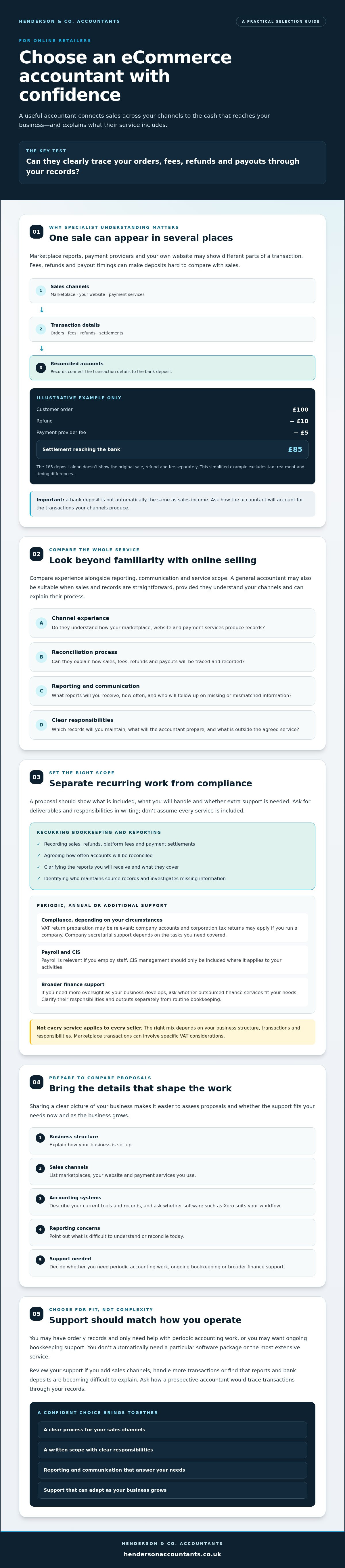
Each order, refund, fee and payout may appear in a different report or at a different time. Your records need to reconcile these items, rather than treating each bank deposit as sales income. Gross sales and net deposits aren’t interchangeable: a deposit may already have deductions for fees, refunds or other adjustments.
Illustrative example only: A customer places a £100 order, later receives a £10 refund, and the payment provider deducts £5 in fees. A settlement of £85 reaches the bank. The £85 deposit alone doesn’t show the original sale, refund and fee separately. This simplified example excludes any tax treatment and timing differences.
When should an online seller consider a specialist accountant?
Review your accounting support if you add sales channels, handle more transactions or find that reports and bank deposits are becoming difficult to explain. This can apply whether you sell through a marketplace, your own website or both. Ask a prospective accountant how they would trace sales, fees, refunds and payouts through your records.
The right level of support depends on your channels, business structure and internal capacity. You may be comfortable maintaining orderly records and need help with periodic accounting work, or you may want ongoing bookkeeping support. You don’t automatically need a particular software package or the most extensive service. Look for ecommerce accountants who can describe a process that fits the way your business operates.
Which services should you expect from eCommerce accountants?
A clear service scope shows what your accountant will do, what you’ll handle and where you may need extra support. Separate recurring work, such as bookkeeping and reconciliations, from periodic or annual compliance tasks. Don’t assume every service is included simply because it appears in a proposal. Ask for the deliverables and responsibilities in writing.
What should bookkeeping and reporting cover?
Ask how sales, refunds, platform fees and payment settlements will be recorded, and how often the accounts will be reconciled. Find out whether you’ll receive regular reports to help you understand sales and costs, or whether reporting is limited to compliance work. Check who maintains source records, investigates missing information and follows up when channel data doesn’t match. Clear ownership helps prevent gaps and makes it easier to act on reliable figures.
Which compliance and finance services might your business need?
The right combination depends on your business structure, transactions and responsibilities. VAT return preparation may be relevant to your circumstances, but it isn’t automatically needed by every seller. Marketplace transactions can involve specific considerations, so consult GOV.UK guidance on VAT rules for online marketplaces and ask how your own sales should be treated.
If you run a company, you may need corporation tax returns and annual accounts. Company secretarial support may also be useful, depending on the tasks your business needs covered. Payroll is relevant if you employ staff, while CIS management should only be included where it applies to your activities.
Some ecommerce accountants also provide broader finance support. If you need more oversight as your business develops, ask whether outsourced finance services could suit your needs. These differ from routine bookkeeping, so clarify the responsibilities and outputs before adding them.
Before agreeing a scope, confirm:
- Deliverables: Which records, returns and reports will be prepared?
- Responsibilities: What information must you supply, and who follows up on gaps?
- Frequency: How often will bookkeeping, reconciliations and reporting take place?
- Exclusions: Which tasks or situations fall outside the agreed work?
Henderson & Co. offers eCommerce accounting, bookkeeping, VAT return preparation, corporation tax returns, annual accounts and wider finance services. If you’re reviewing what support may suit your business, explore eCommerce accounting support and use the checklist above to guide your questions.
How to compare eCommerce accountants for your sales channels
A useful comparison focuses on how each accountant would work with your records, not just whether they list bookkeeping or tax returns as services. Ask for a clear explanation of how they’ll handle your channels and what you’ll receive. The questions below help you compare proposals on the same basis.
| What to compare | Questions to ask |
|---|---|
| Channel experience | Which marketplaces, webshops or payment gateways have you supported? Can you explain how experience with a business like mine applies? |
| Sales data and reconciliation | How will you check platform statements and payment reports against my accounting records? How do you investigate differences, refunds and chargebacks? |
| Service scope | Which bookkeeping, reconciliation, reporting and compliance tasks are included? What information must I provide, and what falls outside the agreed work? |
| Reporting | What reports will I receive, how often, and what business decisions could they help me consider? |
| Communication | Who will be my main contact, and how are routine questions and issues handled? |
Questions to ask about marketplaces, webshops and payment gateways
Ask candidates to describe their process for the channels you use, whether that’s a marketplace, your own website or both. If they have relevant experience, ask for a practical example of how they worked with data from the sales channel and payment provider. You’re assessing their approach, not just their familiarity with platform names.
Find out what happens if a payout doesn’t match the supporting reports. Who investigates the difference? How are refunds and chargebacks identified and recorded? A clear answer should explain the checks and responsibilities, rather than promise that discrepancies never occur.
How to assess communication and financial insight
Consider how clearly each accountant explains their proposed process. Will you receive understandable reports that help you monitor results, or mainly records prepared for compliance? Ask how often you’ll review the figures and whether the accountant can explain what they show in plain English.
Discuss your accounting system and workflow before settling on a tool. Xero Cloud Accounting Setup may suit some businesses, but it isn’t automatically the right choice for every seller. Ask how Xero or another system would fit your existing records and what setup or changes may be needed. Henderson & Co. offers Xero setup, so you can ask how it could fit your requirements.
Check whether the proposed support can change as you add channels, handle more transactions or expand your team. The right ecommerce accountants should explain how the service scope could be reviewed as your needs develop.
What to check before appointing or switching eCommerce accountants
A well-planned appointment or handover gives you a clearer start and helps prevent important tasks from being overlooked. Define what you need, prepare an overview of your records, compare proposals, agree the scope in writing and plan onboarding. This sequence also helps you judge whether prospective ecommerce accountants understand your business or are offering a standard service that may not fit.
- Define your needs: Note the tasks you want handled and the reporting that would help you.
- Prepare your records: Summarise your business and current accounting setup.
- Compare proposals: Check services, responsibilities, communication and exclusions.
- Agree the scope: Record deliverables, deadlines and who supplies or checks each item.
- Plan onboarding: Set out how records and access will be transferred securely.
What information should you prepare for an initial discussion?
A short, accurate overview makes the conversation more useful. Include your business structure, sales channels, payment providers and current accounting software. Note recurring concerns too, such as payouts that don’t reconcile, reports arriving too late to be useful or difficulty understanding your cash position.
Consider what you want from the relationship. Prepare questions about reporting, bookkeeping, compliance support and plans that may affect your future needs, such as adding a sales channel or taking on staff. Tax responsibilities and filing deadlines depend on your circumstances, so check current HMRC guidance and ask how the accountant will confirm what applies to your business.
How can you make an accountant handover smoother?
Agree who will request records and system access from your outgoing accountant, and confirm how information will be transferred. Establish who owns the bookkeeping data and supporting documents, when they’ll be available and how they’ll be shared securely. Don’t assume access to an accounting system means every source record has transferred too.
Keep a written handover list of outstanding filings, unreconciled items and tasks in progress. For each item, record who is responsible and the relevant deadline. Agree how you’ll communicate during onboarding and where to raise questions. Clear ownership matters when work passes between the outgoing accountant, your team and the new firm.
If you’re preparing to appoint or switch providers, use these questions to clarify the support you need. Henderson & Co. offers eCommerce accounting and Xero setup for online businesses. Discuss eCommerce accounting support that fits your records and requirements.
How Henderson & Co. supports UK eCommerce businesses
Henderson & Co. provides eCommerce accounting and Xero Cloud Accounting Setup for online businesses across the UK. Its services include bookkeeping, VAT return preparation, corporation tax returns and annual accounts. These may help if you need support organising online sales records, preparing business accounts or identifying which compliance work fits your circumstances.
As you compare ecommerce accountants, ask how your sales channels will be reflected in the records, what information you’ll receive and which tasks are included. Henderson & Co. also focuses on connecting data flows. If you’re considering Xero, discuss how setup could fit your existing systems and workflow rather than assuming a particular platform is right for you.
Matching accounting support to your business stage
Bookkeeping and compliance support can provide a practical foundation if you want help maintaining records alongside relevant returns and accounts. The precise scope depends on your business and should be agreed clearly. If your needs expand beyond routine accounting, Henderson & Co. also offers an outsourced finance department and outsourced finance director support. Ask what responsibilities each option covers and whether either suits the financial oversight you’re looking for.
There’s no need to select the broadest service by default. Your channels, business structure and internal capacity will shape what’s useful now. Ask how the support could be reviewed if you add a sales channel, change systems or need different financial information as the business develops.
What to discuss with Henderson & Co.
Before a conversation, prepare a short overview of how your business sells and manages its accounts. Include your sales channels, payment providers, current accounting software and any reporting concerns. For example, you might want clearer information about your cash position or help understanding why channel reports don’t match your records. Specific examples make it easier to discuss the work involved.
Then confirm which services are appropriate and what each includes. Ask who will provide source records, what bookkeeping or compliance work is covered, what reporting you can expect and how often it will be prepared. If you’re interested in outsourced finance support, clarify its scope and how it differs from the accounting work you already need. Agree responsibilities and deliverables in writing so you can assess whether the proposed support fits.
To discuss your channels, current accounting setup and the support you’re considering, discuss your eCommerce accounting needs with Henderson & Co.
Choose support that fits your next stage
The right accountant should understand how your sales channels affect your records and explain clearly what their service includes. Compare how each would handle online sales data, reporting and reconciliations, then agree who is responsible for each task. Your needs may change as your business develops, so look for support that can adapt without adding complexity you don’t need.
Henderson & Co. specialises in eCommerce accounting and Xero setup for UK businesses. The firm offers bookkeeping, compliance services and outsourced finance support. As you assess ecommerce accountants, consider whether that range fits your current requirements and the support you may need later.
Before choosing, share your sales channels, accounting setup and main reporting concerns. Ask which services are appropriate, what each includes and how responsibilities will be agreed. A clear conversation can help you decide with confidence.
Discuss your eCommerce accounting needs with Henderson & Co. Find out whether the firm’s accounting support fits your business.
Frequently Asked Questions
What does an eCommerce accountant do?
An eCommerce accountant helps record and report the financial activity of an online business. This can include reconciling marketplace or webshop sales with payment settlements, recording fees and refunds, and carrying out agreed bookkeeping or compliance work. Depending on your business and the services you arrange, support may also include VAT return preparation, corporation tax returns and annual accounts. Confirm the exact tasks and responsibilities in writing.
Do I need an accountant who specialises in eCommerce?
Not necessarily. The right choice depends on your sales channels, business structure, transaction records and support needs. A general accountant may be suitable if they understand your online sales records and can explain how they’ll handle fees, refunds and payouts. If you’re adding channels or struggling to reconcile reports, compare ecommerce accountants on their practical experience and proposed process, not just their specialist label.
Can an eCommerce accountant manage Amazon or Shopify accounts?
An accountant may be able to account for transactions from Amazon or a Shopify webshop, but that doesn’t automatically mean they manage your seller or shop account. Ask whether they’ve worked with reports and records from the channels you use, how they’ll reconcile those figures and what information you must provide. Confirm whether any data connection or accounting system setup is included in the agreed service.
How much do eCommerce accountants charge?
There isn’t one standard fee for every online business. The amount depends on factors such as the services required, number of sales channels, transaction records and level of bookkeeping or reporting support. Rather than relying on a headline figure, ask for a written proposal setting out the work included, any exclusions, your responsibilities and how additional work would be agreed. This makes it easier to compare like with like.
Can an eCommerce accountant help with VAT returns?
Yes, an accountant can prepare VAT returns if that work is included in their service and is appropriate to your business. Your VAT responsibilities depend on your circumstances, so share relevant information about your business and sales before agreeing the scope. Ask what records you’ll need to provide, who checks the figures and how return preparation fits with your bookkeeping. Check current HMRC guidance for requirements that apply to you.
How do I switch to an eCommerce accountant?
Start by agreeing the new accountant’s scope, responsibilities and onboarding plan. Ask who will request records and access from your outgoing accountant, how bookkeeping data and supporting documents will be transferred securely, and when they’ll be available. Keep a written list of outstanding filings, unreconciled items and work in progress, with an owner for each. Confirm deadlines and communication routes so nothing is left unclear during the handover.


