

What if improving ecommerce profit margins starts not with raising prices or cutting spend, but with finding which orders actually make money? Revenue can grow whilst cash and profit struggle to keep pace, especially when product costs, fulfilment, returns, discounts and payment fees are recorded across different channels.
It’s understandable to wonder whether to review prices, reduce expenses or focus on a different sales channel. But acting on overall revenue alone can hide the products and orders that are quietly eroding profit. A clearer view of contribution per order gives you a firmer basis for deciding what to change, and what to leave alone.
This guide explains how to measure margins at product and order level, compare practical improvement options and build a regular review process using reliable financial data. You’ll also see how channel-aware reporting can help pinpoint margin leakage, so your next step is based on evidence rather than guesswork.
Key Takeaways
- Separate profit margin from profit amount to understand what your sales are really retaining.
- Use consistent product and channel data to distinguish gross margin from contribution after selling and fulfilment costs.
- Compare pricing, product mix, fulfilment, returns, marketing and operating costs against their potential impact on customers and growth.
- Make improving ecommerce profit margins a repeatable process: set a baseline, identify leakage, test a change and review the results.
- Accurate bookkeeping, channel-aware reporting and a suitable Xero setup can give you clearer figures for better-informed decisions.
Why improving ecommerce profit margins starts with understanding the numbers
Sales can climb whilst the profit and cash left in your business barely move. The gap often sits in costs recorded separately, including product costs, marketplace and payment fees, fulfilment, discounts and refunds. Improving ecommerce profit margins starts with tracing these figures consistently, rather than treating turnover as a measure of success.
Profit is the amount left after relevant costs are deducted. Profit margin shows that profit as a proportion of revenue, helping you compare performance across products or periods with different sales levels. The basic formula is profit ÷ revenue × 100. Always state which profit figure and revenue basis you’re using. For example, don’t compare profit excluding VAT with sales that include VAT.
What does profit margin mean for an ecommerce business?
Gross margin compares sales with the cost of the products sold. Operating margin goes further, accounting for operating expenses such as marketing, staff and platform costs. Net margin reflects what remains after the business’s expenses, including relevant finance and tax costs. These measures answer different questions, so don’t use them interchangeably. For a helpful overview of understanding profit margins, see the distinctions between margin types and how they’re calculated.
Why can strong sales still produce weak margins?
An order’s margin depends on more than its product cost. Marketplace fees may differ from direct website costs, whilst payment fees, packaging, fulfilment and delivery can vary by channel, basket size or fulfilment method. Discounts reduce the amount received; refunds and returns can reverse sales or add handling costs. A delivery subsidy may also leave you covering part of the postage bill.
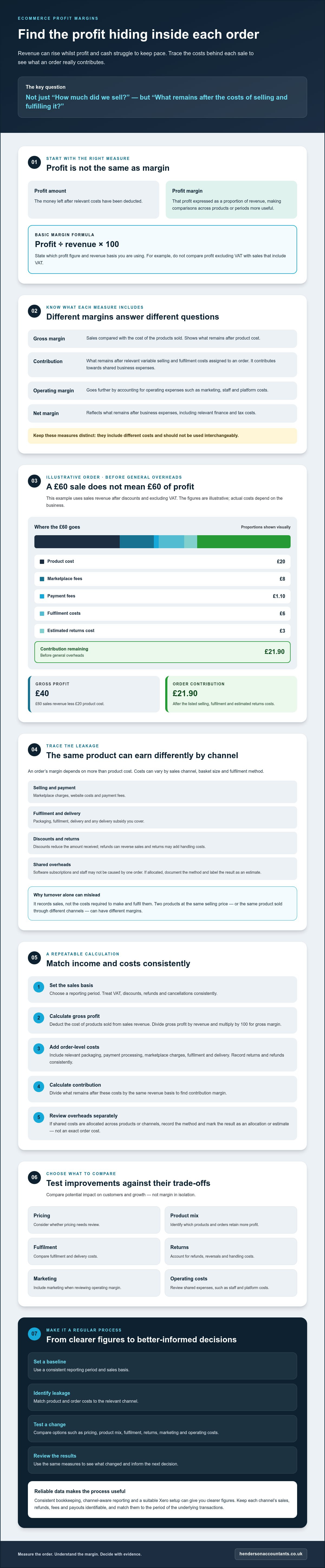
Hypothetical order: A customer pays £60 for an item, using sales revenue after discounts and excluding VAT. The product costs £20, marketplace fees are £8, payment fees are £1.10, fulfilment costs are £6 and an estimated returns cost is £3. After these deductions, £21.90 remains before general overheads. Gross profit is £40, but the order’s contribution after the listed costs is lower. The figures are illustrative, and actual fees and costs will depend on your business.
Margins can therefore differ between two products with the same selling price, or between orders for the same product sold through different channels. Turnover alone cannot show ecommerce profitability because it records sales, not the costs required to make and fulfil them.
How to calculate ecommerce margins accurately across products and channels
A useful margin calculation depends on matching income and costs to the same products, orders, channels and reporting period. This gives you a clearer basis for identifying where profit is being made or lost, and helps turn improving ecommerce profit margins into a data-led task rather than guesswork.
Which costs belong in an order-level margin calculation?
Use a consistent workflow for each product, channel or order group:
- Set your sales basis. Choose a reporting period and record sales consistently, including how you treat VAT, discounts, refunds and cancellations.
- Calculate gross profit. Deduct the cost of the products sold from sales revenue. Divide gross profit by revenue and multiply by 100 to calculate gross margin.
- Deduct order-level costs. Include relevant packaging, payment processing, marketplace charges, fulfilment and delivery costs. Account for returns and refunds consistently, for example by recording actual costs in the period they relate to.
- Calculate contribution. Divide the amount left after these costs by the same revenue basis to find contribution margin. This shows what an order contributes towards shared business expenses.
- Review overheads separately. Costs such as software subscriptions and staff may not be caused by one order. If you allocate them across products or channels, document the method and label the result as an allocation or estimate, not an exact order cost.
Gross margin shows what remains after product cost; contribution margin per order shows what remains after the variable selling and fulfilment costs assigned to that order. Both are useful, but they answer different questions.
How can you compare margins across channels reliably?
Keep each channel’s sales, refunds, fees and payouts identifiable, and match them to the period in which the underlying transactions occurred. Marketplace and payment-provider payouts are often net of fees, refunds or other adjustments, so don’t treat a deposit into your bank account as the same thing as sales revenue. Reconcile settlement reports against your records before comparing channel performance.
Apply the same cost rules across channels, whilst recording genuine differences such as channel-specific fees or fulfilment arrangements. If figures come from different systems, note any gaps or estimates. This is especially useful in the varied UK ecommerce market, where sellers may take orders through several routes.
Accurate bookkeeping and channel-aware reporting can make these comparisons more dependable. If you need help organising multi-channel figures or establishing a consistent review process, specialist ecommerce accounting support is available from Henderson & Co. Accountants.
Which ecommerce margin improvements should you compare first?
Once you can see contribution by product, order and channel, compare improvement ideas against the profit they may protect or create. A price rise might help a low-contribution product, but could reduce demand. Lower-cost fulfilment might improve order economics, but affect delivery expectations. The right choice depends on your figures, customers and growth plans.
There’s no universal target margin that suits every ecommerce business. Product category, channel fees, returns, fulfilment method and business model all shape the result. Use your own comparable data to judge progress, and weigh each option by likely margin effect, customer experience, workload and potential to support profitable growth. Indiscriminate price rises or cost cuts can damage demand or remove capabilities that help generate profitable sales.
When should you review pricing, discounts and product mix?
Look for products and order types where discounts leave little contribution. Then consider whether a different price, a smaller promotion or a stronger focus on better-performing products makes sense. Bundles and minimum order thresholds may encourage larger baskets, whilst controlled price tests can help you assess customer response. Treat these as options, not guaranteed wins. Check demand, competitor context and return patterns before changing prices or promotions.
Product mix matters too. A popular item may bring in sales but contribute less after discounts, fees and returns than a less prominent product. Review whether promotions are supporting repeat purchases or simply reducing the return from orders that would have happened anyway.
How can fulfilment and marketing affect ecommerce margins?
Compare fulfilment methods on total cost, delivery promise and customer experience, not price alone. Review returns for recurring issues, such as unclear product information or avoidable fulfilment errors, and address the cause where possible. For brands importing stock from overseas, quality control and pre-shipment checks by The Inspection Company can help prevent defective batches from reaching customers and driving up return costs. For marketing, assess the contribution from resulting orders, or longer-term customer value where your records support it, rather than relying only on clicks or revenue.
- Fulfilment: Could another method reduce costs without weakening delivery or service?
- Returns: Are particular products, channels or order types linked to avoidable returns?
- Marketing: Which activities bring in orders that remain profitable after their associated costs?
Recurring operating costs deserve a similar review. Check whether software subscriptions are still used and whether each supports an essential process. Cutting tools, service capacity or marketing that underpin customer experience and profitable growth may save money on paper whilst weakening results overall.
Prioritise changes that have a plausible margin benefit, reliable supporting data and manageable customer or operational risk. If the evidence is uncertain, test on a limited basis and review the effect before expanding. This measured approach makes improving ecommerce profit margins less about blunt cuts and more about choosing changes your business can sustain.
How to put an ecommerce profit-margin improvement plan into action
A repeatable review turns margin figures into practical decisions. Rather than changing several things at once, use a clear cycle: establish a baseline, locate possible leakage, choose one change, then review what happened. This helps you see whether an action made a difference and supports steady progress in improving ecommerce profit margins.
How should you choose and test a margin improvement?
Start with one product, channel or cost area where the underlying data is reliable enough to guide a decision. Rank possible actions by likely impact, confidence in the figures, effort required and customer risk. A possible saving based on uncertain data or carrying a high risk to delivery or service may be less suitable than a smaller, better-supported change.
Before acting, write down the baseline measure, the change you’ll make, the period you’ll review and the customer-impact guardrails you’ll monitor. For example, if you adjust a promotion, compare contribution per order alongside order volume and returns. Where practical, test the change with a defined product, channel or customer cohort, keeping other conditions as stable as possible.
Choose a like-for-like comparison, such as similar periods or cohorts, and account for trading patterns. A seasonal demand shift, a change in product availability or a different channel mix could affect results independently of your test. Don’t assume the change caused every movement you observe.
Which measures should you review regularly?
Choose a review rhythm that fits your trading patterns and the reliability of your reporting. The aim is to spot meaningful changes without making decisions from incomplete or inconsistent figures. Useful measures include:
- Gross margin by product or category, to track the return after product costs.
- Contribution per order by channel, to see what remains after selling and fulfilment costs.
- Returns and refunds, including patterns by product or sales route.
- Fulfilment costs and channel performance, to identify changes in order economics and compare like with like.
Keep a short decision log alongside these measures. Record what changed, why you chose it, what happened and what still needs investigation. If channel settlements or bookkeeping are incomplete, flag that limitation before drawing conclusions. Consistent, channel-aware financial reporting makes the review more useful over time.
If reliable figures are difficult to bring together across sales channels, ecommerce accounting and reporting support can help you build a clearer financial picture.
How specialist ecommerce accounting can support better margin decisions
A margin review is only as useful as the records behind it. If sales, fees, refunds and fulfilment costs sit in separate systems, it can be difficult to tell whether a product or channel is genuinely profitable. Better bookkeeping and a regular finance review can bring those figures together, so decisions about improving ecommerce profit margins are based on a clearer picture.
What financial information helps an ecommerce seller make decisions?
Useful reporting brings together sales, refunds, payment and marketplace fees, inventory costs and fulfilment data for each relevant channel. Timely bookkeeping helps keep these records current, whilst reconciling payment settlements makes it easier to understand how gross sales become the amount received in the bank. The result still depends on accurate source data and a setup that records transactions consistently.
For example, if a marketplace payout is recorded only as a single deposit, the underlying sales and deductions may be hard to analyse. Separating the components can help you investigate differences between channels and identify where more detail is needed. A cloud accounting system such as Xero can support organised records when it’s set up to suit the business, but the software alone won’t guarantee better margins or more accurate reporting.
When could an ecommerce accountant add value?
Specialist support may be useful when several sales channels, payment providers or fulfilment methods make product and order profitability difficult to see. An ecommerce accountant can help review how transactions are recorded, improve the usefulness of channel reporting and establish a regular finance review. This gives you a more consistent way to interpret results and decide what needs attention.
Henderson & Co. Accountants provides UK-wide eCommerce accounting, Xero setup, bookkeeping and outsourced finance support for online retailers. The right support can help you make sense of the figures and plan informed next steps, without promising a particular saving or margin result.
For details of the firm’s services, visit Henderson & Co. Accountants.
Build a clearer path to profitable growth
Improving ecommerce profit margins starts with understanding what each product, order and channel contributes, not just how much revenue it generates. Use consistent figures to spot where costs are reducing that contribution, then compare possible changes against their effect on customers and future growth.
Make the review repeatable: establish a baseline, choose a focused action and check the results against comparable data. Reliable bookkeeping and channel-aware reporting help you see whether a change is working or whether the figures need closer investigation.
Henderson & Co. Accountants provides specialist eCommerce accounting for online sellers, alongside Xero cloud accounting setup, bookkeeping and outsourced finance support. These services can help organise financial information and support more informed reviews, without promising a particular margin outcome.
Discuss ecommerce accounting support with Henderson & Co. Accountants. A clearer view of your numbers can help you make confident decisions and build growth on firmer foundations.
Frequently Asked Questions
How do you improve profit margins in an ecommerce business?
Start by calculating margin consistently at product, order and channel level. Include relevant product, payment, marketplace, fulfilment, discount and return costs so you can see what each sale contributes. Then choose the strongest evidence-backed opportunity, such as reviewing pricing, product mix or fulfilment, and test one change. Track its effect before making it wider. Improving ecommerce profit margins is usually more sustainable when you understand what each expense supports before cutting it.
What is a good profit margin for an ecommerce business?
There’s no single profit margin that’s good for every ecommerce business. Margins vary with product category, sales channel, fulfilment model, returns and business stage. For a useful comparison, first define whether you mean gross, operating or net margin, then compare like with like. Your own historical results can show whether performance is changing; relevant, current sector evidence may provide context, but shouldn’t be treated as a universal target.
How do you calculate ecommerce profit margin?
Divide the chosen profit figure by its corresponding revenue, then multiply by 100. For example, gross margin uses gross profit, whilst net margin uses net profit. State which measure you’re calculating and apply consistent periods and cost definitions. For product comparisons, include costs directly linked to orders, such as fulfilment and payment fees. Shared overheads should be allocated using a consistent method, not assigned arbitrarily to individual products.
Can increasing sales reduce ecommerce profit margins?
Yes. Sales can rise whilst margins fall if growth relies on heavy discounts, higher customer acquisition costs, expensive fulfilment, increased returns or products that contribute little after costs. Revenue alone doesn’t show whether additional orders are helping cover overheads and generate profit. Track contribution per order and by channel alongside sales. This helps you assess the quality of growth and spot whether a growing sales route is weakening overall profitability.
Which costs should an ecommerce business review first?
Begin with costs you can reliably link to orders or channels, including product costs, payment and marketplace fees, packaging, fulfilment, discounts and returns. Then review recurring overheads and marketing performance. Prioritise potential changes by likely impact, confidence in the data, effort and customer risk. A large expense isn’t automatically the right one to cut: first consider what it supports and whether removing it could harm service, demand or profitable growth.
How often should an ecommerce business review its profit margins?
Review margins often enough to spot meaningful changes, with the timing guided by trading patterns, seasonality and reporting quality. A regular monthly view may support management discussions, whilst more frequent checks can be useful during promotions or major operational changes. Use consistent reporting periods and investigate unusual movements before acting. If sales, fees or refunds aren’t fully reconciled, improve the underlying information before treating a margin change as conclusive.
Does Xero show profit margins for every ecommerce product automatically?
Not necessarily. Product-level margin reporting depends on accurate records and how sales channels, payment fees, inventory costs, refunds and fulfilment data connect with the accounting system. Xero can support financial reporting, but you may need suitable integrations, processes or additional analysis to view product margins. Check that reports use your actual cost definitions and consistent data before relying on them to compare products or make pricing decisions.
When should an ecommerce business speak to an accountant about margins?
Consider specialist support when sales channels are difficult to reconcile, reports don’t explain where profit is going, or growth makes financial decisions harder. An ecommerce accountant can help improve bookkeeping and reporting processes, and help you interpret the figures. Henderson & Co. Accountants provides eCommerce Accounting, Xero Cloud Accounting Setup, bookkeeping and outsourced finance support. Agree the scope of support, and don’t assume that software or advice guarantees a particular margin outcome.


