

Does your current accountant only get in touch when there is a deadline to meet or a bill to pay? For many growing UK businesses, the frustration of reactive communication and manual data entry errors is all too familiar. You might feel like a small fish in a large firm, watching tax planning opportunities slip away while you struggle with complex Xero reconciliations. It is natural to worry that switching accountants will be a bureaucratic nightmare that disrupts your daily operations or triggers issues with HMRC.
The truth is that moving to a proactive partner should be a strategic upgrade, not a stressful chore. With major regulatory shifts like Making Tax Digital for Income Tax arriving in April 2026, having a tech-savvy ally is more important than ever. This guide explains how to transition your finance function without the friction, specifically focusing on the needs of eCommerce brands and scaling SMEs. We will walk through the process of professional clearance, how we handle the heavy lifting of data migration, and what to expect when you finally have a partner who provides strategic advice for growth.
Key Takeaways
- Recognise the signs of technical stagnation and reactive service that indicate it is time for a more proactive accounting partner.
- Discover the strategic advantages of a mid-year transition and why waiting for your year-end might actually be delaying your growth.
- Master the simple step-by-step process of switching accountants without causing disruption to your daily business operations.
- Learn how a professionally managed Xero cloud accounting migration can eliminate manual data entry errors and streamline your finance function.
- Explore how moving to an outsourced finance department model provides the specialist eCommerce expertise your scaling brand requires.
Signs You Have Outgrown Your Current Accountant
Many business owners start their journey with a local firm that handles basic compliance. However, as your brand scales, the gap between "getting the books done" and strategic financial leadership begins to widen. While the basic definition of What is an Accountant? suggests a focus on recording and reporting financial transactions, a modern partner should offer much more than historical data entry. If you feel like a small fish in a big firm, or if your queries are met with silence, it's a clear signal that switching accountants is the right move to protect your brand's future.
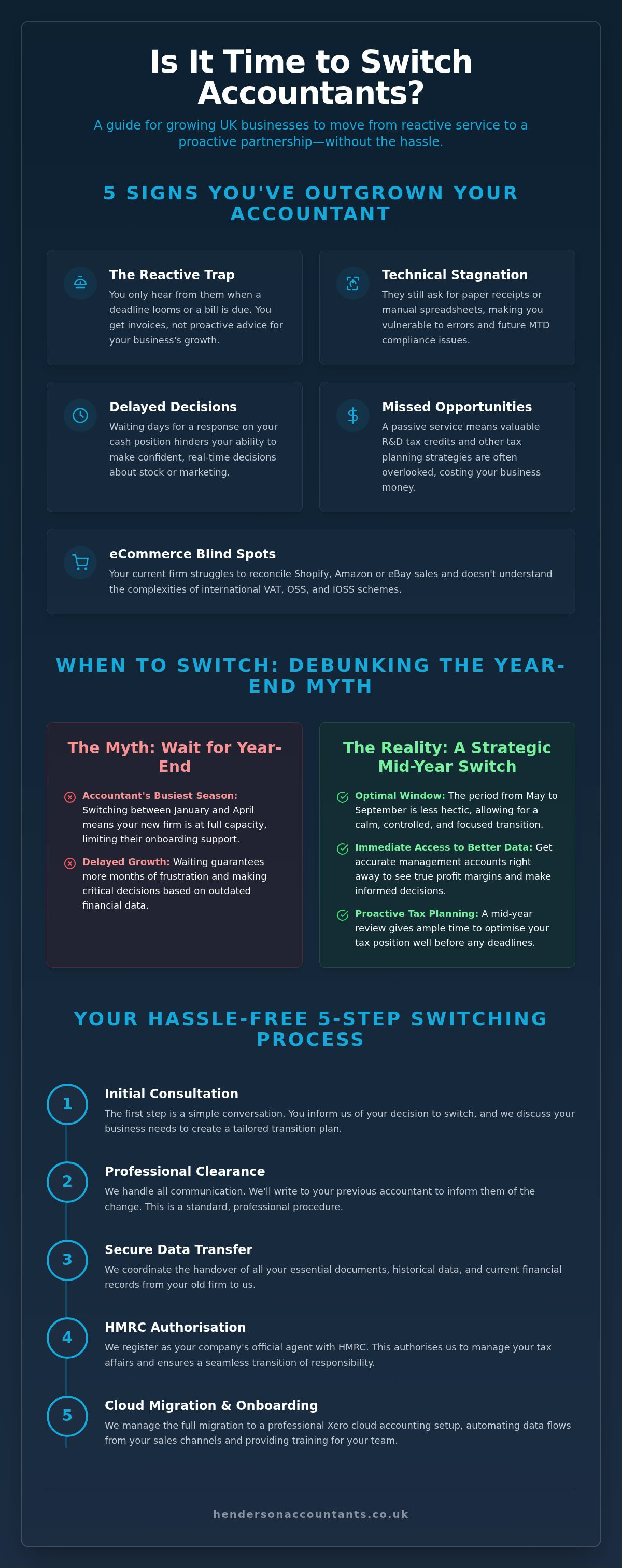
The "Reactive Trap" is perhaps the most common sign of a mismatched partnership. This is when you only hear from your firm when a tax bill is due or a deadline is looming. You aren't getting advice; you're getting an invoice. This technical stagnation often manifests as being asked for paper receipts or manual spreadsheets whilst you run a digital-first business. With Making Tax Digital (MTD) for Income Tax coming into force from April 2026 for those with income over £50,000, being stuck with manual processes is no longer just inconvenient; it's a compliance liability.
The Cost of "Making Do" with a Reactive Firm
Waiting days for a response isn't just annoying. It hinders your ability to make real-time decisions. If you don't know your exact cash position today, you can't confidently invest in new stock or marketing. "Cheap" accounting often proves expensive when you consider lost tax planning opportunities or R&D tax credits that go unclaimed. Choosing to start switching accountants allows you to move away from these hidden costs and toward a model that prioritises your peace of mind and long-term stability.
ECommerce Specific Red Flags
For digital brands, the red flags are often technical. If your firm struggles to reconcile Shopify, Amazon, or eBay sales accurately, your data is likely flawed. You shouldn't have to explain international VAT obligations or the complexities of OSS and IOSS schemes to your professional advisor. A specialist partner ensures that data flows automatically between your store and your cloud accounting software. This automation removes the manual errors that lead to HMRC penalties and ensures your VAT Return preparation is handled with precision and care.
When is the Best Time to Switch Accountants?
You might have heard that the only sensible time to change your financial partner is at the end of the tax year. This "Year End myth" often keeps business owners trapped in unhelpful relationships for months longer than necessary. In reality, the best time for switching accountants is usually right now. If your current service is holding you back, waiting until April only guarantees another twelve months of frustration and missed opportunities.
Research suggests the period from May to September is often the most effective window for a transition. This falls after the previous tax season and before the next one begins. Timing your move to coincide with the start of a new VAT quarter is also a smart move. It creates a natural "clean break" for your quarterly reporting and ensures your new partner can take full responsibility for the next submission. If you're entering a rapid growth phase, you need accurate data immediately. Waiting for a calendar date to pass could mean making critical scaling decisions based on flawed or outdated information.
Switching at the End of the Financial Year
Moving at the end of your financial year provides a neat cut-off point on your balance sheet. Your old firm completes the final accounts, and the new firm starts fresh. However, keep in mind that January to April is the busiest period for most UK practices. A firm at full capacity might not be able to offer the intensive onboarding support you deserve. If you want a transition that feels calm and controlled, avoid the peak season rush.
The Strategic Mid-Year Switch
A mid-year move is often the most effective way to upgrade your systems. It gives your new team time to implement a professional Xero cloud accounting setup without the pressure of an imminent filing deadline. You get immediate access to better management accounts, allowing you to see your true profit margins and cash flow during the year. This proactive approach ensures your tax position is reviewed well before the deadline, preventing nasty surprises. If you're ready for a more supportive partnership, you can explore our outsourced finance department services to see how a mid-year upgrade works in practice.
The Step-by-Step Process of Changing Accountants
The process of switching accountants is often far less daunting than business owners imagine. It follows a structured, professional sequence designed to protect you and ensure your financial data remains accurate. Once you have selected a partner who understands your eCommerce or growth goals, the transition begins with a few clear steps. This isn't a confrontational process; it's a standard professional handover that happens every day in the UK financial sector.
Managing the Notice Period
First, you need to provide notice to your current firm. Check your engagement letter for specific notice periods. These are typically between 30 and 90 days. You don't need to justify your decision in great detail. A simple, polite email stating that you're moving your business to a firm that better aligns with your current needs is perfectly sufficient. Ensure all outstanding fees are settled, as this prevents any delays in the transfer of your records.
How Professional Clearance Works
Professional clearance is a mandatory regulatory requirement. Your new firm will write to your previous accountant to ask if there are any professional reasons why they shouldn't accept the appointment. During this exchange, your new partner will request essential data. This includes trial balances, copies of previous tax returns, and capital allowance schedules. If your previous firm is slow to respond, your new accountant will follow up professionally to keep the momentum going.
Once clearance is received, the focus shifts to HMRC authorisation. This involves submitting a 64-8 form, which allows your new partner to speak to HMRC on your behalf. This is a vital step for managing your VAT Return preparation and Corporation Tax filings. It ensures your new team can handle all correspondence directly, removing the administrative burden from your desk.
The final stage is onboarding and data migration. Your new team will take your historical data and integrate it into your new cloud platform. If you're moving to a professional Xero cloud accounting setup, they'll ensure your bank feeds are connected and your opening balances are reconciled perfectly. This structured approach means you can focus on running your business whilst your new finance department handles the technical transition.
Avoiding Disruption: Managing the Cloud Data Migration
The technical migration is often where business owners feel the most anxiety. You might worry about losing historical records or experiencing a gap in your financial visibility. When switching accountants to a cloud-specialist firm, these risks are managed through a methodical, data-led migration. A professional Xero cloud accounting setup serves as the stable foundation for your entire finance department. It ensures that your data isn't just stored, but is actively working to help you grow.
Migrating historical data doesn't mean moving every single transaction from the last decade. We typically focus on moving the last two years of detailed data and opening balances to ensure continuity. This lean approach keeps your new system fast and clutter-free whilst maintaining full compliance with UK record-keeping laws. We also prioritise connecting your bank feeds and payment gateways like Stripe or PayPal immediately. This ensures day-one accuracy so you can see your true cash position from the moment the switch is finalised.
The Xero Transition Framework
A successful transition involves more than just moving numbers; it's about refining your reporting. We start by auditing your current chart of accounts to ensure they actually reflect how your business operates today. By integrating automation tools like Dext or Hubdoc, we eliminate manual bookkeeping and the errors that come with it. This setup allows for the production of real-time management accounts. Instead of waiting months for a report, you get immediate visibility into your margins and overheads.
ECommerce Data Integrity
For brands selling across multiple channels, data integrity is paramount. We ensure that sales data from platforms like Amazon or Shopify flows directly into Xero without manual intervention. This process includes a thorough reconciliation of historical VAT entries to ensure your reporting remains consistent and accurate. In modern digital business, a Single Source of Truth is a unified financial system where all sales, costs, and tax obligations are automatically synchronised and verified in real time. If you're ready to automate your finance function, our team can help you with a bespoke Xero cloud accounting setup tailored to your eCommerce store.
Training your team is the final, vital step in avoiding disruption. We don't just hand over the keys to a new system and leave you to it. We guide your staff through new digital workflows, showing them how to capture expenses on the go and interpret the new dashboards. This supportive approach replaces confusion with confidence, ensuring your business doesn't skip a beat during the transition.
Why Switch to Henderson & Co. Accountants?
Many traditional firms treat accounting as a volume business, focusing on the numbers rather than the people behind the brand. Choosing to start switching accountants should feel like hiring an internal team that actually cares about your success. At Henderson & Co. Accountants, we specialise in eCommerce and digital-first business models. We don't just file your returns; we help you understand what those numbers mean for your next big move. Our team understands the specific hurdles of modern entrepreneurship, from multi-channel payment gateways to international VAT complexities.
Our "Outsourced Finance Department" model is built specifically for scaling UK businesses. It goes far beyond basic compliance to provide a stable foundation for growth. We take a proactive approach to VAT return preparation and Corporation Tax planning, looking ahead to identify opportunities rather than just reporting on the past. By managing the entire transition process, our dedicated team ensures that your move to a more supportive partner is seamless and efficient.
Beyond Traditional Accounting: Strategic Partnership
Our Outsourced Finance Director services are designed to help you scale with confidence. We act as a forward-thinking partner that stays ahead of the curve. Whilst we manage the daily complexities of payroll and CIS management, you can stay focused on your product and your customers. We believe in clear communication that replaces anxiety with a sense of calm control. You'll receive tailored advice from Henderson & Co. Accountants that speaks your language, not the cold "accountant-speak" that often makes finance feel like a barrier. This collaborative approach ensures you have the strategic insight needed to navigate the challenges of a growing business.
Our Commitment to a Stress-Free Move
We handle the heavy lifting of the switch so you don't have to. Our dedicated transition team manages the professional clearance requests, communicating directly with your previous firm to gather trial balances and historical tax records. We ensure there are no filing gaps whilst we navigate the HMRC authorisation process. This methodical flow ensures that your data integrity is maintained throughout the move. We pride ourselves on being an organised and efficient expert that is deeply empathetic to the stresses of running a business. Ready to upgrade? Speak to our team about switching to Henderson & Co. Accountants today.
Take the Next Step Toward Proactive Growth
Upgrading your business finance is a pivotal moment in your growth journey. It represents a move away from the frustrations of reactive communication and technical stagnation toward a future of clarity and strategic control. By switching accountants, you aren't just moving files; you're gaining a tech-savvy ally that prioritises your peace of mind. As we've explored, the process is methodical and designed to eliminate disruption, allowing you to maintain your focus on scaling your brand whilst the technical heavy lifting is managed behind the scenes.
Henderson & Co. Accountants provide the stability and specialist eCommerce expertise needed to navigate the modern entrepreneurial landscape. As Xero Platinum Partners with a dedicated transition support team, we ensure your migration is accurate and your systems are optimised for day-one success. You don't have to settle for a service that no longer fits your ambitions. Book a free consultation to discuss your stress-free move to Henderson & Co. Accountants today. Your brand's potential is limitless when you have the right foundation in place.
Frequently Asked Questions
Is switching accountants difficult for a small business?
No, it is a straightforward process that is largely managed by your new partner. Whilst it might feel daunting, the heavy lifting of data migration is handled by the firms involved. You simply need to appoint your new team and provide notice to your old one. Switching accountants is smoother than ever with modern cloud tools, ensuring your operations continue without disruption. This organised approach helps maintain your peace of mind.
Can I switch accountants mid-way through the financial year?
Yes, you can transition at any point during the year. In fact, many businesses find that a mid-year switch is ideal for implementing a fresh Xero cloud accounting setup before the year-end rush. It allows your new team to review your tax position early and provide proactive advice whilst there is still time to act. You don't have to wait for a "clean break" at year-end to start seeing improvements.
Does my current accountant have to agree to the switch?
No, your current accountant cannot prevent you from moving your business elsewhere. They are professionally obligated to cooperate with the transition process. This includes responding to professional clearance requests and providing necessary financial data like trial balances and previous tax returns. Whilst you should ensure any outstanding fees are paid to avoid delays, the decision to move is entirely yours and does not require their permission or approval.
How long does the professional clearance process usually take?
The professional clearance process typically takes between 14 and 21 days to complete. This timeframe depends on how quickly your previous firm responds to the request from your new team. Your new partner will handle the correspondence and follow up if there are any delays. During this period, we also begin the HMRC authorisation process, ensuring a steady flow of information so your compliance filings remain on track throughout the move.
Will I have to pay two sets of fees during the transition?
No, you should not be double-charged for the same work during the move. You will pay your old firm for work they have already completed, such as a previous VAT Return preparation. Your new firm's fees will apply to the services they provide from the date of appointment. We work closely with you to review your current engagement letter, ensuring a clear cut-off point that avoids overlapping costs and protects your business's cash flow.
What information do I need to provide to my new accountant?
You only need to provide basic access and identification to get started. Your new team will require your Company House registration details, your most recent sets of accounts, and proof of identity for Anti-Money Laundering (AML) checks. Most of the technical data, such as historical ledgers and tax records, is obtained directly from your previous firm through the professional clearance process. We aim to keep your administrative burden as low as possible during onboarding.
How do I tell my current accountant that I am leaving?
A simple, polite email is the most professional way to notify your current firm. You don't need to provide a lengthy explanation; just state that you are moving to a partner that better suits your current business needs. Mention that your new team will be in touch shortly to request professional clearance. This direct approach keeps the relationship professional and ensures a smooth handover of your records without unnecessary tension or awkwardness.
Will switching accountants trigger an HMRC audit?
No, changing your professional advisor does not trigger an HMRC audit or investigation. Businesses change accountants for many reasons, such as seeking better sector expertise or moving to a cloud-based model, and HMRC views this as a normal part of business growth. In fact, switching accountants to a firm that uses modern software can improve your compliance record by reducing manual errors and ensuring your digital records are accurate.


