

With Xero now capturing nearly 60% of the UK accounting software market, the choice between xero vs quickbooks for ecommerce has become the defining technical decision for your online brand. You likely started your business to create, sell, and grow; you didn't sign up to spend your Sunday evenings manually reconciling Shopify payouts or worrying if your international VAT reporting is actually HMRC-compliant. It's exhausting to feel like you're drowning in spreadsheets while trying to maintain real-time visibility of your inventory across multiple sales channels.
We understand that your accounting software should be a silent partner that provides a stable foundation, not a source of constant anxiety. This comparison will help you discover which giant offers the most seamless integrations and robust VAT automation to keep your books audit-ready. We'll explore how to build a scalable financial architecture that handles everything from Making Tax Digital for ITSA to complex cross-border duties. By the end, you'll know exactly which platform will turn your messy data into a clear, automated flow that supports your long-term growth.
Key Takeaways
- Learn why reporting gross instead of net sales is the most frequent bookkeeping error for UK sellers and how to ensure your VAT is always accurate.
- Compare the specific features of xero vs quickbooks for ecommerce to see which platform handles multi-currency transactions and global marketplaces more efficiently.
- Discover why using summary-based connectors like A2X or Link My Books prevents the transaction deluge that often breaks traditional direct syncs.
- Understand the strategic reasons why the UK accounting profession has largely standardised on Xero for complex, scaling online businesses.
- Gain a clear implementation plan that prioritises a professional Xero cloud accounting setup over high-risk DIY migrations to protect your financial history.
The eCommerce Data Challenge: Why Standard Accounting Fails
High volume selling creates a unique friction point known as the transaction deluge. While a local boutique might process fifty sales a day, a successful Shopify or Amazon store can easily manage thousands of small orders across multiple countries. Traditional bookkeeping methods simply weren't built for this scale. When deciding on xero vs quickbooks for ecommerce, the primary goal isn't just recording numbers; it's managing the sheer weight of data that flows into your business every hour.
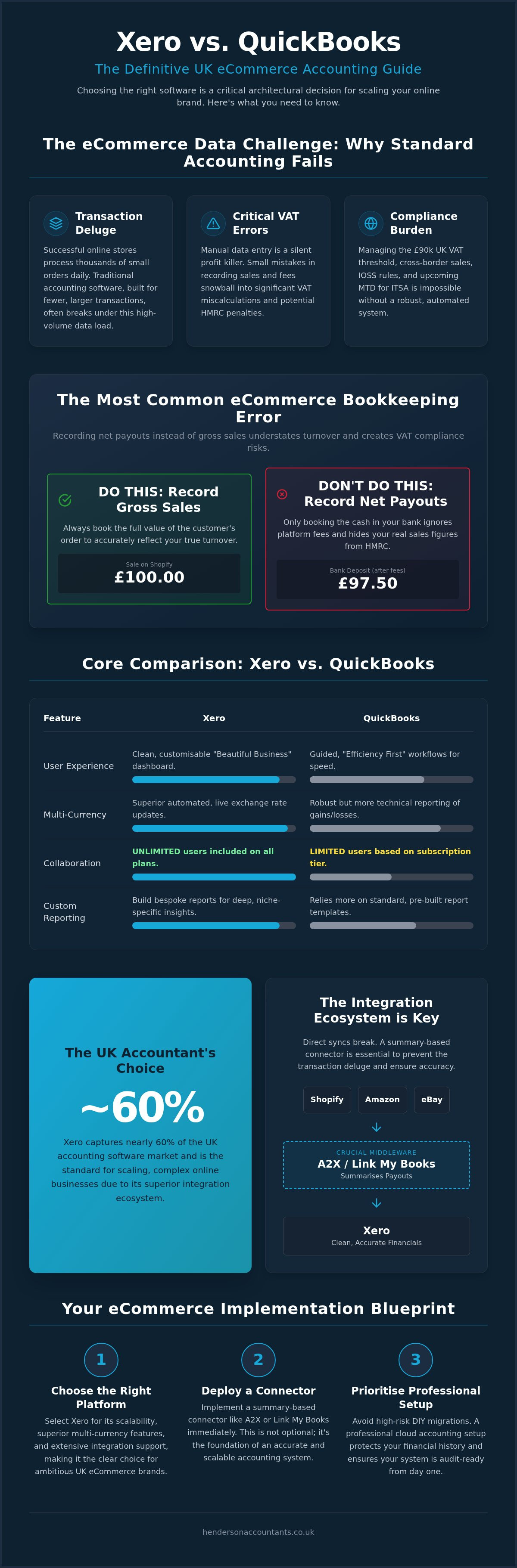
The most frequent mistake we see amongst UK sellers is recording net sales rather than gross figures. If you only log the cash that arrives in your bank account, you're ignoring the fees taken by platforms like Shopify Payments, PayPal, or Stripe. This error means your turnover figures are inaccurate. It can lead to major headaches during an HMRC VAT inspection because your reported revenue doesn't match your actual sales volume. A neutral Comparison of accounting software shows that modern cloud-based tools are now essential to handle these granular details automatically. Cloud accounting is no longer a luxury; it's the mandatory foundation for any retail brand that wants to stay compliant and profitable.
The Problem with Manual Data Entry
Manual data entry is a silent profit killer. It's a trap that many entrepreneurs fall into when they first start out. Typing order details into a spreadsheet might work for ten orders a week, but it leads to inevitable human error as you grow. These tiny mistakes snowball into significant VAT errors and potential HMRC penalties. Beyond the risk, there's the hidden cost of time. Every hour your team spends on manual reconciliation is an hour they aren't spending on marketing or product development. Traditional desktop software cannot keep pace with the real-time nature of digital sales.
VAT Complexity in Multi-Channel Selling
Managing the UK VAT threshold of £90,000 requires precision, especially whilst selling across multiple platforms. The complexity deepens when you factor in international sales and the Import One-Stop Shop (IOSS) rules for EU customers. By 2026, the landscape will shift again with the full implementation of Making Tax Digital (MTD) for Income Tax Self Assessment. HMRC now receives data directly from major marketplaces like Amazon and eBay. This means your software must be MTD-ready and capable of providing a clean audit trail. Without automated flows, keeping up with these evolving tax rules becomes an impossible task for even the most organised business owner.
Core Comparison: Xero vs QuickBooks for eCommerce
Choosing between xero vs quickbooks for ecommerce often feels like a choice between two different business philosophies. Xero prioritises a "Beautiful Business" aesthetic, featuring a clean, modular dashboard that helps you visualise your cash flow without feeling overwhelmed. QuickBooks, on the other hand, leans into an "Efficiency First" model. Its interface is designed for speed, using guided workflows that help you power through high-volume tasks like invoicing or expense tracking. Both are heavyweights in the UK market, but the right choice depends on whether you value customisation or structured guidance.
For sellers expanding via Shopify Markets or Amazon Global, multi-currency handling is a critical differentiator. Xero’s premium tiers provide automated, live exchange rate updates, ensuring your margins remain accurate even as the pound fluctuates against the dollar or euro. QuickBooks also offers robust multi-currency features, though it presents exchange gains and losses in a slightly more technical manner. If you are working with an outsourced finance director from Henderson & Co. Accountants to steer your growth, they will likely appreciate Xero’s reporting depth. The ability to build bespoke reports means you get real-time visibility into the metrics that actually matter for your specific niche.
Collaboration is where the two platforms diverge most significantly. Xero’s unlimited user model is a major advantage for scaling departments. You can grant access to your bookkeeper, inventory manager, and accountant without worrying about per-seat costs. QuickBooks typically limits user numbers based on your subscription level. For a fast-growing eCommerce brand, this can lead to unnecessary bottlenecks or the added expense of upgrading just to give your team the access they need to do their jobs.
User Experience and Accessibility
Xero’s dashboard acts as a customisable hub, allowing you to pin the most important bank accounts and sales charts to the front page. QuickBooks uses a more linear navigation style that is excellent for those who prefer a step-by-step approach to bookkeeping. Both offer powerful mobile apps that allow you to approve bills or check your bank balances whilst you are on the move. Xero’s app generally feels more intuitive for the creative business owner, whilst QuickBooks offers a depth that appeals to those who enjoy a more traditional accounting structure.
Pricing and Value for Money
When evaluating xero vs quickbooks for ecommerce, it is vital to look beyond the introductory offers. Both platforms use tiered pricing structures in the UK that scale as your business complexity increases. Whilst entry-level plans might seem attractive, they often lack the multi-currency support and advanced reporting that a serious online seller requires. You should also consider the cost of integrated add-ons like payroll, CIS management, or expense tracking. The best value is found in the plan that eliminates manual work and provides a stable foundation for growth, rather than the one with the lowest monthly headline figure.
The Integration Ecosystem: Where the Battle is Won
Software alone won't solve your data problems. The real winner in the xero vs quickbooks for ecommerce debate is often decided by the quality of the "middleware" you choose to connect your store. While QuickBooks integrates with over 800 applications, Xero’s App Store features over 1,000 certified apps. This larger ecosystem gives you more flexibility to build a bespoke tech stack that fits your specific niche, whether you're a private label brand or a high-volume dropshipper.
A common pitfall is using a direct, order-by-order sync from Shopify or Amazon into your accounting software. This often causes more problems than it solves. It fills your ledger with thousands of individual lines, making bank reconciliation an expensive nightmare for your bookkeeper. Instead, we advocate for "summary-based accounting" using professional connectors. These tools group your daily sales into clean, manageable batches that match your bank deposits exactly.
The Essential eCommerce Tech Stack
We consistently recommend tools like A2X or Link My Books for Amazon and Shopify reconciliation. These connectors act as a vital filter between your sales platform and your books. They gather the messy data from your sales channels, account for every penny of marketplace fees, and push a clean summary invoice into Xero or QuickBooks. This ensures total data integrity between your front-end store and your back-end finance. Xero is particularly adept at handling data from payment centres like Stripe and PayPal, allowing for smooth, automated matching that keeps your records audit-ready without manual intervention.
Inventory and COGS Management
Tracking your Cost of Goods Sold (COGS) in real-time is one of the hardest parts of running an online business. Both Xero and QuickBooks Plus offer native inventory features, but they have their limits. They work well for basic stock counts, but they often struggle with complex bundles, manufacturing, or multi-location warehouses. If you find your inventory needs outstripping these basic tools, it's time to consider a dedicated platform like Unleashed or Linnworks. Integrating these with your xero vs quickbooks for ecommerce setup allows you to maintain real-time visibility and accurate margins without overwhelming your core accounting software with too much granular stock data.
Compliance and Strategy: Beyond the Software
The choice between xero vs quickbooks for ecommerce isn't just about which interface you like best. It's about how well your system talks to your professional advisors. In the UK, the accounting profession has largely moved towards Xero as the gold standard for digital retail. This isn't just a trend. It's because Xero’s architecture allows for cleaner collaboration between you and your accountant. When it comes to year-end accounts and Corporation Tax, having a system that your accountant can navigate easily saves you time and professional fees.
HMRC is becoming increasingly sophisticated in how it monitors online sales. With the introduction of digital marketplace reporting in 2026, platforms like Amazon and eBay now share seller data directly with tax authorities. If you face a VAT enquiry, your audit trail is your best defence. You need to show exactly how a Shopify order became a bank deposit and how the VAT was calculated. This is especially true for complex IOSS or OSS transactions for EU sales. Xero’s detailed transaction logs provide the transparency required to keep you on the right side of the law without the stress of manual record-keeping.
Professional Oversight and MTD
Many sellers believe that once they've connected their apps, their bookkeeping is on autopilot. This is a dangerous myth. Automation is a tool, not a replacement for professional oversight. An expert needs to review your data flow weekly to catch mapping errors or VAT miscalculations before they become expensive problems. Staying ahead of HMRC’s digital filing requirements, particularly the 2026 MTD for ITSA changes for sole traders, requires more than just software. It requires a system that produces audit-ready books every single month. If you want to ensure your setup is robust enough for these changes, our eCommerce Accounting specialists can help you build a compliant foundation.
Scaling to an Outsourced Finance Department
As your brand grows, your needs shift from simple record-keeping to strategic insight. This is where your choice of xero vs quickbooks for ecommerce really matters. A strategic Outsourced Finance Director uses your data to forecast cash flow, manage inventory investment, and plan for growth. They move you from a reactive state where you're just filing taxes to a proactive one where you're building a scalable financial architecture. If you're ready to move beyond basic bookkeeping, our Outsourced Finance Department services provide the high-level oversight your scaling brand needs to thrive in a competitive market.
Making the Switch: Your eCommerce Implementation Plan
Transitioning your financial data is a significant milestone for any growing brand. When you decide on xero vs quickbooks for ecommerce, the actual migration of your data is the most critical phase. While some software providers claim switching is as easy as clicking a button, the reality is more complex. A DIY approach often overlooks the nuances of historical sales data and open marketplace invoices. Choosing a professional Xero Cloud Accounting Setup is a safer route that ensures your new ledger starts with a clean bill of health and total accuracy.
Our implementation process follows a logical, methodical sequence to replace anxiety with a sense of control:
- Audit your data: We begin by cleaning up your current records to ensure no errors or "ghost" transactions are carried over to the new system.
- Map your accounts: Your chart of accounts must be designed specifically for digital retail. We separate gross sales from platform fees, shipping costs, and advertising spend.
- Configure the integration: We set up the vital "middleware" layer, such as A2X or Link My Books, to ensure a perfect, summary-based sync between your store and your books.
- Team training: We ensure your department understands the new workflows so you can maintain the system with confidence and ease.
Avoiding Migration Pitfalls
The biggest risk during a software switch is the creation of duplicate data. If your sales channels are still pushing data to your old system while the new one is active, you'll end up with a reconciliation nightmare. Historical VAT returns also require careful handling. You must ensure you don't miss any reclaimable input tax during the transition period. The transition between xero vs quickbooks for ecommerce is also the perfect time to audit your VAT settings for international sales. Ideally, we recommend timing your move with the start of a new financial year or a fresh quarter to keep your records as tidy as possible.
How Henderson & Co. Accountants Streamlines Your Setup
We take a specialised approach to every implementation, recognising that no two online businesses are identical. Our team handles the heavy lifting of the migration, allowing you to focus on your customers and your growth. Beyond the initial setup, we provide ongoing support that scales with you. This ranges from precise daily bookkeeping to high-level Outsourced FD advisory. We're here to be your proactive partner, ensuring your financial architecture is built for long-term success without hidden barriers. Ready to transform your finances? Organise your Xero Cloud Accounting Setup with Henderson & Co. Accountants today.
Future-Proof Your eCommerce Financial Architecture
Choosing between xero vs quickbooks for ecommerce is a pivotal step in moving from a reactive business to a proactive brand. We've explored how the right integration layer prevents the transaction deluge from overwhelming your books and why a professional setup is essential for maintaining HMRC compliance. Software is the engine, but the integrity of your data depends on professional oversight and a clean implementation that scales with your ambitions.
As specialists in Xero Cloud Accounting Setup, Henderson & Co. Accountants are dedicated to UK eCommerce growth. We provide the expert Outsourced Finance Director services needed to turn your financial data into a strategic asset. Don't let migration anxiety or messy spreadsheets hold your business back from its full potential. Our team is here to be your forward-thinking partner, ensuring your financial architecture is built for long-term success without hidden complications or barriers.
Ready to automate your data flows and gain real-time visibility? Book a consultation with our eCommerce accounting specialists at Henderson & Co. Accountants to start your journey towards cleaner, audit-ready books today. You've built a great brand; let's ensure your finances are just as impressive.
Frequently Asked Questions
Is Xero or QuickBooks better for Shopify sellers in the UK?
Xero is generally the preferred choice for Shopify sellers due to its superior integration ecosystem and unlimited user model. While both platforms connect to Shopify, Xero's ability to handle the transaction deluge through deep connections with tools like A2X makes it more scalable. It provides a clearer view of your cash flow and margins, which is vital when you're managing multiple Shopify Markets or currency variations.
Can I switch from QuickBooks to Xero mid-way through the financial year?
You can switch at any time, but we usually recommend aligning the move with the end of a VAT quarter to keep your records tidy. Our Xero Cloud Accounting Setup service ensures your opening balances and historical data are migrated with total accuracy. This prevents the common "duplicate data" errors that occur during DIY transitions, giving you a clean start without losing your financial history.
Do I need a specialist eCommerce accountant if I use Xero?
Yes, because software is simply the engine; you still need a specialist to navigate complex UK tax rules. A general accountant might not understand the nuances of gross vs net reporting or how to reconcile marketplace fees correctly. A specialist ensures your xero vs quickbooks for ecommerce setup is robust enough to handle IOSS rules and provides the proactive advisory needed for a scaling digital brand.
How does Xero handle Amazon FBA VAT requirements?
Xero handles Amazon FBA requirements by connecting with professional tax-mapping tools that categorise every sale based on the customer's location. This is essential for staying compliant with the UK's £90,000 VAT threshold and evolving EU customs duties. It ensures that every FBA disbursement is reconciled against the correct tax treatment, providing an audit-ready trail that protects you during an HMRC enquiry.
Is QuickBooks better than Xero for small sole traders just starting out?
QuickBooks is often viewed as more approachable for very small sole traders due to its guided workflows and lower entry-level price points. It's a solid choice if your business is simple and you don't plan to hire a team immediately. However, if you have ambitions to scale, starting with Xero avoids a painful migration later. Xero's unlimited user model offers better value as your department grows.
What are the best Xero integrations for UK eCommerce businesses in 2026?
The gold standard for a xero vs quickbooks for ecommerce tech stack remains A2X or Link My Books for marketplace reconciliation. These tools are essential for gathering messy data from Amazon and eBay. For payment processing, Stripe and PayPal are the most robust options. If your inventory needs are complex, we recommend looking at dedicated platforms like Unleashed or Linnworks to maintain real-time visibility.
How much does it cost to have an accountant set up Xero for eCommerce?
We don't provide a one-size-fits-all price because every eCommerce business has unique requirements, such as the number of sales channels or inventory complexity. Instead, we offer a bespoke quote after auditing your current data quality. Investing in a professional setup prevents the costly human errors and HMRC penalties that often arise from a poorly configured system, saving you significant money in the long term.
Does QuickBooks support Making Tax Digital (MTD) for all UK businesses?
Yes, QuickBooks is fully MTD-compliant for both VAT and the upcoming 2026 MTD for ITSA regulations. It allows UK businesses to submit quarterly reports directly to HMRC, which is a mandatory requirement for sole traders with a qualifying income over £50,000. This ensures you stay on the right side of digital filing requirements without the stress of manual submissions or outdated spreadsheet-based reporting.


