

What if your annual tax return was actually the least valuable thing your accountant did for you this year? It is completely natural to feel a sense of dread as HMRC deadlines approach, particularly with the 2026 rollout of Making Tax Digital. You probably worry about surprise penalties or whether your tax accountants are truly keeping up with complex eCommerce VAT rules. It often feels like you are the one chasing for updates, rather than receiving proactive advice that actually saves you money.
This guide will show you how to identify a partner who does more than just record the past. We will help you find a professional who proactively lowers your tax liability through clever legal planning whilst ensuring total peace of mind. You will discover how to move from reactive stress to automated, real-time reporting via Xero. We have compiled a definitive checklist covering everything from compliance essentials to the strategic questions that separate a basic service from a growth-focused financial ally.
Key Takeaways
- Understand the difference between basic bookkeeping and the strategic value modern tax accountants provide to help you scale your business efficiently.
- Master your 2026 HMRC obligations, including Corporation Tax and Making Tax Digital, to ensure total compliance without the usual last-minute panic.
- Learn why digital businesses require specialist reconciliation for payment gateways like Stripe and PayPal to avoid common reporting errors.
- Identify five critical warning signs that your current accounting firm is too reactive and learn exactly when it is time to switch to a tech-savvy partner.
- Discover how to automate your financial reporting using Xero to gain real-time clarity and lower your tax liability through proactive planning.
What is a Tax Accountant and Why Does Your Business Need One?
Many business owners view their accountant as a seasonal necessity. You might see them once a year to file a return and then forget about them until the next tax bill arrives. However, modern tax accountants act as strategic partners who help you navigate the complex UK tax system. Understanding exactly What is a Tax Advisor and how they differ from a standard bookkeeper is the first step toward better financial health. While a bookkeeper focuses on recording your daily transactions, a specialist accountant interprets those numbers to ensure you aren't overpaying.
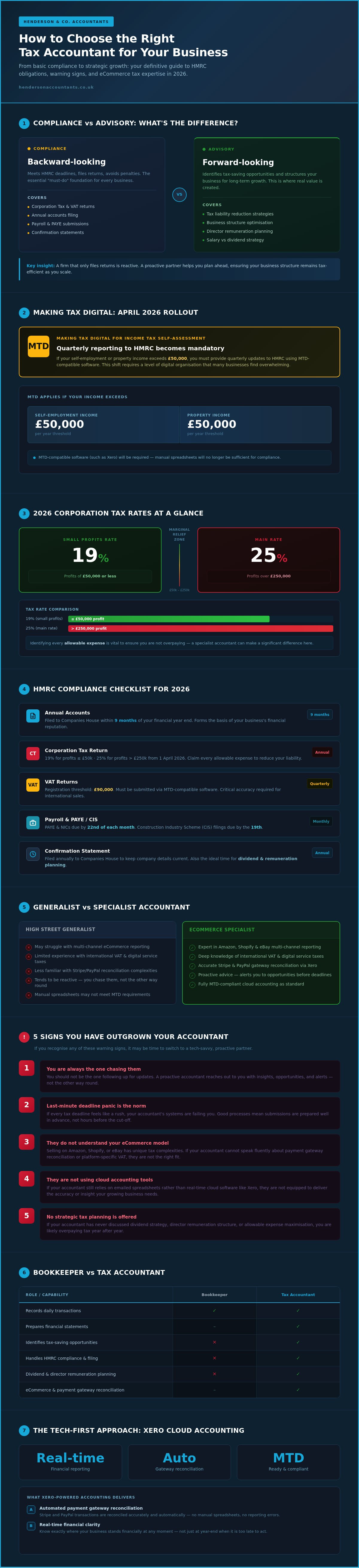
With the April 2026 rollout of Making Tax Digital (MTD) for Income Tax Self-Assessment, having an expert on your side is no longer optional for many. If your self-employment or property income exceeds £50,000, you'll need to provide quarterly updates to HMRC. This shift requires a level of digital organisation that many businesses find overwhelming. It's about more than just software; it's about having a system that keeps you compliant without taking over your life.
The Difference Between Compliance and Advisory
Compliance is essentially looking backward. It involves meeting HMRC deadlines for Corporation Tax or VAT returns to avoid costly penalties. It's the "must-do" part of running a business. Advisory, however, is where the real value lies. It's a forward-looking approach where your accountant identifies tax-saving opportunities and structures your business for long-term growth. You need a partner who does both. A firm that only files returns is reactive. A proactive partner helps you plan for the future, ensuring your business structure remains tax-efficient as you scale.
The Value of Specialist eCommerce Tax Expertise
Selling across platforms like Amazon, Shopify, or eBay adds layers of complexity that a traditional high street firm might struggle to handle. You have to deal with multi-channel reporting, international VAT, and digital service taxes. Specialist tax accountants use tools like Xero cloud accounting to automate these processes. This tech-savvy approach ensures your payment gateway reconciliations from Stripe or PayPal are accurate every single time. It replaces the stress of manual spreadsheets with a sense of calm control. By using an Outsourced Finance Department model, you can access high-level expertise that understands the nuances of digital trade without the overhead of an in-house team.
The Essential Tax Compliance Checklist: HMRC Obligations for 2026
Staying on top of HMRC obligations for 2026 doesn't have to be a source of constant anxiety. When you work with proactive tax accountants, the goal is to turn these requirements into a routine, automated process. Use this checklist to ensure you are meeting the core standards for accuracy and timeliness. Missing a deadline is often just the result of a poor system, not a lack of intent. By organising your records early, you replace last-minute panics with a sense of calm control.
- Annual Accounts: Your year-end filings must be accurate and submitted to Companies House within nine months of your financial year end. These documents form the basis of your business’s financial reputation.
- Corporation Tax Returns: For the financial year beginning 1 April 2026, the main rate is 25% for companies with profits over £250,000. If your profits are £50,000 or less, the small profits rate of 19% applies. Identifying every allowable expense is vital to ensure you aren't overpaying.
- VAT Returns: With the VAT registration threshold set at £90,000, you must manage your returns through Making Tax Digital (MTD) compatible software. Accuracy here is critical, especially if you deal with complex international sales.
- Payroll and CIS: Electronic payments for PAYE and NICs are due by the 22nd of each month. If you operate in the construction sector, your CIS filings must be submitted by the 19th.
Statutory Filings for Limited Companies
Running a limited company brings extra responsibilities that go beyond just paying tax. You must file a Confirmation Statement annually to keep your details up to date at Companies House. This is also the perfect time for director remuneration and dividend planning. Balancing a low salary with dividends remains a popular strategy for tax efficiency. However, it requires careful documentation and timing to stay within legal bounds. Our team can manage these Company Secretarial Services for you, ensuring your statutory books are always in order.
Making Tax Digital (MTD) Readiness
The digital landscape is shifting significantly. From April 2026, individuals with self-employment and property income above £50,000 must follow MTD for Income Tax rules. This requires keeping digital records and providing quarterly updates to HMRC. Deadlines for these updates fall on 5 August, 5 November, 5 February, and 5 May. Manual spreadsheets or paper receipts simply won't cut it in this digital-first environment. Transitioning to cloud software like Xero ensures you are always ready for the next deadline. It provides a stable foundation where you can see your tax liability in real-time, rather than waiting for a surprise at the end of the year.
Generalist vs Specialist: Choosing the Right Accountant for Your Sector
Choosing between a local high street firm and a specialist is one of the most critical decisions you will make for your business. Traditional tax accountants often excel at servicing local trades or brick-and-mortar shops. However, they frequently struggle with the high-volume transaction data and global reach of digital business models. If your accountant treats your Stripe or PayPal account as a single bank transfer rather than a ledger of individual sales and fees, your reporting is likely inaccurate. A specialist understands that payment gateway reconciliation is the backbone of compliant eCommerce accounting.
Evaluating an accountant’s tech stack is a quick way to gauge their suitability. Are they truly cloud-native, or are they just using cloud software to perform traditional tasks? A specialist will help you integrate your sales platforms directly with Xero. This ensures that data flows automatically and reduces the risk of manual errors. It replaces the stress of manual data entry with a system that works while you sleep, providing a stable foundation for your growth.
Specialist eCommerce Tax Challenges
Inventory valuation is a perfect example of where a specialist adds value. How you value your stock at year-end directly impacts your Corporation Tax liability. A generalist might use a simple estimate. A specialist will help you implement accurate tracking that reflects the true cost of goods sold. This becomes even more vital when managing cross-border VAT. Navigating the rules for selling into the EU or the US requires specific knowledge that most general firms simply don't possess. Automating these data flows is the only way to remain competitive and compliant as you grow.
The Role of an Outsourced Finance Director
As you scale, you will eventually need more than just tax filings. This is where the role of an Outsourced Finance Director becomes invaluable. Instead of just looking at what happened last year, they focus on strategic financial forecasting. They help you manage cash flow to fund expansion and identify when it is time to transition from a basic bookkeeping setup to a full Outsourced Finance Department. This proactive approach ensures you have the clarity needed to build your success without fear of hidden barriers or confusing financial hurdles.
5 Critical Signs You Have Outgrown Your Current Tax Accountant
As your business evolves, the financial support you need changes too. Many entrepreneurs start with a local firm that handles basic filings perfectly well. However, as you scale, a gap often opens between what you need and what your provider offers. If you feel like your business is moving faster than your financial advice, it is probably time to reassess. Recognising these signs early can save you from costly mistakes and missed opportunities for growth.
- Communication is reactive: You only hear from your provider when a bill is due or a deadline is looming. You shouldn't have to chase your tax accountants for updates; they should be the ones reaching out to you.
- Lack of tech integration: If you are still sending manual spreadsheets or paper receipts, your system is inefficient. Modern accounting relies on automated data flows that give you real-time clarity.
- Missing out on tax planning: You only find out about tax-saving opportunities after the financial year has ended. By then, it is often too late to take legal action to lower your liability.
- Scaling friction: Your current setup struggles to handle increased transaction volumes or the complexities of international VAT. This friction acts as a handbrake on your expansion.
- No strategic insight: You receive a set of numbers every month, but no narrative explaining what they mean. Without advice on cash flow or forecasting, you are essentially flying blind.
The Cost of "Cheap" Accounting
It is tempting to stick with a low-fee compliance firm to keep overheads down. However, "cheap" accounting often proves expensive in the long run. When your provider only focuses on the bare minimum, you miss out on proactive tax planning that could save you thousands. With the main Corporation Tax rate at 25% for profits over £250,000, efficient planning is more critical than ever. There is also the hidden cost of your own time. If you are spending hours on manual bookkeeping because your accountant hasn't automated your systems, you are losing time that should be spent growing your brand.
How to Switch Accountants Without the Stress
Many business owners stay with the wrong firm because they fear the transition will be a nightmare. In reality, switching is a straightforward professional process. Once you decide to move, your new firm handles the "professional clearance" by contacting your previous accountant for your records. Timing your move around a VAT quarter or the start of a new financial year can help, but modern cloud access makes it possible to switch at any time with minimal disruption. Ready for a more proactive partnership? Explore our Outsourced Finance Department services to see how we can support your growth.
Scaling Your Business with Henderson & Co.’s Tax Expertise
Growing a business in the current economic climate requires more than just a standard filing service. At Henderson & Co., we provide a stable foundation for your success through our Outsourced Finance Department model. This approach allows you to access high-level expertise without the significant overhead of hiring an internal team. Our tax accountants act as an extension of your own business, ensuring that your financial infrastructure is built for scalability and long-term stability.
We specialise in Xero cloud accounting, specifically tailored for the needs of modern eCommerce brands. By integrating your sales channels directly with your accounts, we eliminate the manual data entry that often leads to errors. This tech-forward approach ensures that your multi-channel reporting is always accurate. Whether you are selling on Shopify, Amazon, or eBay, we provide a clear view of your margins and tax liabilities in real-time. It replaces the anxiety of "not knowing" with a sense of calm, organised control.
Our proactive approach to Corporation Tax and VAT compliance means you are never caught off guard by a surprise bill. We don't just tell you what you owe; we help you plan for it months in advance. By identifying every legal tax-saving opportunity early, we ensure you keep more of your hard-earned profit to reinvest in your growth. Having an Outsourced Finance Director on your side provides the strategic insight needed to fund business expansion and manage cash flow effectively during periods of rapid scale.
Tailored Solutions for Modern Entrepreneurs
We understand that your time is your most valuable asset. Our solutions focus on heavy automation to give you back the hours you currently spend on administrative tasks. We pride ourselves on transparent pricing and clear, plain-English communication. You won't find any confusing "accountant-speak" here; just practical advice that helps you move from start-up to scale-up. We support UK businesses through every stage of their journey, providing the stable financial partnership needed to build a lasting legacy.
Take the Next Step Toward Financial Clarity
If you feel your current accounting setup is holding you back, it is time for a fresh perspective. We offer a comprehensive review of your current tax position to identify immediate efficiencies. This includes a detailed audit of your existing Xero setup to ensure your data flows are optimised and your reporting is robust. Moving to a proactive partner is the quickest way to regain control of your business finances. Organise a discovery call with Henderson & Co. today to find out how we can help you achieve total financial clarity.
Take Control of Your Financial Future in 2026
Navigating the UK tax landscape requires more than just meeting deadlines. It's about building a partnership that turns compliance into a competitive advantage whilst protecting your hard-earned profits. By choosing specialist tax accountants who understand the nuances of eCommerce and cloud automation, you move from reactive stress to a state of calm, organised control. Whether you are preparing for the 2026 MTD rollout or managing complex international VAT, the right support ensures your business remains scalable and stable.
As Xero Certified Platinum Partners and experts in Amazon FBA accounting, we help you automate your reporting and protect your margins. Our dedicated Outsourced Finance Director services give you the high-level strategic insight needed to build your success with confidence. Get a proactive tax strategy with Henderson & Co. Accountants today and start focusing on what you do best. Your business has incredible potential; don't let confusing barriers or hidden complications hold you back from achieving it.
Frequently Asked Questions
What is the difference between a tax accountant and a bookkeeper?
A bookkeeper focuses on the daily recording of financial transactions, such as processing invoices and bank reconciliations. In contrast, tax accountants provide high-level analysis and ensure your business meets its legal obligations with HMRC. While bookkeeping keeps your records tidy, an accountant uses those records to identify tax-saving opportunities and manage complex filings like Corporation Tax. Having both functions working in harmony ensures your financial data is accurate and strategically useful for your growth.
Do I really need a specialist eCommerce tax accountant?
If you sell through platforms like Amazon, Shopify, or eBay, a specialist is essential for managing multi-channel reporting and international VAT. Generalist firms often struggle with the sheer volume of digital transactions and the complexities of payment gateway reconciliations from Stripe or PayPal. Specialist tax accountants ensure your data flows are automated through Xero, reducing manual errors and giving you real-time clarity on your margins whilst maintaining total compliance with digital-specific tax rules.
How much does a tax accountant cost for a UK small business?
The cost of hiring an accountant varies significantly depending on the complexity of your business and the level of support you require. Most firms offer a combination of fixed monthly fees for recurring compliance tasks and separate advisory fees for strategic projects. Instead of looking for the lowest price, it is better to consider the value of time saved and the potential tax liabilities reduced through proactive planning and expert guidance from a dedicated partner.
Can a tax accountant help me reduce my Corporation Tax bill?
Yes, an accountant identifies all allowable expenses and capital allowances to ensure you only pay what is legally required. For the financial year beginning 1 April 2026, the main Corporation Tax rate is 25% for profits over £250,000, making efficient planning vital. By reviewing your director remuneration strategies and business structure, a proactive partner helps you lower your tax liability whilst ensuring every claim is fully compliant with current HMRC regulations and reporting standards.
What is Making Tax Digital and how does it affect my business in 2026?
Making Tax Digital is an HMRC initiative requiring businesses to keep digital records and provide quarterly updates. From April 2026, self-employed individuals and landlords with income above £50,000 must follow these rules for Income Tax. This shift means you can no longer rely on manual spreadsheets or paper receipts. Using MTD-compatible software like Xero ensures your reporting is automated, reducing the risk of penalties and providing a much clearer view of your ongoing financial position.
How often should I meet with my tax accountant?
You should ideally communicate with your accountant at least once a quarter to review your performance and adjust your tax planning. While traditional firms might only speak to you once a year, a proactive partnership involves regular check-ins to discuss cash flow and growth strategies. This frequency ensures that you aren't surprised by tax bills and that your financial reporting remains accurate throughout the year, rather than just at the end of the financial period.
Is it difficult to switch tax accountants mid-year?
Switching accountants mid-year is a straightforward process that causes minimal disruption to your daily operations. Your new firm will manage the professional clearance process by contacting your previous provider for your records. Modern cloud accounting software like Xero makes this transition even smoother, as your new team can simply be granted access to your existing data. It is often better to switch as soon as you identify a lack of support rather than waiting for year-end.
What records do I need to keep for my tax accountant?
You must keep accurate records of all business income and expenditure, including sales invoices, purchase receipts, bank statements, and payroll information. HMRC requires you to maintain these records for at least six years. Using digital tools to capture receipts as they arrive ensures nothing is lost and simplifies the reconciliation process. This organised approach provides your accountant with the stable foundation they need to prepare accurate returns and offer strategic financial advice for your business.


