

The biggest mistake online sellers make isn't missing the 31 January deadline; it's assuming their bank balance is the same as their taxable income. When you're managing hundreds of small transactions across Amazon, eBay, or Shopify, it's easy to feel overwhelmed by the sheer volume of data. You might worry about accidentally underreporting your earnings or missing out on legitimate expenses that could lower your tax bill. Filing a sole trader tax return for online sellers uk can feel like a daunting hurdle, especially when the fear of HMRC penalties looms over your hard-earned profits.
We understand that you want to focus on growing your brand, not wrestling with spreadsheets and confusing jargon. This guide will help you master the essentials of your Self Assessment, from distinguishing between gross income and net profit to identifying every allowable expense you're entitled to claim. We'll show you how to organise your digital finances to ensure you're fully compliant for the 2026 tax year. By the end of this article, you'll have a clear system for tracking sales and fees, giving you total peace of mind as the deadline approaches.
Key Takeaways
- Understand the £1,000 trading allowance and exactly when your online selling hobby officially becomes a business in the eyes of HMRC.
- Learn how to simplify your sole trader tax return for online sellers uk by adopting automated digital record-keeping that separates business and personal finances.
- Discover how to maximise your tax efficiency by identifying eCommerce-specific allowable expenses that are "wholly and exclusively" for your business.
- Gain a clear, step-by-step roadmap for completing the Self-employment section of your tax return without the stress of last-minute calculations.
- Identify the specific triggers that indicate your online shop has outgrown manual spreadsheets and requires a more professional, automated accounting strategy.
Understanding the £1,000 Trading Allowance and Your Obligations
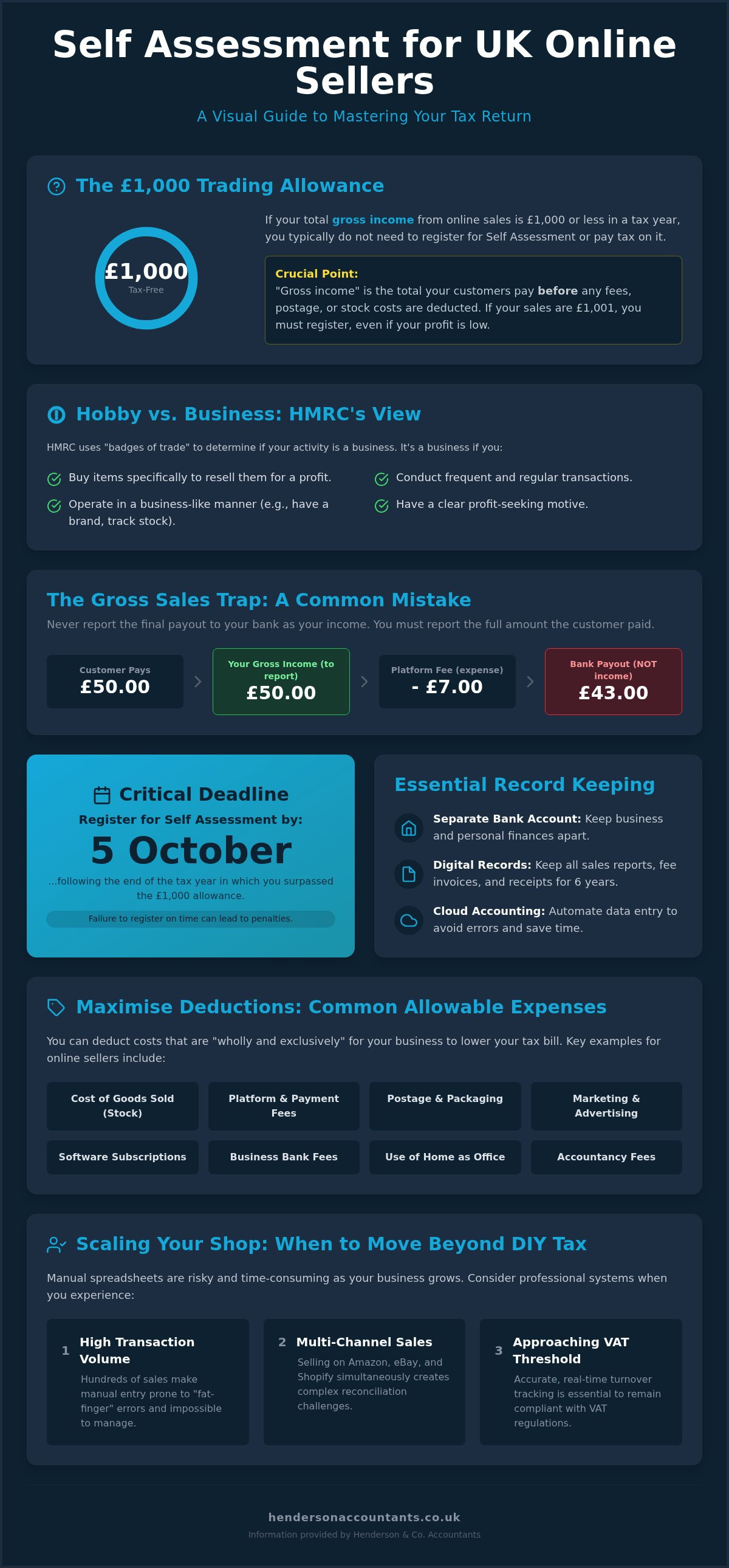
Starting an online shop often begins as a side project, but it quickly evolves into a serious venture. For the 2025/26 tax year, the £1,000 trading allowance remains your first point of reference. This allowance is a tax-free threshold designed for small amounts of income. If your total gross income from selling online is £1,000 or less, you usually don't need to register or pay tax on that money. However, the word "gross" is vital here. It refers to the total amount you receive from customers before you deduct platform fees, postage costs, or the price of your stock. If your sales hit £1,001, even if your actual profit is only £50, you must register for a sole trader tax return for online sellers uk.
Hobby vs. Hustle: Are You Actually a Business?
HMRC uses a set of criteria known as the "badges of trade" to determine if your activity is a business or just a hobby. If you're simply clearing out your wardrobe on Vinted or selling old books on eBay, you're likely a hobby seller. The situation changes when you buy items specifically to resell them for a profit. Frequent transactions, a profit-seeking motive, and the way you organise your sales all suggest you're running a business. By 2026, digital platforms are required to share seller data directly with HMRC, so it's best to be transparent from the start. Transitioning from a casual seller to a registered trader brings clarity to your finances and ensures you're playing by the rules.
The Consequences of Missing the Registration Deadline
If your gross income exceeds the £1,000 threshold, you need to enter the UK Self Assessment tax system. The deadline to register as a sole trader is 5 October following the end of the tax year in which you started trading. For the 2025/26 tax year, this means you must register by 5 October 2026. Failing to notify HMRC by this date can result in penalties, often calculated as a percentage of the tax you owe. If you're unsure about your status, checking early prevents the stress of a last-minute scramble. Registering on time is the first step toward building a stable foundation for your digital brand, allowing you to focus on growth rather than worrying about compliance letters.
Organising Your eCommerce Records: From Platforms to Profits
Managing an online shop means dealing with hundreds, or even thousands, of tiny transactions. Unlike a traditional consultant who might send one invoice a month, an eCommerce seller has data pouring in from Amazon, eBay, and Shopify. Digital record-keeping isn't just a good idea; it's a necessity for staying sane and compliant. It's the only way to ensure your figures are accurate when the time comes for your sole trader tax return for online sellers uk.
Start by opening a dedicated business bank account. Mixing your personal grocery shopping with your stock purchases makes it impossible to track your true profit. HMRC requires you to keep your business records for at least six years, so having a clean, digital trail is essential. This organised approach simplifies the process of filing your Self Assessment tax return and provides a safety net should HMRC ever request a review of your finances.
The "Gross Sales" Trap: Reconciling Payouts and Fees
A common mistake is reporting the "payout" amount that hits your bank account as your total income. If a customer pays £50 for a product but the platform takes £7 in fees and you receive £43, your gross income is £50. You must report the full £50 and then claim the £7 as an allowable expense. This distinction is vital because it affects your total turnover and your proximity to the VAT registration threshold. You also need to track refunds and chargebacks carefully. These should be recorded as a reduction in your sales or as a separate expense to ensure you don't pay tax on money you've already returned to customers.
Automating the Boredom: Why Cloud Accounting Wins
Manual spreadsheets are the enemy of growth. They're prone to "fat-finger" errors and quickly become outdated as your order volume increases. Cloud accounting software like Xero changes the game by fetching data directly from your sales platforms and bank feeds. This automation reconciles your multi-channel sales in real-time, giving you a clear picture of your margins without the manual data entry. If you're feeling overwhelmed by the volume of transactions, our team can help with eCommerce accounting to get your systems running smoothly. This proactive approach turns tax season from a month-long headache into a simple, organised process that supports your business growth.
Allowable Expenses for Online Sellers: Maximising Your Deductions
One of the most rewarding parts of preparing your sole trader tax return for online sellers uk is identifying the costs that reduce your taxable profit. HMRC allows you to deduct Allowable business expenses from your turnover, provided they are incurred "wholly and exclusively" for your trade. This means if you buy a thermal label printer solely for shipping orders, the entire cost is deductible. If a cost has a dual purpose, such as your home broadband or a mobile phone used for both business and personal calls, you must calculate a reasonable percentage to claim for the business side of things.
You have two main ways to calculate these costs. You can either track every single receipt for actual expenses or use "simplified expenses" (flat rates) for certain items like vehicles or working from home. For many high-volume sellers, actual costs often provide a larger deduction, but simplified expenses can save a significant amount of time during your monthly bookkeeping. Choosing the right method depends on your specific setup and how much time you can dedicate to record-keeping.
Home Office and Warehouse Costs
Most online sellers start at the kitchen table or in a spare room. You can claim a portion of your rent, mortgage interest, and council tax based on the number of rooms in your house and the time you spend working. If you're storing stock in a garage or a dedicated warehouse space, these costs are also deductible. Don't forget the physical materials that keep your business moving; packaging tape, cardboard boxes, and bubble wrap are all essential eCommerce expenses that quickly add up over a year. Keeping these receipts organised ensures you don't miss out on valuable deductions.
Digital and Marketing Overheads
In the digital space, your "shop front" is often a collection of software subscriptions. These are frequently overlooked in generic tax guides but are vital for a modern eCommerce business. You can claim for:
- E-commerce platform fees like Shopify or Etsy subscriptions.
- Cloud accounting software such as Xero to manage your finances.
- Creative tools like Canva for social media graphics.
- Digital marketing spend, including Facebook Ads, Google PPC, and Amazon Sponsored Products.
Even your website hosting and domain registration fees are allowable. By keeping a meticulous record of these digital overheads, you ensure you aren't paying more tax than necessary. This level of detail ensures your sole trader tax return for online sellers uk is as efficient as possible whilst keeping you fully compliant with HMRC regulations.
Step-by-Step: Filing Your Self Assessment Tax Return
Once you've organised your records and calculated your expenses, the final step is the actual submission. Filing your sole trader tax return for online sellers uk is the final hurdle in your annual financial cycle. You'll need more than just your Shopify or Amazon reports to complete this accurately. HMRC's system requires the main SA100 form plus the SA103 supplementary pages specifically for self-employment. This is where you'll report your gross turnover and your allowable expenses to arrive at your taxable profit.
If you've balanced your online business with a day job, you must include your P60 details to show the tax you've already paid through PAYE. Don't forget to gather interest statements from your savings accounts too. The system will then calculate your total tax bill and your Class 4 National Insurance contributions, which are 6% on profits between £12,570 and £50,270 for the 2026/27 tax year. If you are ready to move beyond DIY and want professional support, our eCommerce accounting services provide the peace of mind you need.
Deadlines You Cannot Afford to Miss
The hard deadline for online filing and paying your tax bill is midnight on 31 January. Missing this date results in an immediate £100 fine, even if you have no tax to pay. A major trap for growing sellers is the "Payment on Account" system. If your tax bill exceeds £1,000, HMRC usually requires you to pay half of your estimated next year's tax upfront. This can make your first major tax bill 50% higher than expected. Setting aside 25% to 30% of your monthly profit throughout the year is the best way to avoid this "tax shock" in January.
Common Errors to Avoid Before You Press Submit
Mistakes on a sole trader tax return for online sellers uk can lead to HMRC enquiries. A frequent error is forgetting to include "other income," such as dividends from shares or profit from a rental property. You also need to be careful with capital allowances. Large purchases like laptops or warehouse shelving are treated differently than everyday stock; they are capital items that must be claimed through specific sections of the return. Finally, double-check your figures to ensure you haven't double-counted expenses, such as claiming for a platform fee that was already deducted from your gross sales figure in your bookkeeping software.
Scaling Your Online Shop: When to Move Beyond DIY Tax
Success in eCommerce brings its own set of challenges. What started as a manageable side hustle can quickly turn into a complex operation involving multi-channel sales and international shipping. If you find yourself spending more time wrestling with platform data than sourcing new products, it's a clear sign you've outgrown a manual spreadsheet. Managing a sole trader tax return for online sellers uk becomes significantly more difficult when you're balancing currency conversions, marketplace withholdings, and high transaction volumes.
Strategic growth requires more than just keeping up with HMRC. As your turnover approaches the £90,000 VAT registration threshold, the complexity of your reporting increases. This is often the point where many sellers consider transitioning from a sole trader to a limited company structure. A limited company can offer better tax planning opportunities and provides a layer of legal protection for your personal assets. An eCommerce accountant helps you navigate these transitions, ensuring your business structure supports your long-term goals rather than hindering them.
Strategic Finance: More Than Just Compliance
Moving beyond basic bookkeeping allows you to use your financial data as a tool for growth. Management accounts provide a deep dive into your margins, helping you identify which products are your true profit drivers and which ones are being eaten alive by platform fees. By leveraging Xero and its automated integrations, you get real-time visibility of your business health. This allows you to make informed decisions about stock investment and marketing spend based on actual cash flow rather than guesswork. For many scaling brands, having access to an outsourced finance director provides the high-level expertise needed to navigate rapid expansion without the cost of a full-time hire.
How Henderson & Co. Supports Your eCommerce Journey
We understand the specific hurdles of modern entrepreneurship because we live and breathe eCommerce accounting. As Xero Platinum partners, we specialise in multi-channel sales reconciliation and proactive support for digital brands. We don't just file your returns; we help you build a stable foundation for success. Our team takes the stress out of HMRC deadlines and complex VAT rules, giving you back the time to focus on what you do best: growing your shop. If you're ready to replace tax anxiety with calm control, you can Organise your eCommerce accounting with Henderson & Co. today. We act as your collaborative ally, ensuring your digital finances are always as streamlined as your storefront.
Future-Proof Your Online Business
Mastering your finances starts with understanding your obligations. From staying within the £1,000 trading allowance to tracking every digital receipt, you now have the tools to manage your records with confidence. By identifying eCommerce-specific allowable expenses and following a clear filing process, you can ensure your next sole trader tax return for online sellers uk is both accurate and tax-efficient.
Tax season doesn't have to be a source of anxiety. As your shop grows, moving from manual spreadsheets to automated systems like Xero provides the clarity you need to scale. At Henderson & Co., we are Xero Platinum Partners with specialised eCommerce knowledge. We pride ourselves on providing supportive, plain-English advice that helps you focus on sales rather than paperwork. If you're ready to swap confusion for calm control, book a consultation with our eCommerce accounting specialists today. You've built something great; let's make sure your finances are just as strong.
Frequently Asked Questions
Do I need to pay tax if I only sell on Vinted or eBay?
You only need to pay tax if your gross income from these sales exceeds the £1,000 trading allowance in a single tax year. Selling your own second-hand clothes or household items is typically not taxable. However, if you are buying items specifically to resell them for profit, HMRC considers this "trading." In this case, you must register for a sole trader tax return for online sellers uk once your total sales pass that £1,000 threshold.
What is the deadline for filing a sole trader tax return in 2026?
For the 2025/26 tax year, the hard deadline for online submission and paying your tax bill is midnight on 31 January 2027. If you prefer to file a paper return, the deadline is much earlier: 31 October 2026. You should also remember the registration deadline of 5 October 2026 if this is your first year of trading. Missing these dates leads to an immediate £100 penalty from HMRC, even if you owe no tax.
How much money should I set aside for tax as an online seller?
It is wise to set aside between 25% and 30% of your monthly profit to cover your eventual tax and National Insurance bill. This range usually covers the basic rate of income tax and Class 4 National Insurance contributions. Remember that if your tax bill is over £1,000, HMRC will also ask for "payments on account." This means your first January payment could be much larger than you originally anticipated, as it includes a payment for the following year.
Can I claim my home broadband as a business expense?
You can claim your home broadband as a business expense, but only the portion that relates to your business use. Since you likely use your internet for personal browsing too, you must calculate a fair percentage for your eCommerce activities. For example, if you use the internet for business 50% of the time, you can deduct half of your monthly bill. Keeping a simple log of your usage helps justify this claim to HMRC if they ever request evidence.
What is the difference between turnover and profit for my tax return?
Turnover is the total amount of money your business receives from sales before any costs are taken out. Profit is what remains after you have deducted all your allowable business expenses, such as stock costs, platform fees, and shipping. When completing your sole trader tax return for online sellers uk, HMRC asks for your turnover first, but you are only taxed on your final net profit figure. Understanding this helps you avoid the common trap of overpaying tax.
Do I need an accountant to file my Self Assessment?
You are not legally required to hire an accountant to file your Self Assessment, but many sellers find it invaluable for peace of mind. An accountant ensures you are claiming every allowable expense and helps you avoid costly errors that could trigger an HMRC enquiry. As your business grows and transactions increase, professional support saves you time and ensures your digital finances are fully compliant with the latest regulations, allowing you to focus on sourcing new products.
What happens if I make a mistake on my submitted tax return?
If you discover an error after submitting your return, you can usually amend it online within 12 months of the original filing deadline. For the 2025/26 tax year, you would have until 31 January 2028 to make changes. It is better to correct mistakes voluntarily than to wait for HMRC to find them. If the error resulted in underpaid tax, you will need to pay the difference plus any interest, but voluntary disclosure often reduces potential penalties.
How do I register as a sole trader with HMRC?
You can register as a sole trader through the official GOV.UK website by setting up a Government Gateway account. Once registered, HMRC will send you a ten-digit Unique Taxpayer Reference (UTR) number in the post. You need this UTR to file your tax returns and manage your business tax affairs. You must register by 5 October in your business's second tax year to avoid "failure to notify" penalties, which can be significant if you have unpaid tax.


