

For most sellers, preparing annual accounts for ecommerce business isn't just a simple filing task; it's a massive data-reconciliation project that finally reveals your true margins. We know the pressure of staring at thousands of tiny transactions from Shopify or Amazon, wondering if they'll ever truly match your bank feed. It's completely natural to feel a sense of dread about whether your inventory figures are skewing your profit or if a small oversight might lead to an HMRC penalty.
You deserve to feel in control of your numbers rather than buried by them. This guide provides a comprehensive, data-driven checklist designed to help you master your year-end, ensuring your filings are accurate and your tax efficiency is maximised. We'll walk through everything from reconciling complex payment gateways to navigating the 2026 revenue recognition rules that align UK GAAP with international standards. By the end, you'll have a clear roadmap to turn a stressful deadline into a moment of clarity for your business growth.
Key Takeaways
- Audit your Xero setup to ensure bank feeds are accurate and consolidate multi-channel sales data from platforms like Shopify and Amazon.
- Learn how to reconcile payment gateways down to the penny, accounting for pending payments and transaction fees to ensure your records are flawless.
- Navigate your annual accounts for ecommerce business with confidence by aligning your quarterly VAT returns with your final turnover and identifying industry-specific allowable expenses.
- Transform your year-end from a statutory chore into a strategic tool by using your financial data to forecast cash flow and inform future growth.
Understanding Annual Accounts for eCommerce Businesses
Annual accounts are the formal record of your company's financial activities over a twelve-month period. For an online brand, this process is far more than just a box-ticking exercise for the taxman. It's a digital reconciliation of your entire operation. Unlike a local brick-and-mortar shop that handles a few dozen daily sales, your business likely generates a massive "digital paper trail" across Shopify, Amazon, eBay, and various payment gateways. Managing annual accounts for ecommerce business means capturing every one of those high-volume transactions accurately.
Understanding financial statements is the first step to mastering your year-end. Your annual accounts consist of three core components. The Balance Sheet shows what your business owns and owes at a specific moment. The Profit and Loss account (P&L) tracks your performance over the year. Finally, the Director’s Report provides a brief overview of the company’s state. Together, these documents tell the story of your brand's health and growth.
Statutory Filing Obligations for UK Online Sellers
As a UK limited company director, you have strict deadlines to meet. You must file your accounts with Companies House within nine months of your financial year-end. You also need to submit a CT600 Corporation Tax return to HMRC. It's important to know that since April 2026, the joint HMRC and Companies House filing service (CATO) has closed. You now need to file these separately using commercial software. Your submissions must also use iXBRL tagging. This is a digital format that allows regulators to process your financial data automatically and ensures you remain compliant with modern digital standards.
Why Standard Accounting Often Fails eCommerce Brands
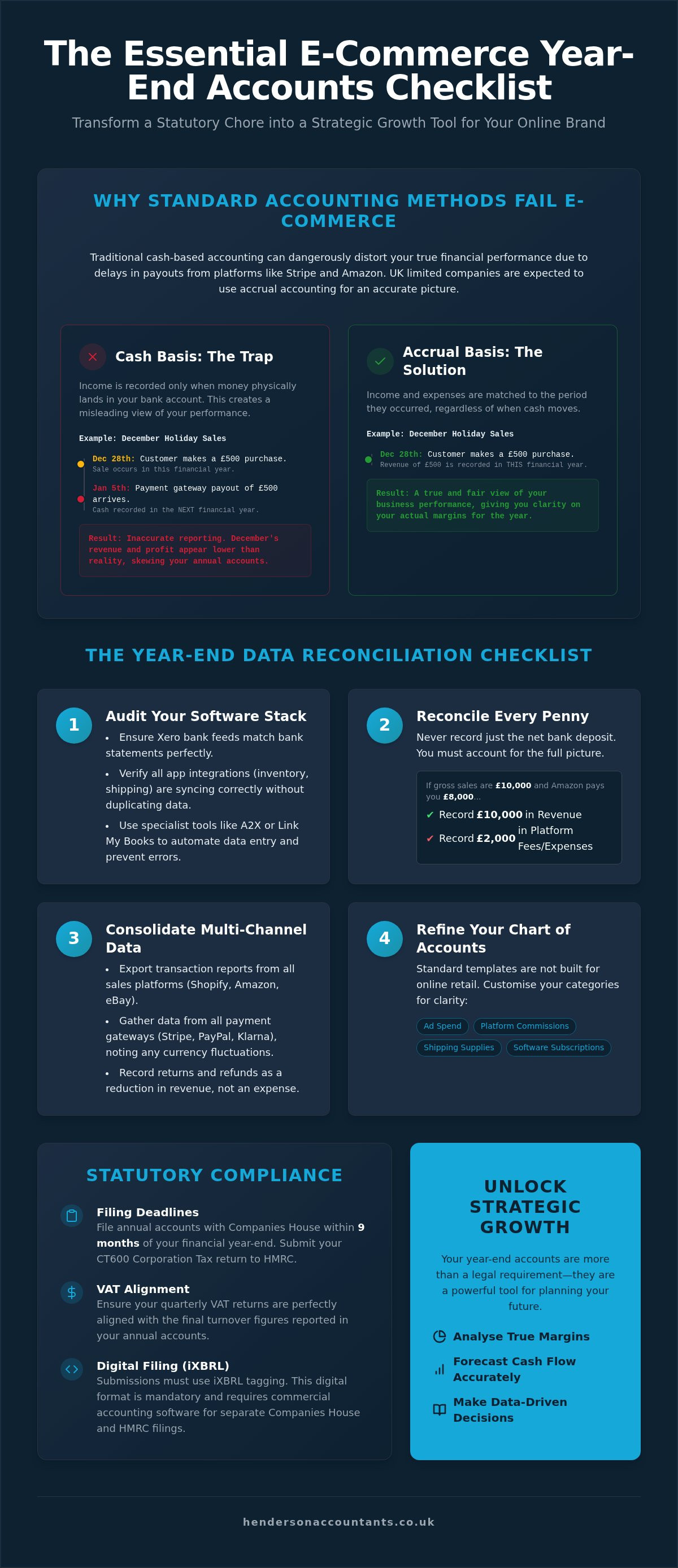
Traditional accounting methods often fall short for modern online sellers. Many small businesses start with "cash basis" accounting, where you only record income when the money hits your bank account. This can distort your true performance. Payouts from Stripe or Amazon often lag days or weeks behind the actual sale. If a big holiday rush happens at the end of your financial year, but the cash arrives in the next, your accounts won't reflect reality. HMRC expects limited companies to use accrual-based accounting to solve this. This method matches your income and expenses to the period they actually occurred, giving you a much clearer picture of your margins and true business value.
The eCommerce Year-End Checklist: Data and Software
Preparing your annual accounts for ecommerce business requires a systematic approach to your digital data. Because online sales happen 24/7 across multiple time zones, your software must be the "single source of truth." Your first task is to audit your Xero bank feeds. Ensure every transaction on your bank statement matches the ledger. If there's even a small discrepancy, it can snowball into a significant headache during the final filing process. You'll also need to verify that every digital app in your stack, from inventory tools to shipping software, is syncing correctly without duplicating entries.
Optimising Your Xero Cloud Accounting Setup
The most common mistake sellers make is recording only the "net" amount that hits their bank account. If Amazon pays you £8,000, but your gross sales were £10,000 before fees, your accounts are technically incorrect. We recommend using specialised integrations like A2X or Link My Books. These tools sit between your shop and Xero, breaking down every payout into gross sales, VAT, and platform fees. This level of detail is exactly what HMRC expects to see. If your current data feels like a tangled web, our Xero cloud accounting setup service can help you build a cleaner, more automated foundation for your year-end.
Consolidating Multi-Channel Sales Data
When you sell on Shopify, Amazon, and eBay simultaneously, consolidation becomes your biggest hurdle. You'll need to export transaction reports from every payment gateway, including Stripe, PayPal, and Klarna. This is particularly important for international sales where exchange rates can fluctuate. Whilst the UK has its own reporting standards, the logic of digital platform reporting is a global priority. You can see this reflected in resources like the IRS tax guide for digital platforms, which highlights the importance of precise payment reporting. Ensure your turnover figures accurately reflect returns and refunds; these should be recorded as a reduction in revenue rather than just another expense line.
Finally, take a moment to review your chart of accounts. Standard accounting templates aren't built for the nuances of online retail. You should have specific categories for things like "Ad Spend," "Platform Commissions," and "Shipping Supplies." Having these clearly defined makes it much easier to produce annual accounts for ecommerce business that actually help you understand your profitability. It turns your year-end from a chore into a moment of strategic insight.
Reconciling the Digital Paper Trail
Reconciling the digital paper trail is where the real work begins for your annual accounts for ecommerce business. It's the stage where you move from having raw data to having verified proof. Many sellers assume that if their bank balance matches their Xero feed, they're ready to file. However, for an online brand, your bank statement only shows the final chapter of the story. It doesn't show the gross sales, the refunds, or the transaction fees that were stripped away before the money ever reached you.
Payment Gateway and Bank Reconciliation
Reconciliation is the process of matching your internal financial records to external statements to ensure every penny is accounted for. To get this right, you must look beyond your high-street bank account and examine your gateway balances. If you have £1,200 sitting in your Stripe account on the last day of your financial year, that money is an asset that belongs on your Balance Sheet. It's income you've earned, even if the payout hasn't arrived yet.
Handling "pending" payments is particularly vital under the 2026 UK accounting standards. These rules require a strict five-step model for revenue recognition. You must ensure that sales are recorded when the customer receives the goods, not just when the payment is authorised. Use this checklist to keep your gateways in order:
- Match every payout to the corresponding sales invoices in your accounting software.
- Account for "pending" payments that are authorised but haven't settled by the year-end date.
- Record gateway fees as a separate expense line rather than just reducing your turnover.
- Verify that your closing balance in the gateway dashboard matches your internal ledger.
Inventory Valuation and Cost of Goods Sold
Inventory is often the largest asset on your Balance Sheet, but it's also where the biggest errors occur. Even for brands using third-party logistics (3PL), a physical stocktake at year-end is essential. You can't rely solely on a digital dashboard. Software doesn't always account for damaged items, obsolete stock, or items that have simply gone missing in the warehouse. Without an accurate count, your profit figures will be skewed.
Accurate inventory is the only way to calculate your Cost of Goods Sold (COGS). If your stock figures are wrong, your tax bill will be too. Use this standard formula to find your COGS:
Opening Stock + Purchases - Closing Stock = COGS
By subtracting your closing stock, you ensure you're only being taxed on the items you actually sold. This prevents your tax bill from being artificially inflated by stock still sitting on a shelf. Getting these figures right ensures your annual accounts for ecommerce business reflect your true gross profit and provide a solid foundation for your Corporation Tax return.
Navigating VAT and Statutory Tax Compliance
Compliance shouldn't feel like a guessing game. When preparing annual accounts for ecommerce business, your VAT records are often the first place HMRC looks for discrepancies. It's vital to ensure that the figures reported in your four quarterly returns match the final turnover shown in your year-end statements. Any mismatch here can trigger an enquiry, so taking the time to cross-reference your data now saves significant stress later.
Reconciling VAT Returns with Annual Turnover
Your total VATable sales must align perfectly with your statutory accounts. A common error for online sellers is failing to account for platform fees. If a marketplace deducts a 15% commission before paying you, your VAT return must still reflect the gross sale price, not the net amount that landed in your bank. International sales add another layer of complexity. If you're using the Import One Stop Shop (IOSS) for EU orders, these must be clearly separated from your UK taxable turnover. Since the VAT registration threshold remains at £90,000 as of April 2026, staying on top of these figures is essential to avoid late registration penalties.
Identifying Allowable Expenses for Digital Brands
Maximising your tax efficiency means claiming every legitimate cost associated with running your shop. Digital brands have unique overheads that are easily overlooked. This includes Shopify app subscriptions, Amazon storage fees, and even a portion of your home utility bills if you manage the business from a home office. You must keep digital receipts for all these costs in a Xero-compatible format to remain compliant with HMRC standards. Ensuring every "ad spend" invoice from Meta or Google is correctly recorded can significantly reduce your taxable profit.
For the 2026 financial year, your Corporation Tax rate depends on your success. If your profits are £50,000 or less, you'll benefit from the 19% small profits rate. However, if your profits exceed £250,000, the main rate of 25% applies. For anything in between, marginal relief is used to determine your effective rate. Staying ahead of these calculations is the best way to manage your cash flow. If you want to ensure your filings are flawless, our VAT return preparation service provides the specialist oversight your brand needs.
Finally, remember that Making Tax Digital (MTD) is now the standard for both VAT and Corporation Tax. HMRC requires iXBRL tagging for all digital submissions, meaning your accounting software must be fully integrated with their systems. By keeping your digital records updated throughout the year, the transition to annual accounts for ecommerce business becomes a streamlined, stress-free process.
Turning Your Year-End into a Strategic Growth Tool
Many business owners view their annual accounts for ecommerce business as a backward-looking chore. It's often seen as a final report card or a simple summary of what happened over the last twelve months. However, if you've done the work of reconciling your data as we've discussed, you now have a goldmine of information at your fingertips. This is the moment to pivot from compliance to strategy. Instead of just filing and forgetting, use these figures to build a robust 12-month cash flow forecast. Accurate year-end data allows you to predict when you'll need to reorder stock or when you have the surplus to invest in a new marketing channel.
From Compliance to Clarity with Management Accounts
Waiting twelve months for a financial health check is risky in the fast-paced world of online retail. This is where management accounts come in. By shifting to monthly or quarterly reporting, you can track vital eCommerce KPIs like Customer Acquisition Cost (CAC) and Lifetime Value (LTV) in real-time. This proactive approach prevents year-end shocks. It allows you to adjust your ad spend or inventory levels before small issues become big problems. If you're ready to move beyond basic bookkeeping, our Outsourced Finance Department solutions provide the regular oversight needed to stay ahead of the curve. It's about turning raw data into a competitive advantage.
The Role of an Outsourced Finance Director
As your brand scales, your financial needs change. You might be looking at a new funding round, an international expansion, or even an eventual exit. These milestones require a level of strategic insight that goes beyond standard accounting. An Outsourced Finance Director provides this high-level guidance without the overhead of a full-time salary. They help you interpret your annual accounts for ecommerce business to identify which products are truly profitable and where your cash is being tied up. They act as a proactive guide, helping you stay ahead of market trends and regulatory changes.
Scaling your finance department shouldn't be a source of anxiety. It's a sign of a healthy, growing business. Whether you need help with a Xero setup or high-level strategic advice, having the right partners ensures your foundation is stable. This allows you to focus on what you do best: building your brand and serving your customers. Speak to Henderson & Co. Accountants about our Outsourced Finance Director services to see how we can help you guide your next stage of growth with quiet confidence and clarity.
Take Control of Your Financial Future
Mastering your annual accounts for ecommerce business is about more than just avoiding HMRC penalties; it's about gaining total clarity over your brand's performance. By reconciling your payment gateways to the penny and aligning your VAT returns with your statutory turnover, you move from reactive bookkeeping to strategic financial management. This process transforms your year-end from a source of anxiety into a stable foundation for your next stage of growth.
We're here to help you navigate these complexities with ease. As a Xero Silver Partner with specialist eCommerce knowledge, we offer the technical expertise and strategic Outsourced FD support your business deserves. We focus on demystifying the numbers so you can focus on scaling your shop. Book a discovery call with our eCommerce accounting specialists to ensure your next filing is accurate, efficient, and stress-free. You've worked hard to build your brand. Now, let's make sure your financial records reflect its true potential.
Frequently Asked Questions
What are the deadlines for filing eCommerce annual accounts in the UK?
For existing UK companies, the deadline for filing annual accounts with Companies House is nine months after the end of your financial year. If you've just incorporated, your first accounts are due 21 months from the date of incorporation. You must also file your Corporation Tax return within 12 months of your year-end, although the tax itself is usually payable nine months and one day after the period ends.
Can I file my own annual accounts for a limited company?
You're legally allowed to file your own accounts as a director, but it's rarely recommended for online brands. Managing annual accounts for ecommerce business involves complex data reconciliation and specific iXBRL digital tagging requirements. Since the joint HMRC and Companies House filing service closed in April 2026, you now need commercial software to submit these documents separately. Mistakes can lead to HMRC enquiries or overpaid tax, making professional oversight a safer investment.
Do I need to include my Amazon or Shopify fees in my annual accounts?
Yes, you must record every fee. Recording only the net payout you receive in your bank account is a common mistake that understates your true turnover. You need to account for gross sales and then list platform commissions, storage fees, and advertising costs as business expenses. This ensures your VAT reporting is accurate and that you're claiming all allowable costs to reduce your final Corporation Tax bill.
How does inventory affect my Corporation Tax bill?
Inventory is treated as an asset on your Balance Sheet rather than an immediate expense. When you buy stock, it doesn't reduce your profit until it's sold. Your Corporation Tax bill is based on your profit after deducting the Cost of Goods Sold (COGS). If your year-end stock count is too high because you haven't accounted for damaged or obsolete items, your profit will look higher, leading to an unnecessarily large tax bill.
What is the difference between annual accounts and a tax return?
Annual accounts are statutory financial statements that show your company's performance to Companies House and shareholders. They include your Balance Sheet and Profit and Loss account. A tax return, specifically the CT600, uses the information from these accounts to calculate exactly how much Corporation Tax you owe to HMRC. Whilst they're linked, they serve different purposes; one is for public record, and the other is for tax calculation.
Why should I use Xero for my eCommerce business accounts?
Xero is the ideal hub for online retail because it integrates seamlessly with platforms like Shopify and Amazon. By using tools like A2X, you can automate the flow of sales data and fees directly into your ledger. This reduces manual data entry and ensures your annual accounts for ecommerce business are based on real-time information. It also handles the iXBRL tagging required for modern UK statutory filings, keeping you fully compliant.
What happens if I miss the deadline for filing my annual accounts?
If you miss the Companies House deadline, you'll face automatic late filing penalties. These start at £150 for being one day late and can rise to £1,500 if you're more than six months overdue. These fines double if you're late two years in a row. HMRC also charges separate penalties for late tax returns and interest on any unpaid Corporation Tax, so it's vital to stay organised and file on time.
Can an eCommerce accountant help me save money on tax?
A specialist accountant identifies allowable expenses that generalists often miss, such as specific software subscriptions, international shipping costs, and home office allowances. We also help you manage your profit levels to take advantage of the 19% small profits rate or apply for marginal relief if your profits fall between £50,000 and £250,000. Strategic planning throughout the year ensures you aren't paying more tax than is legally required.


