

What if the monthly administrative routine draining your Friday afternoons isn't just stealing your time, but quietly exposing your business to severe HMRC fines? Juggling PAYE Real Time Information submissions alongside strict Construction Industry Scheme deadlines is an exhausting balancing act. Between verifying subcontractor tax statuses, calculating deduction statements, and untangling domestic reverse charge VAT, staying on top of payroll and cis management often feels like a continuous, stressful fight against the calendar.
You shouldn't have to run your business under the constant shadow of worker misclassification risks or surprise late penalties. In this complete compliance guide, you'll discover how to master both systems seamlessly whilst protecting your cash flow and eliminating costly reporting errors. We will examine how to establish an automated monthly payroll and CIS routine, verify subcontractors effortlessly, and build a calm, reliable finance workflow that keeps your company fully protected.
Key Takeaways
- Learn how integrating statutory PAYE submissions with Construction Industry Scheme rules establishes reliable payroll and cis management that eliminates filing penalties.
- Discover straightforward verification routines that guarantee you apply the exact HMRC deduction rate every time, protecting both your cash flow and subcontractor trust.
- Identify the core operational differences between payroll staff and CIS subcontractors to avoid the severe retrospective fines linked to worker misclassification.
- Implement a repeatable five-step monthly workflow that streamlines site onboarding, payment deduction statements, and domestic reverse charge VAT reconciliations.
- Explore how partnering with dedicated cloud finance specialists removes administrative friction and frees up valuable commercial focus across your projects.
Understanding Payroll and CIS Management: Core Responsibilities and Legal Framework
Operating a construction or contracting business across the UK requires handling two distinct tax mechanisms simultaneously. Unifying these obligations into a structured routine for payroll and cis management gives you complete control over labour compliance. Instead of viewing office staff salaries and site trade invoices as disconnected tasks, treat them as two halves of a single operational framework. This unified perspective protects your company from statutory breaches whilst ensuring your commercial reporting remains completely clear.
Your business carries strict duties under HM Revenue and Customs (HMRC). You must calculate accurate Income Tax and National Insurance Contributions (NICs) for direct employees, alongside verifying and deducting proper withholding tax for self-employed site operatives. Failing to manage these systems accurately leads to severe trouble. HMRC enforces immediate £100 late-filing penalties for missed CIS returns, which quickly escalate to percentage-based fines on overall deductions. For subcontractors relying on Gross Payment Status, repeated compliance failures can lead to HMRC revoking that status entirely, severely disrupting cash flow across active contracts.
The Scope of the Construction Industry Scheme (CIS)
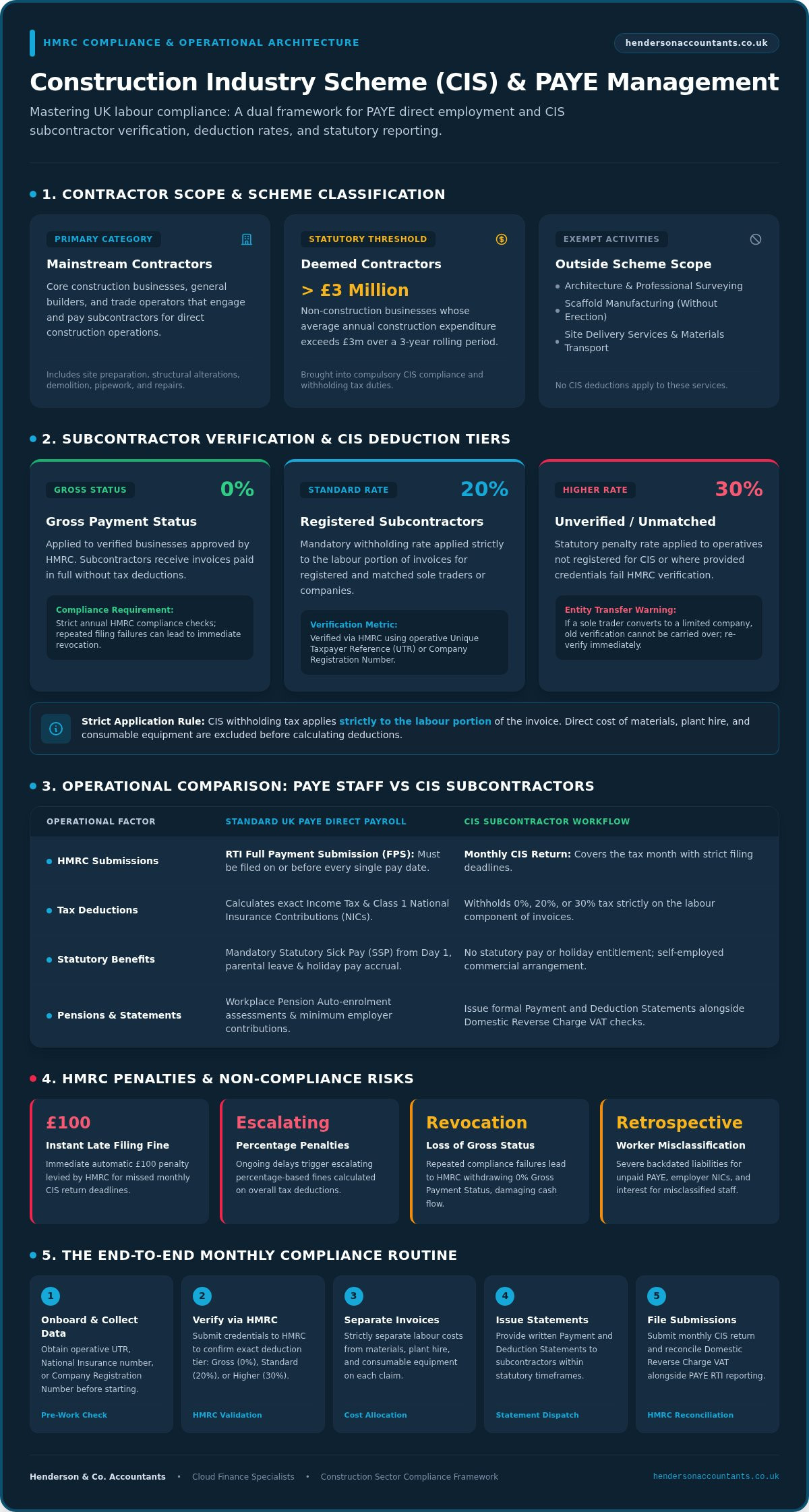
The Construction Industry Scheme governs payments made to subcontractors for construction operations. This legislation encompasses core building activities, including site preparation, structural alterations, demolition, pipework installation, and repairs. UK law divides businesses into two main categories:
- Mainstream contractors: Construction businesses, builders, and trades that pay subcontractors for construction work.
- Deemed contractors: Non-construction businesses whose average annual construction expenditure exceeds £3 million over a three-year rolling period.
Certain activities remain outside the scheme. Architecture, surveying, scaffold manufacturing without erection, and site delivery services do not require CIS deductions.
Employer Obligations Under Standard UK PAYE Payroll
Permanent internal staff fall under the statutory UK Pay-as-you-earn (PAYE) system. This framework mandates submitting Real Time Information (RTI) Full Payment Submissions to HMRC on or before every single pay date. Missing this timing window triggers instant compliance notices and late reporting fees.
Employers must also manage workplace pension auto-enrolment duties. You must assess staff eligibility, issue formal communications, and pay minimum employer contributions on time. Additionally, your payroll system must track statutory pay entitlements, calculating Statutory Sick Pay (SSP) from day one alongside complex calculations for parental leave and accrued holiday pay. Integrating these routines alongside proactive payroll and cis management provides a solid foundation for sustainable growth across the UK.
Navigating the Construction Industry Scheme: Verification, Deductions, and Returns
Mastering site compliance hinges on verified data and strict calendar discipline. Before paying a single invoice, contractors must verify every operative to avoid under-deducting tax. Treating verification as an essential checkpoint keeps your business protected and avoids unexpected liabilities during your routine payroll and cis management.
The Subcontractor Verification Process and Deduction Tiers
Before work begins on site, collect the subcontractor's Unique Taxpayer Reference (UTR), National Insurance number, or Company Registration Number. Verifying these details directly via HMRC confirms the exact deduction tier to apply strictly to their labour costs:
- Gross Payment Status (0%): Paid in full without tax deductions.
- Standard Rate (20%): Applied to registered subcontractors and businesses.
- Higher Rate (30%): Mandatory for unverified or unmatched trades.
If an operative shifts from a sole trader structure to a limited company, you must re-verify the new legal entity immediately. Old verification numbers cannot be carried over.
Filing Monthly CIS Returns and Supplying Payment Statements
The CIS tax month runs from the 6th to the 5th of the following month. You must submit your return to HMRC by the 19th. Contractors must file every single month, which means submitting a nil return even when no subcontractor payments took place, unless HMRC has formally granted an inactivity period.
You must also provide written Payment and Deduction Statements to all deducted subcontractors by the 19th. Filing even one day late triggers an automatic £100 penalty, climbing to £200 at two months, followed by severe tax-geared charges at six and twelve months.
Integrating Domestic Reverse Charge VAT with CIS Invoicing
Domestic reverse charge VAT applies to standard and reduced-rate CIS services between VAT-registered businesses. The rule shifts VAT reporting: the subcontractor does not charge or collect output VAT. Instead, you report both the input and output VAT on your company's own VAT return.
Invoices must clearly display the subcontractor's VAT number and state that the reverse charge applies. Calculate CIS deductions purely on the net labour figure, excluding materials and before VAT calculations. Setting up an integrated workflow prevents costly VAT reporting errors. Relying on an experienced team for your ongoing payroll and cis management ensures reverse charge invoices reconcile smoothly against your monthly subcontractor ledger.
The Operational Differences Between Standard PAYE Payroll and CIS Subcontractor Payments
Managing direct payroll alongside trade subcontractors requires a clear operational divide. A unified routine for payroll and cis management helps you separate employment rights from contracted services. Treating these distinct labour pools identically creates severe compliance risks, especially when navigating tax liabilities and employment status.
Worker Status Determination: Employee or Subcontractor?
HMRC judges working status on daily operational facts rather than contract wording alone. Three foundational tests govern this assessment:
- Control: Does your site management dictate exact working hours, direct daily methods, and actively supervise tasks?
- Substitution: Can the operative send a qualified replacement to finish the work without your permission?
- Mutuality of obligation: Are you required to offer continuous work, and is the operative obliged to take it?
Misclassifying a genuine employee as a self-employed CIS subcontractor exposes your business to retrospective tax liabilities, unpaid employer National Insurance, and backdated holiday pay. For medium and large commercial firms, off-payroll working rules also require formal Status Determination Statements to be issued across the entire supply chain.
Contrasting Submission Deadlines, Liabilities, and Record-Keeping
The operational cadence for payroll and CIS runs on very different schedules and cost structures. PAYE requires an RTI Full Payment Submission on or before every staff payday. Employers must also pay Class 1 Employer National Insurance at 15% on earnings above the £5,000 Secondary Threshold, offset by the £10,500 Employment Allowance for eligible businesses. In addition, you must manage auto-enrolment pension contributions and paid statutory leave.
In contrast, CIS operations involve no employer pension or National Insurance contributions. You act simply as HMRC's tax collector by withholding the verified percentage from labour costs, which you then report and remit by the 19th following each tax month. Both branches demand strict documentation. Keep all timesheets, payslips, domestic reverse charge VAT invoices, and Subcontractor Payment and Deduction Statements safely filed for at least three to six years to satisfy statutory compliance checks.
Step-by-Step Implementation: Establishing a Robust Payroll and CIS Workflow
A reliable compliance routine relies on structured habits rather than last-minute administrative scrambles. Connecting your field operations directly to modern cloud platforms like Xero transforms chaotic month-ends into a smooth, repeatable cycle. By following a clear five-step operational blueprint, you can run your payroll and cis management with absolute confidence.
Step 1 & Step 2: Structured Onboarding and HMRC Verification
Never permit an operative or new staff member onto a job site without completed onboarding paperwork. Standardise this intake with a simple digital portal that captures banking details, National Insurance numbers, and Unique Taxpayer References upfront.
Verify subcontractors immediately against HMRC records before processing an initial invoice. Once confirmed, record their verification reference number and deduction tier directly inside your cloud accounting platform. Having this audit trail stored centrally protects you if HMRC ever reviews your historical payments.
Step 3 & Step 4: Digital Approval Cycles and Automated Deductions
Replace paper timesheets with centralised digital logs that site managers must review and sign off each week. Once approved, push the data directly into your accounting software. Modern cloud setups automatically separate net labour from materials, eliminating human error on deduction calculations.
Produce itemised payslips for permanent employees alongside formal Payment and Deduction Statements for subcontractors at the point of payment. Distributing these records digitally keeps trades informed and prevents disputed figures later in the month.
Step 5: Month-End HMRC Submissions and Bank Reconciliations
File your payroll RTI data on or before pay day, and transmit your monthly CIS return well ahead of the 19th deadline. Complete the cycle by carrying out these essential closing tasks:
- Reconcile actual bank payments against your payroll clearing and CIS control accounts.
- Audit supplier statements to confirm all domestic reverse charge VAT invoices balance correctly.
- Schedule your PAYE and CIS liability settlements to HMRC before the payment window closes.
Running quarterly internal spot-checks ensures small bookkeeping discrepancies don't quietly snowball into systemic compliance failures. If you want to replace manual paperwork with an automated, stress-free workflow, partner with the finance specialists at Henderson & Co. Accountants to manage your complete payroll and subcontractor operations.
Strategic Advantages of Outsourcing Payroll and CIS Management to Modern Cloud Specialists
Managing wages and subcontractor payments internally often appears cost-effective on paper, but the hidden drain on leadership hours tells another story. Handling calculation updates, verifying new site operatives, and reconciling reverse charge VAT consumes valuable management energy. Transitioning your payroll and cis management to dedicated accounting professionals turns a recurring administrative distraction into a streamlined commercial advantage.
Eliminating Administrative Burden and Mitigating Compliance Risk
Handing off manual data entry frees your senior team to focus on project delivery and business growth. Rather than spending evenings cross-checking spreadsheets, you gain the reassurance that statutory submissions are prepared and verified by experts. Qualified specialists keep your business aligned with complex legislation, completely shielding your operations from the late penalties and tribunal risks that trap unassisted contractors.
Harnessing Real-Time Financial Visibility Through Cloud Accounting
Modern outsourcing goes far beyond filing monthly forms. When your payroll and subcontractor records live inside an integrated cloud ecosystem like Xero, bookkeeping and project data align automatically. This connected approach unlocks powerful commercial clarity:
- Accurate labour cost breakdowns across ongoing projects and specific job sites.
- Reliable cash flow forecasting that accurately predicts tax liabilities weeks before they fall due.
- Clear financial data to price future tenders competitively whilst protecting healthy profit margins.
As your company wins larger contracts, an outsourced model scales smoothly alongside your project pipeline. You gain all the capabilities of an advanced finance department without the substantial overheads of hiring, training, and managing internal administrative staff.
Partnering with Henderson & Co. Accountants for Complete Peace of Mind
At Henderson & Co. Accountants, we provide comprehensive payroll and CIS management as part of our full outsourced finance department solutions. We believe financial management should feel calm, transparent, and completely under control. Our proactive team pairs specialist expertise in Xero workflows with approachable, jargon-free advice that removes compliance stress entirely.
Whether you need to streamline regular PAYE runs, automate subcontractor verifications, or unify your day-to-day bookkeeping, we serve as your trusted commercial ally nationwide. Contact Henderson & Co. Accountants to discover how modern financial management can transform your operations.
Transform Your Monthly Payroll and CIS Routine
Managing site operatives alongside permanent staff doesn't have to mean constant deadline anxiety or administrative overload. By establishing structured digital onboarding, verifying workers immediately, and syncing your submissions through cloud tools like Xero, you protect project margins and eliminate costly HMRC penalties. A unified compliance system gives you total clarity over your true labour costs.
You don't need to tackle complex UK tax rules alone. Bringing expert support into your corner ensures flawless statutory compliance whilst freeing your team to focus on winning and delivering profitable work. With specialised workflows and complete outsourced finance department solutions, our proactive advisors are ready to support your business nationwide. Partner with Henderson & Co. Accountants for seamless payroll and CIS management, and build a calm, reliable foundation for long-term growth.
Frequently Asked Questions
What is the primary difference between standard PAYE payroll and CIS management?
PAYE payroll handles direct, salaried employees, requiring income tax, employee National Insurance, and employer Class 1 NICs alongside statutory benefits. CIS management applies exclusively to self-employed subcontractors performing construction operations. Under CIS, you withhold an advance tax deduction from net labour costs without incurring employer NICs, pension contributions, or holiday pay entitlements. Managing both requires distinct workflows to preserve compliance across different employment statuses.
What happens if our business submits a monthly CIS return past the HMRC deadline?
Submitting a CIS return after the 19th incurs an immediate £100 late filing penalty from HMRC. If the return remains unfiled after two months, the fine increases by another £200. At six and twelve months, HMRC levies tax-geared penalties amounting to the greater of £300 or 5% of the total deductions. Nil returns also face these automatic fines unless you submit an inactivity notification in advance.
Do business owners need to verify subcontractors with HMRC every single tax year?
No, you don't need to re-verify subcontractors annually if you have included them on a CIS return during the current or previous two tax years. However, you must verify operatives immediately if they are new, have had a two-year payment gap, or change their trading entity, such as transitioning from a sole trader to a limited company. Regular checks protect your business from applying outdated deduction rates.
Can an individual worker be paid via PAYE and CIS within the same business?
Yes, but this dual arrangement attracts intense scrutiny from HMRC and requires strictly distinct roles. An individual might work part-time as an employed site manager under PAYE whilst providing separate, genuinely independent specialist trade services under CIS contracts. You must maintain separate contracts, track independent timesheets, and demonstrate clear boundaries to prove the subcontractor work isn't disguised employment subject to full employer taxes.
How does domestic reverse charge VAT impact subcontractor payments under CIS?
Domestic reverse charge VAT changes how VAT is accounted for on standard and reduced-rate construction services between VAT-registered firms. The subcontractor no longer receives VAT from you. Instead, you record both the input and output VAT directly on your company's own VAT return. CIS deductions are then calculated strictly on the net labour total, ensuring tax withholding and VAT accounting remain completely accurate and isolated.
What records must contractors retain regarding CIS deductions and employee payroll?
Contractors must keep comprehensive payroll and cis management records for at least three to six years to satisfy statutory HMRC compliance. For standard payroll, this includes gross pay, tax deductions, pension contributions, and leave records. For CIS, you must preserve verification numbers, subcontractor invoices detailing labour and materials separately, domestic reverse charge VAT records, bank payment confirmations, and copies of all monthly payment deduction statements issued.
Why should a growing UK firm outsource payroll and CIS management instead of using DIY software?
Dedicated software only handles calculations, leaving you solely responsible for legal interpretations, worker status disputes, and filing deadlines. Professional outsourced payroll and cis management from specialists like Henderson & Co. Accountants combines robust cloud tools with proactive commercial oversight. This approach removes administrative pressure, prevents expensive HMRC penalties, and ensures your payroll and subcontractor records integrate smoothly with your broader bookkeeping and company cash flow.


