
Seeing a sudden influx of upfront customer cash in your bank account can feel like pure profit, but it often masks a serious financial blind spot. Mastering the accounting for subscription box business operations requires a fundamentally different mindset, because cash collected upfront does not equal earned income until each box physically leaves the warehouse.
If you are struggling to reconcile multi-month customer prepayments against staggered dispatch dates, or scratching your head over HMRC's VAT rules on mixed curation boxes, you aren't alone. Between calculating accurate landed costs for bespoke packaging and trying to connect billing tools like Shopify or Cratejoy with Xero, recurring finances can quickly feel chaotic.
This guide will help you master recurring revenue recognition, navigate UK VAT complexities, and calculate precise unit economics to scale your subscription box business profitably. From deferred revenue liabilities to seamless automated cloud reconciliation, here is everything you need to build an orderly, resilient financial foundation.
Key Takeaways
- Separate cash flow from earned income by treating upfront customer prepayments as balance sheet liabilities until items are physically dispatched.
- Simplify the accounting for subscription box business operations by learning how HMRC treats mixed supplies containing both zero-rated and standard-rated products.
- Uncover true gross margins by building comprehensive landed cost calculations that capture bespoke packaging, kitting labour, and shipping fees alongside wholesale inventory.
- Streamline your month-end close by integrating subscription billing platforms directly with Xero to automate reconciliation and prevent cluttered ledgers.
- Build resilient financial forecasts by tracking unit economics, customer lifetime value, and churn rates to protect long-term profitability.
Understanding the Unique Accounting Complexities of Subscription Box Businesses
Running a subscription box brand creates an operational paradox. On your screen, automated billing platforms process recurring payments like clockwork. On the ground, physical pallets, custom packaging, and assembly lines dictate your actual delivery capacity. This collision of automated recurring commerce and tangible logistics makes robust accounting for subscription box business owners essential.
Traditional retailers receive payment and dispatch stock almost simultaneously. Subscription models disrupt this pattern entirely. When customers sign up for multi-month or annual plans, substantial cash flows directly into your bank account on day one. Treating this cash injection as immediate earned revenue is a dangerous trap. It creates an illusion of instant profit whilst ignoring the contractual obligation to procure, kit, and dispatch boxes for months to come.
The Dual Challenge: Recurring Revenue Meets Physical Inventory
Unlike pure digital software platforms that deliver intangible services via the cloud, physical subscription business models must balance automated billing against complex stock cycles. You often need to order inventory, print bespoke boxes, and pay freight charges months before assembling the final product. That requires diligent working capital management. Unearned upfront cash must remain protected on your balance sheet as a liability until items actually leave your dispatch facility.
Kitting adds another layer of accounting friction. A single monthly curation might combine:
- Three to six individual SKUs from independent suppliers
- Branded tissue wrap, custom inserts, and bespoke outer cartons
- Third-party assembly and packing labour
Without clear financial tracking, stock valuations easily become distorted, leaving you blind to your true unit profitability.
Why Standard eCommerce Accounting Models Fall Short
Off-the-shelf retail bookkeeping operates on an immediate transaction basis. A customer buys a jumper, the sale posts to the profit and loss ledger, and stock depletes instantly. Applying that simple model to recurring boxes will wreck your reporting accuracy.
Selling an upfront twelve-month plan under standard retail rules would artificially inflate your earnings in month one, followed by eleven months of misleading losses as you absorb packaging and dispatch costs. Proper accounting for subscription box business workflows demands tracking deferred revenue alongside subscriber churn, customer acquisition costs, and recurring unit economics. This clarity keeps your cash reserves intact and gives you the confidence to scale sustainably.
Managing Deferred Revenue and Revenue Recognition for Recurring Orders
When an annual subscriber pays upfront, that cash does not belong to your profit ledger yet. It represents unfulfilled work. Under UK accounting standards, recognising full annual receipts on day one violates the mandatory five-step framework aligned with IFRS 15 revenue recognition principles. That framework requires you to identify your performance obligations and recognise income only when goods are actually delivered. Doing this correctly forms the bedrock of accurate accounting for subscription box business models.
Cash Flow vs Earned Revenue: Monthly and Annual Billing
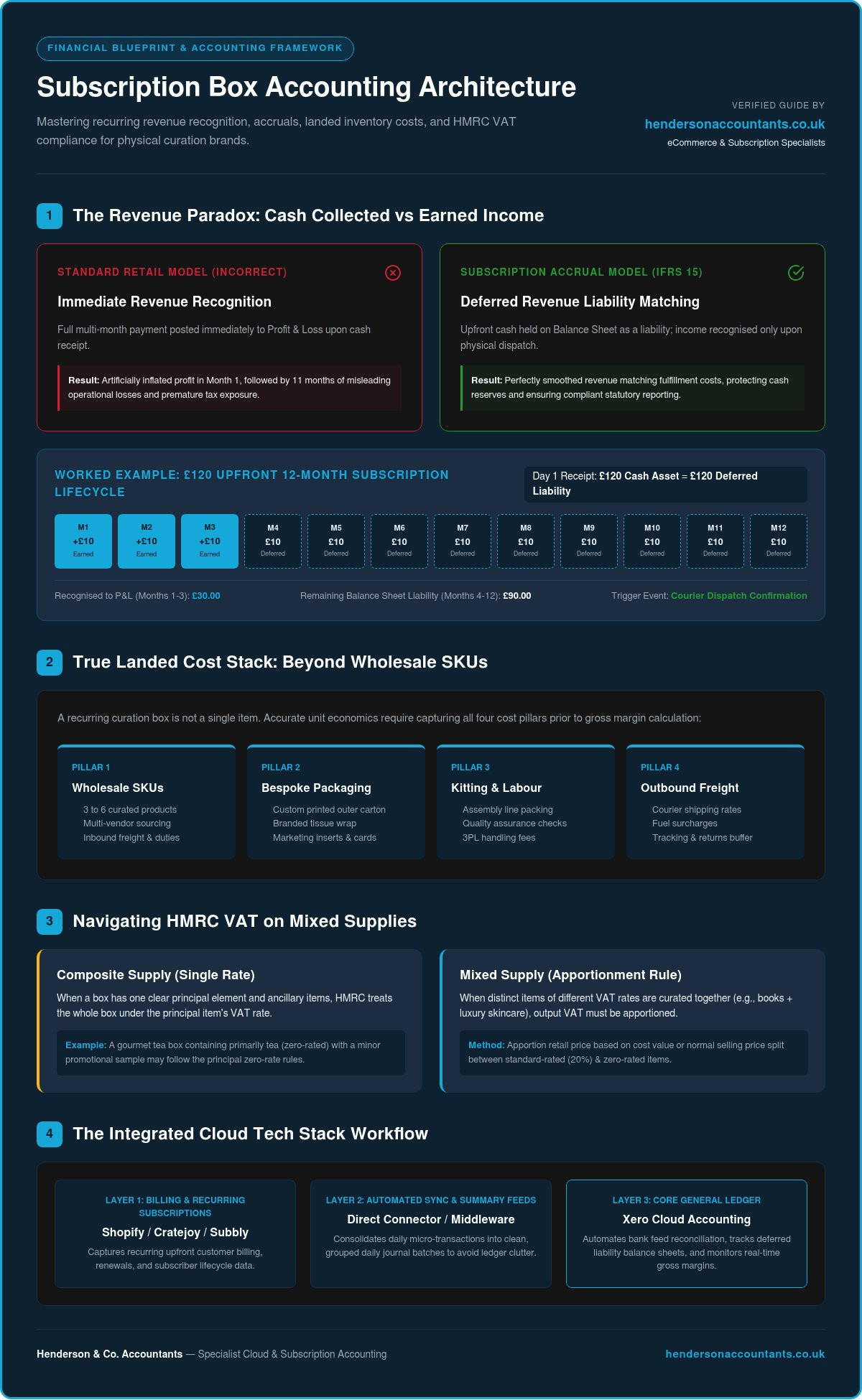
A healthy bank balance can easily masquerade as operational profit. Consider a customer who signs up for a twelve-month plan at £120. When that payment settles, your cash increases by £120, but so does your balance sheet liability under deferred revenue. You owe that customer twelve shipments. Each time a monthly crate is assembled and handed to the courier, you move £10 from deferred income into earned subscription revenue on your profit and loss statement. This matching principle prevents artificial profit spikes and protects you from paying premature corporation tax on unearned funds.
Step-by-Step Accrual Accounting for Subscription Fulfilment
Aligning digital subscriptions with physical dispatch dates requires a predictable monthly routine. To maintain clean books, follow this straightforward month-end process:
- Align billing with dispatch cut-offs: Match your billing engine's monthly payment batches directly with your warehouse dispatch schedules, separating renewals from unfulfilled pre-orders.
- Run deferred income schedules: Reconcile your deferred revenue liability balance against unfulfilled box obligations across all active customer tiers.
- Adjust for churn and pauses: Account for pro-rata refunds, cancellations, and paused memberships promptly to keep your unearned revenue liability ledger completely accurate.
Recognising revenue before physical fulfilment distorts your trading performance and leaves you vulnerable during audit checks or tax filings. If you want structured support implementing these journal schedules into your month-end routine, exploring bespoke eCommerce accounting will help keep your financial ledgers accurate and compliant as order volumes climb.
Navigating UK VAT and Indirect Tax on Curated Crate Products
Value Added Tax is easily the most misunderstood element of accounting for subscription box business founders. Many brands assume that because they operate an online shop, every box simply attracts the standard 20% rate. In reality, bundling different products into a single parcel triggers strict tax point rules that can significantly impact your bottom line.
If your curation contains zero-rated goods such as printed books, unbaked bakery goods, tea, or children's clothing alongside standard-rated lifestyle items, treating the entire package as standard-rated unnecessarily burns your margin. Conversely, failing to charge standard VAT on the non-qualifying elements creates severe historic tax liabilities and potential HMRC penalties once your taxable turnover hits the £90,000 threshold.
The Mixed-Supply Dilemma: Apportioning VAT on Curated Items
Under Section 19(4) of the Value Added Tax Act 1994, HMRC separates bundled transactions into single composite supplies and multiple supplies. A single composite supply occurs when one element forms the principal benefit, with minor items serving merely as ancillary extras. In that scenario, the entire box adopts the tax status of the principal item.
Most curated boxes, however, constitute multiple supplies because the subscriber values each component independently. Official HMRC guidance on multiple supplies and apportionment requires you to divide the retail price between the differing tax rates using a fair and justifiable method. The two standard approaches include:
- Cost apportionment: Calculating the ratio of wholesale purchase costs between zero-rated and standard-rated products, then applying that percentage split to your subscription price.
- Market value apportionment: Splitting the total box price based on the normal standalone retail selling prices of each included item.
Whichever method you choose, you must maintain auditable working papers documenting your calculations for every monthly edition.
Packaging, Delivery Charges, and International Subscriber Rules
Postage and bespoke packaging generally follow the overarching supply. For mixed crates, delivery fees must usually be apportioned across the zero-rated and standard-rated goods in the exact same proportion as the contents.
Shipping outside the UK introduces additional considerations. Parcels sent to overseas subscribers outside the UK and Isle of Man can generally be zero-rated for UK VAT, provided you retain commercial evidence of export from your freight forwarder or postal carrier. For subscribers in Northern Ireland, specific dual-market rules apply under the Windsor Framework, meaning sales of goods continue to follow EU VAT guidelines in select cross-border circumstances.
Key Financial Metrics and Cost of Goods Sold Tracking
Tracking profitability in a physical subscription model requires looking well beyond your supplier invoices. If you only count the wholesale price of the products inside your parcel, your margins will look healthier on paper than they ever will in your bank account. Rigorous accounting for subscription box business leaders demands a complete landed cost framework that links unit economics directly to real-world fulfilment workflows.
Calculating True Landed COGS for Kitted Assemblies
A curated delivery is a manufactured finished good, not a simple resale item. To determine your true Cost of Goods Sold (COGS), you need to capture every operational expense required to assemble a finished box ready for courier collection:
- Packaging consumables: Custom branded outer mailers, bespoke printed tissue paper, eco-friendly shred, branded tape, and product info cards.
- Assembly labour: In-house packing wages or third-party logistics (3PL) pick-and-pack fee structures charged per finished unit.
- Freight and duties: Inbound carriage, customs clearing fees, and port handling charges apportioned across batch units.
- Shrinkage and scrap: Damaged stock during packing runs, courier transit breakages, and surplus items left over from minimum order quantities.
Crucial Unit Economics: MRR, Churn, CAC, and LTV
Understanding these direct costs allows you to calculate reliable subscription metrics. Monthly Recurring Revenue (MRR) must reflect predictable subscription renewals, completely isolated from one-off shop sales. Customer Acquisition Cost (CAC) should be weighed against Lifetime Value (LTV) calculated on net gross margin, never top-line revenue. Research from Whistl shows UK consumers stay active with a physical subscription box for an average of 9 months, meaning a small miscalculation in your unit margin compounds significantly over that customer lifecycle.
You must also distinguish between voluntary churn (cancellations driven by disinterest) and involuntary churn. Involuntary churn happens when recurring payments fail due to expired payment cards or insufficient funds. Implementing automated card updater tools and dunning sequences rescues this revenue before it hits your balance sheet as lost subscriber count.
| Vanity Metric | Actionable Financial KPI | Why It Matters for Box Brands |
|---|---|---|
| Total Bank Cash Balance | Net Working Capital (Cash less Deferred Revenue) | Prevents spending unearned subscriber prepayments on operational overheads. |
| Top-line Revenue Growth | Gross Margin per Dispatched Unit | Confirms that higher subscriber numbers yield expanding, sustainable trading profits. |
| Blended Churn Rate | Involuntary vs Voluntary Churn Ratio | Pinpoints whether you are losing customers to marketing fatigue or fixable billing failures. |
Gaining visibility over these operational KPIs protects your working capital and gives you the leverage to scale marketing spend predictably. If you want strategic oversight across your margins and unit performance, partnering with an Outsourced Finance Director provides the proactive management reporting needed to steer your growth safely.
Building an Integrated Cloud Accounting Tech Stack with Xero
Relying on manual spreadsheets to record monthly recurring payments is an invitation to bookkeeping chaos. Every batch of subscriber renewals brings hundreds, or even thousands, of tiny micro-transactions. Pushing those orders individually into your sales ledger will quickly clog your accounting software and create reconciliation bottlenecks. Developing an automated, scalable approach to accounting for subscription box business growth requires a modern cloud infrastructure centred on Xero.
Connecting Platforms, Payment Gateways, and Core Ledgers
Modern eCommerce architectures rely on purpose-built connectors to bridge the gap between storefronts and double-entry ledgers. Instead of dumping every individual transaction into Xero, integration middleware creates consolidated daily summary invoices that match your operational reality:
- Platform synchronisation: Connect storefront billing tools like Shopify Subscriptions, Subbly, or Cratejoy directly to Xero to separate gross sales from returns and shipping income.
- Merchant fee separation: Route settlements from Stripe, PayPal, or GoCardless through dedicated clearing accounts, isolating processing fees automatically rather than recording net payouts as reduced gross revenue.
- Automated bank matching: Pair incoming gateway bank transfers against outstanding clearing balances in a single click, keeping your live bank feeds neat and balanced.
When to Partner with an eCommerce Finance Specialist
There comes a tipping point where juggling multi-rate VAT apportionments, inventory valuations, and deferred revenue schedules outgrows your internal capacity. Attempting to manage complex recurring ledgers alongside packaging logistics pulls focus away from customer acquisition and product curation.
Working with a dedicated eCommerce accounting firm replaces reactive, end-of-year tax scrambles with clear, proactive management reporting. A specialist team ensures your VAT return preparation remains compliant, your corporation tax obligations are planned well ahead of statutory deadlines, and your monthly numbers reflect true unit profitability. Whether you need an experienced partner to configure your cloud integrations or ongoing outsourced finance support to protect your margins, having specialist oversight provides the calm control required to scale sustainably.
Discover how our eCommerce accounting team can streamline your subscriptions and help you build a resilient, profitable recurring commerce model.
Take Control of Your Subscription Finances and Scale Confidently
Transforming your recurring crate concept into an enduring, profitable enterprise requires clear financial foundations. Sound accounting for subscription box business operations means moving past misleading bank balances. By properly isolating deferred revenue until monthly dispatch, apportioning mixed-rate UK VAT, and factoring full packaging expenses into your landed COGS, you gain the clarity needed to make bold commercial choices.
Henderson & Co. Accountants has supported founders nationwide since 2017 as a specialist UK eCommerce accounting practice. As certified Xero experts, our team streamlines your recurring multi-channel workflows, manages corporation tax, and prepares auditable VAT filings. Whether you need reliable bookkeeping or comprehensive outsourced finance director guidance, we replace compliance friction with structured, dependable systems.
Ready to build an orderly financial engine behind your brand? Speak with our specialist eCommerce accountants today and turn your subscriber growth into sustainable, predictable profit.
Frequently Asked Questions
How do I account for annual upfront payments in my subscription business?
You record upfront annual payments as deferred revenue liabilities on your balance sheet rather than immediate sales income. Under UK accounting standards, revenue is recognised only as performance obligations are satisfied upon physical dispatch of each monthly box. Post a regular monthly journal moving one-twelfth of the prepayment from deferred income into your earned sales ledger, ensuring clean reporting and preventing premature corporation tax liabilities.
Do I pay UK VAT on subscription boxes containing mixed items?
Yes, but you usually apportion the VAT rather than applying the standard 20% rate across the entire box. When your box combines standard-rated items with zero-rated goods like books or certain edible treats, HMRC treats the parcel as multiple supplies. You apportion the VAT based on either purchase costs or standalone selling prices, keeping detailed audit calculations to support your return.
Why does my Stripe payout not match the revenue in my bank account?
Your Stripe payouts differ from your recorded turnover because payment gateways deduct processing fees, customer refunds, and dispute reserves before transferring funds. If you record only net deposits, your gross revenue is understated and transaction fees remain untracked. Specialist accounting for subscription box business setups route sales through dedicated clearing accounts in Xero, automatically separating merchant fees from gross subscriber receipts.
When should a subscription box business register for UK VAT?
You must register for UK VAT once your rolling 12-month taxable turnover exceeds £90,000, or if you expect your turnover to surpass £90,000 in the next 30 days alone. Taxable turnover includes zero-rated items alongside standard-rated products. Subscription businesses often cross this threshold quickly due to multi-month advance payments, making regular turnover monitoring essential to avoid late penalties from HMRC.
What is the difference between MRR and total cash flow?
Monthly Recurring Revenue (MRR) measures the predictable subscription income earned in a given month, whereas cash flow tracks the actual movement of money through your bank account. A twelve-month advance payment creates an immediate cash influx, but only one-twelfth of that payment counts towards that month's MRR. Tracking both prevents founders from mistakenly spending unearned subscriber prepayments on day-to-day overheads.
How should I record damaged or unsold subscription box components?
You should write off damaged, broken, or obsolete inventory as a direct cost of goods sold expense. When leftover items or damaged components can no longer be kitted into future boxes, reclassify their value from your balance sheet stock account into an inventory write-off ledger. This keeps your asset valuations accurate and ensures you claim legitimate tax relief against your trading profits.
Can Xero handle recurring subscription box billing integrations automatically?
Yes, Xero integrates smoothly with subscription platforms like Shopify Subscriptions, Subbly, and Cratejoy via cloud connectors. Rather than pushing thousands of individual renewal orders into your software, middleware bundles daily transactions into consolidated summary invoices. This streamlines modern accounting for subscription box business owners by capturing gross sales, VAT splits, and payment gateway fees without cluttering your core ledgers.


