

A standard high-street firm might keep a traditional shop compliant, but they often struggle with the cross-border tax realities of modern eCommerce. If you dispatch goods directly from overseas suppliers, you've probably felt the anxiety of deciphering the £135 import VAT rules, tracking merchant fees, and worrying whether your gross revenue is creeping past the £90,000 threshold unnoticed. Partnering with a specialist dropshipping accountant UK founders can rely on is the difference between sustainable expansion and unexpected HMRC penalties.
You already know that high turnover means very little if platform fees, chargebacks, and unbudgeted import duties quietly erode your bottom line. In this guide, you'll discover how to select a proactive financial partner who masters international VAT compliance, safeguards your margins, and sets up scalable systems that support your ambition. Here is everything you need to assess, question, and verify before choosing the right accounting specialist for your store.
Key Takeaways
- Master the distinction between gross turnover and net margin to remain fully compliant with UK VAT thresholds and cross-border import regulations.
- Learn why partnering with a specialist dropshipping accountant UK business owners trust prevents ledger bloat and eliminates reconciliation errors across international payment gateways.
- Discover how integrating automated settlement software like Link My Books or A2X with Xero provides true, real-time visibility over your net profits.
- Identify the core capabilities to look for in a modern accounting firm, from cloud software expertise to comprehensive outsourced finance department support.
- Understand how an outsourced finance director delivers the proactive strategic insight required to scale a multi-channel store with complete financial confidence.
Why Your Dropshipping Business Needs a Specialist UK Accountant
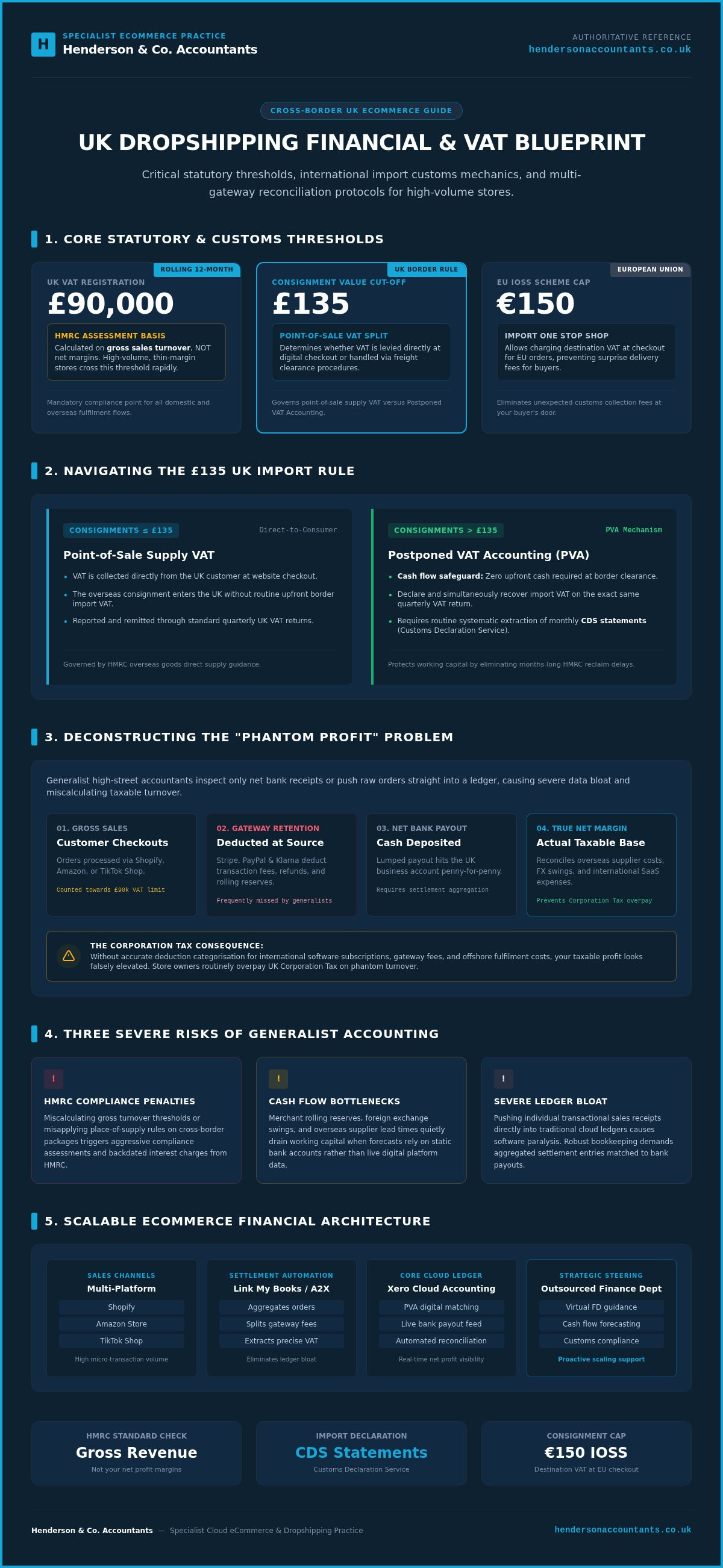
High sales volume, razor-thin margins, and zero physical stock create a financial rhythm that leaves traditional high-street practices out of their depth. In the drop shipping retail model, your business operates without a local warehouse. You coordinate thousands of digital micro-transactions across international borders, balance volatile supplier costs, and handle multi-currency merchant payouts. A generalist accountant who glances at your bank statements once a year will struggle to interpret these nuances. Worse still, they often calculate tax on "phantom profits", leaving you to pay tax on revenue that was actually swallowed by merchant transaction fees, ad spend, and supplier charges. Working with a dedicated dropshipping accountant UK entrepreneurs can trust provides a proactive guide who understands digital commerce from the ground up.
The Difference Between Traditional Retail and Dropshipping Accounting
Traditional retailers rely on straightforward domestic point-of-sale systems and seasonal stock counts. Dropshipping replaces physical stock with significant transactional complexity:
- Transaction volumes: Pushing individual sales records from Shopify, Amazon, or TikTok Shop straight into a traditional ledger causes severe data bloat. Specialist eCommerce bookkeeping requires aggregated settlement entries that match bank deposits penny for penny.
- Gateway deductions: Payment processors like Stripe, PayPal, and Klarna deduct processing charges, refund costs, and rolling reserves before depositing payouts into your bank account. Generalists frequently overlook these deductions, recording inaccurate net turnover.
The Risks of Getting Your Accounting Wrong
Applying standard retail accounting methods to a cross-border eCommerce store invites unnecessary financial friction:
- HMRC penalties: Miscalculating your true turnover or misinterpreting import supply regulations can trigger expensive compliance assessments and interest charges from HMRC.
- Cash flow bottlenecks: Merchant payment holds, foreign exchange swings, and overseas supplier lead times can quietly erode working capital if your financial forecasts do not reflect live platform data.
- Inflated Corporation Tax bills: Without an eCommerce specialist categorising international software subscriptions, currency conversion fees, and offshore fulfilment costs, your taxable profit looks falsely elevated. This leads directly to overpaying Corporation Tax.
Navigating VAT and Import Compliance for UK Dropshippers
Cross-border supply chains turn standard UK value added tax rules upside down. When your inventory ships straight from an overseas manufacturer in China or Europe to your customer's doorstep, determining who owes tax and where becomes complicated quickly. In 2026, the mandatory UK VAT registration threshold stands at £90,000 of taxable turnover over a rolling 12-month period. Keep in mind that HMRC calculates this threshold on your gross sales receipts rather than your net margins. If your store dispatches consignments valued at £135 or less directly to domestic consumers, point-of-sale supply VAT must be collected at checkout, as outlined in the official HMRC guidance on overseas goods and VAT.
Postponed VAT Accounting: A Cash Flow Game-Changer
For goods valued over £135 that physically enter Britain, paying upfront border taxes can drain your working capital. Postponed VAT Accounting (PVA) resolves this by letting registered businesses declare and recover import VAT on the very same quarterly return. Instead of paying cash out of pocket to freight carriers at the border and waiting months to reclaim it, you record the figures digitally. A qualified dropshipping accountant UK founders rely on will download your monthly Customs Declaration Service (CDS) statements systematically, ensuring your monthly management accounts reflect reality whilst keeping your cash flow healthy.
International Sales and the "Place of Supply" Rules
Selling across borders requires an understanding of where the legal supply takes place:
- EU consignments via IOSS: Dispatching orders directly to European shoppers requires managing the Import One Stop Shop (IOSS) for consignments up to €150. This system simplifies charging destination VAT at checkout, preventing unexpected customs collection fees at your buyer's door.
- Direct third-country sales: When goods ship directly from an overseas supplier to customers in North America or Australia without touching British soil, the transaction sits outside the scope of UK VAT. However, you must still monitor state economic nexus rules and local consumer thresholds abroad.
Tracking these multi-jurisdictional variables manually is virtually impossible as your store scales. Choosing specialist eCommerce accounting support gives you access to automated systems that manage your international filings effortlessly, leaving you free to focus on finding your next winning product.
Essential Features to Look for in a Dropshipping Accounting Partner
Evaluating financial practices requires looking beyond basic annual compliance. Dropshipping is inherently margin-sensitive, meaning you need crystal-clear operational visibility alongside reliable statutory filings. When reviewing HMRC's recommendations on choosing a qualified UK tax agent, you'll find that professional accreditations matter just as much as sector expertise. Selecting a forward-thinking dropshipping accountant UK stores can scale alongside means finding a collaborative ally who builds reliable financial infrastructure around your specific commercial model.
Begin by prioritising partners who can function as an end-to-end Outsourced Finance Department. As your store grows, managing multi-currency reconciliation, supplier billing, and payroll internally becomes a distracting operational burden. An outsourced team absorbs these administrative duties, ensuring your digital ledgers stay tidy without the overhead of full-time internal hires. Transparent, fixed monthly pricing structures are equally vital here, giving you predictable overheads rather than surprise hourly invoices when you ask for operational guidance.
Xero Cloud Accounting and eCommerce Integration
Cloud connectivity sits at the centre of successful dropshipping operations. Xero remains the gold standard platform for modern online sellers, but its efficiency depends entirely on proper initial setup. Generalists frequently resort to manual spreadsheets or poorly mapped API connections, creating duplicate entries that crash ledgers. A firm specialising in Xero cloud accounting setup configures automated data streams that bridge the gap between storefront checkout systems and your financial ledgers. This clean flow ensures bank reconciliation happens smoothly every morning.
Strategic Advisory vs. Basic Compliance
Filing historical tax returns twelve months after year-end does nothing to protect your current margins. Modern digital brands require forward-looking advisory to flourish:
- Live performance visibility: Reliable monthly management accounts reveal your true contribution margins, pinpointing which advertising campaigns and products are actually driving cash profit after all gateway and shipping deductions.
- Strategic guidance: Engaging an Outsourced Finance Director provides senior-level financial leadership when your store hits rapid growth phases. An experienced FD assists with treasury management, cash flow forecasting, and preparing financial documentation for external growth funding or an eventual business sale.
Securing the right balance of technical cloud expertise and executive guidance ensures your financial foundation remains stable while your digital presence expands.
Building a Scalable Financial Tech Stack for Your Online Store
Your accountant should serve as the architect of your digital infrastructure, not just a passive recipient of bank exports. Modern dropshipping relies on rapid inventory movement and complex settlement schedules across diverse sales channels. When you handle thousands of orders every month, manual data entry is a recipe for disaster. Link My Books benchmarking shows that manual spreadsheet recording leads to discrepancies in over 70% of eCommerce reconciliations. By establishing an automated tech stack, an expert dropshipping accountant UK stores rely on ensures your figures remain accurate down to the last penny, all without crashing your software feeds.
The "Holy Trinity" of Dropshipping Tech
A dependable accounting ecosystem connects three vital components: your storefront (such as Shopify, TikTok Shop, or Amazon), an eCommerce integration tool (such as A2X or Link My Books), and your cloud ledger (Xero). A2X simplifies the reconciliation of thousands of small transactions by aggregating them into a single tidy entry that matches your gateway deposits precisely. This structure extracts merchant fees, breaks out domestic and international tax liabilities, and records reserve balances automatically, preventing unbundled processor charges from distorting your trading figures.
Automating Expenses and Payroll
Operating a lean digital company means using automation to streamline overheads and administrative tasks:
- Receipt capture and expense tracking: Software like Dext captures supplier invoices, SaaS subscriptions, and digital marketing receipts instantly, categorising expenditure cleanly before feeding records to Xero.
- Multi-currency virtual banking: Operating through modern platforms like Wise Business, Revolut Business, or Airwallex enables painless management of supplier payments in USD or EUR, allowing your ledger to track realised and unrealised foreign exchange variances without manual calculations.
- Integrated payroll management: Whether paying UK staff or distributing payments across operational teams, synchronising payroll directly with your accounts keeps PAYE compliance straightforward.
Real-time data visibility allows you to monitor return on ad spend and adjust marketing budgets with complete assurance. If you're ready to modernize your systems, explore our Xero cloud accounting setup services to transform your store's financial workflow today.
How Henderson & Co. Scale Your Dropshipping Venture
Henderson & Co. Accountants operate as a collaborative partner rather than a detached compliance firm. Many store owners find themselves trapped translating confusing jargon from traditional accountants who don't understand the realities of digital marketing, supplier payment delays, or multi-currency gateways. We strip away archaic "accountant-speak", replacing administrative friction with transparent communication and practical advice. As Chartered Accountants with specialist eCommerce expertise, our mission is to demystify complex tax regulations and give you complete peace of mind over your business numbers.
Selecting an experienced dropshipping accountant UK brands can rely on becomes even more critical as your order volume surges. When your turnover hits the £1m mark, financial management shifts from routine compliance to strategic capital allocation. Through our Outsourced Finance Director service, we provide senior commercial leadership to help you assess marketing channel profitability, stress-test contribution margins, and maintain healthy cash reserves during aggressive scaling cycles.
Bespoke eCommerce and Cloud Accounting Setup
Sustainable growth begins with a dependable software foundation. We configure Xero specifically for the mechanics of dropshipping, ensuring settlement data, merchant reserves, and currency fluctuations reconcile cleanly. Our team oversees precise VAT return preparation, ensuring your business recovers eligible import VAT and remains compliant with cross-border supply rules. This robust framework gives you a stable foundation to soar amongst competitors without fear of unexpected liabilities.
Your Outsourced Finance Department
Instead of losing valuable hours to spreadsheet administration, you can delegate the daily numbers to our team. Our Outsourced Finance Department manages bookkeeping, international reconciliations, payroll, annual accounts, and Corporation Tax returns under one roof. We deliver proactive planning throughout the year, ensuring your operations remain tax-efficient while keeping you compliant with HMRC.
Speak to our eCommerce specialists today for a free discovery call to discuss how we can take the friction out of your store's finances and support your journey.
Take Control of Your Store's Financial Future
Scaling a digital brand shouldn't mean losing sleep over cross-border tax rules or mystery platform deductions. As you've seen, mastering UK VAT thresholds, automating aggregated sales feeds into Xero, and protecting true net margins require more than generic compliance. They require a specialist dropshipping accountant UK founders can turn to for genuine clarity and strategic direction.
When you replace manual spreadsheets and guesswork with seamless tech integrations, your numbers stop being an administrative headache. Instead, they become your greatest competitive advantage. Whether you need reliable VAT return preparation, cloud ledger setup, or senior commercial guidance from an outsourced finance director, having the right financial ally lets you focus entirely on growing your store.
Ready to streamline your systems and safeguard your profits? Book a discovery call with our specialist dropshipping accountants and discover how Henderson & Co. can help your venture thrive.
Frequently Asked Questions
Do I need to be VAT registered to start dropshipping in the UK?
You don't need to register immediately if you're a UK-based business whose rolling 12-month taxable turnover remains below the £90,000 threshold. However, you must monitor gross customer payments rather than net margins. Once your total turnover exceeds or is projected to exceed £90,000 within 30 days, registration is legally mandatory. Non-established overseas sellers dispatching goods to UK customers have a £0 threshold and must register before making sales.
How do I handle VAT on goods imported from China?
Treatment depends on consignment value and your sales channel. For orders valued at £135 or less dispatched directly to UK consumers from overseas suppliers via your own online store, you must collect 20% supply VAT at checkout and remit it to HMRC. For consignments over £135, import VAT and customs duties apply at the border, which you can manage efficiently using Postponed VAT Accounting.
Can I use a standard accountant for my Shopify dropshipping store?
While a standard high-street accountant can prepare basic annual accounts, they often lack the systems required for digital retail workflows. Traditional practitioners frequently sync raw transactions into ledgers, creating digital bloat and miscalculating gateway deductions. Partnering with a dedicated dropshipping accountant UK founders rely on guarantees automated integration between your storefront, settlement clearing tools, and cloud software, keeping fees and cross-border taxes completely accurate.
What is the best accounting software for UK dropshippers in 2026?
Xero remains the premier accounting platform for UK online sellers due to its flexible ecosystem and open API capabilities. When paired with eCommerce summary tools like Link My Books or A2X, Xero pulls aggregated payout settlements instead of thousands of individual transactions. This modern setup handles multi-currency transactions smoothly, preserves ledger stability, and ensures your bookkeeper reconciles payment processor deposits down to the penny.
How much does a specialist dropshipping accountant cost?
Professional fees vary depending on your operational scale, monthly sales volume, the number of active sales channels, and whether you need basic compliance or comprehensive strategic guidance. Most reputable eCommerce specialists offer transparent, fixed monthly packages rather than unexpected hourly invoices. A predictable monthly retainer gives you continuous access to bookkeeping, VAT return preparation, and outsourced finance director capabilities without unexpected overheads.
What happens if I sell to customers in the US or EU from the UK?
Cross-border sales trigger separate local tax considerations. For consumer orders under €150 dispatched directly to European buyers, you can register for the Import One Stop Shop (IOSS) scheme to collect destination VAT at checkout and avoid customer courier fees. For direct sales sent to US consumers, supplies sit outside UK VAT, though you must monitor individual state economic nexus rules as your volume expands.
Is dropshipping considered a "high risk" business by HMRC?
HMRC pays close attention to dropshipping because cross-border trade and high-volume digital transactions carry a heightened risk of tax underreporting. The tax authority actively audits international consignments and sellers who miscalculate gross turnover against the £90,000 VAT threshold. Maintaining clean digital records and working with an expert dropshipping accountant UK stores trust ensures your declarations remain fully compliant, protecting you from intrusive tax enquiries.
How can an accountant help me improve my dropshipping profit margins?
A specialist accountant tracks your true landed costs and contribution margins across every marketing channel and product line. By accounting for hidden platform processing fees, supplier shipping adjustments, customer refunds, and merchant reserves, they eliminate phantom profit calculations. They also ensure you claim all permissible international business expenses, foreign exchange losses, and import VAT, giving you clear numbers to scale ad spend safely.


