

Did you know that nearly 45% of cross-border parcels are now abandoned by customers because of unexpected handling fees and import taxes at the doorstep? It's a frustrating reality for many eCommerce owners who simply want to master UK VAT for selling goods to EU markets without the constant fear of HMRC penalties. You've likely felt the sting of anxiety when staring at complex customs paperwork or worrying if a manual data entry error might lead to a costly fine. Selling to your neighbours in Europe should be a mark of your success, not a source of endless administrative headaches.
We're here to help you turn that uncertainty into a sense of calm control. This guide is designed to simplify the complexities of 2026 trade, covering everything from IOSS thresholds to the latest July 2026 customs duty changes. By the end of this article, you'll understand how to achieve seamless shipping and automated VAT reporting in Xero. We'll walk you through the essential steps to ensure your business remains fully compliant and scalable whilst giving you the peace of mind to focus on what you do best: growing your brand.
Key Takeaways
- Learn how to navigate the IOSS and OSS schemes to ensure your EU customers never face unexpected fees at the border.
- Discover the critical differences between selling to consumers and businesses, including how to correctly validate EU VAT numbers.
- Master the specific requirements for UK VAT for selling goods to EU markets to avoid costly HMRC penalties and manual reporting errors.
- See how automating your data flows through Xero cloud accounting can replace messy spreadsheets with predictable tax costs and real-time reporting.
- Understand why a specialist eCommerce accountant is the key to scaling your international sales whilst maintaining full compliance.
Navigating the 2026 Landscape for UK-EU Trade
2026 has brought the most significant changes to cross-border trade since the initial Brexit transition. For UK exporters, the concept of "business as usual" has been replaced by a landscape defined by digital transparency and stricter enforcement. Relying on outdated methods isn't just a minor risk; it's a direct threat to your bottom line. If you haven't updated your approach to UK VAT for selling goods to EU customers recently, you might face seized shipments or heavy fines from tax authorities. Beyond the financial penalties, the brand damage from customers receiving unexpected "doorstep" tax bills can be impossible to repair.
The status of UK-EU trade today is heavily influenced by the Windsor Framework, which creates a unique set of rules for Northern Ireland. Whilst goods moving from Great Britain to the EU face standard import requirements, those located in Northern Ireland remain subject to EU VAT rules for goods. This dual-status system means your compliance strategy must be precise to avoid double taxation or customs delays. Failing to distinguish between these regimes is one of the primary reasons goods are currently being held at borders.
The Evolution of Post-Brexit VAT Rules
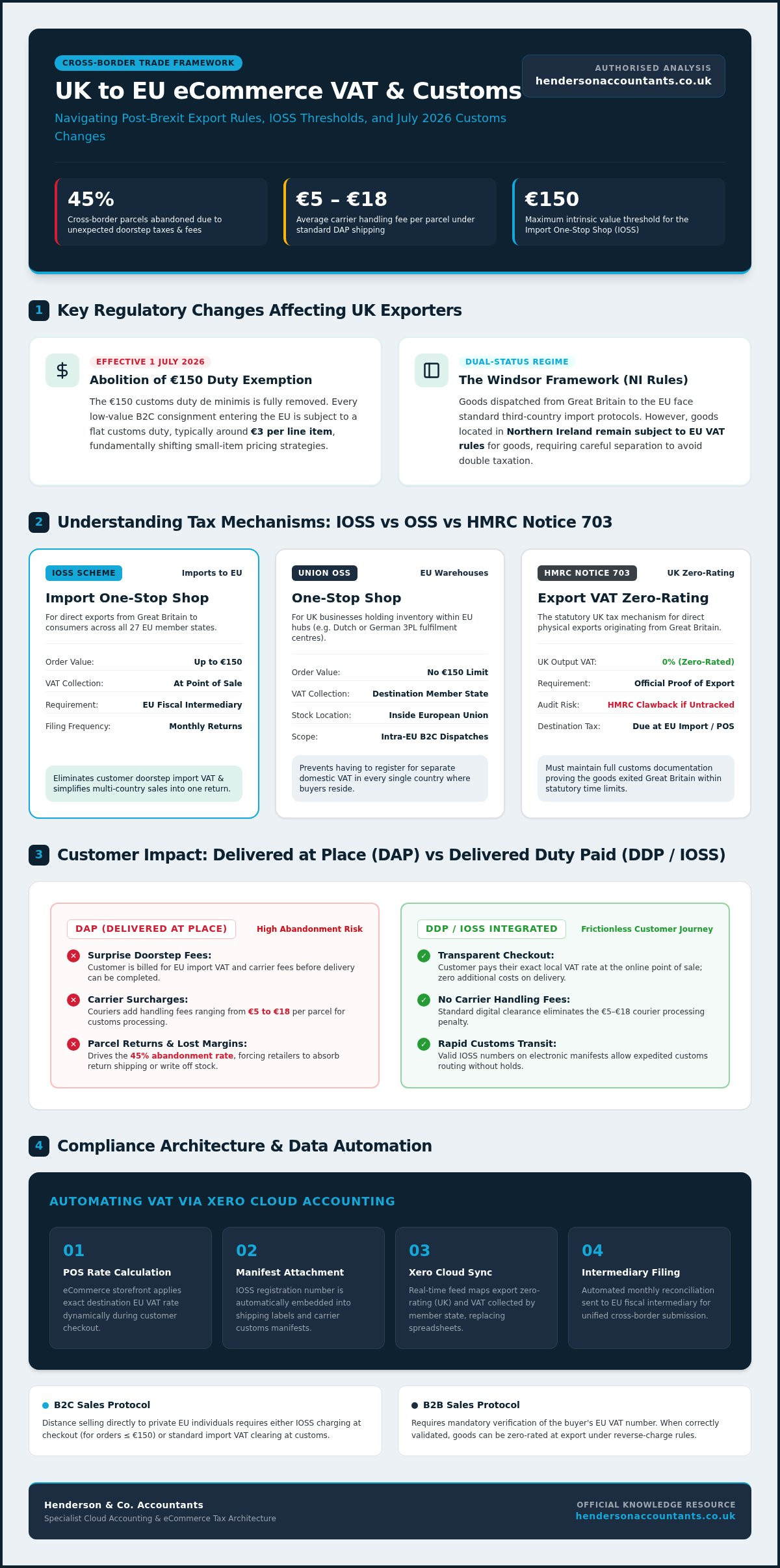
Since the 2021 reforms, the rules have continued to mature. The most notable shift occurred on 1 July 2026 with the abolition of the €150 customs duty exemption. Now, every low-value B2C consignment entering the EU faces a flat customs duty, typically around €3 per line item. This change has fundamentally altered how retailers price their products, as the old "de minimis" thresholds no longer protect small-ticket items from duty costs.
To manage these complexities, many sellers utilise the Import One-Stop Shop scheme to collect VAT at the point of sale. This is more important than ever because HMRC and EU tax authorities now share data with unprecedented speed. They can spot discrepancies in real-time, making manual errors a major liability for any scaling eCommerce business.
Why Your Current VAT Strategy Might Be Outdated
Many businesses are still leaking profit through hidden carrier handling fees, which typically add between €5 and €18 per parcel. These costs often stem from using a "Delivered at Place" (DAP) model rather than a fully integrated digital setup. If your reporting still relies on manual spreadsheets, you're likely missing the nuances of modern digital reporting requirements. In the 2026 context, distance selling refers to the B2C supply of goods where a UK seller dispatches items directly to a consumer in an EU member state.
Transitioning to real-time compliance isn't just about avoiding trouble; it's about staying competitive. A proactive strategy ensures your pricing is accurate and your deliveries are frictionless, keeping your customers happy and your margins protected. By moving away from reactive filing and towards automated data flows, you can turn your tax obligations from a headache into a strategic advantage.
Understanding IOSS, OSS, and Import VAT Mechanisms
The key to a scalable EU strategy is choosing the right tax mechanism for your specific order values. For most UK retailers, this means navigating the Import One-Stop Shop (IOSS) or the Union One-Stop Shop (OSS). Whilst they sound similar, they serve very different purposes. IOSS handles imports into the EU from the UK, whereas OSS is used if you hold stock within an EU member state, such as in a Dutch or German warehouse. Under HMRC VAT Notice 703, you can zero-rate your exports from Great Britain, but you must ensure the destination tax is handled correctly to avoid double taxation.
The IOSS Scheme: A Lifeline for Small Consignments
The IOSS scheme is designed for B2C consignments with an intrinsic value of up to €150. It allows you to charge the customer's local VAT rate at the point of sale. This removes the need for the customer to pay import VAT when the parcel arrives, ensuring a much smoother delivery. It's the most effective way to manage UK VAT for selling goods to EU customers without the risk of parcels being held at customs.
To use this, UK-based businesses must appoint an EU-established fiscal intermediary to register and submit monthly returns. Once registered, you simply add your IOSS number to your shipping documentation. Platforms like Shopify and Amazon have built-in tools to help, but the responsibility for accurate reporting remains with you. If you're selling across multiple channels, keeping these data flows organised is essential for a clean audit trail.
DDP vs DAP: Managing the Customer Experience
Choosing between Delivered Duty Paid (DDP) and Delivered At Place (DAP) is often a choice between conversion rates and administrative simplicity. Under DAP, the customer is the importer of record. This often leads to negative reviews when they're hit with carrier handling fees of between €5 and €18 per parcel. In fact, research shows that up to 45% of cross-border parcels are abandoned when unexpected charges appear at the doorstep.
DDP is the gold standard for customer satisfaction. You take on the responsibility for all taxes and duties, including the €3 flat customs duty introduced in July 2026 for low-value items. This requires robust accounting to ensure your margins aren't swallowed by these costs. When you're refining your UK VAT for selling goods to EU strategy, the goal is to find the balance between a frictionless checkout and a healthy bottom line. If you need help calculating your landed costs, our eCommerce accounting specialists can help you build a compliant, profitable model.
B2B vs B2C: Different Rules for Different Sales
Your compliance path for UK VAT for selling goods to EU markets depends entirely on who's clicking the "buy" button. Tax authorities treat a sale to a private individual in Paris very differently from a bulk order sent to a VAT-registered business in Berlin. Getting this distinction wrong doesn't just lead to incorrect tax filings; it can cause your shipments to be rejected at the border or trigger an unwanted HMRC audit. Understanding the specific mechanics for each customer type is the only way to keep your international growth on track.
Selling to EU Consumers (B2C)
The days of low-value consignment relief are long gone. Every single sale to an EU consumer is now subject to VAT, regardless of its value. If you're selling through an Online Marketplace (OMP) like Amazon or eBay, you've likely encountered the "deemed supplier" rule. In many cases, the marketplace is responsible for collecting and remitting the VAT on your behalf for imports under €150. Whilst this simplifies your life, it doesn't remove your responsibility to keep accurate records. You must still ensure your shipping labels correctly reflect the marketplace's IOSS number to avoid your customer being double-charged upon delivery.
Selling to EU Businesses (B2B)
When you sell to a VAT-registered business, the process usually shifts to a zero-rated export from the UK. The EU buyer then accounts for the import VAT using a reverse charge mechanism in their own country. However, you can't just take their word for it. You must validate their VAT number using the EU VAT One Stop Shop portal or the VIES system before you ship. If you zero-rate a sale without a valid number, you're liable for that tax if HMRC comes knocking.
Documentation is your best friend in B2B trade. To justify zero-rating your UK VAT for selling goods to EU business clients, you must hold valid evidence of export, such as a bill of lading or a certificate of shipment, and keep it for six years. You'll also need a dual-EORI setup if you're acting as the importer of record. This means having a GB EORI number to get the goods out of the UK and an EU EORI number to clear them into the destination country. Pitfalls often arise when an invoice doesn't clearly state both parties' EORI and VAT numbers, which is a common red flag for customs officials.
Managing "mixed" orders, where a single basket contains both B2B and B2C items, requires a methodical approach. Usually, it's cleanest to treat the entire order as B2C unless the buyer provides a verified VAT number for the business-related items. Splitting these into two separate shipments is often the safest way to ensure the correct tax treatment is applied to every line item without confusing the customs software.
Automating VAT Compliance with Cloud Accounting
Manual spreadsheets are the biggest threat to your 2026 VAT compliance. Relying on static files for UK VAT for selling goods to EU is no longer viable when tax authorities expect real-time accuracy under Making Tax Digital (MTD). A single formula error can lead to under-reported liabilities and subsequent fines. By moving your financial records into the cloud, you replace anxiety with a system that updates as fast as your sales. It's about building a foundation that supports growth rather than one that creates a bottleneck.
Xero Cloud Accounting: The eCommerce Backbone
At Henderson & Co., we specialise in Xero cloud accounting setup to ensure your international sales tax is tracked automatically. We configure Xero to handle multi-currency reconciliations, which is vital when you're receiving Euros but reporting in Sterling. Reconciling payment gateways like Stripe and PayPal with your EU VAT liabilities becomes a simple task rather than a weekend-long ordeal. Automated bank feeds reduce VAT errors by pulling transaction data directly into your ledger, removing the risk of human oversight or missing entries.
Data Flows: From Storefront to VAT Return
The real magic happens when your storefront speaks the same language as your accounting software. Mapping tax codes correctly across platforms like Shopify or Magento and Xero ensures that the correct VAT rate is applied based on the customer’s location. This is particularly important for IOSS and OSS reporting, where you might be dealing with 27 different EU tax rates. Accurate mapping prevents the "tax leakage" that occurs when you accidentally overpay or under-collect on international orders.
Handling returns and refunds across borders is another area where manual systems often fail. If a customer in Spain returns an item, you need to ensure the VAT credit is correctly reversed in your next filing. Our outsourced finance department monitors these data flows constantly, catching discrepancies before they become HMRC problems. Integrating tax engines like Avalara or TaxJar with your Xero setup provides an extra layer of protection. These tools calculate the latest rates in real-time. This proactive approach ensures your UK VAT for selling goods to EU strategy remains scalable without your administrative burden growing alongside your sales volume.
How a Specialist eCommerce Accountant Protects Your Growth
A generic accountant might treat your tax returns as a simple quarterly task. However, an eCommerce specialist understands that UK VAT for selling goods to EU markets is a dynamic part of your business operations. We don't just look at the numbers after they've happened. We look ahead to ensure your tech stack is correctly capturing every data point from your sales channels. This proactive approach prevents the "VAT headache" that often stalls international expansion, replacing anxiety with a sense of calm control.
Beyond Compliance: Strategic Advisory
Scaling into Europe requires more than just knowing the rules. As your outsourced finance director, we use your management accounts to identify which EU markets are actually driving your profit. It's easy to see high sales figures in France or Germany, but we dig deeper to see the impact of shipping, local VAT, and carrier handling fees on your true margins. This data-driven perspective allows you to invest your marketing budget where it yields the highest return.
We also help you manage the risks of "permanent establishment." If you decide to hold stock in an EU fulfillment centre to speed up delivery times, you'll likely trigger immediate VAT registration requirements in that country. We guide you through these transitions, ensuring you remain amongst the most tax-efficient sellers whilst avoiding the trap of double taxation. Our goal is to provide a stable foundation so you can build your success without fear of hidden barriers or confusing tax triggers.
Getting Started with Henderson & Co.
Our process begins with a comprehensive audit of your current EU VAT setup. We look for common leaks, such as misapplied tax codes or unrecovered import VAT, and then we build a roadmap for automation. This transition to an outsourced finance department gives you the freedom to focus on product development and customer acquisition. You'll gain the quiet confidence that comes from knowing your UK VAT for selling goods to EU is being handled by experts who understand the unique hurdles of modern entrepreneurship.
If you're ready to remove the complexity from your international trade, we're here to help. Book a consultation with our eCommerce specialists today to secure your business's future in the EU market and ensure your operations remain fully scalable.
Scaling Your eCommerce Brand in 2026 and Beyond
Growing your business into the European market shouldn't feel like an uphill battle against red tape. By mastering the nuances of UK VAT for selling goods to EU customers, you're not just ticking a compliance box; you're building a frictionless experience that keeps your customers coming back. We've explored how moving from manual spreadsheets to automated cloud accounting protects your margins, and why choosing the right VAT scheme is essential for avoiding those dreaded doorstep fees.
As Xero Certified Platinum Partners and specialists in multi-channel retail, we're here to turn your tax obligations into a strategic advantage. Whether you need an automated Xero setup or the high-level perspective of strategic outsourced FD expertise, we'll ensure your finance department is ready for the next stage of your journey. You've built a brand people love; don't let administrative complexity hold you back.
Secure your international growth with our specialist eCommerce accounting services and take the first step towards a simpler, more profitable future. You have the vision to grow, and we have the tools to make it happen.
Frequently Asked Questions
Do I need to register for VAT in every EU country I sell to?
No, you don't need multiple registrations if you utilise the IOSS or OSS schemes. These systems allow you to register in just one EU member state and report VAT for sales across all 27 countries in a single monthly or quarterly return. However, if you choose to hold stock in an EU warehouse, you'll usually trigger an immediate requirement to register for VAT in that specific country.
What is the IOSS scheme and is it mandatory for UK sellers?
The Import One-Stop Shop (IOSS) is a system for B2C consignments with a value of up to €150. While it isn't strictly mandatory, it's highly recommended to avoid delivery friction. Using IOSS allows you to collect the correct UK VAT for selling goods to EU consumers at the point of sale, ensuring your customers don't face unexpected import fees when their parcel arrives.
How much does it cost to manage EU VAT compliance in 2026?
Costs vary depending on your sales volume and the complexity of your supply chain. You'll typically need to budget for an EU fiscal intermediary, which is a mandatory requirement for UK businesses using the IOSS scheme. Professional fees for VAT return preparation also apply. Working with a specialist ensures you don't overpay through inefficient data mapping or by failing to reclaim eligible tax credits on your returns.
What happens if I don’t pay the correct VAT on goods sent to the EU?
Failing to pay the correct VAT can lead to shipments being seized at the border or significant financial penalties from EU tax authorities. HMRC and EU authorities now share data with high efficiency, making it much easier for them to spot reporting discrepancies. Beyond the fines, you risk serious brand damage if your customers are hit with surprise tax bills or if their orders are delayed indefinitely.
Can I use Xero to file my EU VAT returns directly?
Xero doesn't submit IOSS or OSS returns directly to EU tax authorities from its core platform. Instead, it acts as the vital data source for your filings. By using a professional Xero cloud accounting setup, you can ensure your international sales data is pre-mapped and accurate. This allows your accountant to export the necessary figures for a seamless submission, ensuring your UK VAT for selling goods to EU reporting is always precise.
Do I need an EU EORI number as well as a UK one?
Yes, you'll likely need both if you're responsible for clearing goods through customs. You need a GB EORI number to export products from Great Britain and an EU EORI number to import them into the destination country. Having both numbers ready ensures that your shipping documentation is complete and prevents your parcels from being stalled by customs officials who require valid identification for the importer of record.
What is the difference between IOSS and OSS for a UK business?
IOSS is used for goods imported into the EU from the UK in consignments worth up to €150. OSS is generally used when your goods are already located inside the EU, such as in a 3PL warehouse in the Netherlands, and you're selling them to consumers in other EU member states. The choice between them depends entirely on where your stock is housed at the moment the customer places their order.
How do I handle VAT on returns from EU customers?
When an EU customer returns an item, you must ensure the VAT originally paid is credited back in your next IOSS or OSS filing. This requires a methodical process to match returns with the original transaction data in your accounting software. Without accurate tracking, you might end up paying tax on sales that were refunded, which can quickly reduce your overall profitability in the European market.


