

A profitable store can run out of cash long before it runs out of customers. Seeing record revenue on Shopify or Amazon whilst watching your company bank account dwindle is one of the most stressful experiences in retail. That disconnect is why traditional profit calculations fall short, and why cash flow forecasting for ecommerce must track volatile working capital cycles rather than simple paper margins.
You already know the strain of funding heavy supplier deposits months before stock arrives, all whilst juggling merchant settlement lags and bracing for an unpredictable quarterly VAT bill. It creates constant anxiety when your focus should be on scaling. In this guide, you'll discover how to build a rolling cash forecast tailored specifically to online retail dynamics. We will walk through practical ways to align your inventory reorders, fund tax bills with confidence, and free up the working capital required to scale your digital ad campaigns safely.
Key Takeaways
- Understand why top-line store profitability does not equal available bank balance, and how timing gaps create hidden liquidity risks.
- Unpack the four core working capital drivers that drain reserves, from container shipping deposits to multi-day merchant settlement holds.
- Implement a practical 13-week rolling model of cash flow forecasting for ecommerce to predict cash troughs well before they occur.
- See how connecting modern cloud platforms like Xero gives you reliable, real-time baseline data that manual spreadsheets simply cannot match.
- Transform your cash visibility into a strategic asset, freeing up working capital to scale ad spend safely whilst keeping HMRC liabilities fully funded.
What Is eCommerce Cash Flow Forecasting and Why Traditional Methods Fail?
In simple terms, cash flow forecasting models when money will physically enter and leave your bank account, rather than when sales are booked. While routine bookkeeping reconciles transactions that have already happened, forward-looking cash flow forecasting for ecommerce maps your future liquidity against real operational cycles. Digital retail rarely moves in a straight line. Between merchant holding periods, ad platform deductions, and supplier deposits, relying on conventional accounting leaves you operating in the dark.
The Profit versus Cash Paradox in Online Selling
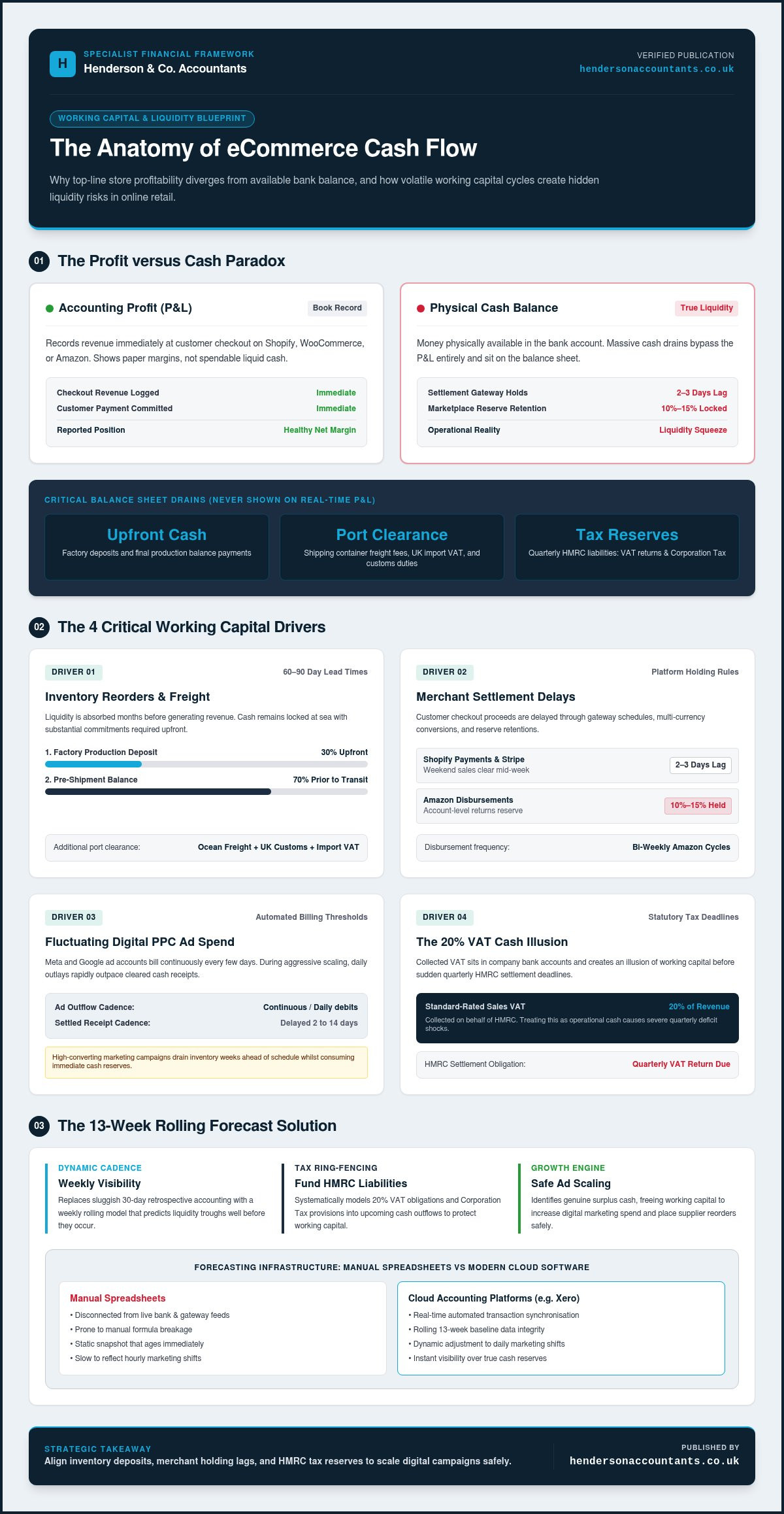
Standard profit and loss reports show accounting profitability, not spendable bank balances. When a customer checks out on Shopify, WooCommerce, or Amazon, your accounting software records that revenue immediately. That money, however, is not instantly accessible in your bank account.
Crucially, some of your largest cash outflows never show up on a profit and loss statement when they happen. Large cash drains sit on the balance sheet instead:
- Upfront factory deposits and final balance payments for production runs
- Shipping container fees, UK import VAT, and customs duties cleared at port
- Funds set aside to meet quarterly HMRC liabilities, like VAT and Corporation Tax
Because of this timing disconnect, an online store can show healthy net margins on paper whilst struggling to pay suppliers on time.
Why Monthly Accounting Cycles Are Too Slow for Digital Brands
Traditional accounting operates on a thirty-day cycle, delivering reports weeks after month-end. That cadence simply does not work for modern eCommerce, where turnover and marketing spend shift by the hour. Digital ad spend fluctuates daily on platforms like Meta and Google, and a high-converting campaign can drain inventory weeks ahead of schedule.
Waiting for a retrospective monthly report leaves you vulnerable to sudden cash crunches. If ad acquisition costs rise unexpectedly or a supplier demands payment two weeks early, a monthly review discovers the problem far too late. Navigating these swings requires dynamic cash flow forecasting for ecommerce that updates weekly, giving you clear visibility over your working capital before decisions become emergencies.
The 4 Critical Working Capital Drivers That Break eCommerce Cash Flow
Generic financial models treat cash outlays as smooth, predictable expenses. In online retail, your bank balance moves in sudden bursts dictated by four primary operational levers. Understanding how these forces interact is the secret to accurate cash flow forecasting for ecommerce.
Inventory Reorders, Freight, and Upfront Production Deposits
Physical inventory absorbs substantial liquidity months before it produces a penny of revenue. Overseas factories typically require a 30% deposit to commence production, followed by the remaining 70% balance before goods ship. Add ocean freight charges, UK port handling, customs duties, and import VAT, and you have significant cash locked up at sea. If lead times stretch from 60 to 90 days, your cash remains trapped, leaving little room for error if sales dip.
Merchant Settlement Delays and Rolling Marketplace Reserves
Revenue from customer orders rarely arrives right away. Most payment gateways and multi-channel platforms hold cash under varying settlement rules:
- Shopify Payments and Stripe: Rolling payouts take two to three business days, meaning weekend sales spikes do not clear until mid-week.
- Amazon Disbursements: Bi-weekly disbursement schedules tie up capital. Account level reserves can hold back 10% to 15% of your gross sales for weeks to cover potential returns.
- Multi-Currency Friction: International orders incur currency conversion fees and additional clearing delays before landing in your domestic account.
Fluctuating Digital Ad Spend and Statutory VAT Deadlines
PPC marketing outlays introduce daily volatility. Meta and Google ad accounts bill continuously, debiting corporate cards or bank accounts every few days based on automated billing thresholds. During seasonal scaling, daily ad spend can quickly outpace cleared cash receipts from previous days.
Compounding this strain are your statutory tax deadlines. When you collect sales revenue, you are also collecting 20% VAT on standard-rated goods on behalf of HMRC. It feels like operational revenue in your account, but spending it creates sudden, severe deficits when your quarterly VAT return falls due. Pairing your forecasts with specialised eCommerce accounting ensures these tax liabilities remain segregated and funded well before payment dates.
Comparing eCommerce Forecasting Methods: Spreadsheets versus Cloud Software
Choosing the right forecasting approach depends heavily on your transaction volume and operational pace. Getting your method right is what separates accurate cash flow forecasting for ecommerce from guesswork. The two core methodologies, direct and indirect forecasting, serve entirely different strategic purposes.
Direct versus Indirect Cash Flow Forecasting Methodologies
Indirect forecasting starts with your projected net profit on the income statement, adjusting backwards for non-cash expenses and working capital changes. It works well for long-term corporate planning over three to five years. However, it completely lacks the day-to-day granularity needed to manage volatile retail operations.
Direct forecasting tracks expected cash receipts and physical disbursements day by day and week by week. It monitors actual merchant payouts landing in your bank against scheduled supplier invoices due for payment. For navigating short-term commitments like bulk production milestones or payroll runs, direct forecasting is indispensable.
Spreadsheets versus Automated Xero Cloud Accounting Systems
Most brand founders begin with manual spreadsheet models. Spreadsheets offer complete customisation and carry zero software cost at the outset. Yet as order volumes grow, their structural limitations quickly create serious operational risks:
- Formula Fragility: One accidental overwrite or broken cell reference can distort your projected bank balance by thousands of pounds.
- Stale Data Feeds: Manual models rely on human data entry, meaning your cash visibility is already outdated by the time you finish updating the sheet.
- Multi-Currency Errors: Manually tracking fluctuating exchange rates between supplier currencies like USD and your domestic GBP accounts invites frequent discrepancies.
Integrated cloud ecosystems resolve these vulnerabilities by establishing automated, continuous data flows. Connecting your online sales channels and bank feeds directly into a platform like Xero provides a verified, real-time foundation for your rolling projections. Working with an experienced eCommerce accounting specialist ensures these system integrations are configured cleanly, giving you dynamic, reliable numbers without hours of repetitive spreadsheet administration.
How to Build an Accurate 13-Week Rolling eCommerce Cash Flow Forecast
A 13-week cycle represents an entire business quarter. This timeframe captures typical factory production runs, ocean freight journeys, customer deliveries, and upcoming quarterly VAT returns. Establishing a disciplined 13-week model is the benchmark for cash flow forecasting for ecommerce, giving you early warning of potential shortfalls long before they threaten operations.
Setting Up Baseline Balances and Calibrating Revenue Inflows
Start by identifying your true opening liquidity. Consolidate cleared balances across your primary UK bank accounts, pending balances sitting inside Stripe or Shopify Payments, and balances held in multi-currency wallets like Wise or WorldFirst.
Next, project cash receipts based on realistic operational cycles rather than optimistic sales goals:
- Project net sales using recent baseline velocity, adjusting for planned marketing promotions
- Deduct average customer return rates and platform processing fees upfront
- Apply settlement lags, ensuring Friday sales spikes reflect on the actual weekday they clear into your account
Plotting Inventory Milestones and Operational Cash Outflows
Schedule your predictable baseline costs first. Enter fixed operational outlays, including warehouse storage, staff payroll, software subscriptions, and corporation tax reserves.
Layer in your physical stock milestones next. Mark the exact weeks when 30% manufacturing deposits fall due, followed by remaining balance payments and port customs clearance charges. Finally, assign flexible marketing allowances for Meta and Google Ads, calibrating these budgets to align with inventory arrival dates rather than spending ahead of stock availability.
Reconciling Actuals and Running Stress-Test Scenarios
A forecast is only effective if it stays up to date. Establish a routine every Monday morning to replace the previous week's projections with actual bank receipts and outlays, extending your forecast horizon by an additional week.
Use this updated view to stress-test your business against common trading hurdles. What happens if container shipping takes an extra three weeks? How does your bank balance look if ad acquisition costs spike by 25%? Spotting cash troughs six to eight weeks early gives you time to renegotiate terms or adjust marketing spend. If you want professional guidance building and managing these forward-looking models, speak with Henderson & Co. Accountants about setting up an outsourced finance department to safeguard your cash reserves.
Scaling Your eCommerce Brand with Strategic Financial Oversight
Predictive modelling turns financial management from an exercise in damage control into an engine for growth. Knowing your liquidity weeks in advance changes how you make operational decisions. Rather than wondering whether your bank account can handle a larger production run or increased ad spend, cash flow forecasting for ecommerce gives you the hard data required to expand with poise.
Using Cash Visibility to Negotiate Better Supplier Terms
Suppliers value reliability above almost everything else. When you possess clear visibility over upcoming cash receipts, you can negotiate commercial terms from a position of strength:
- Favourable Payment Milestones: Negotiate moving from rigid 30/70 deposit structures to 20/40/40 terms, deferring final payments until goods clear UK customs.
- Prompt-Settlement Discounts: Secure 2% to 5% reductions on unit costs by offering rapid settlement windows during periods when your forecast identifies surplus working capital.
- Inventory Funding Decisions: Determine precisely when commercial credit lines or specialist stock loans make financial sense, ensuring financing costs remain comfortably lower than your margin gains.
The Role of an Outsourced Finance Director in eCommerce Growth
Raw numbers are only useful when translated into commercial strategy. Scaling brands often reach a ceiling where the founder can no longer manage supplier orders, marketing allocations, and tax planning alone, yet hiring a full-time, in-house financial officer is unnecessary. This is where an outsourced finance director provides fractional leadership, bridging the gap between everyday accounting and long-term expansion.
A fractional finance director tests trading hypotheses before you commit capital. They help you calibrate digital ad spend against proven customer acquisition costs, confirm that upcoming quarterly VAT liabilities are fully covered, and balance stock replenishment with dividend planning. Discover how our outsourced finance department solutions deliver end-to-end financial control, giving you the specialist guidance needed to scale your brand sustainably.
Take Command of Your eCommerce Working Capital
Achieving healthy revenue on paper means little if cash constraints keep you awake at night. By replacing static monthly accounts with an agile 13-week rolling model, you regain full visibility over supplier deposits, platform payout lags, and upcoming VAT bills. Reliable cash flow forecasting for ecommerce turns unpredictable liquidity swings into an orderly, manageable roadmap for growth.
You don't have to navigate these operational complexities on your own. Henderson & Co. Accountants provides specialist UK eCommerce accounting and certified Xero cloud setup to keep your financial data accurate and automated. Whether you require dependable day-to-day bookkeeping or high-level strategic guidance from an outsourced finance director, our team gives you the foundation to expand with confidence. Take control of your online business cash flow with Henderson & Co. Accountants and build a resilient brand that thrives through every retail cycle.
Frequently Asked Questions
What is the difference between a cash flow forecast and a profit and loss statement?
A profit and loss statement measures accounting profitability over a set period, whilst a cash flow forecast tracks physical money entering and leaving your bank account. Profit reports record sales upon checkout and spread stock costs over time. In contrast, cash flow forecasting for ecommerce accounts for money leaving immediately for upfront stock deposits, advertising, and VAT, revealing your true spendable balance.
Why is a 13-week cash flow forecast recommended for eCommerce businesses?
A 13-week window directly aligns with a full financial quarter and mirrors the operational cash conversion cycle of digital retail. This timeframe is long enough to capture overseas factory lead times, freight transit, and quarterly HMRC tax deadlines. At the same time, it remains short enough to keep weekly receipts and payments accurate, giving you enough runway to correct potential shortfalls.
How do merchant payout delays affect my cash flow forecast?
Merchant payout delays create an operational gap between making an online sale and receiving usable cash in your bank. Gateways like Stripe or Shopify Payments hold funds for several days, whilst Amazon holds rolling account reserves to cover potential returns. If you project revenue based on order dates rather than settled disbursement dates, your forecast will dangerously overstate available capital.
How should I account for inventory deposits and manufacturing lead times?
Map inventory outlays based on payment milestones rather than when products arrive at your warehouse. Record the initial 30% factory deposit in the week production begins, followed by customs duties, freight charges, and final balances when goods ship. Tracking cash drains against your standard 60 to 90-day lead time ensures your reserves aren't exhausted before fresh stock sells.
Can cloud accounting software like Xero automate cash flow forecasting for my online shop?
Xero automates the essential data foundation needed for reliable forecasting, though dynamic projections still require operational inputs. Integrating sales channels and bank feeds directly into Xero ensures real-time accuracy for past and pending transactions. However, effective cash flow forecasting for ecommerce requires overlaying that data with manual schedules for upcoming factory deposits, planned ad budgets, and seasonal sales shifts.
How often should an eCommerce business update its cash flow forecast?
You should review and update your 13-week forecast on a weekly basis. Every Monday, replace the previous week's projections with actual settled bank figures, analyse any variance, and add a new week to the horizon. This steady rhythm ensures your financial visibility stays current, helping you spot emerging cash gaps caused by unexpected ad costs or delayed payouts before they escalate.
What should I do if my forecast reveals a cash shortfall in six weeks?
Identifying a shortfall six weeks ahead gives you the runway needed to take proactive measures. Start by discussing phased payment terms with suppliers or deferring non-essential stock orders. Next, adjust flexible ad spend to preserve working capital. If external funding is required, six weeks provides ample time to arrange commercial credit lines or stock financing calmly, avoiding expensive emergency borrowing.


