

A busy till can hide a retail business running short of cash. The cost of poor financial management in retail often builds quietly: money is tied up in slow-moving stock, margins are difficult to track and regular commitments become harder to meet.
If your cash position is unclear, stock decisions rely on incomplete figures or reports arrive too late to act on, you’re not alone. Retail finances can be difficult to interpret when sales, fees and stock movements span several channels. Without timely, accurate information, small gaps can compound and make planning less confident.
This article explains how weak financial controls affect cash flow, inventory, profit margins and growth. You’ll learn which measures and reporting routines can give you a clearer view, and how to compare practical ways to strengthen financial oversight in a UK retail business. It also covers how accurate sales data, regular reconciliations and organised bookkeeping can support better decisions, whether you manage finances in-house or consider outsourced support.
Key Takeaways
- The cost of poor financial management in retail includes visible errors and less obvious missed opportunities.
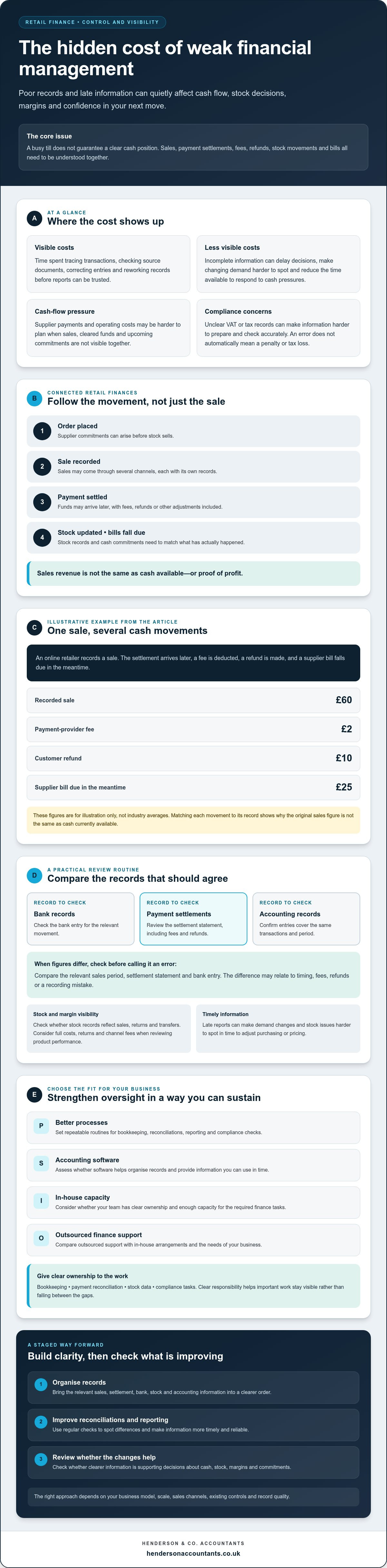
- Compare bank records, payment settlements and accounting records to find discrepancies and establish a repeatable review routine.
- Assess whether better processes, accounting software, in-house capacity or outsourced finance support best fits your business.
- Give clear ownership to bookkeeping, payment reconciliation, stock data and compliance tasks so important work doesn’t fall between the gaps.
- Take a staged approach: organise records first, improve reconciliations and reporting, then review whether the changes are helping you make decisions.
What the cost of poor financial management in retail really includes
The cost of poor financial management in retail is the financial and operational impact of unreliable, late or inadequately controlled records and processes. It can include visible costs, such as time spent correcting errors, and less obvious costs, such as acting on incomplete information or missing the chance to respond to changing demand.
Retail finances are closely connected. You may pay suppliers before stock sells, take sales through several channels, and need to account for payment settlements, refunds, fees and other outgoings. If these records don’t line up, it can be harder to tell what cash is available, which products are earning a useful margin or what commitments are approaching. The principles of financial management apply to retail too: decisions about cash, costs and profitability depend on information you can rely on.
The impact differs between retailers. It depends on factors such as business model, scale, sales channels, existing controls and record quality. A shop with straightforward transactions may face different challenges from an online or omnichannel retailer reconciling orders across multiple platforms.
Direct costs: errors, avoidable rework and weak financial controls
When records are incomplete or inconsistent, someone may need to trace transactions, check source documents and correct entries before reports can be trusted. This takes time and can delay useful information. For example, if sales records and payment settlements don’t match, you may need to check whether the difference relates to timing, fees, refunds or a recording mistake.
Errors in VAT or tax records can also create compliance concerns, depending on the circumstances and applicable UK requirements. An error doesn’t automatically mean a penalty or tax loss, but unclear records can make it harder to prepare and check information accurately. Clear processes and regular bookkeeping make discrepancies easier to identify and resolve.
Indirect costs: decisions made without a reliable financial picture
The less visible cost is a decision you can’t make confidently. If reports arrive late, a change in demand or a stock issue may be harder to spot in time to adjust purchasing or pricing. A product that appears to sell well may also tie up cash if its full costs, returns or channel fees aren’t reflected in the figures.
Weak cash visibility can make routine commitments, such as supplier payments and operating costs, more difficult to plan. It doesn’t guarantee a missed payment or lost growth, but it can leave you with less time to respond if cash arrives later than expected or an outgoing is higher than planned. The costs can compound: incomplete information slows decisions, leaving less room to manage stock, cash and commitments effectively.
How poor retail financial management affects stock, cash flow and margins
Retail finances move through connected steps: an order is placed, a sale is recorded, payment is settled, stock is updated and bills fall due. If information from your sales channels, payment providers and accounting records doesn’t line up, it can be harder to trace those movements. For online and omnichannel retailers, checking that each system covers the same transactions and time period can help explain apparent differences.
Sales revenue alone doesn’t tell you how much cash is available or whether a sale was profitable.
Cash flow pressure when sales, settlements and bills do not line up
A recorded sale and cleared funds are different things. Payment may reach your bank later, and the settlement can include fees, refunds or other adjustments. Supplier commitments also need to be considered. When reviewing a difference, check the relevant sales period, settlement statement and bank entry before deciding whether it’s an error or a timing difference.
Illustrative example: An online retailer records a £60 sale. The payment provider settles it later, deducting a £2 fee, and the customer then receives a £10 refund. A £25 supplier bill is due in the meantime. These figures are for illustration only, not industry averages. Matching each movement to its record shows why the original sales figure isn’t the same as cash currently available.
Stock and margin decisions built on incomplete information
Stock records that don’t reflect sales, returns or transfers can make replenishment decisions less reliable. You might reorder an item that is already available or miss a pattern of stock that isn’t moving. Check adjustments against the underlying records and investigate repeated differences before using stock figures to guide purchasing.
Product-level margin comparisons also depend on complete information. A selling price alone won’t show the effect of discounts, returns, fulfilment costs or channel fees. If charges from one channel are missing, a product may appear more profitable there than it is. The right measures depend on your sales model and the costs your records capture, so a single stock ratio or margin benchmark won’t suit every retailer.
Clear records across sales channels make these comparisons more useful. If you need help organising them, eCommerce accounting support is one option to consider.
How to spot and measure the cost of weak financial management
There’s rarely one figure that captures the full cost of poor financial management in retail. A more useful approach is to follow a consistent review process, identify where information stops matching and track whether the same issues recur. This helps you look beyond symptoms, such as a cash shortfall, to possible causes in the records or routine processes.
A useful monthly finance review compares records, trends and exceptions so you can investigate differences and decide who needs to act. Keep the same definitions and review periods each month. Otherwise, a change in how you calculate a measure may look like a change in business performance.
A practical review of records, reconciliations and reporting
Start by checking bank records against the accounting records, then match payment-provider settlements to the sales they relate to. List any unexplained differences, assign someone to investigate them and record what was done. Next, check that sales, refunds, fees and VAT entries are complete and consistently categorised across relevant sales channels.
Then assess how quickly management information is prepared and who reviews it. A report is less useful if it arrives after the decision it was meant to inform or nobody is responsible for following up exceptions. Note when key information becomes available and whether delays or corrections keep recurring.
Retail organisations and trade bodies may offer useful sector context. For example, you can explore resources from myhfa.org. Use external material as background, and base your review on your own records and business model.
Choose measures that reveal causes, not just symptoms
Choose measures that help explain what’s happening in your business. Depending on your sales channels and available records, these might include:
- Cash: compare a cash flow forecast with actual movements, and note where expected receipts or outgoings differ.
- Margins: review gross margin by channel or product where sales and cost information is complete and consistently recorded.
- Stock: examine stock movements and adjustments alongside purchasing and sales records.
- Process: track repeated corrections, overdue reports and unexplained variances, including how long they take to resolve.
Set a baseline before deciding whether a measure is improving. A margin comparison is meaningful only if it uses the same treatment of discounts, returns and relevant costs each time. Stock measures need context too: product range, seasonality and sales model can all affect what a movement means. Avoid treating a single ratio as a universal target.
If you’d like help bringing bookkeeping and retail records into a clearer routine, retail bookkeeping support from Henderson & Co. Accountants is one option to explore.
Which fixes suit your retail business: processes, software or finance support?
The right response depends on what’s causing the difficulty. The cost of poor financial management in retail won’t be addressed by choosing software alone if responsibilities are unclear or the information entered is incomplete. Start with the source of the problem, then weigh the complexity of the fix, who will own it, the quality of your data and the time needed to maintain it.
When better processes or cloud accounting may be enough
If the same transactions are handled differently by different people, clearer responsibilities and a consistent routine may be the best first step. Agree who records sales, checks settlements and reviews exceptions. Where records are organised but difficult to access or keep current, cloud accounting may help bring financial information together. Xero is one option, but software still relies on accurate inputs and regular review. Check that any system suits your business and how its sales data is handled.
Use this comparison to weigh up the options:
| Option | Potential benefit | Limitations and ownership | May suit you if… |
|---|---|---|---|
| Process improvements | Clarifies responsibilities and creates consistent routines. | Someone must document, follow and review the process; it won’t fix poor source data by itself. | Recurring issues stem from unclear or inconsistent ways of working. |
| Accounting software | Can support more organised, accessible financial records. | Requires suitable setup, reliable inputs and time for regular checks. | Your records are manageable, but the current system makes information harder to organise. |
| In-house finance capacity | Provides direct oversight and closer day-to-day ownership. | Requires suitable skills, capacity and clear responsibilities within the business. | You need ongoing internal control and have the capacity to support the role. |
| Outsourced finance support | Can provide access to finance expertise without building a full in-house team. | Needs clear scope, timely records and agreed communication with your team. | Internal capacity is limited or you need additional bookkeeping or finance support. |
When to consider in-house or outsourced finance expertise
In-house capacity can keep finance work close to daily trading, provided the role has enough time and the right skills. Outsourced bookkeeping or finance support may be worth considering if important tasks compete with other demands or your reporting needs have become more complex. Neither route is automatically best. Weigh the level of control you need against the capacity and expertise available.
If external support fits your needs, explore eCommerce accounting support as one possible next step.
Build stronger retail financial management with a practical next-step plan
You don’t need to redesign every finance process at once. Start by making the records dependable, then build a routine that gives you information you can use. A staged approach can help address the causes behind the cost of poor financial management in retail without adding unnecessary complexity.
A manageable first-month plan for improving financial control
Use the first month to understand what’s happening before deciding whether to change systems. Focus on recurring problems, assign clear owners and keep review measures relevant to your business.
- Start with the records: Identify the most frequent errors, late information and unexplained differences. Note which sales channels, payment records or stock updates are involved.
- Assign responsibility: Name an owner for bookkeeping, payment reconciliation, stock data and compliance records. Make clear who checks the work and who follows up unresolved items.
- Set a timetable: Agree how often each task will be completed and when management information should be ready. Keep the routine realistic for the size and complexity of your retail operation.
- Choose a small set of measures: Track relevant indicators, such as unresolved reconciliation differences, reporting delays, cash forecast movements or stock adjustments. Establish a baseline, then review the same measures consistently.
Once records are more reliable, use each review to ask what has changed, why it changed and whether someone needs to act. This makes bookkeeping and reporting a regular input to decisions about purchasing, cash and trading priorities, rather than tasks completed only after the event.
How specialist eCommerce accounting can support the next stage
Online and omnichannel retailers may need to bring sales information from different channels into a consistent bookkeeping routine. Clear records can support more useful management information, but the right approach depends on your business’s channels, processes and available data.
Henderson & Co. Accountants provides eCommerce accounting, bookkeeping, Xero cloud accounting setup, VAT return preparation, annual accounts and outsourced finance support. These services may be relevant if you need help organising records or additional finance expertise without building a full in-house team. The right scope depends on what your business needs and what your current processes already cover.
If you’d like to discuss a proportionate next step, talk to Henderson & Co. about eCommerce accounting.
Take the next step towards clearer retail finances
The cost of poor financial management in retail isn’t always easy to capture in one figure. You can make it easier to manage by giving someone ownership of key finance tasks, checking information regularly and choosing improvements that match your business’s needs.
Reliable records help you understand how cash, stock and margins are changing, while timely reporting gives you a stronger basis for decisions. You don’t have to overhaul everything at once. Start with the areas causing the most uncertainty, then review whether your changes are giving you a clearer picture.
Henderson & Co. Accountants provides specialist accounting support for eCommerce businesses, including bookkeeping, VAT and corporation tax compliance, and outsourced finance department and finance director support. If you’d like to discuss what could suit your business, discuss your eCommerce accounting needs with Henderson & Co.
With a practical routine and appropriate support, you can build greater confidence in your figures and make your next business decision with more clarity.
Frequently Asked Questions
What are the signs of poor financial management in a retail business?
Common signs include figures that don’t agree across sales, bank and accounting records, reports that arrive too late to guide decisions, and frequent bookkeeping corrections. You may also find it hard to explain stock differences, compare margins across products or channels, or plan upcoming supplier payments. One issue alone doesn’t prove financial management is poor, but repeated problems can signal that records, responsibilities or review routines need attention.
How does poor financial management affect retail cash flow?
Poor financial management can make it harder to see when money will reach your bank account and what commitments need paying. A sale may be recorded before payment is settled, while fees, refunds and supplier bills affect the eventual cash position. If these movements aren’t tracked clearly, you may plan using sales figures rather than available funds. Regularly comparing expected and actual cash movements helps you spot differences and respond with more time.
Can poor bookkeeping lead to VAT or tax problems for a UK retailer?
Yes, inaccurate or incomplete bookkeeping can make it harder to prepare and check VAT or tax information correctly. For example, missing sales records or inconsistent transaction categories may need investigating before figures are used for a return. An error doesn’t automatically mean a penalty or tax loss, and the outcome depends on the circumstances and applicable requirements. Keep supporting records organised, and check current HMRC guidance or speak with an accountant if you’re unsure.
How can a retailer measure the cost of inaccurate financial records?
There isn’t one figure that captures every effect, so start with a consistent baseline. Record time spent correcting entries, unresolved differences, reporting delays and repeated stock adjustments. Then compare these over consistent periods alongside cash movements, overdue balances and margin trends. The purpose is to identify patterns and root causes, not to assume every discrepancy represents a financial loss. Keep definitions consistent so changes in the measures reflect business activity rather than a changed method.
What financial reports should an online retailer review regularly?
Useful reports can include a profit and loss report, a cash flow forecast, a balance sheet and sales information by channel or product where records support that level of detail. Retailers may also review stock movement, supplier balances and payment settlements. Choose reports that answer practical questions, such as whether cash is likely to cover planned commitments or how margins are changing. Review them on a regular timetable and investigate unusual movements rather than relying on figures alone.
Is accounting software enough to fix poor financial management?
No. Accounting software can help organise financial information, but it can’t compensate for inaccurate inputs, unclear responsibilities or missing sales data. It also needs regular checks to confirm transactions are recorded and categorised consistently. Before choosing software, identify the process problem you want to address and who will maintain the system. Xero cloud accounting setup is one option for businesses seeking a more organised accounting process, but the fit depends on your needs and records.
When should a retail business consider outsourced finance support?
Consider outsourced finance support if important bookkeeping or reporting tasks are falling behind, your team lacks capacity for regular checks, or you need finance expertise without building a full in-house team. First, clarify which tasks need support and what information your business can provide. Henderson & Co. Accountants offers bookkeeping, eCommerce accounting and outsourced finance department and finance director services. These may suit different needs, so consider the level of support and ownership your business requires.


