

What if your sales are growing, but the numbers behind them aren’t ready to stand up to investor questions? Making your online business investor-ready means more than presenting an ambitious growth plan. Investors will want a clear, consistent picture of how the business performs and what supports its potential.
If you’re unsure whether your records are complete, or how to explain sales, margins and cash flow across different channels, you’re not alone. Operational gaps and unresolved compliance questions can add to that uncertainty. You can work through the preparation step by step.
This practical 2026 checklist will help you identify the evidence investors may request, spot areas that need attention and prioritise realistic improvements. You’ll review financial records, multi-channel reporting, day-to-day operations and the assumptions behind your growth plans. By the end, you’ll have a clearer framework for presenting your business without overstating its performance or assuming that preparation guarantees investment.
Key Takeaways
- Investor readiness means explaining performance, risks and growth plans with evidence, not simply presenting an ambitious vision.
- Check that your accounts, cash-flow records and statutory filings are current, and that sales, refunds, fees and key costs reconcile across channels.
- Map potential weaknesses, such as reliance on one marketplace, supplier or acquisition channel. Assess their impact and decide what to address first.
- Making your online business investor-ready is easier when you organise records, reconcile data, identify gaps and build forecasts from clear assumptions.
- Consider whether specialist eCommerce accounting or outsourced finance support could help improve reporting clarity as your business prepares for growth.
What does making your online business investor-ready actually mean?
Making your online business investor-ready means being able to explain how it performs, where its risks lie and how it could grow, using clear, credible evidence. That doesn’t mean every figure must point to rapid growth. Your records and explanations should be consistent, with uncertainties and gaps acknowledged.
Investors may carry out a due diligence process to examine a business’s financial position, operations and risks. Preparation can make those enquiries and conversations more straightforward, but it can’t guarantee funding, investor approval or a particular valuation.
Think of this checklist as a staged review, not a signal that every online business needs institutional investment. It can also help you make better-informed decisions about your next stage of growth.
Investor interest is a conversation; investor readiness is the evidence that helps you take part in it clearly.
What evidence might an investor expect to review?
Requests differ depending on the investor, your business structure, sector and stage. Start with useful management information: current accounts, trading results, cash-flow records and a clear explanation of how your business model generates sales and incurs costs. For an online retailer, be ready to explain how sales, refunds, platform fees, stock costs and marketing spend relate to reported results.
Some investors may later ask for supporting material such as relevant statutory filings, ownership information, intellectual property records or material contracts. You don’t need to assume every item will be requested. First make sure your core figures are current, understandable and supported by records. Then organise additional documents that fit your business and the investor’s questions.
Does an online business need to be profitable to attract investment?
Profitability can matter, but it’s only one part of the picture. Investors may also consider margins, cash generation, customer or channel concentration, and whether there’s a credible route to growth. If your business isn’t currently profitable, be ready to explain why, what is driving that position and how your plans address it. Don’t present projections as achieved results.
Keep actual performance separate from forecasts. Label future figures clearly and state the assumptions behind them, such as expected sales, costs or operational changes. No particular growth rate or financial position guarantees investment. Clear evidence and realistic explanations help others assess the opportunity, while leaving room for them to reach their own view.
Build investor confidence with reliable online business financials
Investors need to see how your online business makes money, what it costs to operate and how cash moves through it. Reports are more useful when they connect to the underlying records, especially if sales come through several marketplaces, your own webstore and separate payment providers.
Start by organising the core information that applies to your business:
- Current accounts and recent management information, using consistent reporting periods.
- Historic trading results showing revenue, gross profit and operating costs over time.
- Cash-flow records that explain the timing of money in and out.
- Relevant statutory filings, such as annual accounts, VAT returns or corporation tax returns, as applicable.
- Supporting schedules for sales, refunds, payment fees, stock costs and advertising spend.
Reported sales are more useful when they reconcile to payment-provider settlements and accounting records. This creates a clearer trail from an order or transaction through to the figures in your accounts.
Can your sales and payment data be reconciled?
Compare marketplace, webstore and payment-provider reports with your bookkeeping records. Don’t assume the gross sales figure will match the cash received. Refunds, chargebacks, discounts and fees affect the amounts, while settlement dates can create timing differences between reports and bank receipts.
Use the same method each period to record these items. If a balance doesn’t agree, trace it to the relevant transaction or settlement report, note the cause and document any correction. Leave unexplained differences visible until you’ve investigated them rather than adjusting figures to make reports match. Specialist eCommerce accounting support can help bring multi-channel reconciliations and reporting into clearer focus.
Can you explain cash flow, margins and forecasts?
Explain the numbers in plain English. Revenue is sales earned; gross profit is what remains after direct costs such as stock; operating costs cover the wider running of the business. Cash movement is different, because the timing of customer payments, supplier bills and stock purchases affects the cash available.
Show actual results beside forecasts and explain material differences with evidence, such as changed advertising spend or a delayed stock delivery. Make assumptions visible, including seasonality, stock requirements and planned spending. Forecasts should connect your plans to measurable business drivers and explain how you’ll review assumptions as actual results emerge.
If multi-channel records or reporting need attention, explore eCommerce accounting support. Well-organised records can support investor discussions, but can’t guarantee an investment outcome.
Compare investor-readiness gaps across sales, operations and risk
Reliable figures tell only part of the story. Investors may also want to understand whether your sales channels, suppliers and daily processes can support the business as it grows. Use a gap review to record what evidence you have, what remains unclear and how you plan to respond. Readiness doesn’t mean hiding weaknesses. A specific, realistic mitigation plan can show that you understand the risks and are managing them thoughtfully.
| Evidence available | Gap identified | Business impact | Next action |
|---|---|---|---|
| Sales and customer reports by marketplace, webstore and product | A large share of sales depends on one platform, product or customer group | A change in demand or access could affect trading | Track concentration and assess feasible alternatives |
| Supplier records and stock plans | A key product relies on one supplier, with limited contingency planning | Supply disruption could affect availability and sales | Document the dependency and investigate suitable options |
| Fulfilment, returns and stock procedures | Processes rely on informal knowledge or one key person | Errors or absence could disrupt service and operations | Write down essential steps and clarify responsibilities |
| Access arrangements and business records | Important data or accounts are difficult to retrieve | Reviews and day-to-day decisions may be delayed | Organise access and keep key records current |
How resilient is your online business model?
Map where revenue comes from and how customers find you across platforms, products and sales channels. Note whether continuity depends on one supplier, a marketplace account or a key person. You may not be able to remove every dependency, and you don’t need to pretend otherwise. Record practical mitigations, alternatives considered and any remaining exposure so the picture is clear.
Include operational details in your review, not just sales. Consider how orders are fulfilled, returns are handled, stock is monitored and essential data can be accessed if a process or account becomes unavailable. Describe what happens today, where the process is fragile and what you’re doing next. This helps clarify the business impact and prioritise improvements.
Are ownership, compliance and business records organised?
Prepare an inventory of company, tax, contractual and intellectual property records for appropriate professional review. Check that important records are accessible, up to date and consistent with the way the business trades. List missing or unclear documents rather than implying they’re in order. If you identify a legal or regulatory question, raise it with a suitably qualified adviser. Accounting guidance isn’t a substitute for legal advice.
Making your online business investor-ready means understanding and addressing gaps, not claiming the business has none. Keep a short record of each issue, its likely effect and the next action. This gives you a practical basis for prioritising work and discussing risks transparently.
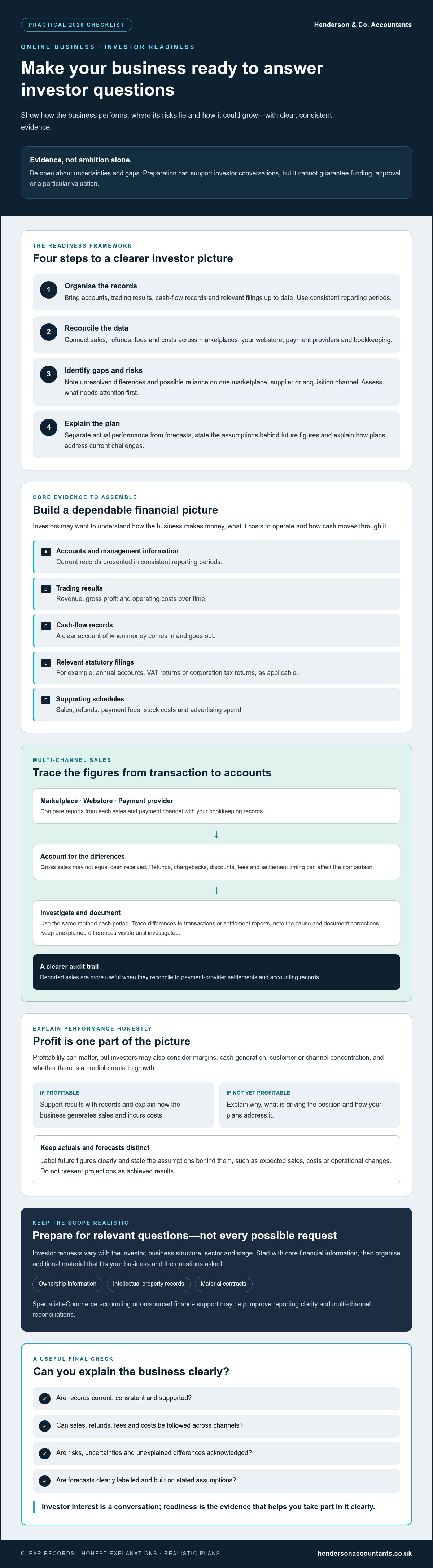
Use this step-by-step checklist to prepare your investor materials
A clear preparation process helps you turn scattered records into a focused account of the business. Work through these steps in order, but prioritise issues by investor relevance, urgency and the effort needed to resolve them. A missing document that affects reported performance may need attention before a lower-impact item that can be gathered later.
- 1. Organise records. Group information into financial records, sales and operations, company records, risks and growth plans. Name files clearly and note the period they cover.
- 2. Reconcile data. Check that sales, payment settlements and bookkeeping records agree. Record unresolved differences and who will investigate them.
- 3. Identify gaps. Mark each item as ready, incomplete or requiring specialist advice. Consider business impact, urgency and the work involved before setting priorities.
- 4. Prepare forecasts. Build projections from measurable drivers, document assumptions and test how results might change under different conditions.
- 5. Assemble supporting materials. Create a concise index so you can find relevant evidence without sending every file at once.
What should your investor-readiness checklist include?
For each item, assign an owner and a review date. This clarifies who is responsible for filling a gap and helps prevent incomplete evidence from being overlooked. Not every document will apply to every business or be requested by every investor, so use the checklist as a working guide rather than a universal set of requirements.
If you use a virtual data room or shared folder, organise documents under the same headings as your index. Control access to confidential information, share only what’s appropriate for the stage of discussions and review permissions as the process develops.
How should you prepare forecasts and a growth case?
Link projections to business drivers you can track, such as order volume, average order value and contribution margin. Prepare base, downside and upside scenarios, and state what would need to be true for each. Review assumptions against actual results, including seasonality, stock availability and planned spending.
Explain how any proposed investment might be used and what evidence would indicate progress, such as improved contribution per order or the ability to support more sales. These are measures to monitor, not promised outcomes. Making your online business investor-ready means presenting a reasoned case, making assumptions visible and clearly distinguishing forecasts from actual performance.
If multi-channel records or reporting need attention, explore eCommerce accounting support to help organise financial information for investor discussions.
Choose the right financial support and take your next steps
The right support depends on what’s missing and how much financial oversight your business needs. You might manage preparation yourself, bring in an eCommerce accountant for specialist accounting work, or consider broader outsourced finance support. Compare options by the work required and the capacity you have, rather than assuming one approach suits every business.
| Approach | May suit you if | Consider |
|---|---|---|
| Self-managed preparation | Your records are organised and you have time to maintain them | Whether you can keep reporting accurate and preparation on track alongside daily operations |
| Specialist eCommerce accounting | You need help with online sales records, reconciliations or reporting clarity | Which channels, records and accounting tasks the accountant will cover |
| Outsourced finance support | You need wider financial oversight or ongoing support as the business develops | Whether bookkeeping, payroll, finance department or finance director support fits your needs |
When could an eCommerce accountant help?
If sales flow through several marketplaces, webstores or payment providers, an eCommerce accountant may help organise bookkeeping and reconciliations so reporting is easier to understand. Xero cloud accounting setup can support a structured accounting process. Well-organised records for VAT returns, corporation tax returns and annual accounts can also help build a clearer financial picture. Before engaging an accountant, confirm which services are included and whether they fit your business and preparation needs.
When might outsourced finance support be useful?
Bookkeeping or payroll support may help with defined, recurring tasks, while an outsourced finance department or finance director may suit a business seeking broader financial oversight. External support can be considered alongside building an in-house finance function, but the right choice depends on your workload, plans and available capacity. Clarify the responsibilities, reporting and level of input you need.
Accounting support can improve reconciliations and reporting clarity, but it can’t guarantee investor approval, funding or a particular valuation. Legal questions, statutory audit work or investment advice may require separate, appropriately qualified professionals.
To take the next step, assess your gaps, decide which to address first and seek relevant professional guidance. If support with eCommerce records and reporting would be useful, Discuss your eCommerce accounting needs.
Take the next step towards investor readiness
Making your online business investor-ready starts with evidence you can explain, not a promise of future success. Keep financial records organised, make sure channel performance and cash flow are clear, and identify operational or compliance gaps with practical next steps. Realistic forecasts, with visible assumptions, help you describe where the business could go without presenting projections as guarantees.
You don’t have to prepare everything alone. Henderson & Co. Accountants supports eCommerce and digital businesses with specialist accounting, Xero setup, bookkeeping, VAT and corporation tax returns, and annual accounts. If you need wider financial oversight as your business develops, outsourced finance department and finance director services may also be worth considering.
Accounting support can help improve reconciliations and reporting clarity, but it can’t guarantee investment or a particular valuation. Choose support that fits the gaps you’ve identified, and confirm the scope before you begin. Discuss your eCommerce accounting needs and take a practical next step towards presenting your business with greater confidence.
Frequently Asked Questions
What does making an online business investor-ready mean?
Making an online business investor-ready means having credible financial information, organised business records, explainable performance and a realistic growth plan. You should be able to answer questions about how the business trades, its risks and the assumptions behind its plans. Preparation can help you respond to investor enquiries, but it can’t guarantee funding, a valuation or investor approval. Requirements vary, so treat a checklist as a useful starting point, not a universal standard.
Can an online business attract investors before it is profitable?
Yes. Profitability isn’t the only factor an investor may consider, but there’s no guarantee that losses will be acceptable to a particular investor. They may also examine margins, cash flow, customer demand, repeatability and a credible route to sustainable growth. Present actual results separately from forecasts, and explain the assumptions behind projections in plain English. Be ready to describe what is driving current performance and what evidence supports your plans.
What financial records do investors usually ask to see?
Requests vary, but investors may ask for statutory accounts, management information, cash-flow records, tax filings and supporting evidence for sales and costs. For an online seller, this could include reconciliations between marketplace, webstore and payment-provider reports and bookkeeping records. Don’t assume every investor will request the same documents. Check their specific requirements, and seek professional advice if you’re unsure how records were prepared or what a figure includes.
How do I prove the sales figures for my online business?
Connect order and sales-platform reports to payment settlements, bank transactions and accounting entries. Your reconciliation should account for refunds, fees, chargebacks and timing differences, since reported sales won’t always equal the cash received in a particular period. Use a consistent method and keep supporting records for the figures you report. Headline totals or screenshots alone may not explain how sales were recorded. Accounting support can help organise complex data across sales channels.
Do I need a data room before speaking to investors?
No, a formal data room isn’t essential in every situation. An organised, access-controlled document space can make a review easier, but the format depends on the investor and stage of discussions. Create an index and group relevant financial, operational and company records so you can locate them efficiently. Protect confidential information: share sensitive documents selectively, check who has access and seek appropriate advice if you’re unsure what should be disclosed.
How much does it cost to make an online business investor-ready?
There’s no single cost. The work depends on the state of your existing records, the complexity of your sales channels and the type of support you need. Start by listing the gaps, then ask relevant accountants or advisers to explain their proposed scope and fees. Accounting preparation is separate from legal, audit or investment advice, which may require other suitably qualified professionals. Clarifying what you need first can help you compare proposals.
Should I hire an accountant before approaching investors?
An accountant may help organise records, reconcile online sales, prepare clearer management information and identify accounting issues to address. The right support depends on your business needs and current systems, so agree the scope before engaging. Henderson & Co. Accountants specialises in eCommerce accounting and also provides Xero setup, bookkeeping, tax return preparation and annual accounts support. Accounting help can improve financial clarity, but can’t guarantee an investor’s decision. Legal, audit or investment advice may require other qualified professionals.


