

Most business owners treat their annual tax bill as an unavoidable penalty, but what if you viewed it as a strategic variable you could actually influence? Staying on top of your corporation tax uk obligations often feels like a stressful balancing act between complex tiered rates and the constant pressure of HMRC deadlines. It's completely natural to feel a sense of frustration when trying to figure out where your profits sit within the current system or whether you're accidentally overpaying through missed allowances.
This guide helps you regain control by demystifying the 19% and 25% thresholds and explaining the new 14% writing down allowance effective from April 2026. You'll learn exactly how to calculate Marginal Relief and discover strategic opportunities to protect your bottom line through tools like full expensing and the £1 million Annual Investment Allowance. We'll walk through the essential filing dates, the updated penalty structures, and the proactive steps you can take to keep your business growth on track without the fear of hidden complications or unexpected costs.
Key Takeaways
- Understand the tiered system where your company pays 19% on profits under £50,000 or 25% for those over £250,000.
- Learn how to manage the complexities of corporation tax uk by calculating Marginal Relief for profits sitting between the two main thresholds.
- You can lower your taxable profit by using strategic allowances like the £1 million Annual Investment Allowance and updated writing down rates.
- Master the critical timelines for HMRC compliance, including why you've got to pay your tax bill before you actually file your return.
- Discover how proactive planning and optimised director remuneration protect your bottom line whilst supporting business growth.
What is Corporation Tax and Who Must Pay in the UK?
At its simplest, corporation tax uk is a tax paid on the taxable profits made by limited companies and certain other organisations. Unlike personal income tax, there's no "tax-free allowance" here; your business starts paying from the very first pound of profit. This tax isn't just a levy on your daily sales. It also covers the interest your business earns in the bank and any "chargeable gains" made when you sell a business asset, such as a property or equipment, for more than it cost you.
The rules change depending on where your business is legally based. If your company is a UK resident, you'll usually pay tax on all your profits, regardless of where in the world they were earned. This is a vital consideration for modern eCommerce brands that might sell across Europe or North America whilst managing operations from a UK office. Conversely, foreign companies with a UK branch or a permanent base here only pay tax on the profits resulting from their UK-based activities. Understanding the History of UK Corporation Tax helps clarify how these residency rules have evolved to keep pace with a globalised economy.
Your journey with this tax starts at the very beginning of your business lifecycle. When you register with Companies House, they'll notify HMRC, but you still have a responsibility to tell HMRC yourself within three months of starting to trade. This proactive step ensures you're set up for the correct reporting periods from day one. It's the first step in a cycle of registration, accounting, and filing that keeps your business compliant.
Taxable Profits: What Counts as Business Income?
Calculating your taxable profit isn't always as straightforward as looking at your bank balance. It's a specific figure reached after you've added up your trading profits, which is the money left from your core business activities after deducting allowable expenses. You also need to include:
- Investment income: Any interest earned on business savings or dividends from other company shares.
- Chargeable gains: Profits made from disposing of assets like land, buildings, or shares.
Entities Required to File a CT600
Whilst most people associate this tax with private limited companies, the net is actually much wider. You're required to file a CT600 tax return if you're running:
- A limited company (both private and public).
- An unincorporated association, such as a local sports club, a community group, or a co-operative.
- A foreign company with a UK branch or a permanent place of business on British soil.
If you're unsure where your specific setup falls, it's always better to check early. Getting the registration right at the start prevents the stress of backdated filings and unexpected HMRC enquiries later on.
Corporation Tax Rates, Thresholds, and Marginal Relief
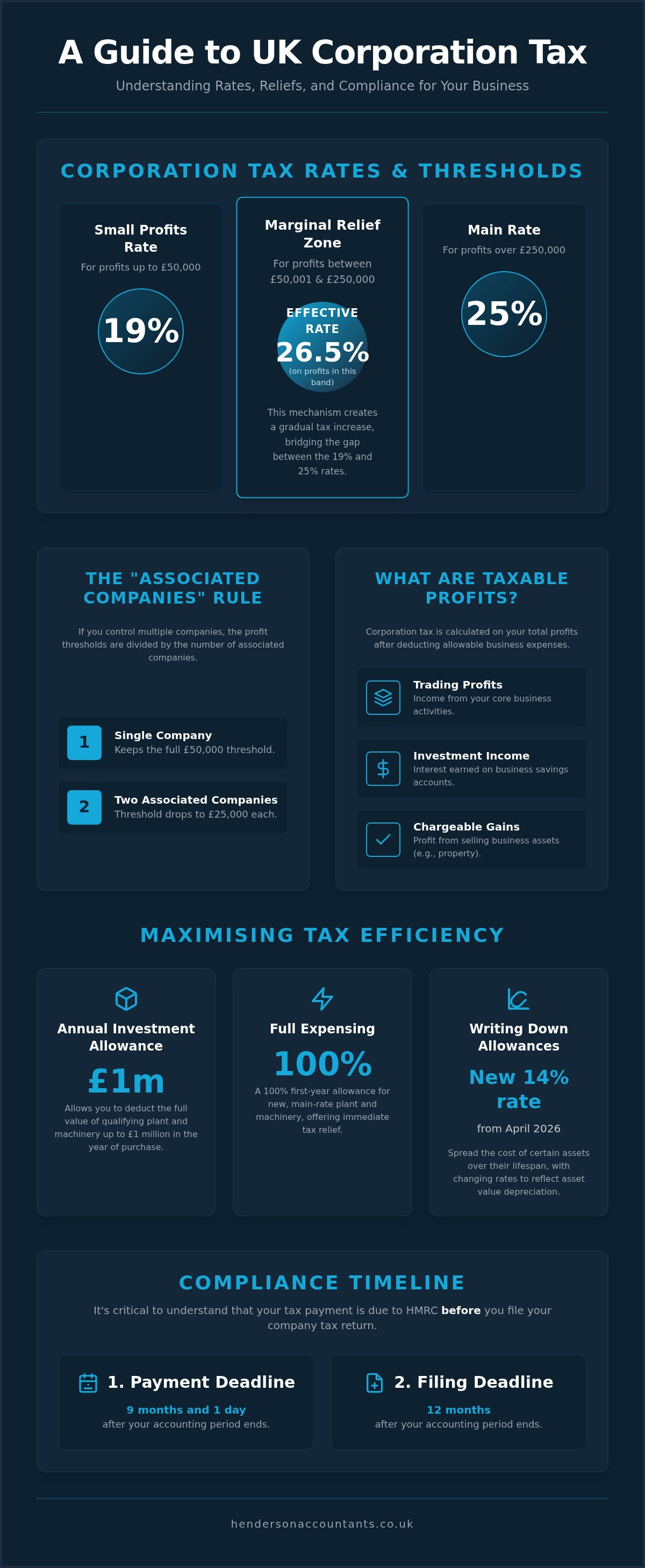
Understanding how much you'll pay starts with two key numbers: 19% and 25%. If your company's taxable profits are £50,000 or less, you fall under the Small Profits Rate of 19%. Once your profits exceed £250,000, you'll pay the Main Rate of 25% on everything. It sounds simple, but the area between these two figures is where most business owners feel the most confusion regarding corporation tax uk.
If you run multiple businesses under common control, HMRC views them as "associated companies". This means you don't get the full £50,000 or £250,000 threshold for each one. Instead, these limits are divided by the number of associated companies you have. For example, if you own two companies, your Small Profits Rate threshold drops to £25,000 each. This prevents owners from splitting one large business into several smaller ones just to pay less tax. Keeping track of these connections is a vital part of proactive tax planning to ensure you aren't hit with an unexpected bill.
Calculating Marginal Relief: The Effective Rate
Marginal Relief is the mechanism that bridges the gap between the 19% and 25% rates. When your profits sit between £50,000 and £250,000, HMRC applies a gradual increase. Whilst the headline rate is 25%, the calculation actually works out to an effective rate of 26.5% on the profits within that specific band. This ensures that as your business grows, your tax bill doesn't suddenly jump in one giant leap. HMRC calculates the corporation tax uk liability based on these moving targets using a specific relief fraction, so keeping a clear eye on your profit projections is vital.
Threshold Adjustments for Short Accounting Periods
Tax years aren't always a perfect 12 months. If your accounting period is shorter, perhaps because you've just started or you're changing your year-end date, your thresholds are pro-rated. A six-month period would see your Small Profits threshold drop to £25,000. Aligning your tax periods with your natural business cycles is a smart move, but you must stay on top of Corporation Tax registration and filing rules to avoid penalties during these transitions. Changing your year-end date can affect your cash flow, so it's a decision that requires a bit of forward-thinking to get right.
Maximising Tax Efficiency Through Reliefs and Allowances
While the rates might seem fixed, the amount you actually pay depends heavily on how you use available reliefs. These aren't loopholes; they're government-backed incentives designed to encourage business investment and growth. By understanding how to apply these to your specific business model, you can significantly lower your corporation tax uk liability whilst keeping more cash in your company. The Official GOV.UK Corporation Tax guidance provides the full framework, but knowing how to apply it to your daily operations is where the real value lies.
Capital allowances are one of the most effective ways to reduce your tax bill. They let you deduct the cost of certain assets from your taxable profits before the tax is even calculated. As of 1st April 2026, the standard Main Pool Writing Down Allowance (WDA) rate is 14%. While this is a reduction from previous years, you still have powerful tools like Full Expensing. This allows incorporated companies to claim an uncapped 100% first-year allowance on qualifying new and unused plant and machinery, providing an immediate tax write-off. Additionally, the Annual Investment Allowance (AIA) remains at £1 million, covering both new and second-hand equipment.
Capital Allowances for Digital and eCommerce Businesses
For eCommerce and digital brands, your tech stack is often your biggest investment. You can claim allowances for server hardware, laptops, and even specific office equipment. It's vital to distinguish between revenue expenditure, such as monthly software subscriptions, and capital expenditure, like buying hardware. If you're investing in green technology, such as electric delivery vans or EV charging points, you might qualify for 100% first-year allowances until 2027. This proactive approach ensures your tax strategy supports your environmental goals.
R&D Relief for SME Innovation
Many business owners think Research and Development (R&D) is only for scientists in white coats. In reality, if you're developing new software to automate your supply chain or creating a unique product to solve a technical problem, you could be eligible. This relief allows you to deduct an extra percentage of your qualifying costs from your yearly profit. If your company isn't yet profitable, you can often claim a payable tax credit instead. This provides a vital cash injection during the early stages of innovation.
If your business has a difficult year, you don't just lose out. You can carry business losses forward to offset against future profits, or even carry them back one year to get a refund on tax you've already paid. It's a supportive mechanism that helps stabilise your finances during periods of rapid scaling or market shifts. Managing these losses effectively is a cornerstone of smart financial planning.
Managing Compliance: Registration, Filing, and Deadlines
Staying compliant doesn't have to be a source of anxiety if you understand the sequence of events HMRC expects. Your first job is to register for corporation tax uk within three months of starting to trade. If you miss this window, you risk penalties right at the start of your business journey. Once you're registered, the lifecycle follows a predictable pattern of recording, paying, and finally, reporting.
One of the most confusing parts of the system is the timing of your bill. Most business owners expect to pay when they file their return, but HMRC actually requires payment first. For most companies, the deadline to pay your tax is nine months and one day after the end of your accounting period. You then have until 12 months after that same period end to actually file your return. This gap means you must have your figures finalised early to avoid interest charges on underpaid tax.
Missing these dates is expensive. For returns due on or after 1 April 2026, a late CT600 filing triggers an immediate £200 penalty if you're up to three months late. This jumps to £400 if you're more than three months late, and the costs escalate if you're consecutively late. It's much easier to stay organised than to manage the stress of rising HMRC debts. If you need help staying on top of these dates, our team provides expert Corporation Tax Returns services to keep you on the right side of the rules.
The Reporting Timeline: Key Dates to Remember
Managing your cash flow requires a clear view of these milestones. You'll need to pay your liability by the nine-month mark, whilst the final submission of your statutory accounts happens at the 12-month mark. The CT600 is the primary tax return document for UK companies, and it must be submitted electronically alongside your accounts.
Leveraging Cloud Accounting for Accurate Filings
Modern tools like Xero have transformed how businesses handle compliance. Instead of a year-end scramble, you can automate the reconciliation of your income and expenses in real-time. This provides a clear estimation of your corporation tax uk liability throughout the year, so you aren't surprised by a large bill. Using cloud software also ensures your records are ready for Making Tax Digital (MTD) requirements, keeping your data secure and your reporting accurate. It turns a reactive chore into a proactive part of your business strategy.
Strategic Tax Planning: Beyond Standard Compliance
Many business owners view their tax return as a reactive, year-end chore. However, treating corporation tax uk as a fixed cost rather than a manageable variable can lead to missed opportunities and unnecessary cash flow strain. Strategic tax planning is about looking forward, ensuring that every business decision you make today is structured to protect your future profits. It's the difference between merely staying compliant and building a resilient, tax-efficient foundation for growth.
One of the most effective ways to manage your liability is through optimised director remuneration. By carefully balancing your salary, dividends, and pension contributions, you can reduce the company's taxable profit whilst maintaining your personal income. For example, employer pension contributions are usually treated as an allowable business expense, which directly lowers your corporation tax uk bill. Planning these payments throughout the year, rather than in a last-minute scramble, allows you to maximise your allowances without disrupting your operational budget.
Staying ahead of government policy is also vital. With the recent reduction in the Main Pool Writing Down Allowance to 14% from April 2026, the pace of tax relief on capital investments has slowed. A proactive strategy helps you navigate these shifts, ensuring you invest in assets at the most tax-advantageous times. This forward-thinking approach prepares your business for legislative changes before they impact your bank balance.
Proactive vs. Reactive Tax Management
Reactive accounting only tells you what happened in the past. Proactive management identifies savings whilst you still have time to act. This might involve timing a large equipment purchase to fall within a specific financial year or restructuring international transactions to suit your residency status. Engaging Outsourced Finance Director services gives you access to this high-level strategic oversight without the cost of a full-time hire. It turns your finance function into a growth engine rather than a back-office requirement.
Building a Scalable Tax Strategy
As your business scales, you'll naturally move through the Marginal Relief thresholds. Managing this transition requires a joined-up approach where your corporation tax planning works in harmony with your VAT and payroll strategies. For instance, rapid growth might push you over the £90,000 VAT threshold and towards the 25% main rate of tax simultaneously. Henderson & Co. Accountants provide the clarity and control you need to manage these overlapping complexities. By integrating your Xero data with professional expertise, we ensure your tax strategy evolves alongside your business, keeping you in calm control of your financial future.
Take Control of Your Business Tax Strategy
Mastering your tax position requires moving from a reactive year-end mindset to a proactive, forward-thinking approach. By understanding the current tiered rates and correctly calculating Marginal Relief, you ensure your business is never surprised by its final bill. Leveraging powerful capital allowances like the £1 million Annual Investment Allowance and full expensing helps you keep more hard-earned profit within your company. Staying ahead of HMRC deadlines is the final piece of the puzzle, protecting your cash flow whilst maintaining a stable foundation for growth.
As specialists in Xero and eCommerce accounting, we help you demystify the complexities of corporation tax uk. Our proactive tax planning and outsourced finance director expertise provide the clarity and control you need to scale your business without the fear of hidden barriers. Ensure your business is fully HMRC compliant with our expert Corporation Tax services.
You've worked hard to build a successful business; don't let tax complexity hold you back. With the right digital tools and a strategic partner by your side, you can turn compliance into a genuine competitive advantage and focus on what you do best.
Frequently Asked Questions
How much is Corporation Tax in the UK for 2026?
For the financial year starting 1 April 2026, the main rate of corporation tax uk is 25% for companies with profits over £250,000. If your profits are £50,000 or less, you qualify for the Small Profits Rate of 19%. Businesses sitting between these two figures pay a tapered rate through Marginal Relief. These thresholds ensure that smaller entities aren't burdened with the same tax weight as large corporations whilst encouraging steady growth.
When is the deadline to pay my Corporation Tax bill?
Your payment deadline is usually nine months and one day after the end of your accounting period. It's vital to remember that this date falls before your filing deadline, which is 12 months after your period end. For example, if your year-end is 31 December, you must pay HMRC by 1 October the following year. Finalising your accounts early helps you manage your cash flow and avoids the stress of last-minute calculations.
Can I pay my Corporation Tax in instalments?
Most SMEs pay their tax in a single lump sum, but very large companies with annual taxable profits exceeding £1.5 million must pay in quarterly instalments. If your profits are below this threshold, HMRC doesn't offer a standard instalment plan for corporation tax uk. However, if you're struggling to meet a bill, you can contact HMRC to discuss a "Time to Pay" arrangement, which allows for a controlled repayment schedule based on your circumstances.
What happens if my company makes a loss?
If your company makes a trading loss, you can use it to reduce your tax bill. You have the option to carry the loss back one year to get a refund on tax previously paid, or carry it forward to offset against future profits. This flexibility is a vital safety net for businesses during periods of heavy investment or market downturns. It ensures that your tax liability over several years reflects your true overall profitability.
Do I need to pay Corporation Tax if my company is dormant?
You don't pay Corporation Tax if your company is dormant for tax purposes, meaning it isn't trading or receiving any income. You must still inform HMRC that the company is dormant to stop them from sending you tax return reminders. Even whilst dormant, you're still required to file annual accounts and a confirmation statement with Companies House. Keeping these administrative tasks up to date prevents your company from being struck off the register.
What is the difference between the main rate and the small profits rate?
The difference lies in the profit thresholds and the resulting tax percentage. The Small Profits Rate of 19% applies to companies with profits up to £50,000, whilst the Main Rate of 25% applies once profits exceed £250,000. Companies in the middle ground pay the Main Rate but receive a deduction through Marginal Relief. This tiered system replaces the previous flat-rate model, requiring more precise profit forecasting to manage your effective tax rate.
How do associated companies affect my tax thresholds?
Having associated companies means your tax thresholds are divided by the number of businesses under common control. If you own three separate companies, the £50,000 Small Profits threshold is split, giving each company only £16,667 at the 19% rate. This rule prevents owners from artificially lowering their tax by splitting one business into many smaller entities. It's a critical factor to consider when structuring your group or launching new ventures.
Is Corporation Tax the same as Capital Gains Tax for companies?
Limited companies don't pay Capital Gains Tax; instead, they pay Corporation Tax on any "chargeable gains" made from selling assets. This includes profits from disposing of business property, land, or shares. Whilst the calculation methods for the gain are similar to personal Capital Gains Tax, the resulting profit is simply added to your other business income. It's then taxed at either 19% or 25% depending on your total profit for that accounting period.


