
Are you accidentally paying HMRC more than you owe simply because your receipt pile feels too daunting to tackle? It's a common worry for many business owners who fear that a single mistake might trigger a stressful audit or a heavy penalty. You want to be tax-efficient, yet the confusion over dual-purpose costs and changing rules often leads to missed opportunities. Understanding allowable expenses corporation tax uk doesn't have to be a source of anxiety or a manual chore that eats into your weekends.
We know that you value clarity and want to feel in control of your company's finances. This guide promises to help you master the latest HMRC rules for 2026, ensuring your limited company remains fully compliant whilst maximising your tax efficiency. We'll replace the guesswork with a clear, actionable list of what you can legally deduct from your profits to ensure you only pay what's necessary.
You'll discover exactly which costs qualify, how to handle complex areas like staff entertainment, and how to use Xero to automate your record-keeping. We'll also explore strategic planning tools like the Annual Investment Allowance and director's pension contributions to help your business grow with confidence and stability.
Key Takeaways
- Master the "wholly and exclusively" rule to identify which allowable expenses corporation tax uk regulations permit, ensuring you only pay the tax you truly owe.
- Learn to distinguish between tax-deductible staff events and non-deductible client hospitality to avoid common HMRC penalties.
- Discover how to transition from manual receipt tracking to a digital-first approach using Xero to meet upcoming Making Tax Digital requirements.
- Identify core operational deductions, from office rent to employer pension contributions, that can significantly reduce your company's taxable profit.
- Understand the value of proactive, year-round tax planning to move beyond simple compliance and towards strategic business growth.
The Fundamentals of Allowable Expenses for UK Corporation Tax
Running a limited company involves a constant stream of costs. Understanding which of these qualify as allowable expenses corporation tax uk is vital for your bottom line. Simply put, these expenses are deducted from your total income to reach your taxable profit figure. Since your tax bill is calculated as a percentage of this profit, every legitimate pound you claim helps keep more money in your business for future growth. This principle is a central part of the UK Corporation Tax System, which aims to tax companies on their actual earnings after the necessary costs of doing business are met.
The Wholly and Exclusively Rule Explained
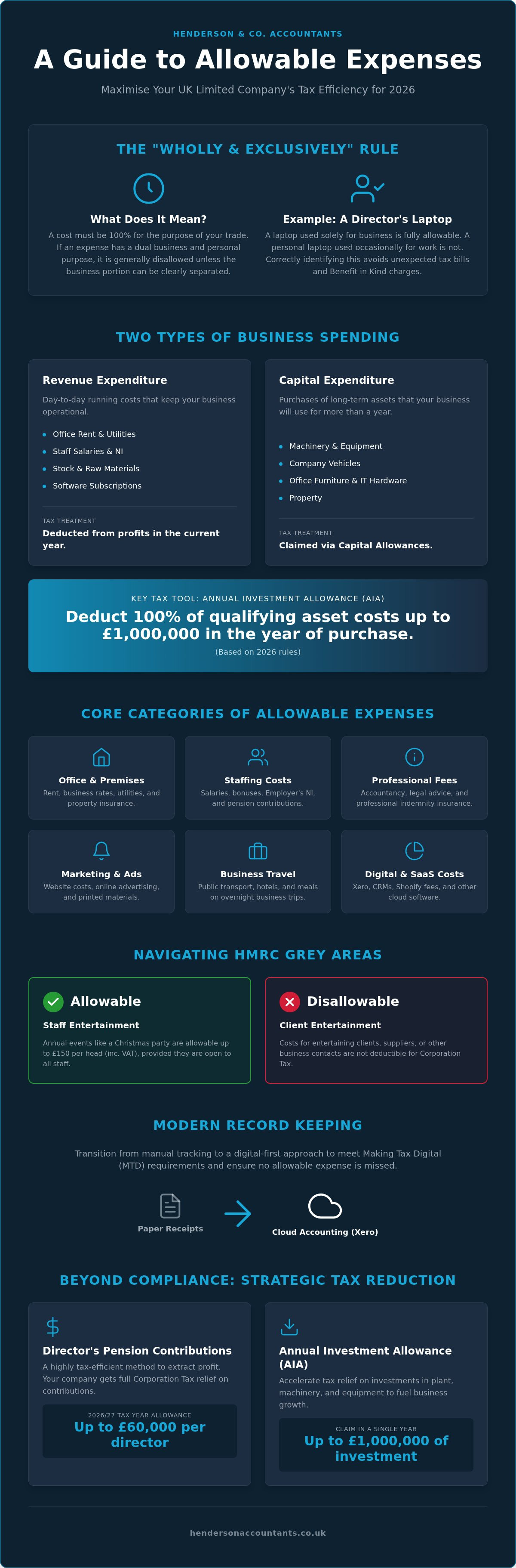
HMRC uses a specific phrase to decide if a cost is deductible: it must be incurred "wholly and exclusively" for the purpose of your trade. This sounds formal, but it's actually a straightforward test. If you buy a laptop that stays in the office and is only used for client work, it's a clear business expense. However, if you buy a high-end camera for your personal holiday but use it once for a business headshot, HMRC will likely view this as having a dual purpose.
When a cost serves both your business and your personal life, you must be able to separate the two. For example, if you work from home, you can apportion a percentage of your utility bills based on the space you use. If you can't clearly separate the business portion, the entire expense becomes disallowable. Correctly identifying allowable expenses corporation tax uk directors can claim protects you from unexpected tax bills and prevents personal items from triggering a Benefit in Kind (BiK) charge.
Revenue vs Capital Expenditure
Your business spending falls into two main buckets. Revenue expenditure includes the day-to-day costs of keeping your doors open, such as:
- Office rent and utility bills
- Business insurance and professional fees
- Staff salaries and stock for resale
Capital expenditure refers to longer-term investments in assets that your business will use for more than a year, like machinery, vehicles, or expensive IT hardware. You don't usually deduct the full cost of these from your profits in the same way as revenue expenses. Instead, you claim Capital Allowances. Under current 2026 rules, the Annual Investment Allowance (AIA) remains at £1 million, allowing many businesses to deduct 100% of the cost of qualifying assets in the year they are bought. This is a powerful tool for tax-efficient scaling, provided you categorise your purchases accurately from the start.
Core Categories: What Your Limited Company Can Claim
Your limited company's day-to-day costs are the most frequent allowable expenses corporation tax uk rules cover. These include your business premises rent, utilities, and insurance. If you operate an eCommerce business, this category expands to include essential platform costs like Shopify subscriptions or Amazon marketplace fees. Shipping costs and software for managing multi-channel inventory are also fully deductible. These digital-first costs are often overlooked by traditional firms, but they're vital for calculating your true taxable profit. We often find that eCommerce sellers miss these small, recurring software fees, which can add up to thousands in unclaimed relief over a year.
Staffing is another major area for savings. You can claim for gross salaries, employer National Insurance contributions, and pension payments. For the 2026/27 tax year, you can deduct employer pension contributions of up to £60,000 per director. This is a highly effective way to reduce your tax bill whilst building long-term security. If you're scaling quickly, our outsourced finance department service can help you manage these payroll complexities and ensure every penny of relief is captured.
Professional Fees and Subscriptions
Professional support is a core part of allowable expenses corporation tax uk directors should track carefully. You can claim for the professional support that keeps your business compliant. This includes your fees for bookkeeping, legal advice for business contracts, and professional indemnity insurance. Most trade association memberships are also allowable. In the digital age, your Software as a Service (SaaS) costs are significant. Whether it's your Xero cloud accounting subscription or your CRM system, these are all legitimate deductions that reduce your Corporation Tax liability.
Travel and Subsistence
Business travel is deductible as long as the journey is purely for work. For the 2026/27 tax year, the approved mileage rate for cars and vans has increased to 55p per mile for the first 10,000 miles. If you use public transport, keep every digital receipt for trains, buses, and flights. You can also claim for modest overnight hotel stays and meals whilst away on business duty. Be careful with the 24-month rule; if you work at a temporary location for longer than two years, HMRC may view it as a permanent workplace. This change in status makes your travel costs to that location disallowable, so it's worth monitoring your project timelines closely.
Allowable vs Disallowable: Navigating the HMRC Grey Areas
Distinguishing between what you can and cannot claim is often where the most confusion lies for limited company directors. While most operational costs are straightforward, HMRC has strict rules on items that might seem like business necessities but are actually disallowable. Understanding these allowable expenses corporation tax uk nuances prevents you from overstating your deductions and facing potential penalties. It's about finding that balance between being tax-efficient and staying safely within the rules to maintain a sense of calm control over your finances.
Entertainment and Gifts
One of the most common misconceptions involves client hospitality. Even if a lunch with a prospect leads to a major contract, the cost is not tax-deductible. You must add these costs back to your profit when calculating your tax bill. In contrast, staff entertainment is treated differently. HMRC allows a tax exemption of up to £150 per head, per year for annual social events like a Christmas party or a summer BBQ. This limit includes VAT and all related costs like transport or accommodation. If you spend £151, the entire amount becomes a taxable benefit for the employee, so keeping a close eye on the budget is essential.
Small "trivial benefits" for employees are also allowable, provided they cost £50 or less, aren't cash or a voucher, and aren't a reward for performance. For example, a bouquet of flowers for a birthday is fine. When it comes to business gifts, you can only claim for items costing up to £50 that carry a prominent advertisement for your company, such as branded diaries or pens. Gifts of food, drink, or tobacco are generally disallowable regardless of the branding, which is a subtle trap that many business owners fall into.
Legal and Financial Anomalies
Not all professional fees are created equal. Legal fees related to trade, such as recovering bad debts or renewing a short lease, are usually revenue expenses and fully deductible. However, legal costs for capital items, like purchasing a new office or defending your title to an asset, are capital in nature. These cannot be deducted from your trading profit in the same way. Similarly, interest on business loans is an allowable cost, but interest on personal borrowing used for the company is often more complex to claim and requires careful documentation.
HMRC also draws a hard line on fines and penalties. If you receive a parking ticket whilst on a business trip or a penalty for a late tax filing, these are strictly disallowable. The logic is that tax relief should not subsidise a breach of the law. Political donations follow the same rule; they are never deductible for Corporation Tax purposes. Finally, you can claim for bad debts, but only if you have taken reasonable steps to recover the money and can prove the debt is truly uncollectible. Writing off these unpaid invoices directly reduces your taxable profit, ensuring you don't pay tax on income you never actually received.
Modern Record Keeping: Capturing Expenses in a Digital World
HMRC requires you to keep business records for at least six years from the end of the accounting period they relate to. For many directors, this used to mean a shoebox full of fading paper receipts and manual spreadsheets. That old-fashioned approach is not only time-consuming but also increasingly risky under the "Making Tax Digital" (MTD) initiative. By 2026, digital record-keeping is no longer just a modern convenience; it is a fundamental compliance necessity for businesses of all sizes. Moving your allowable expenses corporation tax uk tracking into a digital environment ensures that no deduction is lost to a spilled coffee or a misplaced envelope. It replaces the anxiety of a potential audit with the calm security of a searchable, cloud-based archive.
Leveraging Xero for Expense Management
Cloud accounting software like Xero has transformed how you capture data. Instead of manual entry, you can use mobile apps to snap a photo of a receipt the moment you pay. The software reads the data and prepares the entry for you. By automating your bank feeds, transactions flow into your accounts in real-time. This allows you to reconcile your spending whilst you're on the train or between meetings. This automation significantly reduces human error in your calculations, ensuring your VAT and Corporation Tax figures are accurate. If you haven't made the switch yet, we can help with a professional Xero cloud accounting setup to get your systems running smoothly.
The Role of Management Accounts
Tracking your costs shouldn't be a once-a-year task performed in a rush before the filing deadline. When you manage your expenses on a monthly basis, you gain access to Management Accounts that tell the true story of your business health. This real-time visibility helps you identify trends in your overheads before they become expensive problems. For example, an eCommerce seller might notice a sudden spike in marketplace fees or shipping costs that requires a change in pricing strategy.
Consistent tracking also prevents the dreaded "tax shock" at year-end. By seeing your projected allowable expenses corporation tax uk deductions throughout the financial year, you can forecast your tax bill with high precision. This proactive approach turns tax planning into a strategic growth tool rather than a reactive compliance burden. It gives you the stable foundation needed to make confident investment decisions, knowing exactly how much cash you need to set aside for HMRC and how much is truly available for reinvestment.
Optimising Your Tax Position with Professional Compliance
Attempting to handle your own Corporation Tax returns often leads to missed opportunities. While the basics like rent and stock are easy to spot, the more nuanced allowable expenses corporation tax uk rules permit can be overlooked. A reactive, year-end approach means you're simply recording history rather than shaping it. By the time you sit down to file, it's often too late to implement the strategies that could have significantly lowered your bill. Professional compliance replaces that year-end panic with a steady, methodical process that runs in the background of your daily operations.
This is where a proactive partnership makes a difference. An Outsourced Finance Director doesn't just look at receipts; they look at your business structure. For eCommerce brands, this might mean reviewing how you manage multi-channel data flows or identifying industry-specific reliefs that a generalist might miss. We ensure your business is structured for maximum efficiency from day one, helping you avoid the associated companies trap where profit thresholds are divided amongst commonly controlled entities. This level of oversight provides a sense of calm control, knowing that every legal deduction is being captured.
Strategic Tax Planning for Growth
We focus on moving beyond basic compliance to proactive financial strategy. For example, many innovative companies fail to claim R&D tax credits, which currently offer an enhanced deduction of 186% on qualifying costs. Others miss out on full expensing, which allows for a 100% first-year deduction on new machinery and tech. Henderson & Co. acts as your proactive guide, identifying these capital allowance opportunities whilst you focus on scaling your operations. As your business grows, your finance function must scale too, moving from simple bookkeeping to a sophisticated, outsourced finance department that stays ahead of the curve.
Next Steps for Your Limited Company
Your first step should be a thorough review of your current expense policy to spot any HMRC red flags, such as high volumes of dual-purpose costs or missing digital records. Transitioning to a tech-enabled finance function isn't just about software; it's about having the right experts to interpret the data. It's about building a stable foundation where you can reinvest your profits without fear of hidden complications or confusing barriers. If you're ready to gain confidence in your tax position, Speak to our tax specialists today for a comprehensive review of your Xero setup and tax strategy.
Take Control of Your Tax Efficiency
Managing your company's finances doesn't have to be a source of constant worry. By mastering the fundamental "wholly and exclusively" rule and embracing digital tools like Xero, you can ensure your business remains compliant whilst keeping more of your hard-earned profit. Proactive record-keeping turns a once-a-year stress into a clear, manageable process that supports your long-term growth.
Identifying every legitimate allowable expenses corporation tax uk regulation permits is often the difference between a business that merely survives and one that truly thrives. As Xero Platinum Partners and specialist eCommerce accountants, we understand the specific hurdles you face. Our expert outsourced finance directors are here to help you navigate complex HMRC rules and find strategic reliefs tailored to your industry.
Ready to replace tax anxiety with calm control? Optimise your Corporation Tax with Henderson & Co. Accountants today. We are committed to your peace of mind and are ready to act as your collaborative ally in building a stable, successful business.
Frequently Asked Questions
Can I claim for working from home as a limited company director?
Yes, you can. Most directors choose between a flat-rate payment of £6 per week or a formal rental agreement between themselves and their company. If you choose the latter, you must calculate a fair proportion of your household bills based on the area used for work. This ensures your allowable expenses corporation tax uk claims remain transparent and defensible if HMRC ever requests a review of your home office costs.
Is my business insurance an allowable expense for Corporation Tax?
Yes, business insurance is a fully deductible expense. This includes professional indemnity insurance, public liability, and employer's liability cover. If you run an eCommerce business, you can also claim for product liability or specialised stock insurance. These costs are essential for protecting your company's stability and are viewed by HMRC as being incurred "wholly and exclusively" for the purpose of your trade. Always ensure the policy is in the company name.
Can I deduct the cost of my commute to the office?
No, you cannot claim for your regular commute between your home and a permanent place of work. HMRC views this as a personal choice rather than a business necessity. However, you can claim for travel to temporary workplaces or client sites. For the 2026/27 tax year, the approved mileage rate for the first 10,000 miles is 55p. This distinction is vital to avoid "red flags" during a tax review or compliance check.
Are training courses and professional development tax-deductible?
Yes, provided the training updates or reinforces skills you already use in the business. For example, a course on new Xero features or an eCommerce marketing seminar is allowable. If the course teaches you an entirely new trade or skill, HMRC may view it as capital expenditure rather than a revenue expense. Keeping your professional knowledge current is a strategic growth tool that helps your company stay ahead of the curve in a competitive market.
What happens if I accidentally claim for a personal expense?
You should correct the error as soon as you notice it by adjusting your bookkeeping records. If the company paid for a personal item, it's usually treated as a payment to you via your Director's Loan Account. If left uncorrected, it could trigger a Benefit in Kind charge or a Section 455 tax penalty. Using real-time software like Xero helps you identify these anomalies early, replacing potential anxiety with a sense of calm control.
Can a limited company claim for Christmas parties?
Yes, your company can claim for an annual event like a Christmas party. HMRC allows a tax-free limit of £150 per head, per year, which can be split across multiple events. This limit must cover everyone attending, including partners. It's a great way to boost staff morale whilst remaining tax-efficient. Be careful not to exceed the £150 threshold by even a penny, as the entire amount then becomes a taxable benefit for your employees.
Is digital advertising (Google/Meta Ads) an allowable expense?
Yes, digital advertising costs are fully deductible allowable expenses corporation tax uk rules cover. Whether you are investing in Google Ads, Meta Ads, or SEO services, these are viewed as legitimate marketing costs intended to generate revenue. For eCommerce brands, these often represent a significant portion of monthly overheads. Tracking these accurately in Xero allows you to see the real-world impact of your ad spend on your company's overall profitability and tax position.
Do I need to keep physical receipts if I use cloud accounting software?
No, you don't need to keep the original paper receipts if you have a clear, legible digital copy stored in your accounting software. HMRC accepts digital records as long as they are accurate and accessible. Using a mobile app to snap and upload receipts instantly is a modern, efficient way to manage your records. This transition to digital compliance ensures you meet "Making Tax Digital" requirements whilst eliminating the need for physical storage and paper shoeboxes.


