

If a role is technically optional for your private limited company, does that mean the legal responsibilities have simply vanished? You likely understand that whilst the law no longer requires a formal appointment for every firm, the essential duties of a company secretary in the UK haven't gone anywhere. It's perfectly natural to feel a sense of dread when a Companies House deadline looms or when you're trying to untangle the latest 2026 regulatory updates. You want to focus on growth, not get bogged down in the fine print of the Companies Act.
We're here to help you regain control and find peace of mind. This guide explores how these vital tasks shield your business from compliance risks and administrative errors. We'll clarify which responsibilities are mandatory, walk you through the new identity verification rules ending in November 2026, and provide a practical checklist for statutory compliance. By the end, you'll have a clear roadmap to keep your company legally sound whilst you focus on what you do best. We'll demystify the jargon and replace anxiety with a sense of calm, proactive control over your business's future.
Key Takeaways
- Learn why the duties of a company secretary uk remain a legal necessity for directors even if your private firm chooses not to formally appoint one.
- Understand the critical 2026 deadline for mandatory identity verification (IDV) for all directors and Persons with Significant Control to avoid compliance penalties.
- Discover how transitioning to digital statutory registers and cloud accounting tools like Xero can automate your annual filings and eliminate paperwork stress.
- Master the essentials of board governance, including how accurate minute-taking acts as a vital legal shield for your business decisions.
- Identify the strategic benefits of outsourcing secretarial tasks to reclaim your time and ensure your business stays ahead of changing Companies House regulations.
Mandatory vs Optional: Do You Need a Company Secretary in 2026?
Decisions about your company's structure often feel like a balancing act between compliance and efficiency. One of the most common questions we hear is whether you actually need a secretary in 2026. The short answer is that for most private firms, it's not a legal requirement, but it's almost certainly essential for your peace of mind. Since the law changed, many business owners assume the workload has vanished. In reality, the work remains; it just shifts onto the directors' shoulders.
If you choose not to appoint a secretary, the legal burden for all administrative filings and compliance falls squarely on you. This means you're personally liable for any missed deadlines or errors. The role of a company secretary remains a cornerstone of a healthy business. It acts as a safety net that prevents small administrative oversights from turning into expensive legal headaches. Beyond the law, there's the 'hidden' mandate of credibility. Banks, lenders, and venture capitalists often look for a named secretary as a sign of professional maturity. It shows you take your statutory obligations seriously and have a stable foundation for growth.
The Legal Framework: Companies Act 2006
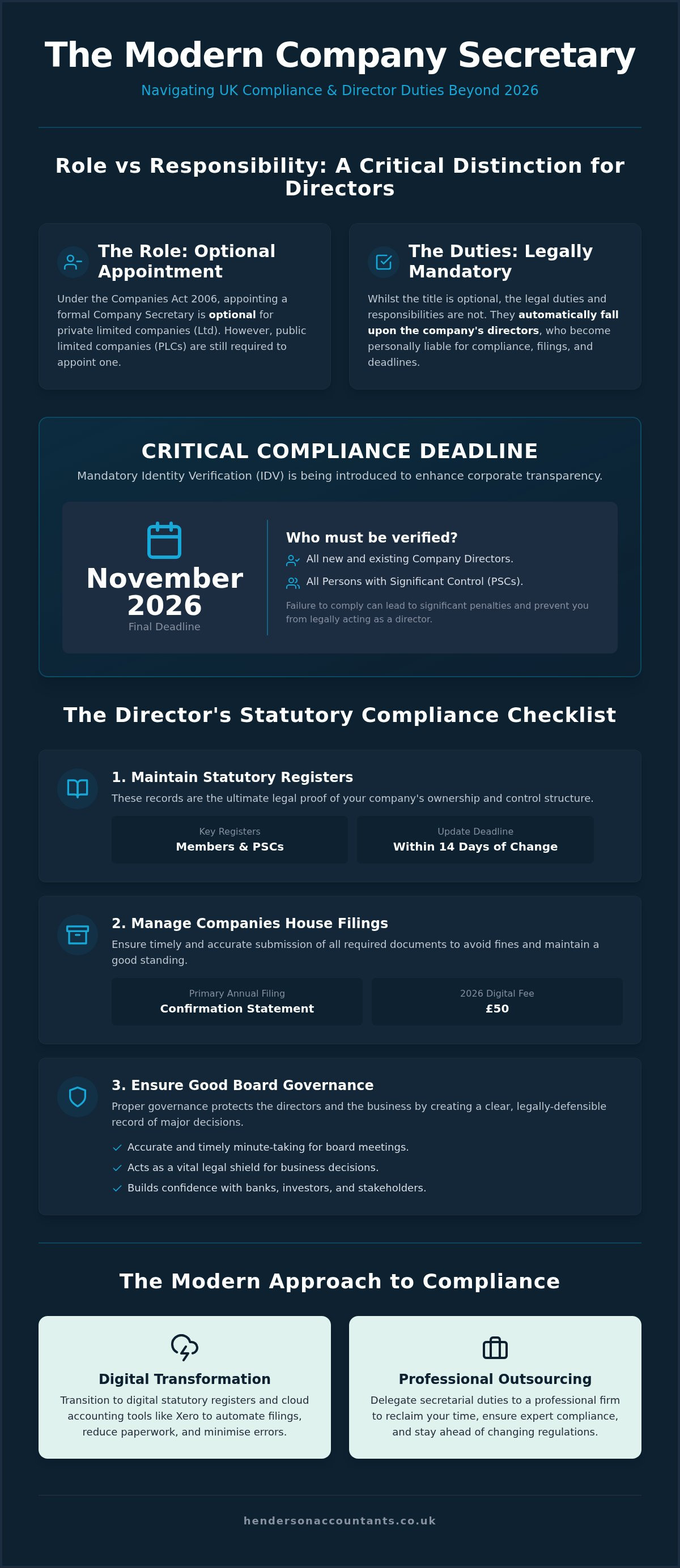
The Companies Act 2006 remains the primary legislation governing these roles. Under Section 271, public limited companies (PLCs) must have a qualified secretary. For private firms, Section 270 makes the appointment optional. It's vital to remember that 'optional' only refers to the title, not the tasks. The duties of a company secretary uk are still mandatory requirements that must be completed by someone in the business. The role has evolved from a basic clerk into a modern governance professional who ensures the board stays on the right side of the law. You should also check your Articles of Association, as some older companies have internal rules that still mandate the role regardless of the general law.
Why eCommerce Brands Still Appoint Secretaries
For fast-growing eCommerce businesses, the duties of a company secretary uk become complex very quickly. If you're managing multiple share classes for investors or dealing with international directors who aren't familiar with UK filing standards, a secretary is your proactive guide. They ensure your corporate face remains spotless for payment gateways and stakeholders. This is especially important when you're scaling quickly and need to maintain a clear trail of board decisions. Having a dedicated professional handles the intricate details of Companies House compliance whilst you focus on your products and customers. It replaces the anxiety of "did we file that?" with the calm confidence that your business is legally sound.
The Statutory Core: Essential Legal Duties and Filings
At the heart of any compliant business lies a collection of records often called the "Bible" of the company. These aren't just administrative chores; they are the legal proof of who owns and runs your business. The duties of a company secretary uk revolve around keeping these documents accurate and accessible. If your records are messy, it's not just a technicality. It can block investment, delay a sale, or even lead to prosecution. Your registered office serves as the official hub for this correspondence, making it the first place authorities look when they need to verify your statutory duties are being met.
Maintenance of Statutory Registers
The Register of Members remains the ultimate proof of ownership in a UK company. Whilst many believe a share certificate is enough, it's the entry in this register that truly counts in a legal dispute. Following reforms in late 2025, information for directors and the Register of People with Significant Control (PSC) is now held centrally at Companies House. However, the secretary must still ensure this central record is updated within strict windows, usually 14 days, whenever changes occur. This is a critical anti-money laundering requirement that protects the integrity of the UK business environment. These records must be easily accessible at your registered office or a Single Alternative Inspection Location (SAIL) to remain fully compliant.
Companies House Submissions
The Confirmation Statement is the annual snapshot of company data that confirms your registered details are correct. In 2026, the digital filing fee for this statement is £50, a cost designed to fund the expanded powers of Companies House. Missing this deadline or failing to notify the register of changes in share capital can lead to your company being struck off. Filing annual accounts is another high-stakes task where the secretary and accountant must work in perfect sync. For eCommerce brands with international directors, this coordination is even more vital to ensure that identity verification requirements are met before filing. You must use specific forms like AP01 for new appointments or AD01 for address changes to keep the public record current and accurate.
If you're dealing with the complexities of international trade or multiple directors, our company secretarial services can take the weight off your shoulders and ensure you never miss a deadline. This proactive support replaces the anxiety of administrative errors with the calm confidence that your business is legally sound.
Governance and Board Support: Beyond the Paperwork
Governance isn't just about ticking boxes. It's about building a stable foundation for every decision your board makes. Whilst filings are the visible part of the job, the internal duties of a company secretary uk involve acting as the bridge between the board and its shareholders. This support ensures that even a small, three-person board operates with the same professional rigour as a large corporation. By handling the logistical weight of meetings and records, the secretary allows directors to stay focused on strategy and growth. They help you stay amongst the best-run businesses in your sector by providing a clear, transparent framework for leadership.
Effective Meeting Management
A well-run board meeting starts long before the directors sit down. The secretary organises the 'notice' of the meeting, ensuring all participants are legally informed within the required timeframe. They craft the agenda to ensure high-priority growth items aren't buried under operational noise. Once the meeting begins, accurate minute-taking becomes the priority. These aren't just notes; they are your best legal defence should a decision ever be questioned. Under UK law, you must keep these minutes for at least 10 years. In 2026, managing these records often involves navigating virtual or hybrid environments, ensuring that remote directors are properly counted for a quorum and that digital votes are securely recorded.
Shareholder Relations
Equity management is another area where the duties of a company secretary uk provide essential protection. When your business reaches a stage of issuing new shares or transferring existing ones, the secretary manages the paperwork to ensure every transaction is legally binding. They issue share certificates and maintain the transparency required to keep investors confident. This role extends to communicating annual results and dividend payments, ensuring that all stakeholders feel informed and valued. By maintaining this clear line of communication, the secretary helps foster a culture of 'fair play' and accountability amongst all members of the company. Accessing a detailed factsheet on the duties of a company secretary can help you understand how these internal relationships protect your business's long-term health.
Modernising the Role: Digital Compliance and Cloud Integration
The era of dusty ledgers and paper-heavy filing cabinets is firmly behind us. In 2026, the duties of a company secretary uk are increasingly defined by digital agility and cloud integration. This shift isn't just about saving trees; it's about building a more resilient, transparent, and efficient business. By moving to digital statutory registers, you ensure your records are always up-to-date and accessible from anywhere. This provides a level of clarity that paper simply cannot match. It replaces the old anxiety of misplaced documents with a secure, searchable digital archive that serves as a stable foundation for your growth.
The Cloud-First Approach to Compliance
Integrating your corporate filings shouldn't be a separate, manual chore. When you connect your Companies House software with accounting suites like Xero, you create a seamless flow of information. This synergy ensures that your annual accounts and confirmation statements are based on the same real-time data you use to run your business. At Henderson & Co. Accountants, we use this tech-forward approach to create a 'calm control' environment for our clients. Directors can access their statutory data in real-time, eliminating the need for frantic manual reports. Automated reminders ensure that a filing deadline never slips through the cracks again. This turns a source of stress into a quiet, background process that protects your business whilst you focus on strategy.
Security and Identity Verification
The digital landscape brings new responsibilities, particularly regarding data security and fraud prevention. As of November 2025, mandatory identity verification (IDV) for directors and Persons with Significant Control (PSC) has become a core requirement. The transition period for existing officers ends on 18 November 2026, making this a high-priority part of the modern duties of a company secretary uk. By acting as the gatekeeper of sensitive corporate data, the secretary protects the company from corporate identity theft through secure digital filings. This role now includes a growing focus on GDPR and digital privacy. It ensures that your company's most sensitive information is handled with the care and security it deserves in an increasingly digital world.
Ready to bring your compliance into the digital age? Explore our Xero cloud accounting setup and secretarial services to streamline your business today.
Outsourcing Secretarial Duties: Why Professional Support Wins
Running a company is a demanding endeavour, and managing its legal administrative burden shouldn't be what keeps you awake at night. Many directors attempt to handle everything themselves to save on costs, but the true expense of a DIY approach isn't found in a filing fee. It's found in the hours you lose to complex paperwork and the constant, low-level anxiety that you might have missed a critical update. Administrative tasks are a silent thief of your potential. Every hour you spend navigating the Companies House portal is an hour taken away from prioritising your eCommerce brand or refining your financial strategy.
Professional support changes this dynamic entirely. By delegating the duties of a company secretary uk, you eliminate the risk of late filing penalties or the nightmare scenario of a company strike-off. As your business expands, your governance needs will naturally become more complex. What worked for a solo start-up won't suffice when you're managing multiple share classes or preparing for an investment round. Specialist support ensures your corporate structure keeps pace with your ambition, providing a stable foundation that investors and lenders respect.
Reclaiming Your Time
When you look at the numbers, the case for outsourcing is clear. A specialist can often complete in minutes what might take a director hours of research and double-checking. This is why our outsourced finance department model includes secretarial support as a standard feature. We believe that financial strategy and statutory compliance should work in harmony. Whilst we handle the filings and register maintenance in the background, you're free to focus on the high-level decisions that actually drive profit. It's about moving from a reactive state of "putting out fires" to a proactive state of calm, methodical growth.
The Henderson & Co. Accountants Advantage
Transitioning from a self-managed setup to professional support is simpler than you might think. The key is to find a partner who understands both the technical requirements of the law and the specific hurdles of your sector. You need a team that is tech-savvy enough to integrate with your existing cloud tools and proactive enough to stay ahead of changing regulations. Henderson & Co. Accountants offers this specialised expertise, acting as a collaborative ally in your business journey. We provide transparency and a clear roadmap for your compliance. If you're ready to replace administrative dread with professional precision, you can Discover how our Company Secretarial Services can protect your business and help you get back to what you do best.
Building Your Business on a Stable Foundation
Mastering the duties of a company secretary uk is about more than just avoiding fines; it's about building a stable foundation for your business's long-term success. We've explored how the shift toward digital filings and mandatory identity verification makes expert oversight more critical than ever. Whether you're managing board minutes or navigating the 2026 fee updates, staying ahead of the curve ensures your business remains a credible partner for banks and investors. Professional compliance replaces the dread of administrative errors with a sense of calm, organised control.
You don't have to manage this complex landscape alone. Henderson & Co. Accountants are specialists in eCommerce growth and compliance, providing the guidance you need to scale safely. From expert Xero cloud accounting setup to dedicated outsourced finance director services, we ensure your statutory obligations are handled with precision. Book a consultation with our specialist UK team today to reclaim your time and focus on your next big milestone. Your business deserves a partner that values your peace of mind as much as your commercial success.
Frequently Asked Questions
Is a company secretary legally required for a UK private limited company?
Private limited companies in the UK aren't legally required to appoint a secretary, though public limited companies (PLCs) still must. Whilst the role is optional, the underlying duties of a company secretary uk remain a mandatory part of your legal compliance. If you don't appoint someone, these responsibilities automatically fall to the company directors. This includes maintaining registers and ensuring all filings with Companies House are accurate and submitted on time.
Can a director also be the company secretary?
Yes, a director can simultaneously hold the position of company secretary in most private limited companies. This is a common setup for smaller firms looking to streamline their leadership structure. However, you should check your company's Articles of Association to ensure there aren't specific internal rules prohibiting this. Even when one person wears both hats, they must still fulfil every statutory obligation to keep the business in good legal standing.
What are the penalties for failing to file a Confirmation Statement?
Failing to file your Confirmation Statement is a serious matter that can lead to your company being struck off the register. Directors can also face personal criminal prosecution and significant fines, as it's a criminal offence to not file on time. Beyond the legal penalties, a late filing remains on your public record. This can damage your credit score and make it much harder to secure business loans or attract new investors.
What is the difference between a company secretary and a personal assistant?
A personal assistant focuses on day-to-day productivity, such as managing diaries and travel. In contrast, a company secretary is a governance professional responsible for the legal integrity of the business. Their work centres on statutory compliance, board transparency, and upholding the Companies Act 2006. Whilst an assistant helps you manage your time, a secretary helps you manage your legal liability and protects the company's official standing with the government.
Can our accountant act as our company secretary?
Yes, and many businesses find this to be the most efficient solution. Having your accountant handle the duties of a company secretary uk ensures that your financial records and statutory filings are perfectly aligned. At Henderson & Co, we offer this as a professional service to help you automate data flows. This integrated approach reduces the risk of administrative errors and gives you a single, reliable point of contact for all your compliance needs.
Does a company secretary have to live in the UK?
There is no legal requirement for a company secretary to be a UK resident. However, they must be able to effectively manage the company's statutory obligations and respond to official correspondence sent to the registered office. With the 2026 digital filing requirements and identity verification rules, having a secretary who is familiar with UK law is more important than their physical location. They must still pass mandatory identity verification to act in the role.
What is a Person with Significant Control (PSC) and why must the secretary report them?
A PSC is someone who owns or controls your company, typically holding more than 25% of shares or voting rights. The secretary must report them to ensure corporate transparency and combat financial crime. This information is a core part of the UK's anti-money laundering framework. Accurate PSC reporting is vital because failing to keep this information up to date can lead to fines and is considered a breach of your statutory requirements.
Can a company secretary be a corporate entity rather than a person?
Yes, a corporate entity can be appointed as a company secretary, which is often referred to as a corporate secretary. This is frequently done when a business outsources the role to a professional service provider or an accounting firm. Using a corporate secretary can provide greater continuity, as the service isn't dependent on a single individual. It ensures that your compliance remains steady even if there are personnel changes within your own internal team.


