

If you've ever felt a pang of anxiety whilst claiming a business expense, you aren't alone. Many UK entrepreneurs worry that their efforts to be tax-efficient might accidentally be flagged as "dodgy" by HMRC. However, there's a fundamental distinction when comparing tax avoidance vs tax evasion. One is a legal, strategic way to protect your hard-earned profits, whilst the other is a criminal offence that can lead to unlimited fines or even prison time.
We understand that the complexity of UK legislation can feel overwhelming, especially with the 2026 updates to penalty regimes and the tax gap now estimated at £59.2 billion. You want to pay what you owe, but you also want to ensure your business remains financially healthy. This guide provides the clarity you need to move forward with confidence and replace that worry with a sense of calm control.
We'll explain exactly where the legal boundaries lie, break down the latest HMRC compliance standards, and show you how modern tools like Xero can act as your source of truth to keep your finances organised and above board.
Key Takeaways
- Understand the clear legal boundaries of tax avoidance vs tax evasion to protect your profits without risking an HMRC investigation.
- Identify legitimate ways to reduce your tax bill through approved methods like Corporation Tax reliefs and capital allowances.
- Recognise the warning signs of "aggressive" schemes that could trigger the General Anti-Abuse Rule (GAAR) and lead to significant penalties.
- Discover how using Xero as your source of truth can automate compliance and remove the stress of manual bookkeeping errors.
- Learn why professional oversight from an Outsourced Finance Director is the most effective way to stay compliant whilst optimising your financial position.
Tax Avoidance vs Tax Evasion: Defining the Difference
Understanding the clear line between tax avoidance vs tax evasion is the first step toward financial peace of mind. For most business owners, the goal is simple: you want to keep as much of your profit as possible to reinvest in growth, but you don't want to look over your shoulder for an HMRC enquiry. The core difference between these two concepts comes down to three things: legality, transparency, and intent.
Tax avoidance is the legal utilisation of the tax regime to your advantage. It involves using legitimate reliefs and allowances exactly as they were intended. In contrast, tax evasion is the illegal non-payment or underpayment of taxes through deliberate concealment or misrepresentation. When Defining Tax Evasion and Avoidance, it's helpful to remember that while the former is a strategic choice, the latter is a criminal act. In a UK context, the "letter of the law" refers to the literal wording of tax statutes, while the "spirit of the law" refers to the actual purpose or intention Parliament had when creating those rules.
The Legal Framework: Why Avoidance is Lawful
HMRC doesn't expect you to pay more tax than you owe. They actually provide specific allowances and reliefs to encourage certain economic behaviours, such as investing in new equipment or developing innovative products. This is often called "tax planning." It's the process of organising your business affairs efficiently to ensure you aren't overpaying.
- Tax Planning: Using ISAs, pension contributions, or R&D tax credits.
- Tax Avoidance: Sometimes viewed as more "aggressive" if it involves complex structures, but it remains legal as long as it doesn't cross into artificiality.
You have a fundamental right to arrange your affairs so that your tax bill is as low as the law allows. As long as you're transparent with HMRC and your actions have a genuine commercial purpose, you're on solid ground.
The Criminal Element: Why Evasion is a Felony
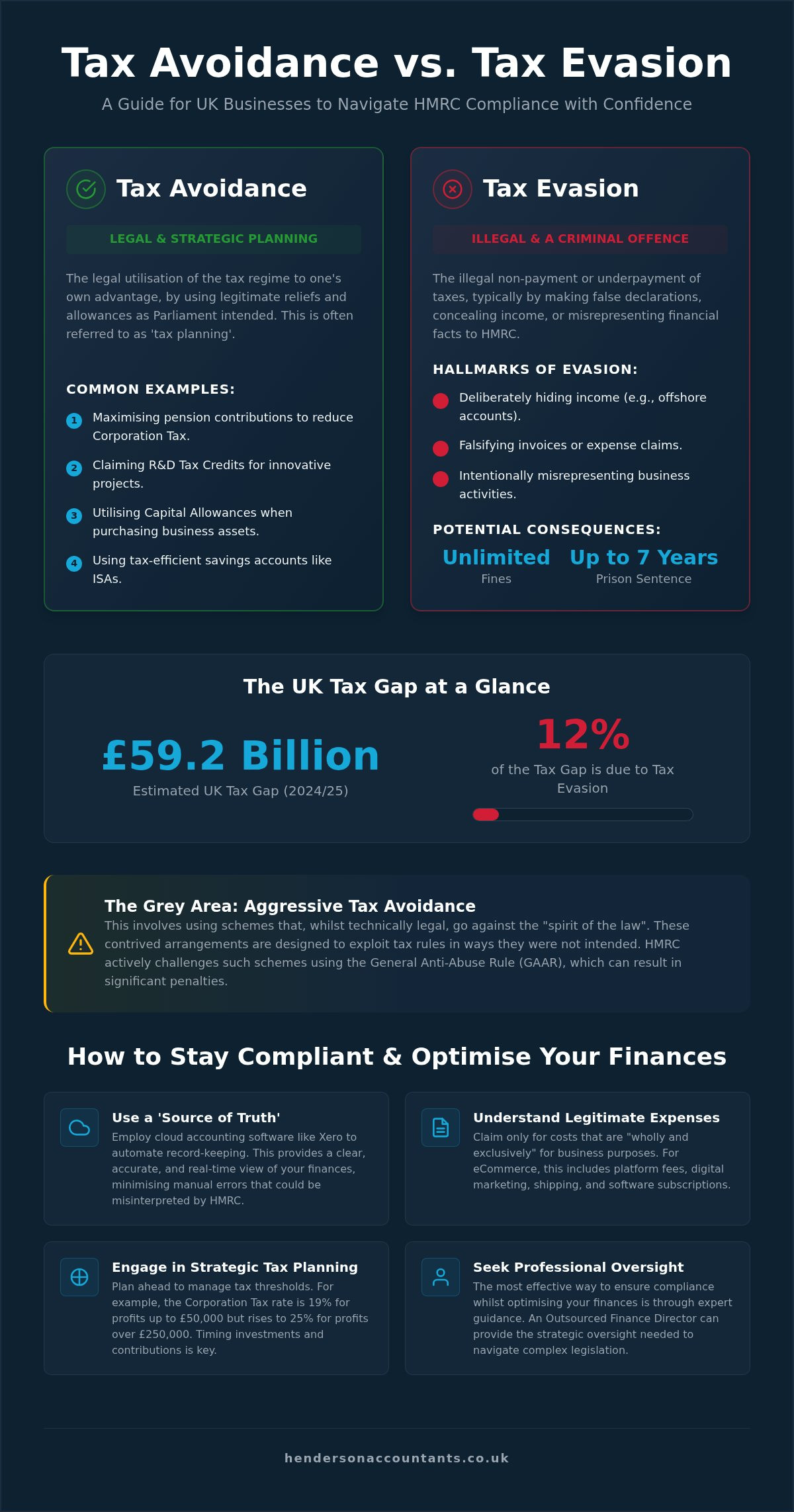
Tax evasion is a different matter entirely. It involves active dishonesty. The hallmarks of evasion include falsifying invoices, hiding income in offshore accounts, or deliberately misrepresenting your business expenses. It's a serious criminal offence that can lead to custodial sentences of up to seven years and unlimited fines.
A common misconception is that "not knowing the rules" will protect you. Unfortunately, HMRC doesn't accept ignorance as a valid legal defence. As a business owner, the responsibility for your tax affairs ultimately stops with you. This is why having a source of truth for your data is so vital; it prevents the kind of "accidental" errors that might look like deliberate evasion during an audit. Evasion accounted for 12% of the UK's £59.2 billion tax gap in the 2024/25 tax year, and HMRC is increasingly using AI technology to spot these discrepancies.
Understanding Legal Tax Avoidance: Planning Within the Rules
Legal tax planning isn't about finding "dodgy" loopholes; it's about using the system exactly as it was intended. When we look at the comparison of tax avoidance vs tax evasion, the former is simply the act of ensuring you don't pay a penny more than you're legally required to. The UK government policy on tax evasion and avoidance makes it clear that while evasion is a crime, avoidance is often the result of using legitimate reliefs to support business growth. For a UK limited company, this might involve claiming Research and Development (R&D) tax credits or utilizing capital allowances when buying new equipment.
Timing plays a massive role in effective planning. For instance, making pension contributions before your company's year-end can significantly reduce your Corporation Tax liability. For the 2026-2027 tax year, the small profits rate remains 19% for profits up to £50,000, while the main rate is 25% for profits over £250,000. Strategic planning helps you manage these thresholds, ensuring you don't drift into a higher bracket without a clear financial roadmap.
Legitimate Business Expenses and Reliefs
For eCommerce and digital businesses, the key to staying compliant lies in the "wholly and exclusively" rule. Every expense you claim must be solely for business purposes. Common deductible costs include:
- Platform fees for marketplaces like Shopify, Amazon, or Etsy.
- Digital marketing spend, including Google Ads and social media promotions.
- Shipping, packaging, and logistics costs.
- Software subscriptions for inventory management and accounting.
Correctly categorising these costs ensures you're maximising your position whilst staying safe. Professional VAT return preparation is particularly helpful here, as it identifies missed input tax on imports or domestic purchases that you might have otherwise overlooked. It's about being thorough, not aggressive.
Strategic Tax Planning for Growth
True financial confidence comes from looking forward, not just looking back at last year's receipts. This is where an Outsourced Finance Director becomes a vital ally. They don't just file forms; they help you forecast future liabilities so there are no nasty surprises in January or July.
Using Xero cloud accounting provides the real-time visibility needed for this proactive approach. Instead of guessing your tax bill, you can see your current obligations at the click of a button. This transparency transforms tax from a source of anxiety into a manageable business cost. If you're feeling unsure about your current setup, our team can help you organise your finances to ensure you're both compliant and tax-efficient.
The Reality of Tax Evasion: Risks, Penalties, and Criminality
While the goal of tax planning is to keep your business lean and efficient, crossing the line into evasion carries consequences that go far beyond a simple slap on the wrist. When discussing tax avoidance vs tax evasion, it's vital to recognise that HMRC views the latter as a deliberate attempt to cheat the public purse. According to the House of Commons Library briefing on tax avoidance and evasion, the UK's tax gap reached an estimated £59.2 billion in the 2024/25 tax year, with evasion accounting for 12% of that figure. To close this gap, the government has empowered HMRC with advanced AI systems and severe legal penalties.
If HMRC finds deliberate inaccuracies in your filings, the financial fallout is heavy. In the Crown Court, VAT or income tax evasion can result in up to seven years' imprisonment and unlimited fines. Even less serious cases handled in Magistrates' Court can lead to six months in prison or fines reaching £20,000. Beyond personal penalties, directors must be aware of the "Corporate Offence of Failure to Prevent the Facilitation of Tax Evasion." This means your company could be held criminally liable if anyone acting on its behalf facilitates evasion, unless you can prove you had "reasonable procedures" in place to prevent it.
Common Examples of Evasion in the SME Sector
In the fast-paced world of eCommerce, it's easy for record-keeping to become messy, but HMRC doesn't distinguish between "disorganised" and "dishonest" as easily as you might hope. Common pitfalls include:
- Hiding Multi-Channel Sales: Failing to declare income from secondary platforms like eBay or Etsy whilst only reporting Shopify or Amazon revenue.
- Personal Expenses: Attempting to claim family holidays, luxury goods, or household bills as business costs under the guise of "travel" or "subsistence."
- VAT Fraud: Falsifying invoices to reclaim input tax on purchases that never happened or were for personal use.
The Long-Term Consequences Beyond Fines
The damage of an evasion charge lasts long after the fines are paid. HMRC regularly publishes a "Naming and Shaming" list of deliberate tax defaulters, which is easily searchable by future partners and clients. A criminal record for tax offences usually results in a ban from acting as a company director, effectively ending many entrepreneurial careers.
Securing business finance also becomes nearly impossible. Lenders and credit providers view a history of tax dishonesty as a high-risk factor, which can starve a growing business of the capital it needs. The reputational blow amongst your staff and suppliers can be just as fatal; trust is the foundation of any successful venture, and once it's broken by a criminal investigation, it's incredibly difficult to rebuild.
Where the Line Blurs: Aggressive Schemes and HMRC Challenges
While we have discussed the clear-cut differences in tax avoidance vs tax evasion, there is a middle ground that often catches business owners off guard. This is known as "aggressive tax avoidance." These are schemes that technically follow the letter of the law but are designed in a way that Parliament never intended. To tackle this, HMRC uses the General Anti-Abuse Rule (GAAR). This rule allows them to look past complex legal structures to see if a transaction is "artificial" or lacks any genuine commercial purpose other than reducing a tax bill.
You might also hear about the Disclosure of Tax Avoidance Schemes (DOTAS) rules. These require promoters to tell HMRC about the schemes they are selling. It is a common myth that having a DOTAS registration number means HMRC has "approved" a scheme. In reality, it simply means HMRC is aware of it and is likely preparing to challenge it. By August 20, 2026, HMRC has significantly expanded its list of named promoters and enablers to warn taxpayers away from these high-risk arrangements.
Spotting "Dodgy" Tax Schemes
If a tax strategy sounds too good to be true, it usually is. Unregulated promoters often target successful entrepreneurs with "pre-packaged" products that promise massive savings. You should be extremely cautious if you see any of these red flags:
- Complex offshore structures that have no clear business reason for existing.
- Arrangements that claim to turn your income into "loans" or capital payments to avoid Income Tax.
- Schemes where the tax savings are significantly larger than the actual commercial profit.
Using these products without bespoke advice is a massive gamble. HMRC is increasingly successful in court, and the fallout often leaves the business owner liable for the full tax amount plus interest and heavy penalties.
HMRC’s "Spotlight" Series and Investor Warnings
HMRC regularly publishes a "Spotlight" series to warn the public about specific schemes they are investigating. If you find yourself involved in a challenged arrangement, you might receive an Accelerated Payment Notice (APN). This is a powerful tool that requires you to pay the disputed tax upfront whilst the investigation or court case continues. This can cause a massive cash flow crisis for a growing business.
eCommerce businesses need to be particularly wary of aggressive international VAT structures. Some promoters suggest using offshore hubs to "optimise" VAT in a way that HMRC considers abusive. If you want to ensure your growth strategy stays on the right side of the law, our Outsourced Finance Director services provide the expert oversight you need to plan safely. It's about building a stable foundation rather than chasing short-term gains that could put your entire business at risk.
Proactive Compliance: How Expert Accounting Ensures Peace of Mind
The journey through the complexities of tax avoidance vs tax evasion often starts with a feeling of uncertainty, but it should end with a sense of total control. Compliance isn't a hurdle to clear once a year. It's a continuous process that, when managed correctly, becomes a stable foundation for your business growth. By moving from a reactive "fingers crossed" approach to a proactive strategy, you replace anxiety with the confidence that your financial position is both optimised and entirely legal.
Professional tax planning is about more than just saving money. It provides "sleep-at-night" security. When your records are transparent and your strategy is aligned with current legislation, you no longer have to fear an HMRC enquiry. Instead, you can focus your energy on scaling your eCommerce brand or digital service, knowing that your compliance is handled by experts who understand the nuances of the UK tax system.
Leveraging Xero for HMRC Transparency
In the modern business environment, cloud accounting has become the ultimate tool for transparency. With the ongoing rollout of Making Tax Digital (MTD), maintaining real-time records is no longer optional for most business owners. Xero acts as your digital source of truth, automating data flows from your sales platforms and bank accounts to significantly reduce the risk of manual errors.
These "accidental" mistakes are often what trigger HMRC investigations. By using Xero, you create a robust digital audit trail. If HMRC ever asks for clarification on a specific transaction or expense, you can provide the evidence at the click of a button. This level of organisation demonstrates to the authorities that you are a responsible, compliant business owner. It turns a potentially stressful audit into a straightforward verification process.
The Role of an Outsourced Finance Department
Having a dedicated team behind you prevents the "cutting corners" mentality that often leads to trouble. When you're busy running a business, it's easy to overlook a VAT deadline or misinterpret a new Corporation Tax relief. An Outsourced Finance Department provides the strategic oversight needed to navigate these complex areas without the overhead of an in-house team.
Your Outsourced Finance Director acts as a proactive guide, using regular management accounts to spot compliance gaps long before they become problems. They ensure that your tax planning stays firmly on the right side of the law whilst making use of every legitimate relief available to you. This partnership ensures your business remains agile and resilient. If you're ready to take the stress out of your finances, you can speak to Henderson & Co. Accountants about your tax compliance strategy today to ensure your business is protected for the future.
Secure Your Business Future with Confidence
Distinguishing between tax avoidance vs tax evasion is about more than just staying out of trouble. It's about empowering your business to grow with a clear conscience. By utilising legitimate reliefs and maintaining a transparent digital audit trail, you can optimise your financial position whilst ensuring total HMRC alignment. The key is to move away from reactive worry and towards a structured, proactive strategy that protects your hard-earned profits.
At Henderson & Co. Accountants, we specialise in helping modern entrepreneurs navigate these complexities. As Xero Platinum Partners with deep eCommerce accounting expertise, we provide the proactive outsourced finance director services you need to stay ahead of regulatory changes. We take the weight of compliance off your shoulders so you can focus on what you do best: running your business.
Ready to replace tax anxiety with calm control? Book a consultation with our eCommerce tax specialists today to ensure your business remains both efficient and resilient. You've built something remarkable; let's work together to keep it safe.
Frequently Asked Questions
Is all tax avoidance legal in the UK?
Tax avoidance is legal by definition, as it involves using the tax system as Parliament intended to minimise your bill. This includes claiming legitimate reliefs like R&D credits or capital allowances. However, if a scheme is purely artificial with no commercial purpose, HMRC can challenge it under the General Anti-Abuse Rule (GAAR). This doesn't make it illegal from the start, but it can lead to the scheme being defeated and you being liable for the full tax amount.
What happens if I accidentally commit tax evasion through a bookkeeping error?
HMRC distinguishes between "deliberate concealment" and "careless errors." If you make a genuine mistake in your bookkeeping, it isn't classed as criminal evasion because there was no intent to deceive. You'll still likely face interest and penalties, especially under the 2026 points-based system for late submissions. Keeping your records organised through a professional bookkeeping service helps ensure these small slips don't escalate into a formal HMRC enquiry or larger financial penalties that could have been avoided.
How does HMRC find out about tax evasion?
HMRC employs a sophisticated AI system called "Connect" that cross-references billions of data points. This includes information from banks, land registry records, and even social media activity. They also receive data from digital platforms like Amazon and eBay regarding seller income. If your lifestyle or business growth doesn't match your declared tax returns, it triggers an investigation. Proactive transparency through cloud accounting is the best way to ensure your data always matches the records HMRC holds on your business.
Can I go to prison for tax avoidance?
You cannot go to prison for legitimate tax avoidance because it's a lawful activity. Custodial sentences are reserved for tax evasion, which is a criminal offence involving fraud or dishonesty. When navigating the nuances of tax avoidance vs tax evasion, remember that the former is about following the rules, whereas the latter involves breaking them. If a scheme involves falsified documents, it could be reclassified as criminal, making professional oversight essential for your ongoing legal protection.
What is the difference between tax planning and tax avoidance?
Tax planning is the most straightforward way to manage your finances, such as using ISAs or making pension contributions. Tax avoidance often involves more complex structures to reduce liability, which is still legal but carries more risk of being challenged. When comparing tax avoidance vs tax evasion, the main difference is that avoidance is done openly within the law, while evasion involves hiding information. Strategic planning with an Outsourced Finance Director ensures you stay on the right side of this line.
Are eCommerce businesses at higher risk of HMRC scrutiny?
eCommerce businesses often face higher scrutiny because multi-channel sales and international VAT can be incredibly complex. HMRC is aware that it's easy to lose track of revenue across different platforms like Shopify, Etsy, and Amazon. They specifically target digital entrepreneurs to ensure all income is being reported correctly. Specialist eCommerce accounting ensures your data flows are automated and accurate, which significantly reduces the risk of being flagged for an audit during a routine HMRC compliance check.
How can I check if a tax-saving scheme is legitimate?
You should start by checking HMRC's "Spotlight" series and their list of named tax avoidance schemes. If a scheme promises to turn your salary into "non-taxable loans" or involves complex offshore transfers with no business purpose, it's likely illegitimate. Always seek advice from a reputable firm rather than an unregulated promoter. A qualified professional will help you understand if a strategy aligns with the "spirit of the law" or if it's a high-risk gamble for your business.
Does using Xero help with HMRC compliance?
Using Xero is one of the most effective ways to stay compliant with HMRC. It creates a clear, digital audit trail for every transaction, which is essential for Making Tax Digital (MTD) requirements. By automating your bank feeds and sales data, you remove the human error that often leads to "accidental" evasion. It gives you real-time visibility into your tax obligations, allowing you to plan your payments accurately and avoid the stress of unexpected bills or late-payment penalties.


