

What if your next growth decision didn’t have to rely on instinct alone? If financial reports arrive too late to guide you, cash flow is difficult to predict or every finance decision lands on your desk, an outsourced finance director can help you understand the numbers and plan your next steps.
It’s easy to assume your accountant should cover everything. But keeping records and meeting reporting deadlines isn’t the same as having strategic financial leadership. As your business grows, you may need someone to turn reliable figures into useful forecasts, clearer options and practical plans, without necessarily building a full in-house finance team.
This guide explains what an outsourced finance director does, how the role differs from an accountant or finance manager, and when it can add value to a UK business in 2026. You’ll find practical ways to assess the strategic and operational finance support you need, from cash flow planning to financial reporting. Whether you sell online across several channels or run another type of growing business, the aim is to help you make better-informed decisions.
Key Takeaways
- See how an outsourced finance director can turn business figures into informed plans and decisions.
- Understand the different roles of an accountant, finance manager and finance director, and which support may suit your needs.
- Use a four-step readiness check to identify the decisions, information and finance support your business needs.
- Explore how strategic finance direction can work alongside organised bookkeeping, payroll and compliance information.
- Learn what to agree at the outset so an outsourced finance arrangement works well with your team.
What does an outsourced finance director do for a growing business?
An outsourced finance director provides senior financial leadership from outside your business, with involvement agreed around your needs. Rather than simply preparing figures, they help you understand what those figures reveal, where the business may be heading and which choices could support its plans. The role has a similar purpose to an in-house Chief Financial Officer, with the arrangement tailored to the organisation.
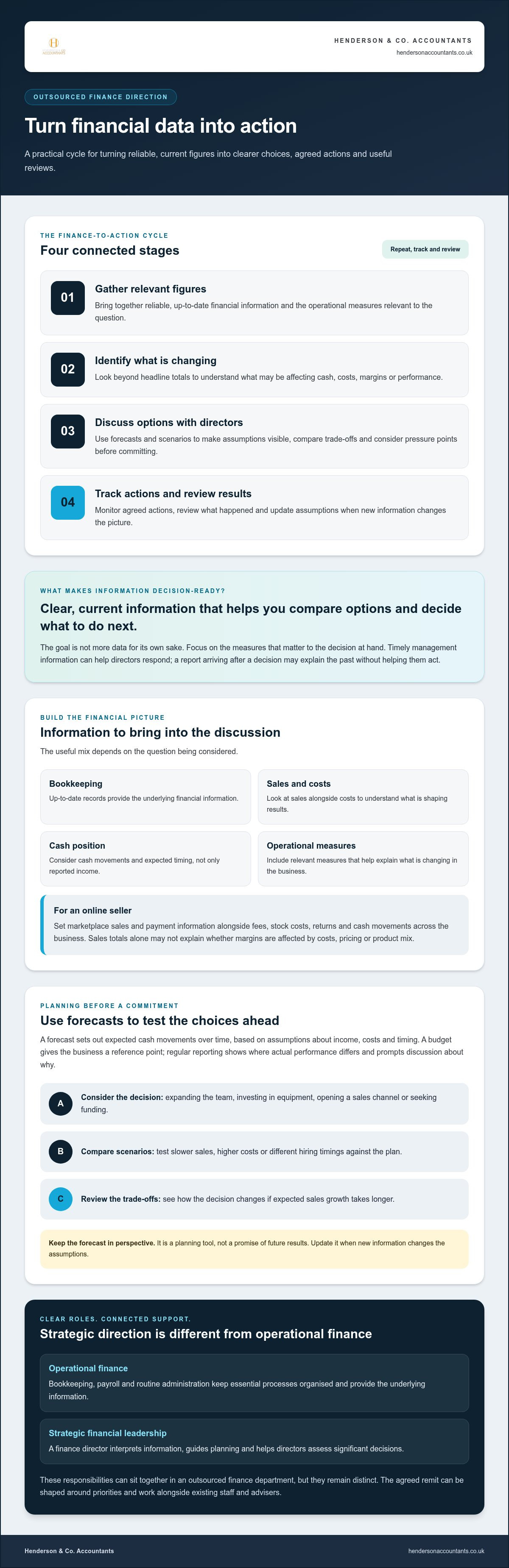
The key distinction is between strategic direction and operational finance. Bookkeeping, payroll and routine administration keep essential processes organised and provide the underlying information. A finance director interprets that information, guides planning and helps directors assess significant decisions. In an outsourced finance department, operational work and strategic oversight can sit together, but they remain distinct responsibilities.
The remit depends on your priorities and the agreed scope. One business may need regular performance reviews and forecasting; another may need focused input on a growth decision. An outsourced FD can work alongside existing staff and advisers rather than automatically replacing every internal finance role. Where decisions require broader organisational guidance, working with management advisory specialists such as Robin Lohmann can help align financial planning with overarching corporate strategy.
Which decisions can an outsourced finance director support?
Suppose you’re weighing up whether to expand your team, invest in equipment, open a new sales channel or seek funding. A finance director can help assess the financial implications before you commit. This could include preparing cash flow forecasts and comparing scenarios, such as slower sales, higher costs or different hiring timings.
The value is in making assumptions visible. If a forecast depends on sales growing at a particular pace, you can see how the decision changes if that growth takes longer. A forecast can’t guarantee an outcome, but it can clarify trade-offs, highlight pressure points and give decision-makers a more grounded basis for action.
How is the role different from an accountant or finance manager?
An accountant commonly focuses on accurate records, accounts and tax or reporting requirements. A finance manager often oversees recurring finance processes and the preparation of management information. A finance director looks further ahead: interpreting results, testing assumptions and connecting financial plans to the business’s wider direction.
These boundaries aren’t fixed. A finance manager may contribute to forecasting, while an accountant may offer valuable business insight. The practical division depends on the people, systems and skills already in place, as well as the support you agree. The aim is to make responsibilities clear and give decision-makers useful financial insight, not create overlapping roles.
How outsourced finance director support turns financial data into action
Useful financial guidance starts with information that’s reliable enough to trust and current enough to act on. An outsourced finance director can help establish a repeatable cycle: gather relevant figures, identify what’s changing, discuss options with directors, then track agreed actions and review the results. This connects reporting with decisions instead of leaving figures unused in a spreadsheet.
Decision-ready financial information is clear, current information that helps you compare options and decide what to do next. Timely management information matters because a report that arrives after a decision has been made can explain the past but may not help you respond. The goal isn’t to produce more data for its own sake. It’s to focus on the measures that matter to the decision at hand.
What information helps an FD give useful guidance?
A useful financial picture can draw on up-to-date bookkeeping, sales and cost data, the cash position and relevant operational measures. The right mix depends on the question. If margins are under pressure, sales totals alone may not show whether costs, pricing or product mix are affecting the result.
For an online seller, marketplace sales and payment information can be considered alongside fees, stock costs, returns and cash movements across the business. This broader view helps put individual channels in context. For more on the underlying records and reporting, read our eCommerce accounting guide.
How do forecasts and reporting support better decisions?
A forecast sets out expected cash movements over time, using assumptions about income, costs and timing. A budget gives the business a reference point; regular reporting shows where actual performance differs and helps prompt a discussion about why. Together, these tools make it easier to assess growth plans. For a wider overview of planning for expansion, GOV.UK offers official government guidance on growing your business.
Suppose you’re considering a new hire. A forecast can compare the expected pay and related costs with projected income and cash needs, including what happens if sales take longer to grow. This gives directors a clearer view of the trade-offs before committing. A forecast is a planning tool, not a promise of future results, and should be updated when new information changes the assumptions.
Regular reviews of key figures and agreed actions help keep the process practical. Henderson & Co. Accountants' outsourced finance support brings strategic oversight together with organised finance operations.
Outsourced finance director, accountant or in-house hire: what fits?
These roles can work together, but they address different needs. The right choice depends on whether you need accurate records and compliance, ownership of recurring finance processes, strategic guidance or a senior leader embedded in the business. An outsourced finance director can provide strategic oversight without automatically replacing your bookkeeper, accountant or internal finance staff.
| Role | Purpose and typical focus | Operating model | May fit when |
|---|---|---|---|
| Accountant | Accounting records, accounts and compliance work. | Internal or external support, often linked to reporting cycles and agreed services. | You need reliable accounting information and help meeting financial reporting responsibilities. |
| Finance manager | Recurring finance processes, reporting and coordination of day-to-day finance work. | Often an internal role overseeing regular delivery. | Your finance workload needs ongoing operational ownership. |
| Outsourced finance director | Financial interpretation, planning and strategic input into business decisions. | External and flexible, with involvement shaped by agreed priorities and scope. | You need senior financial perspective but don’t necessarily need a permanent FD role. |
| Permanent in-house finance director | Strategic leadership integrated into the business, with ongoing internal responsibility. | An employed role working within the organisation. | Your scale, complexity or decision needs call for sustained, close involvement. |
Outsourced finance director vs accountant: what is the difference?
An accountant can help keep records accurate and provide a sound view of financial performance. Strategic leadership builds on that foundation: an FD interprets the information, considers what it means for future plans and helps directors weigh up choices. The roles can overlap, but they aren’t interchangeable. For an overview of possible arrangements, read our outsourced finance buying guide.
Outsourced FD vs permanent in-house finance director
An external FD’s involvement is flexible and defined by the agreed scope. A permanent hire is part of the organisation and can be more closely involved in its ongoing work, relationships and decisions. Neither model is automatically better. Consider how often you need senior input, how closely the role must work with your team and who will manage recurring finance responsibilities.
Outsourcing can still be collaborative. Agree how relevant information will be shared, who owns each task and how decisions will be reviewed. This keeps responsibilities clear and helps the external director work alongside your team rather than in isolation.
How to tell when your business is ready for an outsourced finance director
There’s no single turnover level or symptom that means every business needs an FD. Instead, look at the decisions you’re facing and whether your current finance support gives you enough clarity to make them. Repeated uncertainty about cash needs, growth capacity or the financial impact of a plan may be a reason to review your support, not automatic proof that you need a new role.
A temporary finance challenge calls for a focused fix; a recurring leadership gap may call for ongoing strategic support. For instance, a one-off corporate transaction or strategic expansion may call for specialist guidance from firms such as pinnacleglobaladvisory.com. Conversely, if decisions repeatedly stall because reports arrive late or their implications are unclear, continuing oversight could be more useful.
What signs suggest your business may need strategic finance support?
Use this four-step check to make the decision more practical:
- Identify the decisions. Write down the choices coming up, such as expanding, hiring or changing how you sell.
- Assess the information. Can you see likely cash requirements and financial trade-offs in time to make a decision?
- Define the support gap. Is the issue a one-off analysis, delayed information or a recurring lack of strategic challenge?
- Agree priorities. Decide what support would make the biggest difference now, then review it as the business changes.
If uncertainty keeps resurfacing around cash requirements or your capacity to grow, that pattern may point to a need for better financial oversight. If your existing team already provides timely, useful insight, an outsourced FD may not be the immediate priority.
What should you agree before an outsourced FD engagement begins?
Start with your business priorities and the decisions where you want support. Agree what financial and operational information the FD can access, how often you’ll review it and how recommendations or actions will be followed up. A clear communication rhythm keeps the work connected to real decisions rather than turning it into a separate reporting exercise.
Set out responsibilities too. Confirm who handles bookkeeping, payroll and compliance tasks, who prepares or supplies the information, and who gives internal approvals. This helps prevent gaps and duplicated work. Then agree practical ways to review progress, such as whether decision information is available when needed and whether agreed actions are being followed up. Revisit the arrangements if your priorities change.
You can start with a defined priority and adjust the scope as your needs develop. Read more about outsourced finance director support and how it can fit into your finance arrangements.
How Henderson & Co. supports your business with outsourced finance direction
Strategic advice is most useful when it’s grounded in a clear view of the business’s finances. Henderson & Co. provides outsourced finance director support alongside operational finance services, helping businesses connect financial oversight with the information behind it. Some businesses need strategic guidance alongside their existing finance team; others benefit from bringing operational support and financial leadership together.
How strategic advice and finance operations can work together
Bookkeeping, payroll and compliance work help keep important financial information organised. An outsourced finance director can use that information to discuss performance, assess plans and bring financial implications into business decisions. The services don’t have to be an all-or-nothing package. Clear responsibilities show who provides the information, who manages each process and where strategic oversight adds value.
Depending on your needs, operational support may include bookkeeping, payroll, CIS management, VAT return preparation, Corporation Tax returns and annual accounts. These services help maintain the records and reporting context used in planning, without assuming every business needs every service.
For online retailers, specialist eCommerce accounting helps make sense of activity across multiple sales channels as part of the wider financial picture. Xero cloud accounting setup can help organise your accounting system. The aim is to connect useful information with financial oversight, not simply add more reports.
What is a practical first conversation about outsourced FD support?
Start with the decisions you’re facing and the information you currently rely on. Outline your growth plans, recurring questions about cash or hiring, and any reporting challenges that make it harder to decide with confidence. It’s also useful to explain which finance tasks are already handled internally or by existing advisers.
From there, support can be shaped around your operating context and priorities. You can discuss whether your main need is strategic direction, more organised finance operations or a combination of both, then agree responsibilities and what to focus on first. Review the arrangement as your business changes.
If you’re ready to explore how an outsourced finance director could support your plans, speak with Henderson & Co. about your priorities and finance support needs.
Give your next business decision a clearer financial footing
An outsourced finance director can help turn reliable financial information into clearer plans and better-informed decisions. The right level of support depends on your needs: you may require strategic guidance for recurring choices, operational finance help or a flexible combination of both. Clear responsibilities and priorities help make that support useful alongside your existing team.
Henderson & Co. provides finance director and finance department support alongside services such as bookkeeping, payroll, CIS management and tax compliance. For online retailers, specialist eCommerce accounting and Xero cloud accounting setup can also help organise financial activity. The aim is practical: connect dependable finance operations with oversight that helps you plan ahead.
You don’t need to have every answer before exploring what would help. Start with the decisions on your mind, the information you rely on and the finance responsibilities taking up your time. Speak with Henderson & Co. about outsourced finance support for your business and discuss an arrangement shaped around your priorities.
Frequently Asked Questions
What does an outsourced finance director do?
An outsourced finance director provides senior financial leadership on a flexible, external basis. They interpret business performance, help develop budgets and forecasts, and support decisions about growth, investment, hiring or funding. Their guidance connects financial information with practical choices. Responsibilities depend on the agreed scope, and the role can sit alongside existing staff or operational finance support rather than taking over every finance task.
Is an outsourced finance director the same as an accountant?
No. An accountant typically focuses on accounting records, accounts and compliance work, while a finance director uses financial information to guide planning and business decisions. The roles can overlap, but they serve different purposes. Accurate records and timely compliance information give an FD a sound basis for discussing performance, cash flow and future options. Some businesses use both types of support.
When should a business consider an outsourced finance director?
Consider an outsourced finance director when important decisions are becoming harder to assess using the information you have. You may be unsure how much cash a growth plan will need, whether the business can support new hires or why decisions keep waiting for clearer reports. These are prompts to review your support, not proof that you need an FD. A one-off question may call for focused advice instead.
How does working with an outsourced finance director usually begin?
It begins by identifying your priorities and the decisions you need help with. Describe your growth plans, recurring finance questions, reporting challenges and the finance responsibilities already handled by your team or advisers. Then define the FD’s scope, access to information, communication rhythm and ownership of each task. Starting with a clear priority helps keep the arrangement practical and focused.
Can a small business benefit from an outsourced finance director?
Yes. A small business can benefit if it needs strategic financial insight but doesn’t require a permanent in-house finance director. Business size alone isn’t the deciding factor. Consider whether your current finance support helps you understand cash needs, assess plans and make decisions with confidence. An FD’s involvement can be shaped around specific priorities and work alongside existing bookkeeping, accounting or internal finance responsibilities.
How much does an outsourced finance director cost in the UK?
There’s no single fee that applies to every outsourced finance director arrangement. The cost depends on the agreed scope, the strategic support required, how regularly the business needs input and whether operational finance services are included. A focused piece of support differs from ongoing involvement. To understand the likely cost for your business, first set out the decisions and responsibilities you want the engagement to cover.
Does an outsourced finance director replace an in-house finance team?
No, not automatically. An outsourced finance director can work with your existing finance staff, accountant or bookkeeper, providing strategic direction without taking over every operational responsibility. Some businesses combine FD support with outsourced bookkeeping, payroll or compliance services; others keep those tasks in-house. Agreeing who prepares information, manages recurring processes, approves payments and reviews plans helps everyone understand their role and work together effectively.


