

What if the lump sum hitting your bank account every fortnight was actually a barrier to your growth rather than a sign of success? For many UK sellers, the reality of ecommerce accounting is a blur of bundled payouts from Shopify or Amazon that make true reconciliation feel impossible. You aren't alone if you've spent your weekends staring at spreadsheets, worrying about hidden VAT errors on international sales or wondering why your bank balance doesn't reflect your hard work.
We understand that you need more than just a list of transactions; you need a clear view of your margins. This guide will show you how to transform that complex data into a scalable financial strategy that ensures full HMRC compliance and fuels your business growth. We'll explore how to automate your reporting, navigate the £90,000 VAT threshold, and prepare for upcoming changes like MTD for Income Tax in April 2026. You'll discover how to move from reactive bookkeeping to proactive financial leadership that puts you back in control of your numbers.
Key Takeaways
- Learn how to unpick bundled payouts from platforms like Shopify to see your true margins after fees and advertising are deducted.
- Discover how to build a scalable financial stack using Xero and automated connectors to eliminate manual data entry and human error.
- Understand why switching to accrual accounting provides a more accurate picture of your profitability during busy sales periods.
- Master the complexities of UK VAT and international selling to ensure you stay compliant with HMRC whilst expanding into new markets.
- Explore how professional ecommerce accounting moves you beyond basic bookkeeping and into the realm of high-level strategic growth.
Beyond the Bank Feed: Why eCommerce Accounting is a Different Beast
Traditional accounting usually involves matching invoices to bank statements. If you run a high-street shop, it's straightforward. However, for online sellers, your bank feed only tells a fraction of the story. Ecommerce accounting is actually the management of complex, multi-channel data flows. It requires you to look past the final deposit and understand exactly how that money was calculated.
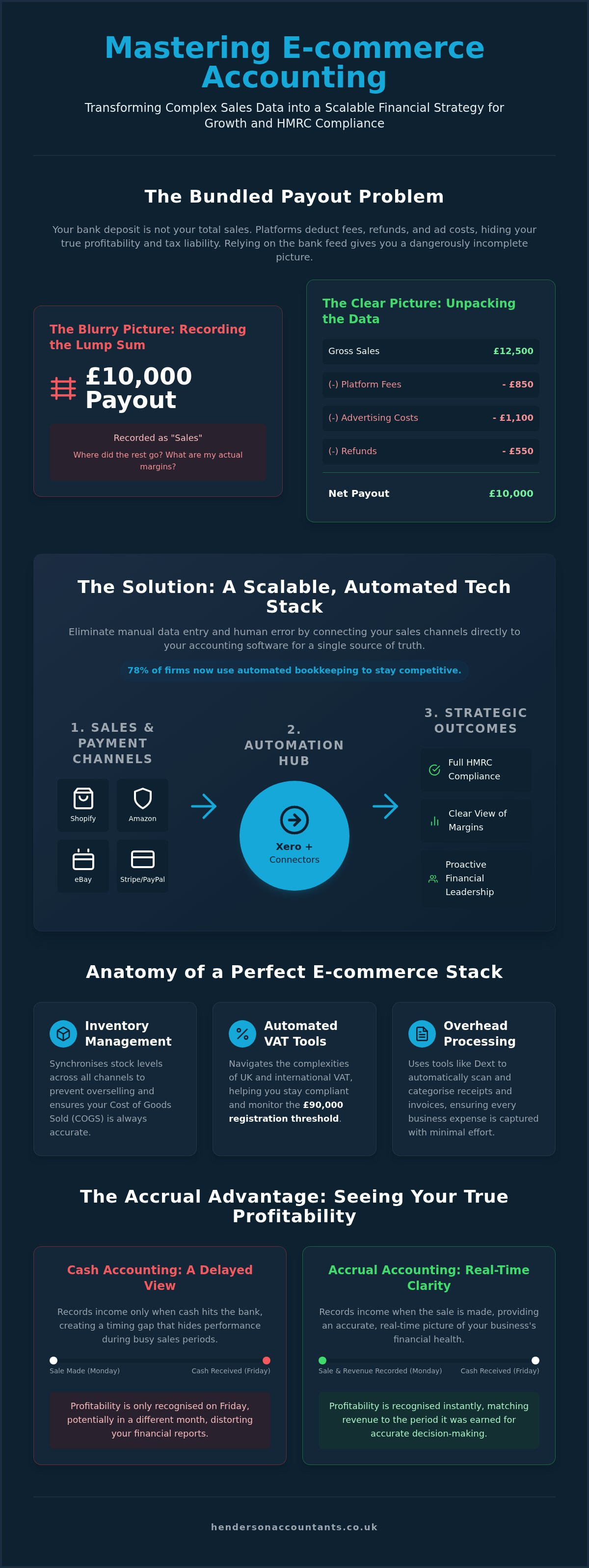
The biggest hurdle is the "Bundled Payout" problem. Platforms like Shopify or Amazon don't just send you your total sales. They deduct platform fees, refund amounts, and advertising costs before the cash ever reaches you. If you simply record the bank deposit as "Sales," you're missing vital data. You won't see your true tax liability or your actual marketing spend. This timing gap, where a customer clicks "buy" on a Monday but the cash arrives on Friday, creates a disconnect. This is why choosing between cash vs. accrual methods becomes a strategic decision rather than just a technical one. Most traditional accountants aren't equipped for these digital nuances, often leaving sellers with a blurred financial picture.
The Complexity of Multi-Channel Sales
Selling across Amazon, Shopify, and eBay simultaneously creates massive data silos. Each platform has its own reporting style and fee structure. When you add payment gateways like Stripe, PayPal, and Klarna into the mix, reconciliation becomes a nightmare. Trying to manage this via manual data entry is often the primary cause of financial inaccuracies. It's slow, prone to human error, and makes it impossible to see a unified view of your business health. You need a system that pulls this data together automatically so you can stop guessing and start growing.
Understanding Your True Gross Margin
Your turnover is a vanity metric if you don't know what's actually staying in your pocket. There's a significant difference between your gross sales and what arrives in your bank. Hidden costs like platform commissions and unexpected shipping surcharges can quietly erode your profits. Without real-time visibility, you might be reinvesting in stock that isn't actually making you money. Accurate ecommerce accounting gives you the clarity to see which products are winners. This data is essential for making informed inventory purchasing decisions that protect your cash flow and improve your long-term margins.
Building a Scalable Stack with Xero and Automation
Xero has become the heartbeat of modern business finance, particularly for online sellers. It provides the real-time visibility you need to track e-commerce success metrics without drowning in paperwork. However, Xero alone isn't a magic wand. To truly master your ecommerce accounting, you need a system where your store and your books speak the same language. This is where "connectors" come in. These tools act as a bridge, translating complex platform data into clean, reconciled entries that match your bank deposits perfectly.
Automation does more than just save you time. It removes the risk of human error that inevitably creeps in when you're manually moving figures between spreadsheets. Recent industry data shows that 78% of firms are now adopting automated bookkeeping to stay competitive. By the time you reach the reporting stage, your data should be accurate and ready for analysis. Technology is powerful, but it's only as effective as the professional setup behind it. If your software isn't mapped correctly from the start, you're simply automating your mistakes.
The Anatomy of a Perfect eCommerce Tech Stack
A scalable business relies on a trio of integrated tools. First, an Inventory Management System (IMS) ensures your stock levels are synchronised across Amazon, eBay, and Shopify. This prevents overselling and keeps your Cost of Goods Sold (COGS) accurate. Second, you need automated VAT calculation tools. These are vital for navigating the complexities of international sales or monitoring the UK's £90,000 registration threshold. Finally, overhead processing tools like Dext can automate the recording of your daily expenses. This setup ensures every penny is accounted for with minimal manual effort.
The Henderson & Co. Accountants Approach to Xero Setup
We don't believe in one-size-fits-all solutions. Our Xero cloud accounting setup focuses on customising your Chart of Accounts to reflect the specific realities of online retail. This means creating distinct categories for marketplace fees, shipping income, and advertising spend. We also implement intelligent bank rules that handle recurring transactions automatically. This keeps your data "clean" and ensures your financial reports actually make sense. When your system is built correctly, reconciliation takes minutes rather than hours. This gives you back the time to focus on your next product launch or expansion strategy.
The Accrual Advantage: Navigating Cash vs. Accrual Methods
Choosing how you record your sales and expenses is one of the most important decisions you'll make for your business. Most small sellers start with cash accounting, which simply records transactions when the money actually changes hands. It's easy to understand because it mirrors your bank statement. However, as you grow, this simplicity can become a liability. Ecommerce accounting requires a more sophisticated approach to give you a true sense of your profitability.
Accrual accounting records income when the sale happens and expenses when they're incurred, regardless of when the cash moves. This allows you to match your revenue directly against your Cost of Goods Sold (COGS). If you're a smaller seller not quite ready for full accrual, we often suggest "modified cash" as a middle ground. This involves tracking your daily cash flow but making adjustments for inventory at the end of the month. It provides a clearer picture than basic cash tracking without the full complexity of a corporate setup.
Why Inventory Makes Cash Accounting Risky
Online retail is often built on the "Inventory Trap." You might place a £20,000 order for stock in July that you won't fully sell until the Christmas peak. Under cash accounting, July looks like a financial disaster whilst December looks like pure profit. This skewed reporting makes it impossible to judge your actual performance. By using the accrual method, you spread that stock cost across the months you actually sell the items. This is vital for understanding your Q4 peaks and ensuring you have the cash reserves to survive the quieter months. It stops you from feeling a false sense of security when your bank balance is high but your unpaid supplier bills are mounting.
Choosing the Right Method for Your Scale
HMRC has specific turnover-based requirements that dictate which accounting methods you can use. Whilst many sole traders can stay on the cash basis up to certain limits, limited companies and high-growth brands often find that accrual reporting is essential for both compliance and strategy. Transitioning between these methods can feel like a technical hurdle, but it's a vital step for any brand hitting a growth spurt. We specialise in guiding you through this transition seamlessly. We ensure your ecommerce accounting remains compliant whilst giving you the deep financial insights needed to scale with confidence.
Managing VAT and International Compliance Without the Headache
VAT is often the single biggest source of anxiety for online sellers. The rules feel like they're constantly shifting, especially when you're moving goods across borders. Effective ecommerce accounting isn't just about recording what you've sold; it's about staying three steps ahead of HMRC to avoid costly surprises. Whether you're approaching the registration limit or already selling globally, clarity is your best defence against penalties.
The "Place of Supply" rules can be particularly tricky. For physical goods, the tax usually follows the customer's location, but digital products have their own set of requirements. If you get this wrong, you risk backdated tax bills that can wipe out your annual profit in one go. Non-compliance isn't just a paperwork issue; it's a significant threat to your business's survival. HMRC penalties for late registration or incorrect filings can be substantial, so getting your data flows right from day one is essential.
Navigating the VAT Threshold
In the UK, you must register for VAT if your taxable turnover exceeds £90,000 over a rolling 12-month period. It's vital to remember this isn't based on your fixed financial year. If you have a sudden spike in sales, you could cross the line without realising it. We help you monitor this figure proactively so you aren't hit with late registration fines. Proactive monitoring is the only way to stay in control as you scale.
Sometimes, registering voluntarily before you hit the limit makes sense. This allows you to reclaim VAT on your initial stock purchases and business setup costs, which can provide a welcome cash injection. However, it also means you'll need to add the standard 20% VAT rate to your prices or absorb the cost yourself. We can help you weigh up these pros and cons to find the right timing for your brand, ensuring you don't lose your competitive edge whilst staying compliant.
International Sales and Global Tax Obligations
Selling to the US or EU adds layers of complexity that traditional accounting methods struggle to handle. US Sales Tax operates differently from UK VAT, with rules that vary from state to state based on economic nexus. Meanwhile, Brexit has fundamentally changed how we ship to European customers. Using systems like the One-Stop Shop (OSS) or Import One-Stop Shop (IOSS) can simplify EU sales, but they require precise data management to work effectively.
Automated reporting ensures you never miss a filing deadline, even as your global footprint expands. By integrating your tax tools directly into your books, you can maintain full compliance without the manual headache. If you're feeling overwhelmed by international tax, our team can provide the expert VAT return preparation you need to sell with confidence across any border.
From Bookkeeping to Strategy: The Outsourced Finance Department
Many business owners think accounting is just about keeping the taxman happy. Whilst filing your returns is essential, basic bookkeeping only looks at the past. High-level financial strategy looks at the future. Professional ecommerce accounting should do more than just record transactions; it should provide the insights you need to make better business decisions. This is where the concept of an outsourced finance department becomes a game changer for growing brands.
You might not be ready for a full-time CFO, but you still need that level of expertise. An outsourced model gives you access to a complete finance team without the overhead of internal hires. We provide management accounts that dive deep into your numbers, helping you identify which SKUs are driving your profit and which are simply draining your cash. By seeing your margins clearly, you can stop guessing and start focusing your marketing budget on the products that actually move the needle. This transition from reactive recording to proactive planning is what separates hobbyists from serious entrepreneurs.
The Role of an Outsourced Finance Director
A strategic partner helps you look at the bigger picture. We focus on cash flow forecasting, which is vital when you're planning your next big inventory buy. If you don't know exactly when your cash will be tied up in stock, you can't scale safely. We also help you analyse your customer acquisition costs (CAC) against the lifetime value (LTV) of your shoppers. This data is essential if you're seeking investment or preparing your business for a future sale. Knowing your numbers inside out builds confidence with lenders and buyers alike.
Scalable Support for Growing Brands
Our model is designed to grow alongside you. Whether you're hitting your first £100,000 in sales or scaling past £10 million, our support remains consistent and proactive. We handle the heavy lifting of payroll, CIS management, and statutory filings, giving you the peace of mind to focus on brand building. You shouldn't have to worry about the mechanics of your finance department whilst you're trying to conquer new markets. We take care of the foundation so you can build the empire.
We position ourselves as your strategic partner, helping you manage the hurdles of rapid growth rather than just your tax bill. If you're ready to move beyond basic spreadsheets and gain real-time visibility into your true profitability, it's time to level up. Organise a consultation with Henderson & Co. to discover how our outsourced finance director services can fuel your eCommerce strategy.
Scaling Your Brand with Financial Clarity
Managing an online store shouldn't mean being buried in spreadsheets. You've seen how unpicking bundled payouts and adopting the accrual method provides the visibility you need to grow safely. By automating your tech stack with Xero, you can reclaim your time and focus on the products that actually drive your profit. Expert ecommerce accounting isn't just about recording the past; it's about building a stable foundation for your future success.
Navigating HMRC regulations and international VAT doesn't have to be a source of anxiety. As specialist eCommerce and Xero experts, we provide the proactive support you need to stay compliant whilst you scale. Our comprehensive outsourced finance department solutions offer the strategic guidance you need to move beyond basic bookkeeping and into high-level growth. Discover how Henderson & Co. can streamline your eCommerce finance and turn your data into a powerful growth strategy. You've built a great brand; now it's time to give it the professional financial support it deserves.
Frequently Asked Questions
What is the difference between bookkeeping and eCommerce accounting?
Bookkeeping is the basic process of recording daily transactions like sales and expenses. In contrast, ecommerce accounting involves managing complex data flows from multiple platforms and payment gateways. It requires unpicking bundled payouts to reveal true margins and ensuring your financial reporting reflects the reality of digital retail. Whilst bookkeeping keeps your records straight, specialist accounting provides the strategic insight needed to scale a brand across different marketplaces.
Do I need a specialist eCommerce accountant, or will a local firm do?
A local firm might understand general tax, but a specialist understands the digital architecture of your business. Online selling involves specific challenges like API integrations, international VAT, and platform fees that high-street accountants often overlook. A specialist ensures your Xero setup correctly mirrors your store's data. This expertise prevents reconciliation errors and provides peace of mind that your compliance is handled by someone who speaks the language of online retail.
How does Xero help with eCommerce VAT reconciliation?
Xero serves as a central hub that integrates with your sales platforms through automated connectors. These tools pull detailed transaction data into your books, separating gross sales from platform fees and VAT. This automation makes VAT reconciliation much faster and more accurate than manual entry. It also ensures you stay compliant with Making Tax Digital (MTD) rules, which require all VAT-registered UK businesses to keep digital records and submit returns using compatible software.
What are the main VAT challenges for UK sellers on Amazon and Shopify?
The biggest challenge is monitoring the £90,000 registration threshold on a rolling 12-month basis. Sellers also struggle with "Place of Supply" rules when shipping to the EU or the US. Amazon and Shopify often provide reports that include various tax rates, making it difficult to identify exactly what is owed to HMRC. Without proper ecommerce accounting systems, it is easy to miscalculate your liability, leading to backdated tax bills or penalties during an audit.
Can I manage my eCommerce accounts myself as a sole trader?
You can manage your own accounts when you're starting out, but it becomes increasingly difficult as your volume grows. Simple spreadsheets quickly fail when you're dealing with hundreds of transactions across different channels. From April 2026, sole traders with income over £50,000 must also comply with MTD for Income Tax. Investing in professional support early prevents the "Inventory Trap" and ensures you have the accurate data needed to make informed growth decisions.
When should I consider hiring an outsourced finance director?
You should consider this move when you're hitting growth hurdles that basic bookkeeping can't solve. If you're struggling to forecast cash flow for large inventory buys or need to analyse customer acquisition costs against lifetime value, a strategic partner is essential. An outsourced finance director provides CFO-level insights without the cost of a full-time hire. This is particularly valuable when preparing for investment or seeking to improve overall business margins and efficiency.
How do I handle international sales tax when selling from the UK?
Handling international tax depends on where your customers are located and the value of the goods. For EU sales, schemes like the One-Stop Shop (OSS) or Import One-Stop Shop (IOSS) can simplify your filings. If you're selling into the US, you must monitor "economic nexus" thresholds for individual states. These rules are complex, so using automated tax tools that integrate with your accounting software is the most reliable way to ensure global compliance.
What is the best way to track inventory costs in my accounting software?
The most effective method is using an Inventory Management System (IMS) that syncs with Xero. This allows you to record your Cost of Goods Sold (COGS) at the point of sale rather than when you pay the supplier. By matching the cost of the item to the revenue it generates, you get a true picture of your monthly profit. This accrual-based approach prevents the skewed reports that often happen when you place large, upfront manufacturing orders.


