

What if the transactions you record each week could give you a clearer view of what your business can afford next? Good bookkeeping turns everyday sales, costs and payments into organised records. Knowing what to keep and finding time to keep it up to date can feel like another job on an already full list.
If you’re unsure whether your records are complete, you’re not alone. Gaps can make it harder to understand cash movements, track unpaid invoices and prepare for reporting and tax work. With Making Tax Digital for Income Tax starting in April 2026 for sole traders and landlords with qualifying income over £50,000, digital record-keeping is also becoming more important for those affected.
This guide explains what bookkeeping involves for UK businesses, which transactions and documents to record, and how to organise the information. You’ll also learn how accurate records can help you track money coming in and going out, and when expert support could save time and improve visibility. As your business grows, bookkeeping can sit alongside wider finance support, including Xero cloud accounting setup and compliance services.
Key Takeaways
- Use a practical records checklist to keep sales invoices, purchase invoices, receipts and payment evidence organised.
- See how bookkeeping turns routine transactions into a clearer picture of business finances.
- Compare DIY, software-supported and outsourced approaches against your transaction volume, available time and reporting needs.
- Build a repeatable routine to spot missing paperwork and uncategorised transactions sooner.
- Learn how Henderson & Co. Accountants’ bookkeeping can sit alongside wider finance and compliance support as your business grows.
What is bookkeeping, and why does it matter to a UK business?
Sales come in, supplier bills arrive, payments leave the bank and customer invoices remain outstanding. If you don’t record this activity as it happens, it can quickly become difficult to work out what happened and when. Bookkeeping is the ongoing process of recording and organising a business’s financial transactions, giving you a more dependable picture of its activity.
These records help you follow money coming in and going out, identify customer payments and supplier bills that are still due, and prepare information for reporting and later accounting work. For a useful starting point on the term’s history and common methods, see What is bookkeeping? For a business owner, the practical value is straightforward: information is easier to use when it’s recorded consistently, rather than pieced together at year-end.
What does bookkeeping include in day-to-day business?
Routine bookkeeping captures the financial activity of your business, including:
- Sales and customer payments
- Purchases, supplier bills and business payments
- Receipts and other evidence of transactions
- Amounts customers still owe you and bills you still need to pay
Support each entry with clear documentation, such as an invoice, receipt or payment record. This helps you check what a transaction relates to and resolve questions if an amount or description is unclear. A bank payment, for example, shows that money left your account, while the supplier invoice explains what the purchase was for.
Recording and sorting transactions creates an organised base. It won’t, by itself, explain why costs have risen or decide whether a new investment makes sense. Those questions involve interpreting the information and applying it to business decisions.
How is bookkeeping different from accounting?
Think of transaction records as the groundwork. Accounting uses that organised information to prepare reports, support compliance work and explain what the figures may mean for the business. The exact work depends on the business and its reporting needs, but it relies on records that are accurate and complete.
The two functions work together. Clear records make it easier to review performance, prepare accounts and deal with reporting tasks. If information is missing or unclear, the next stage can take longer because transactions may need to be traced or clarified. Keeping records up to date throughout the year gives you and anyone supporting your finance work a firmer basis to work from.
Which bookkeeping records should your UK business organise?
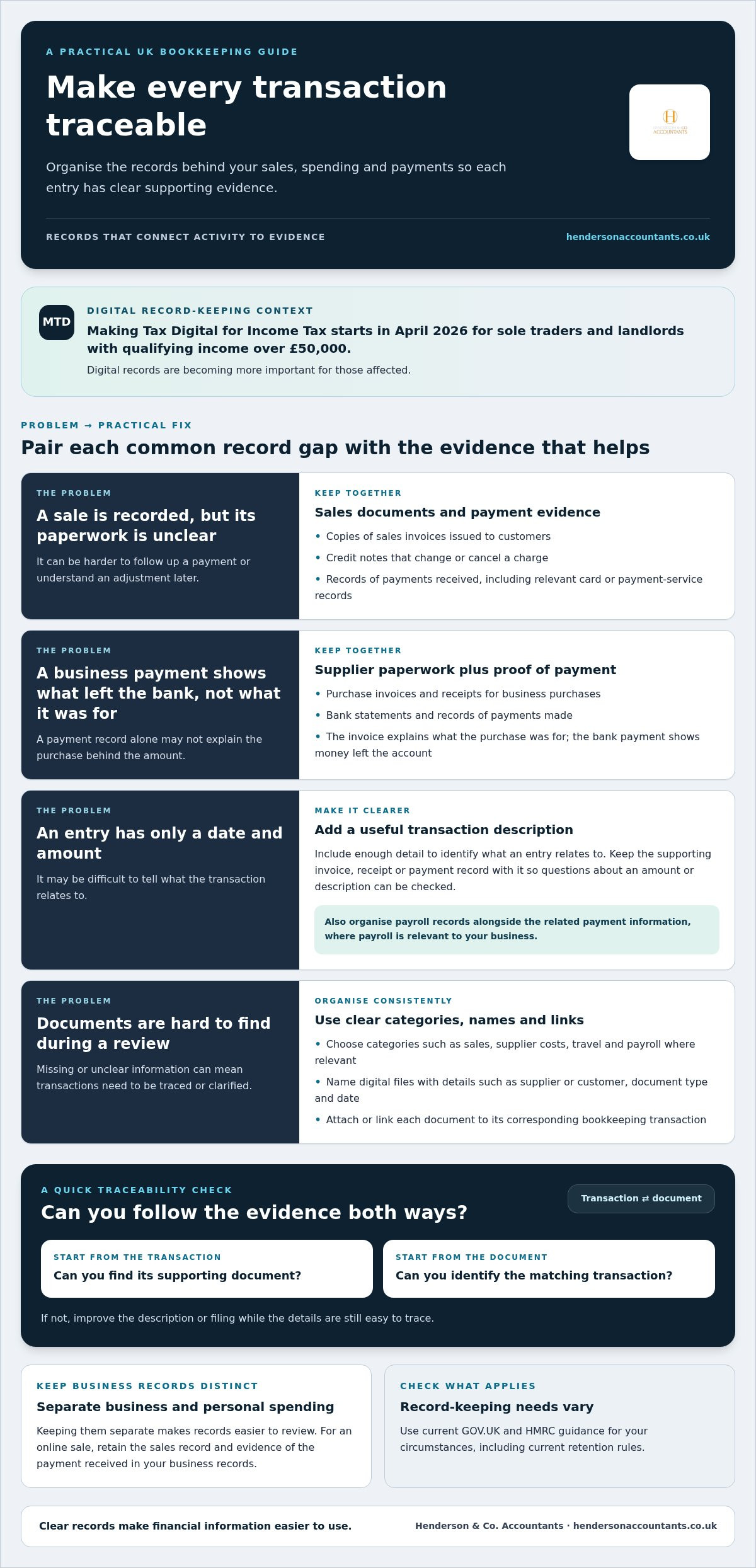
A useful records system makes it easy to connect each transaction with evidence of what it was for. The documents you need depend on how your business operates. Use this checklist as a starting point, then check the latest GOV.UK guidance on records to keep for your circumstances, including current retention rules.
- Sales invoices and credit notes: Keep copies of invoices issued to customers and any credit notes that change or cancel a charge.
- Purchase invoices and receipts: File supplier bills and receipts for business purchases so the reason for each cost is clear.
- Evidence of payments: Keep bank statements and records of payments made or received, including card or other payment service records relevant to your business.
- Payroll information, where relevant: Organise payroll records alongside the related payment information.
- Transaction descriptions: Add enough detail to identify what an entry relates to, rather than relying on a date and amount alone.
What income and spending documents should you keep?
Invoices show what you charged or were billed, receipts support purchases, and credit notes explain adjustments. Together, these documents help you make sense of the amounts recorded and follow up missing or unclear transactions.
Keeping business and personal spending separate makes records easier to review. If you sell an item online, for example, retain the sales record and evidence of the payment received in your business records. These documents connect the sale to the money received without having to reconstruct the transaction later.
How should you organise records for regular review?
Choose a consistent set of categories, such as sales, supplier costs, travel and payroll where relevant. File digital documents in a predictable way, with clear names that include details such as the supplier or customer, document type and date. Then attach or link each document to its corresponding transaction in your bookkeeping system.
Use a simple test: can you find the supporting document from the transaction, and can you identify the transaction from the document? If not, improve the description or filing while the details are still easy to trace. Record-keeping needs vary by business activity, so use HMRC’s current guidance to confirm what applies to you. Henderson & Co.’s bookkeeping support can help you keep business records organised.
DIY bookkeeping, software or outsourced support: what suits your business?
The right approach depends on how much financial activity you handle, the time you can set aside and how confident you feel reviewing your records. Organised information helps you spot what needs attention and make decisions with a clearer view of the numbers. For an overview of why bookkeeping matters, see how well-kept records form a basis for understanding business performance.
| Approach | May suit you if… | Consider… |
|---|---|---|
| Owner-managed | Transactions are manageable, you have time for regular updates and you’re comfortable keeping documents in order. | Entries can fall behind if record-keeping competes with other work or relies on memory. |
| Software-supported | You want a digital system to help organise transactions and supporting documents. | Software still depends on accurate information, consistent document capture and regular checks. It can’t guarantee every transaction is complete or correctly described. |
| Outsourced | Transaction volumes are growing, time is limited or you need a more consistent process and clearer reporting information. | You’ll need to share relevant business records and keep communication about transactions clear. |
When can a business manage bookkeeping in-house?
Managing records yourself can work when activity is straightforward and you can maintain a regular routine. Set aside time to enter transactions, save supporting documents and review anything unclear. Waiting until a reporting deadline approaches can make it harder to remember what a payment was for or find a missing receipt. Small, regular checks help prevent the task becoming a catch-up exercise.
When might outsourced support provide more help?
As sales, purchases or payment channels multiply, the time needed to keep records complete can grow too. Outsourced bookkeeping support can establish a consistent process and sit alongside related finance work such as payroll, VAT return preparation and wider finance support. This can help keep organised records connected to reporting, rather than treating each task in isolation.
Online retailers, for example, may need to track activity across sales and payment channels. Explore the eCommerce bookkeeping guide for a closer look. Henderson & Co. specialises in eCommerce accounting and Xero cloud accounting setup, supporting businesses as their finance processes develop.
How can a simple bookkeeping routine keep your records under control?
A repeatable process makes it easier to keep financial information current and spot questions while the details are still fresh. Choose a review rhythm that fits your business activity, then follow the same steps each time.
- Gather documents: Collect invoices, receipts and payment records since your last review.
- Enter transactions: Record each item with a clear description and category.
- Attach evidence: Link supporting documents to the matching entries in your records.
- Compare records: Check recorded payments against bank or payment service records.
- Review exceptions: Follow up missing documents, uncategorised entries and amounts that don’t match.
- Check what’s due: Review unpaid customer invoices and upcoming supplier payments.
Reconciliation means comparing transactions in your records with bank or payment records to identify differences. It helps you check whether the activity you’ve entered matches the money moving through your accounts. If something doesn’t line up, investigate it rather than assuming it will resolve itself.
What should a weekly or monthly review cover?
Your review doesn’t have to follow a fixed schedule. Base its timing on how often transactions arise and how quickly you need an up-to-date view of your finances. Check recent entries against supporting documents, look for unusual or uncategorised items, and see whether customer invoices remain unpaid or supplier payments are coming up.
Regular attention helps surface small gaps sooner. A missing receipt or unclear description is usually easier to resolve close to the transaction than much later, when the details may be harder to recall.
Which mistakes should you catch early?
Look for missing receipts, duplicate entries and transactions assigned to categories that don’t clearly explain their purpose. Also investigate differences between your records and bank or payment information. They could point to a missed entry, an incorrect amount or a transaction that needs clarification. Don’t adjust figures simply to make them match. First work out what caused the difference.
This review gives you more dependable information for decisions, from following up overdue customer payments to understanding upcoming commitments. Henderson & Co.’s bookkeeping support helps businesses keep records organised.
How can Henderson & Co. support your bookkeeping as the business grows?
As a business develops, its financial activity can become harder to manage alongside day-to-day work. A consistent process can help keep records organised and give wider finance tasks a clearer starting point. Henderson & Co. provides bookkeeping as part of its outsourced finance support for UK businesses.
What can connected bookkeeping and finance support help organise?
Well-organised transaction records provide a foundation for other finance work. Depending on your needs, bookkeeping can sit alongside services such as payroll, VAT return preparation and annual accounts. Keeping these activities connected can make it easier to see what information is available and where a gap needs attention. Bookkeeping alone doesn’t guarantee compliance or business growth, but complete, clear records help support the work that follows.
Henderson & Co. also specialises in eCommerce accounting and Xero cloud accounting setup. For online sellers, the finance process needs to reflect how their business operates. Learn more about expert eCommerce accounting services to explore this specialist context.
What is a practical next step if record-keeping is taking too much time?
Start by identifying where the process feels difficult. Are documents being filed late? Do transactions remain uncategorised, or are you unsure what a payment relates to? Perhaps you can keep records up to date but struggle to see clearly what’s owed or what needs attention. Pinpointing the sticking points makes it easier to focus on what needs to change.
Discussing these challenges as part of wider finance support can help clarify which parts of the process need attention and how they relate to other tasks, such as payroll, VAT preparation or annual accounts. Henderson & Co.’s outsourced finance support brings these needs into the same conversation as your records.
If keeping your finances organised is taking time away from running your business, talk to Henderson & Co. about bookkeeping support.
Make your financial records work for you
Good bookkeeping is built on consistent habits: record transactions clearly, keep supporting documents together and review entries regularly. The right approach may be owner-managed, software-supported or outsourced, depending on the time and processes your business can sustain.
As your business grows, a reliable finance process can connect day-to-day records with wider support. Henderson & Co. provides bookkeeping within its outsourced finance support, alongside specialist eCommerce accounting and Xero cloud accounting setup.
If keeping records up to date is taking time away from running your business, take a practical next step. Talk to Henderson & Co. about bookkeeping support and explore how a more consistent approach could give you a clearer view of your finances.
Frequently Asked Questions
What is bookkeeping in a small business?
Bookkeeping is the process of recording and organising a small business’s financial transactions. It includes tracking sales, purchases, payments received and money paid out, with documents such as invoices and receipts to support the entries. Keeping this information current helps you understand what has happened financially, follow outstanding amounts and provide an organised base for reporting and accounting work.
What records does a UK business need to keep for bookkeeping?
Most businesses should organise sales and purchase invoices, receipts, credit notes, bank statements and evidence of business payments. Keep payroll information too if you employ staff, and use clear descriptions so transactions are easy to identify. The records you need depend on your business activity and circumstances. Check current HMRC guidance for the records relevant to your situation and how long to keep them.
Can I do my own bookkeeping with accounting software?
Yes, you can manage your records yourself using accounting software if you have time to enter transactions, keep supporting documents and review entries regularly. Software can help organise information, but it can’t ensure that every transaction has been recorded correctly or that a receipt has been matched to the right entry. Check for missing documents, duplicate entries and unclear categories so the information remains useful.
How often should a business update its bookkeeping?
Update records at a frequency that suits your transaction volume and how often you need a current view of the business. A weekly or monthly review can help you check recent activity, file supporting documents and follow up unpaid invoices or upcoming supplier payments. The key is consistency. Leaving everything until a reporting deadline can make missing information harder to trace and transactions more difficult to explain.
What is the difference between bookkeeping and accounting?
Bookkeeping records and organises the transactions a business makes. Accounting uses those records for tasks such as preparing reports, supporting compliance work and interpreting financial information. The two functions work together: accounting depends on clear, complete records, while the resulting reports can help you understand business activity. Keeping transactions and documents organised makes it easier to prepare accounts and address reporting needs.
When should a business outsource bookkeeping?
Consider outsourcing if transaction volumes are growing, keeping records up to date is taking time away from other work, or you need a more consistent process. It may also help if bookkeeping needs to connect with tasks such as payroll, VAT preparation or annual accounts. Henderson & Co. provides bookkeeping within its outsourced finance support, giving businesses a way to manage record-keeping alongside wider finance needs.
Does bookkeeping include preparing VAT returns?
Not automatically. Bookkeeping involves recording and organising transactions, while preparing a VAT return is a separate task that uses relevant financial records. Keeping sales, purchases and supporting documents clear can provide useful information for VAT preparation, but accurate bookkeeping alone doesn’t mean a return has been prepared. Henderson & Co. offers both bookkeeping and VAT return preparation as part of its wider finance support.


