

Could you outsource accounting without losing control of your business finances? Bookkeeping, payroll, VAT and reporting can take time away from customers and growth. As transactions increase, it can become harder to keep records complete, reconcile payments and stay on top of deadlines. For online sellers, sales, fees, refunds and payouts may also sit across several channels and payment providers.
Outsourcing doesn’t have to mean handing everything over. It works best when you delegate defined accounting tasks and retain clear ownership of business decisions. With agreed responsibilities and a regular process, an external team can help keep records and compliance work moving while you remain in control.
This guide explains what outsourced accounting can cover, how to choose which tasks to delegate and what to keep in-house. You’ll also see how bookkeeping, compliance support, Xero and eCommerce accounting can fit together, and how to set up a working relationship that can adapt as your business changes.
Key Takeaways
- Define which finance workflows you want to outsource, and keep ownership of business decisions clear.
- See how bookkeeping, reconciliations, reporting and compliance tasks can fit into a day-to-day accounting process.
- Compare in-house, outsourced and hybrid arrangements to identify what best suits your workload and plans to grow.
- Use a clear handover process to agree who manages records, deadlines, approvals and regular reviews.
- Learn how to outsource accounting with support that can bring bookkeeping, payroll and compliance together as your needs change.
What does it mean to outsource accounting for a UK business?
As a business grows, invoices, payroll, reconciliations and reporting can claim more of your week. Work that once fitted around other responsibilities may become harder to keep on top of. To outsource accounting is to assign defined finance tasks to an external team, giving that work a clear process and owner without shifting control of the business away from you.
Outsourced accounting is an arrangement where an external team completes agreed financial workflows for your business. It’s one form of Business Process Outsourcing, where a business assigns specific processes to an outside provider. The scope can cover recurring work, such as bookkeeping, or selected compliance tasks. It doesn’t have to include every finance function.
Recurring accounting support differs from one-off advice. A regular arrangement can keep records and agreed processes moving throughout the year. A one-off engagement might focus on a particular question or piece of work. Strategic finance direction is another layer: an outsourced finance director can support planning and financial decision-making, rather than simply processing transactions.
The distinction matters: outsourcing changes who performs agreed work, not who owns business decisions. You and your directors retain responsibility for commercial judgement, approvals and oversight. Set those boundaries early so the external team can act on instructions without making decisions that belong inside the business.
Which accounting tasks can a business outsource?
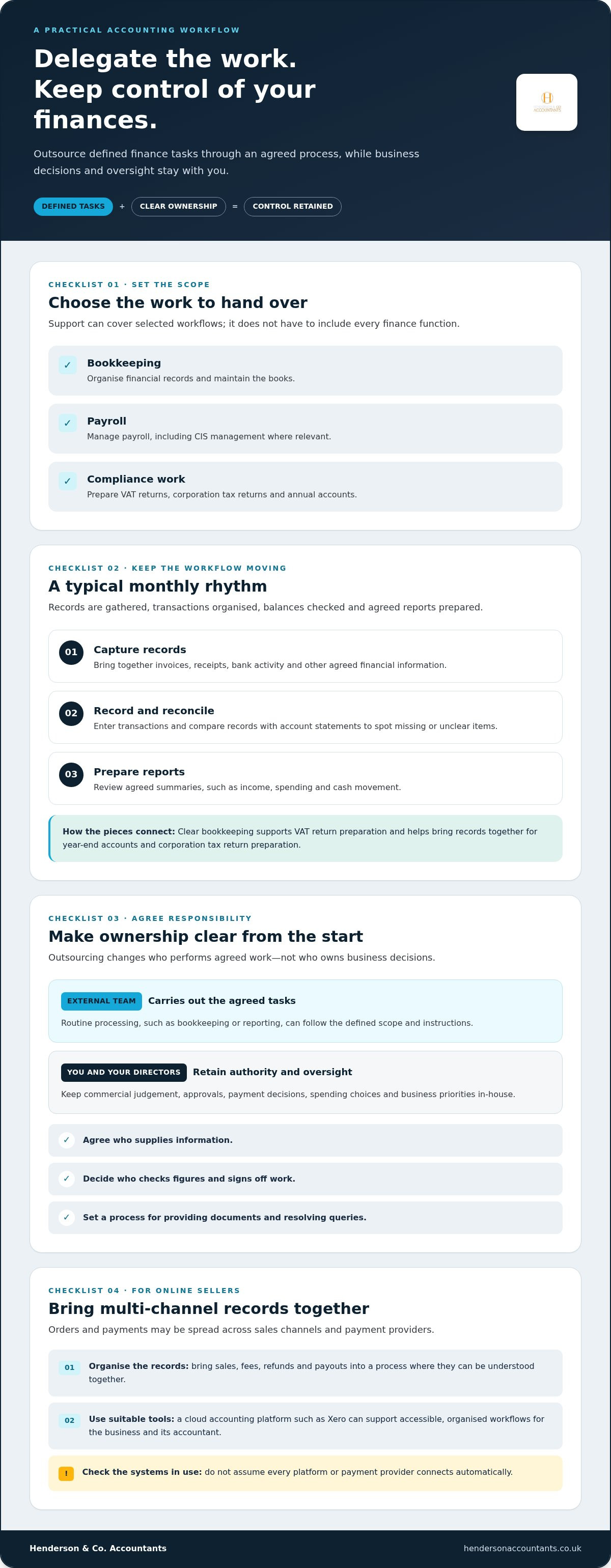
The work can be shaped around your business structure, transaction volume and support needs. An agreed scope might include:
- Bookkeeping: organising financial records and maintaining the books.
- Payroll: managing payroll, with CIS management where relevant.
- Compliance work: preparing VAT returns, corporation tax returns and annual accounts.
Routine processing can sit with the external team, while you retain approval of payments, spending choices and other commercial decisions. Agree who supplies information, checks figures and signs off work to avoid gaps or duplicated effort.
Who is outsourced accounting designed to help?
Outsourcing can suit a growing business whose finance workload is becoming difficult to manage internally, whether the owner is doing the books or an in-house team needs support with defined tasks. Online sellers may also need a consistent way to organise sales records from marketplaces, websites and payment providers. Support can begin with selected workflows; a complete outsourced finance department isn’t necessary for every business.
What does outsourced accounting include in day-to-day business operations?
Good accounting support follows a clear rhythm: records are gathered, transactions are organised, balances are checked and agreed reports are prepared. This gives you a more useful picture of what has come in, what has gone out and which payments may still be due. It doesn’t replace your judgement, but it gives you organised information to work with.
A typical monthly workflow might include:
- Capturing records: bringing together invoices, receipts, bank activity and other agreed financial information.
- Recording and reconciling: entering transactions and comparing records with account statements to identify missing or unclear items.
- Reporting: preparing agreed summaries for you to review, such as income, spending and cash movement.
The scope can also include payroll and compliance tasks. Bookkeeping maintains the records used to prepare VAT returns, while organised information throughout the year can support annual accounts and corporation tax return preparation. The British Business Bank’s guide for smaller businesses also describes accounting, including payroll and tax work, as an area businesses can outsource.
How do outsourced bookkeeping and compliance work together?
Bookkeeping is the record-keeping foundation. When transactions are recorded clearly and supporting information is organised, it’s easier to review figures before preparing VAT returns or bringing records together for year-end accounts. These tasks work best as connected steps, with an agreed process for providing documents and resolving queries. For practical record-keeping routines that online retailers may need, see the eCommerce bookkeeping guide.
What changes for an eCommerce business?
Online sellers may receive orders through several sales channels, while payments arrive through separate providers and settlement reports. Organise those records so sales, fees, refunds and payouts can be understood together. A cloud accounting platform such as Xero can support accessible, organised workflows for the business and its accountant. The process for bringing records together depends on the systems in use, so don’t assume every platform or payment provider connects automatically.
For a fuller look at the financial records and reporting needs of online sellers, explore this eCommerce accounting guide. If you’re considering which recurring tasks to outsource, Henderson & Co.’s outsourced accounting support can bring bookkeeping and compliance work into an agreed process.
Outsourced vs In-house Accounting: Maintaining Control
Choosing to outsource accounting doesn’t mean stepping away from your finances. The key difference is who carries out agreed tasks, not who makes decisions. You can delegate bookkeeping or reporting while keeping approval authority, business priorities and oversight with your directors.
Each arrangement balances internal involvement and external support differently:
| Area | In-house | Outsourced | Hybrid |
|---|---|---|---|
| Responsibility | Internal staff manage agreed finance tasks. | An external team handles the agreed workflows; your business retains decision-making. | Internal staff coordinate or approve work, with an external team delivering selected tasks. |
| Expertise | Depends on the skills available within the business. | Can provide access to accounting support across the agreed scope. | Combines internal business knowledge with external accounting support. |
| Continuity | Work may depend on internal cover and processes. | Work follows the agreed service arrangements and handover processes. | Internal knowledge and external delivery share the workload. |
| Workload and scale | Finance tasks sit with the internal team. | Selected tasks move outside the business as needs change. | Internal capacity can focus on coordination while external support handles defined work. |
Will outsourcing accounting mean losing control of your finances?
No, provided responsibilities and approval points are clear. For example, an external team might organise records and prepare a report, while a director reviews the figures and approves spending. Agree who can access financial records, who signs off payments or submissions, and who handles questions that need a business decision.
Use regular reporting to review activity, and agree an escalation route for urgent or unusual items. Include data access and information sharing in the handover: decide who needs access to which records, how documents will be shared and how queries will be handled. Clear arrangements make it easier to maintain oversight without delaying routine work.
When might an in-house or hybrid approach suit better?
An in-house arrangement may suit a business that needs daily finance coordination close to its operations, or already has the people and processes to manage its workload. A hybrid model can keep day-to-day coordination, approvals and commercial context inside the business while an external accountant handles defined accounting work.
There’s no single model that suits every company. Consider where work gets delayed, which tasks need close internal input and what level of oversight helps you make decisions confidently. Those answers can guide the balance between internal capacity and external delivery.
How do you set up outsourced accounting without disrupting your business?
A smooth handover starts with a clear picture of what happens now. Before you outsource accounting, map the recurring tasks, the people involved and the points where work tends to stall. That gives you and your accountant a practical basis for agreeing a scope that fits your operations.
What should you prepare before handing over accounting tasks?
Gather the essentials first: the accounting software you use, current financial records, the reports you rely on and recurring task deadlines. Note who supplies records, approves payments and answers questions about day-to-day transactions. This helps define what the accountant will handle and what remains with your team.
Then work through the setup in order:
- Map existing work. List the regular finance tasks, who currently completes them and where the information comes from.
- Agree the scope and owners. Set out which tasks the external team will perform, who provides source records and who approves work or decisions.
- Organise records and tools. Decide how documents and queries will be shared. If useful, Xero cloud accounting setup can form part of organising the workflow and making records accessible to the business and accountant.
- Set routines and checkpoints. Agree how often information is supplied, when reports are reviewed and how missing records or unusual transactions are raised.
- Review the first reporting cycle. Check that the reports answer your needs, responsibilities are clear and any handover gaps have been addressed.
How can an outsourced accounting workflow stay clear?
Make the working arrangement easy to follow. Record task owners, information-sharing routines, approval routes and review points in one shared process. For example, agree who responds when a receipt is missing, who resolves a transaction query and who escalates an item that needs a director’s decision. Clear routes help prevent uncertainty from building up between reporting cycles.
Compliance responsibilities need the same care. Agree who prepares information and who reviews or approves each submission, then check relevant HMRC requirements and filing responsibilities against current guidance. Requirements can change, so use current guidance when setting your working calendar rather than relying on old dates or assumptions.
If you’re considering how accounting support could sit within a wider finance function, read this outsourced finance guide for SMEs. Henderson & Co. provides outsourced accounting support for defined workflows, from bookkeeping to compliance tasks.
How can Henderson & Co. make outsourced accounting fit your business?
Outsourced accounting works best when it reflects how your business operates. Henderson & Co. provides support around the tasks you agree to delegate, including bookkeeping, payroll and selected compliance work. You don’t need to hand over every finance task: the scope can focus on the areas where external support is most useful.
These activities can connect as part of a wider workflow. Organised bookkeeping records can support VAT return preparation and year-end accounts, while payroll and CIS management can sit within the agreed responsibilities. The aim is to make task ownership clear and give you a dependable process for the work you choose to outsource.
Routine accounting delivery is distinct from broader strategic support. An outsourced finance department can provide a wider layer of finance support, while an outsourced finance director offers a strategic perspective on financial planning and decisions. These are options for businesses that need them, not automatic additions to every accounting arrangement.
How does specialist support help online sellers?
Online businesses often need to make sense of sales recorded across different channels and payments received through separate providers. Henderson & Co.’s eCommerce accounting expertise and Xero cloud accounting setup can support a more organised workflow for bringing financial records together. Clear records give owners and accountants a shared view of business activity, while the workflow should reflect the sales platforms and payment providers the business uses.
For a broader look at the considerations involved in specialist support, read the online business accountant guide.
What is the next step towards outsourcing accounting?
Before discussing how to outsource accounting, jot down the recurring tasks that take up time, the finance processes that feel difficult to manage and the reports you use to make decisions. Include any deadlines, record-keeping challenges or areas where responsibilities are unclear. This gives the conversation a practical starting point.
An initial discussion with Henderson & Co. can help shape a support scope around your operations and priorities. You can consider which tasks belong in the arrangement, how they fit together and what you’ll continue to manage internally. Discuss your accounting needs with Henderson & Co.
Build a finance arrangement that grows with your business
Outsourcing works best when you define the tasks to delegate and retain clear ownership of approvals and business decisions. A well-organised workflow can connect bookkeeping, reporting and compliance, while regular reviews help you see whether the agreed support still fits as your needs change.
The right model doesn’t have to be all or nothing. Choose support around your recurring finance workload, then consider broader finance department or finance director input if your needs develop. For online sellers, specialist eCommerce accounting and Xero cloud accounting setup can help organise financial workflows across sales channels and payment providers.
Henderson & Co. supports UK businesses with eCommerce accounting, bookkeeping, payroll and compliance services. Before taking the next step, note which tasks take time, where records or deadlines become difficult to manage, and what information you need to make decisions. That gives you a practical starting point for discussing a suitable scope.
Ready to define the right scope for your business? Talk to Henderson & Co. about outsourced accounting.
Frequently Asked Questions
What accounting tasks can a small business outsource?
A small business can outsource recurring finance tasks such as bookkeeping, payroll processing, VAT return preparation and annual accounts. Depending on its structure and requirements, it may also arrange support with corporation tax returns or CIS management. The scope doesn’t need to cover every task. Start by identifying what takes the most time, then agree which records, approvals and decisions will remain with you or your team.
How much does it cost to outsource accounting in the UK?
The cost to outsource accounting depends on the agreed work, transaction volumes and the complexity of your business’s records and reporting needs. A focused bookkeeping arrangement differs from broader support that includes payroll or compliance work. Rather than assuming one standard fee applies, define the tasks you need covered and the information you’ll provide. This helps establish a scope that reflects your business instead of paying for work you don’t need.
Can I outsource accounting but keep control of my business finances?
Yes. You can delegate processing, record-keeping and agreed reporting while retaining control of approvals and business decisions. For example, an accountant might organise transactions and prepare information for review, while you approve payments, set spending priorities and decide how the business responds to the figures. Agree who can access records, who signs off work and how questions are escalated. Regular reporting gives you a clear routine for oversight.
Is outsourced accounting suitable for an eCommerce business?
Yes, outsourced accounting can suit an online business, particularly if sales and payment records come from several channels or providers. The important step is organising orders, fees, refunds and settlement information into a clear accounting workflow. Specialist eCommerce accounting can help bring those records together for review and reporting. The process should reflect the channels and payment arrangements your business uses, rather than assume every seller has the same setup.
How does outsourced accounting work with Xero?
Xero can provide a cloud-based place for a business and its accountant to work with accounting records. The accountant can support the setup and help organise workflows around the business’s records and reporting needs. The practical arrangement depends on how your business operates, what information needs recording and which tasks are agreed. Discuss responsibilities, access and review routines at the outset, and don’t assume every sales or payment system connects automatically.
What happens when I move my accounting to an outsourced provider?
The process usually starts by agreeing which tasks are included and who owns each step. You then organise the existing records, software and relevant deadlines for handover, and decide how information and queries will be shared. The business retains agreed approval responsibilities, while the external team completes its assigned work. After the first reporting cycle, review whether the records, task ownership and reports are working as intended and adjust the process if needed.
Is outsourced accounting the same as hiring a finance director?
No. Outsourced accounting usually covers agreed operational work such as bookkeeping, payroll, reporting and compliance tasks. An outsourced finance director provides a distinct strategic layer, supporting financial planning and business decisions. A business may use one or both types of support, depending on its needs. Clarify whether you need reliable delivery of routine finance processes, strategic financial direction, or a defined combination, then set out the responsibilities for each.


