

The best payroll provider isn’t necessarily the one with the most software features. For a small business, payroll services for small business UK owners can rely on should make responsibilities clear, help keep pay accurate and on schedule, and fit smoothly with the wider finance process.
If PAYE, RTI submissions and employee records are taking time away from running your business, you may be looking for dependable support. Outsourcing doesn’t automatically mean handing over every task. You’ll still need to know what information to provide, what the provider will manage and how payroll updates connect with bookkeeping and reporting.
This 2026 guide explains what a small business payroll service may cover and what to clarify before choosing a provider. You’ll learn how to compare support, agree responsibilities and prepare the records and regular information your provider needs. We’ll also look at how payroll can sit within a wider outsourced finance function, so you can choose support that works for your business now and can adapt as your team changes.
Key Takeaways
- Check which payroll tasks, records and reporting responsibilities are included, and get the agreed scope in writing.
- Understand how PAYE, Real Time Information, payslips, year-end information and workplace pensions fit into your payroll process.
- Compare in-house processing, payroll software and payroll services for small business UK needs across control, time, expertise and scalability.
- Before outsourcing, agree cut-off dates, data transfer, approval steps and how errors will be escalated.
- Explore how Henderson & Co. Accountants' payroll and CIS management may fit within wider outsourced finance support, and confirm the specific arrangements directly.
Payroll services for small businesses: what support can you expect?
A payroll service helps a business calculate employee pay, maintain payroll records and complete agreed reporting tasks. That can reduce payday administration, but “outsourced payroll” doesn’t mean the same thing from every provider. The written service scope should spell out what the provider does, what you supply and which decisions remain yours. For a high-level introduction to what support can you expect from payroll as a business function, see this overview of its core concepts.
Payroll administration is distinct from broader HR support, accounting work and employment-law advice. A provider may handle payroll calculations without managing recruitment, staff performance matters or employment disputes. Payroll figures can feed into bookkeeping and wider financial reporting, but confirm whether that work is included or handled separately.
What tasks might a small business payroll service cover?
Depending on the agreement, routine tasks may include calculating gross and take-home pay, applying deductions, preparing payslips and keeping payroll records. Submitting payroll information, administering workplace pensions and responding to employees’ pay questions may also be included, but shouldn’t be assumed. Check the written scope for each task and who is responsible for it.
Agree how the process works in practice. Who approves the figures before payday? Who follows up missing hours or changes to pay? If information is inaccurate, will the provider flag it for you to correct, or is correcting it part of the agreed work? Clear answers help prevent last-minute confusion.
When should a small business consider payroll support?
Review your current process if payroll is repeatedly late, manual calculations lead to errors or there’s too little internal time to check records carefully. Hiring employees, paying different rates or introducing variable hours can add steps and make a simple routine harder to manage. The right level of support depends on your workforce and how much responsibility you want to retain.
Payroll software gives you tools to process pay; a managed payroll service also provides people to carry out agreed tasks and coordinate the workflow. This distinction can help you compare payroll services for small business UK providers on responsibilities and handovers, not just software features. Confirm exactly what the service covers before deciding.
UK small business payroll obligations: what the service must handle
Outsourcing payroll can shift agreed processing tasks to a provider, but it doesn’t automatically transfer the employer’s responsibilities. You remain responsible for providing accurate, timely information and should understand what you’re approving and what the provider is submitting on your behalf. Be clear about who acts if a submission is late or an employee’s details need correcting.
PAYE is the system employers use to work out and report deductions such as Income Tax and National Insurance from employees’ pay. Real Time Information (RTI) is HMRC’s process for receiving payroll information, generally as part of a regular pay run. The precise steps and timing depend on current rules and your circumstances. Check HMRC’s UK small business payroll obligations guidance for up-to-date requirements, rather than relying on an old checklist or a provider’s software description alone.
How PAYE and RTI fit into a regular pay run
A typical workflow begins with approved information, such as hours worked, salary changes and relevant employee details. The payroll processor uses that data to calculate pay and deductions, prepares the agreed outputs and handles any HMRC reporting included in the service. You or an authorised contact then review and approve the figures in line with the agreed process. Check the current RTI terminology, submission procedure and timing against HMRC guidance.
Pensions, payslips and payroll records
Employees need clear information about their pay, while the business needs organised payroll records and relevant year-end information. Secure handling matters because these records contain sensitive personal and financial details. Workplace pension duties vary according to the employer’s circumstances, so check what applies to your business and whether pension administration is included in the provider’s scope.
Accurate source data and timely approvals give payroll a reliable foundation; a provider can’t safely resolve information it hasn’t received or been authorised to change. Agree who checks hours, new starter details and pay changes, and how corrections are recorded. If payroll figures also feed into bookkeeping or wider reporting, clarify the handover so your business records stay consistent.
Before appointing a provider, map each responsibility: what your team supplies, what the provider processes, who approves the final figures and who responds to discrepancies. This practical detail matters as much as the service description, particularly when comparing payroll services for small business UK owners may need. If you’re considering support as part of a wider finance function, you can learn about Henderson & Co.’s accounting support, then confirm directly which payroll tasks and reporting responsibilities are included.
Payroll software, in-house processing or outsourced services: compare your options
There’s no single right setup for every small business. Your choice depends on how much control you want, the time you can set aside and whether someone in the business can confidently manage payroll tasks. Software can support calculations and record-keeping, but it doesn’t decide who enters data, checks results or deals with exceptions. Compare the working arrangements, not just the tools.
| Factor | In-house processing | Payroll software | Outsourced service |
|---|---|---|---|
| Control | Your team manages the process directly. | You retain control, using software to support processing. | You agree which tasks the provider handles and retain agreed inputs and approvals. |
| Internal time | Staff carry out the administration manually. | Less manual calculation may be needed, but setup, data entry and checks still take time. | Some processing work can move outside the business, though you still provide information and review outputs. |
| Expertise | Knowledge and checks rely on your internal team. | Your team needs to learn the system and assess unusual cases. | You can access provider support within the agreed service scope. |
| Workflow | Steps depend on your internal process. | The software supports the workflow, but responsibilities need defining. | Tasks and handovers should be set out with the provider. |
| Scalability | More staff or varied pay arrangements may add to the workload. | Check whether the system and your team can accommodate changes. | Discuss how the service can adapt as your workforce changes. |
When does payroll software suit a small business?
Software may suit you if someone in the business can keep employee and pay data accurate, oversee each run and follow up exceptions. Factor in the time needed to set up the process, train users and check outputs. A system can help organise the work, but someone still needs to interpret unusual information and decide what needs correcting.
When might outsourced payroll be a better fit?
Consider outsourcing if payroll takes a disproportionate amount of your time or your team lacks confidence managing it. It may reduce some internal processing, but you’ll still need to send complete information and approve outputs on time. Ask how responsibilities, reporting and changes to your workforce will be handled before you commit.
To assess payroll support as part of a wider finance setup, read this outsourced finance buying guide. Use the comparison above to shortlist payroll services for small business UK businesses can realistically manage, then check the scope and handovers behind each option.
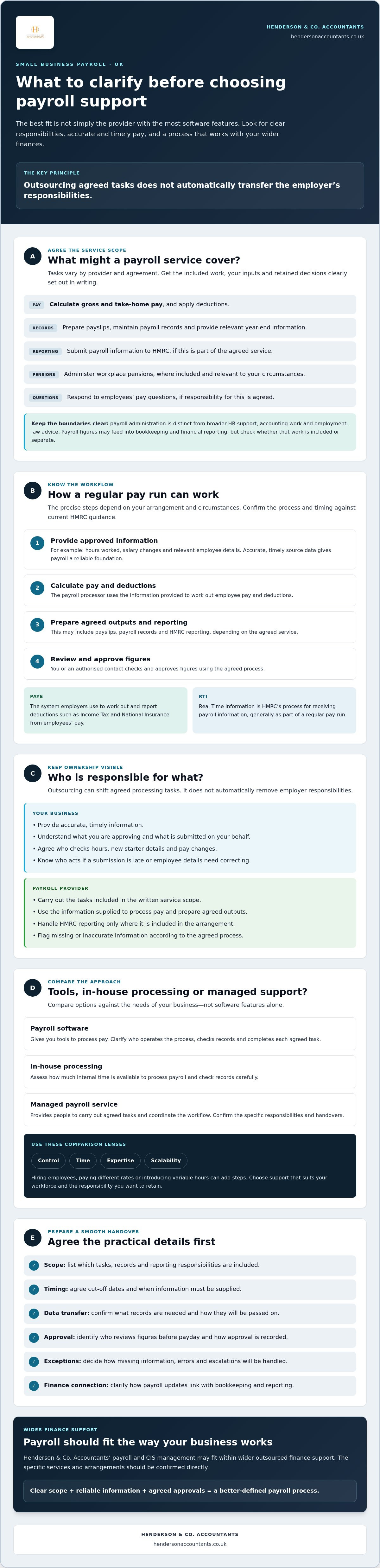
How to choose a payroll service and prepare a smooth handover
A good handover starts before the first pay run. Use this checklist to compare payroll services for small business UK providers and check that the process works for your team, not just on paper.
- Define your needs. List your workforce, pay arrangements and the tasks you want help with.
- Compare the written scope. Check which calculations, submissions, payslips and pension-related tasks are included, and which are not.
- Confirm responsibilities. Agree who supplies information, checks results, approves payroll and corrects errors.
- Plan the transition. Set a start date and cut-off dates, and agree a secure method for transferring records. Ask how continuity will be managed during the changeover.
- Review reporting. Check what reports you’ll receive, when they’ll arrive and how you can raise questions or flag a problem.
Before signing, ask how the provider handles staff changes, employee pay queries, corrections and ending the service. Clarify who can access personal data, how confidentiality and security are managed, and what happens to your records if you leave. Discuss typical response arrangements and how urgent issues are escalated, rather than assuming a particular level of availability.
Questions to ask a payroll provider before signing
Ask what’s included in the regular service, including calculations, HMRC submissions, payslips and any pension-related administration. Find out what information you must supply and by when, who approves the results, and how missing or inaccurate details are handled. A clear answer should describe the recurring handover, not just the software or onboarding process.
Information to prepare for payroll onboarding
Prepare employee details, agreed pay arrangements and existing payroll records, along with relevant information about changes to staff or pay. The provider should explain what they need and how to transfer it. Use the agreed secure process for personal data, then confirm who will check that transferred records are complete and accurate before processing begins.
For online retailers, payroll information should also fit sensibly alongside bookkeeping and wider financial reporting. This eCommerce accounting guide offers related context.
If you’re considering support, discuss payroll and CIS management with Henderson & Co. Confirm the current service scope, handover process and responsibilities directly before making a decision.
How Henderson & Co. can support small business payroll
Payroll doesn’t have to sit apart from the rest of your finance processes. Henderson & Co. offers payroll and CIS management as part of its outsourced finance support, which may suit businesses considering payroll alongside bookkeeping or wider finance administration. The firm also provides bookkeeping and outsourced finance department services, giving businesses options to consider as their needs develop.
That doesn’t mean every task is automatically combined or that systems connect without arrangement. Before engaging a provider, confirm which payroll activities are included, how information will be shared and what reporting you can expect. Ask how payroll figures can be made available for bookkeeping and wider reporting, and who is responsible for checking that records are complete and consistent. Those practical links matter for growing firms as well as businesses with a small team.
Payroll alongside bookkeeping and wider finance support
Review payroll as part of your overall finance workflow. For example, consider how pay information will reach the people maintaining your books and how you’ll monitor payroll costs over time. Online sellers may also have changing staffing needs as trading patterns shift, so consider payroll records alongside sales, costs and wider business reporting. For more on the bookkeeping side, see this eCommerce bookkeeping guide.
Henderson & Co. also provides eCommerce accounting and Xero cloud accounting setup. If these services are relevant to your business, ask how each would sit alongside payroll support. Don’t assume a particular software link or shared process is included; confirm the practical arrangements directly.
What to discuss before requesting payroll support
To make an initial discussion useful, outline your workforce size, pay frequency and current payroll process. Mention any changes you expect, such as hiring or different pay arrangements. Then ask for clarity on:
- the payroll and CIS tasks covered, and what remains your responsibility
- onboarding information and records you’ll need to provide
- how approvals, regular communication and reporting will work
- how payroll information may fit with bookkeeping or wider finance support
These details will help you judge whether the proposed arrangement suits your needs now and can adapt as the business changes. They’re also a more useful basis for comparing payroll services for small business UK owners may be considering than a general promise of support.
If you’d like to explore whether the service could suit your business, discuss your payroll requirements with Henderson & Co. Ask the team to confirm the current scope, processes and responsibilities, so you can decide with a clear picture of what’s included.
Choose payroll support that can grow with your business
The right payroll arrangement gives you a clearer process, not just another system to manage. Before choosing payroll services for small business UK needs, compare what each provider will handle, what your team must supply and how approvals, reporting and corrections will work. A clear written scope and well-planned handover help keep payroll connected to your wider finance processes as your workforce changes.
Henderson & Co. offers payroll and CIS management among its services, and payroll support can sit within its outsourced finance department offering. The exact tasks and responsibilities depend on the agreed service, so discuss your requirements directly before deciding whether the support is a good fit.
Discuss your payroll requirements with Henderson & Co. Share how your payroll currently works and what you’d like to change. With the responsibilities and reporting agreed, you can approach payday with greater clarity and focus on running your business.
Frequently Asked Questions
What do payroll services for a small business usually include?
Payroll services may include calculating pay and deductions, preparing payslips, maintaining payroll records and completing agreed reporting tasks. Some providers also handle submissions, pension-related administration or employee pay queries, but these aren’t automatically included. Before choosing payroll services for small business UK needs, ask for a written scope explaining what the provider does, what information you must supply, who approves the results and how corrections are handled.
Can a small business outsource payroll?
Yes, a small business can outsource agreed payroll tasks to an external provider. You’ll generally still need to provide accurate, up-to-date employee and pay information, review outputs and understand which responsibilities remain yours as the employer. Before engaging a provider, agree how information will be shared, when it’s due, who approves each pay run and how queries or errors are escalated. Check the written service scope rather than assuming all payroll tasks are covered.
Is it better to use payroll software or an outsourced payroll service?
It depends on your available time, internal knowledge and preference for control. Software can help your team process payroll, but you’ll still need to enter and check information, learn the system and deal with exceptions. An outsourced service may take on agreed processing tasks, while still relying on you for inputs and approvals. Compare the full workflow and responsibilities, not just features. Neither option is automatically best for every small business.
Does a small business need to run PAYE payroll?
Not every business has the same PAYE requirements. Whether you need to operate PAYE depends on factors such as who you pay and the circumstances of those payments. Check current HMRC guidance for your situation before deciding; don’t rely on a general rule or assume that outsourcing changes the requirement. If you appoint a provider, clarify whether PAYE processing and HMRC submissions are included, and which decisions or employer responsibilities remain yours.
What information does a payroll provider need from a small business?
A provider will usually ask for relevant employee details, pay arrangements and existing payroll records. They may also need information about changes, such as new starters, changes to hours or pay, and absences that affect pay calculations. Ask for a specific onboarding list and agree when updates must be supplied. Transfer personal information using the provider’s agreed secure process, then establish who checks that the records are complete and accurate before payroll is processed.
Can an accountant manage payroll for a small business?
Yes, an accountant may offer payroll management, but services differ between firms. Confirm whether the accountant handles calculations, payslips, submissions, pension-related tasks or employee queries, and ask what remains your responsibility. Henderson & Co. offers payroll and CIS management, with payroll support available within its outsourced finance department offering. Contact the firm to confirm the current scope, process and reporting arrangements that would apply to your business.
How do I switch payroll providers without disrupting pay?
Plan the change around an agreed pay run and confirm which provider is responsible for each task during the transition. Ask what records are needed, how they’ll be transferred securely, when the new provider needs your information and who approves the first run. Check how the outgoing provider’s records and any unresolved corrections will be handled. Keep a named contact for questions and agree how urgent issues will be raised before the changeover begins.
How much do payroll services for small businesses cost?
There’s no single fee that applies to every business. The price can depend on the agreed service scope, workforce and complexity of the payroll process. Ask providers for a written quotation based on your circumstances, and check whether it covers the tasks you need or treats any work as additional. Compare what each service includes, such as processing, reporting and support, rather than weighing providers on a headline figure alone.


