

Running a business by looking only at your annual figures is like trying to drive a car while staring at the rear-view mirror. It tells you exactly where you've been, but it does very little to help you navigate the sharp corners ahead. If you've ever felt a pang of anxiety over fluctuating cash flow or made a major decision based on a gut feeling rather than hard data, you aren't alone. Many UK entrepreneurs find that traditional financial reports feel too complex or arrive far too late to be truly useful for daily operations.
We believe that financial clarity should be your greatest competitive advantage. In this guide, we'll demystify management accounts and show you how they provide the real-time insights you need to scale your business with confidence. You'll discover a framework for making smarter investment and hiring decisions, ensuring you always have a clear view of your profit margins and cash runway. From setting up Xero for automated data flows to leveraging outsourced expertise, we'll help you replace uncertainty with a sense of calm control over your company's future.
Key Takeaways
- Learn why shifting from annual statutory filings to regular internal reporting is essential for proactive and modern business management.
- Understand the core components of a monthly financial pack, including how to compare your actual profit and loss against your original budgets.
- Use management accounts to identify your most profitable products and services, allowing you to allocate resources with total confidence.
- Discover how cloud technology like Xero automates data collection to provide real-time dashboards and a clear view of your cash runway.
- Shift from making decisions based on gut feeling to a data-driven framework that offers peace of mind whilst you scale your business.
What are Management Accounts? A Definition for Modern Business
At its simplest, management accounts are a collection of financial reports produced at regular intervals, typically every month or quarter. While your annual statutory accounts satisfy legal obligations for HMRC and Companies House, management reports are designed specifically for you, the business owner. They act as a live pulse check for your company, translating raw numbers into a clear narrative that helps you understand exactly where your money is going and how your operations are performing in real-time.
Although there's no legal requirement to produce these reports, they're the foundation of any business aiming to scale. If you're planning to secure a bank loan or attract private investment, lenders and investors will almost certainly ask to see your management information. It proves that you have a firm grip on your finances and aren't just guessing your way through growth. By providing timely data, these accounts allow you to monitor performance and make informed decisions whilst you still have time to influence the outcome.
The Purpose of Regular Financial Reporting
The primary goal of regular reporting is to replace guesswork with certainty. By reviewing your figures frequently, you can track your progress against pre-defined business goals and budgets. This level of detail allows you to spot small problems before they grow into expensive crises. For example, if your marketing spend has spiked without a corresponding rise in revenue, you'll see it immediately rather than discovering it at the end of the financial year. It provides a steady baseline for your financial health, even amongst the volatility of the current UK market.
Why Real-Time Data is Non-Negotiable in 2026
The days of historical accounting, where you wait months to see if you made a profit, are quickly fading. In 2026, the pace of business moves too fast for outdated data. Digital-first companies, particularly those in the eCommerce sector, deal with rapid stock turnover and shifting ad costs that require daily or weekly monitoring. Proactive financial management means using your management accounts to look forward, not just back.
When you have access to real-time information, you gain a significant competitive edge. You can pivot your strategy, adjust your pricing, or double down on a high-performing product line while your competitors are still waiting for their annual statements to arrive. It's about moving from a reactive state of mind to one of calm, strategic control. Having this data at your fingertips ensures you're never left wondering if you can afford that next big hire or equipment investment.
Management Accounts vs Statutory Accounts: Key Differences
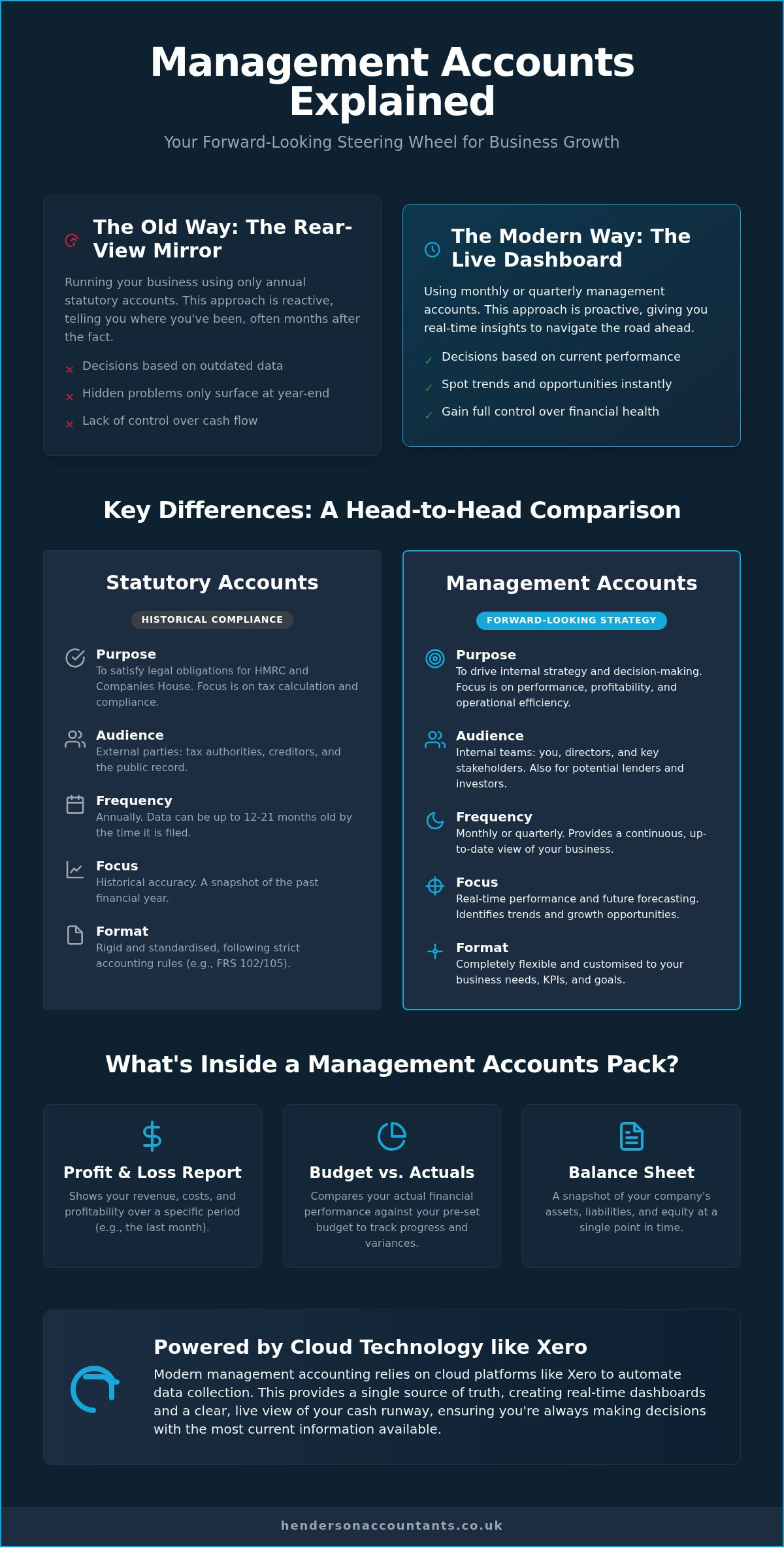
Many business owners view accounting as a once-a-year hurdle. This is the world of statutory accounts. These reports are historical by nature; by the time you file them with Companies House, the data is often many months out of date. They serve as a "rear-view mirror" for HMRC to calculate your tax bill. In contrast, management accounts act as your forward-looking steering wheel. They provide the real-time data you need to adjust your course today, not next year.
The audience for these two types of reports is entirely different. Statutory accounts are public documents meant for HMRC and potential creditors. Management accounts are strictly for internal use. They stay within your business, shared only with directors and key stakeholders who need to understand the "why" behind the numbers. This privacy allows for a much more honest and granular look at your performance. Timing is also a critical differentiator. While you only look at statutory filings annually, management information is delivered monthly or quarterly. This frequency ensures you're never more than a few weeks away from a fresh financial update.
Compliance vs Strategy: A Detailed Breakdown
Statutory accounts are strictly standardised. They follow rigid rules to ensure legal accuracy and tax compliance. They don't care about your marketing ROI or which product line is most profitable. Management reports focus entirely on strategy. They highlight operational efficiency and identify growth opportunities that annual filings simply miss. Management accounts complement your statutory filings by bridging the gap between historical compliance and future success.
Flexibility and Customisation in Reporting
One of the biggest advantages of these reports is their inherent flexibility. You aren't tied to a specific format. You can segment your data by department, specific sales channels, or even individual product lines. This is particularly useful for eCommerce businesses that need to see which platforms are delivering the best margins.
You can also include non-financial data to get a fuller picture. Metrics like customer acquisition costs or lead conversion rates provide vital context to your financial figures. Because every business faces unique challenges, there isn't a one-size-fits-all template. Your reporting pack should be as unique as your company. If you're ready to move beyond basic compliance, our team can help you build a bespoke Outsourced Finance Department that delivers these insights every month.
What is Included in a Typical Management Accounts Pack?
A well-constructed reporting pack is your company's financial health certificate. It goes far beyond a simple list of transactions, instead grouping data into meaningful categories that tell a clear story. While every pack is bespoke, a standard set of management accounts usually includes a Profit and Loss statement, a Balance Sheet, and a detailed breakdown of aged debtors and creditors. Together, these reports show you what you've earned, what you own, and what you're owed at any given moment.
By reviewing these documents together, you gain a three-dimensional view of your business. You can see the relationship between your sales activity and your bank balance, helping you understand how operational changes impact your bottom line. It's about moving away from isolated numbers and looking at the bigger picture of your company's stability and potential.
Analysing the Profit and Loss Statement
The Profit and Loss (P&L) statement is often the first report directors look at. It shouldn't just show your total income; it should compare your actual performance against your original budgets and prior periods. This comparison, known as variance analysis, helps you understand why spending might be higher than expected. By focusing on your gross and net profit margins, you can identify if rising supplier costs are eating into your earnings or if your pricing strategy needs an urgent update. It also helps you keep a close eye on overheads, ensuring your fixed costs aren't growing faster than your revenue.
The Critical Role of Cash Flow Forecasting
Perhaps the most vital tool for growth is the cash flow forecast. It's common for a business to show a healthy "paper profit" while having very little actual cash in the bank. Forecasting predicts your future bank balance, allowing you to plan for significant outgoings like Corporation Tax bills or large inventory orders.
For eCommerce brands, this is especially important. You often face a "cash gap" between paying for stock and receiving the proceeds from a sale. Using management accounts to bridge this gap ensures you have enough liquidity to keep operating without stress. By seeing your cash runway months in advance, you can make confident decisions about when to invest in new products or when to pull back on marketing spend. This foresight replaces the anxiety of a low bank balance with a structured plan for your next move.
How Management Information Drives Strategic Growth
Scaling a business requires more than just hard work; it requires precision. While your bookkeeping tracks every penny, your management accounts reveal which of those pennies are working the hardest for you. Many business owners treat these reports as a simple byproduct of bookkeeping, but they're actually your most powerful tool for expansion. By identifying your most profitable services or product lines, you can stop wasting marketing budget on low-margin areas and double down on what truly drives your bottom line.
Professional financial data is also your best friend when it's time to find external funding. If you're applying for a business loan or seeking private investment, lenders want to see that you understand your numbers. Having a consistent history of management information proves you're a low-risk, high-control director. It also makes tax planning a much calmer process. Instead of guessing your liability, you can predict your Corporation Tax and VAT payments throughout the year, ensuring the cash is always ready when the deadline hits.
KPI Tracking for eCommerce and Digital Brands
For digital-first businesses, growth is often a numbers game that happens at high speed. You need to know exactly how much it costs to win a customer and how much that customer is worth over time. Your management pack allows you to track specific metrics that matter:
- CLV vs CAC: Monitoring Customer Lifetime Value against Acquisition Costs ensures your growth is sustainable.
- Inventory Turnover: Tracking how quickly stock moves helps you avoid tying up thousands of pounds in slow-moving items.
- Marketplace Performance: Using data to decide exactly when you have the cash runway to expand into new international territories.
The Role of an Outsourced Finance Director
Data is only useful if you know how to act on it. This is where a strategic partner makes the difference. An Outsourced Finance Director services provider doesn't just hand over a PDF; they interpret the story behind the figures. They help you move from "data collection" to "strategic execution" by highlighting trends you might miss while busy with daily operations.
Having an expert voice in your ear provides the confidence to make big moves, whether that's a major new hire or a significant equipment purchase. It's about having a proactive guide who stays ahead of the curve, ensuring your stable foundation remains solid whilst you build your success. If you're ready to see how these insights can transform your business, let's talk about building your bespoke growth strategy today.
Implementing Management Accounts with Xero and Cloud Technology
Modern business moves too fast for manual spreadsheets and paper receipts. Using cloud accounting software like Xero changes everything. It automates data collection from bank feeds and third-party apps, ensuring your management accounts are always built on live, accurate data. Instead of waiting weeks for a bookkeeper to finish their monthly tasks, you get real-time dashboards that offer a constant view of your financial health. This visibility allows you to spot a dip in margins or a spike in costs the moment it happens, rather than discovering it months later.
This level of automation does more than just save you hours of admin. It removes the anxiety of human error by using automated reconciliation to keep your data clean. When your systems talk to each other, the risk of a misplaced decimal point or a forgotten invoice vanishes. This accuracy provides the stable foundation you need to build your success with confidence. Choosing an Outsourced Finance Department is also a smart financial move. It's often far more cost-effective than hiring an in-house team, giving you access to senior-level expertise without the heavy overheads of a permanent salary, pension, and office space.
The Xero Ecosystem: Automating Your Finance Function
For digital brands, the real power of cloud technology lies in its connectivity. Integrating payment gateways like Stripe and PayPal allows for seamless eCommerce reporting that captures every transaction automatically. When you work with specialists for your Xero cloud accounting setup, you can also tap into a vast library of add-ons designed for advanced forecasting and KPI tracking. These tools turn your raw data into visual stories that are easy to digest, helping you spend less time looking at spreadsheets and more time growing your brand.
Steps to Setting Up Your Management Reporting
Building a reporting habit starts with a clear, methodical structure. Follow these practical steps to get your finance function moving in the right direction:
- Step 1: Organise your chart of accounts to reflect your specific business structure and sales channels so you can see exactly where profit is generated.
- Step 2: Set realistic budgets for the financial year to create a benchmark for your performance and growth.
- Step 3: Establish a strict monthly closing routine to ensure every penny is accounted for before your reports are generated.
- Step 4: Review your reports with a professional partner to turn the numbers into a clear, actionable strategy for expansion.
Take Control of Your Financial Future
Transitioning from annual compliance to regular management accounts is the most effective way to replace business anxiety with calm, strategic control. You now understand how real-time visibility of your profit margins and cash runway provides the confidence to make major investment or hiring decisions without the guesswork. By leveraging modern cloud technology and a structured reporting pack, you move your finance function from a historical record to a forward-looking growth engine.
As Xero Platinum Partners and specialist eCommerce accountants, we're here to help you navigate the complexities of scaling. We don't just deliver reports; we provide proactive strategic advice that helps you stay ahead of the competition. Whether you're managing fluctuating cash flow or planning your next big move, having an expert partner ensures you're always moving in the right direction. Ready to gain total clarity? Explore our Outsourced Finance Department services and discover how we can build your success on a stable, data-driven foundation. Your business has incredible potential. With the right insights, there's no limit to what you can achieve.
Frequently Asked Questions
Do I legally need to produce management accounts in the UK?
No, there is no legal requirement to produce these reports. Unlike statutory accounts, which must be filed with Companies House and HMRC, management information is entirely for your own internal use. While not mandatory, they are indispensable for directors who want to move beyond basic compliance. Having these figures ready is also frequently a prerequisite if you decide to apply for external funding or attract new investors to your business.
How often should I review my management accounts?
You should ideally review your management reports once a month to maintain a clear view of your performance. Monthly reviews allow you to catch cash flow fluctuations or rising overheads before they become critical issues. If your business is scaling rapidly, especially in the eCommerce sector, you might even check specific real-time dashboards weekly. The goal is to ensure your decisions are always based on the most recent financial data available.
What is the difference between a bookkeeper and someone who prepares management accounts?
A bookkeeper focuses on the accurate recording of daily transactions and maintaining your ledger. In contrast, the person preparing your management accounts takes that raw data and turns it into a strategic narrative. They look for trends, compare actual performance against your budgets, and provide the insights needed for high-level decision-making. While bookkeeping is about data entry, management accounting is about data interpretation and driving business growth.
Can I produce my own management accounts using Xero?
You can generate basic reports using Xero, but professional setup is key to making them useful. Xero provides the technology to automate data flows, but an accountant ensures your chart of accounts is organised correctly to reflect your specific business structure. Without professional oversight, you might miss vital adjustments or accruals that ensure your profit and loss statement accurately reflects your company's true financial position for that specific period.
Why do banks ask for management accounts when I apply for a loan?
Banks and lenders ask for these reports because annual statutory accounts are often too outdated to show your current creditworthiness. They need to see a real-time snapshot of your cash flow, profit margins, and debt levels to assess your ability to repay a loan. Providing a professional management pack demonstrates that you are a proactive director with a stable foundation, which significantly increases your chances of securing the funding you need.
How much do management accounts cost for a small business?
The cost of producing management accounts varies depending on the size of your business and the complexity of your financial transactions. Most firms include this service as part of a wider Outsourced Finance Department package. While it's an additional investment compared to basic year-end filing, the value comes from the tax savings and growth opportunities identified through the data. It's generally much more cost-effective than hiring a full-time in-house finance team.
What are the most important KPIs to include in my management pack?
Your management pack should include KPIs tailored to your specific industry goals. At a minimum, you should track your gross profit margin, net profit margin, and current cash runway. If you run a digital or eCommerce brand, it's vital to include metrics such as Customer Acquisition Cost (CAC) and inventory turnover rates. These indicators help you understand if your marketing spend is delivering a high enough return to justify your current growth strategy.
How do management accounts help with HMRC compliance and VAT?
These reports simplify HMRC compliance by ensuring your records are reconciled and accurate throughout the year. Regular reporting makes VAT return preparation much faster and reduces the risk of errors that could lead to penalties. Perhaps most importantly, they allow you to predict your future Corporation Tax liabilities. This foresight ensures you can set aside the correct amount of cash each month, replacing the anxiety of an unexpected tax bill with calm control.


