

With the global cross-border eCommerce market projected to reach $636.34 billion in 2026, the opportunity for your brand to grow beyond British borders has never been bigger. However, that growth often comes with a heavy side of compliance anxiety. You've likely spent late nights worrying about HMRC penalties, the removal of the EU's €150 customs duty exemption, or the shifting "nexus" rules across dozens of US states. It's a lot to manage whilst you're trying to run a business.
We understand that managing international sales tax for uk ecommerce feels like a moving target. The good news is that global tax compliance doesn't have to be a barrier to your success. This guide provides a clear roadmap to help you master VAT, GST, and US Sales Tax. We'll look at how to automate your tax collection and reporting, ensuring you stay ahead of the curve. By the end of this article, you'll have the peace of mind to scale your brand globally without the fear of hidden barriers or manual data errors.
Key Takeaways
- Understand the shift to destination-based taxation and how it affects your global pricing strategy and profit margins.
- Simplify your EU trade by mastering the IOSS scheme for consignments under €150 to avoid unexpected customs delays for your customers.
- Identify your specific registration triggers for international sales tax for uk ecommerce by learning the latest US economic nexus thresholds.
- Remove the risk of manual data entry errors by automating your tax tracking through a seamless Xero and sales channel integration.
- Learn why a specialist eCommerce accountant acts as a proactive partner to help you scale globally without compliance anxiety.
Understanding the Global Sales Tax Landscape for UK eCommerce
Scaling your brand beyond British shores is a significant achievement. It also marks a turning point in your financial responsibilities. You're no longer just dealing with HMRC; you're now a participant in a complex global network. Managing international sales tax for uk ecommerce requires moving away from a local mindset to one that embraces global compliance as a strategic growth lever.
VAT vs GST vs Sales Tax: What is the Difference?
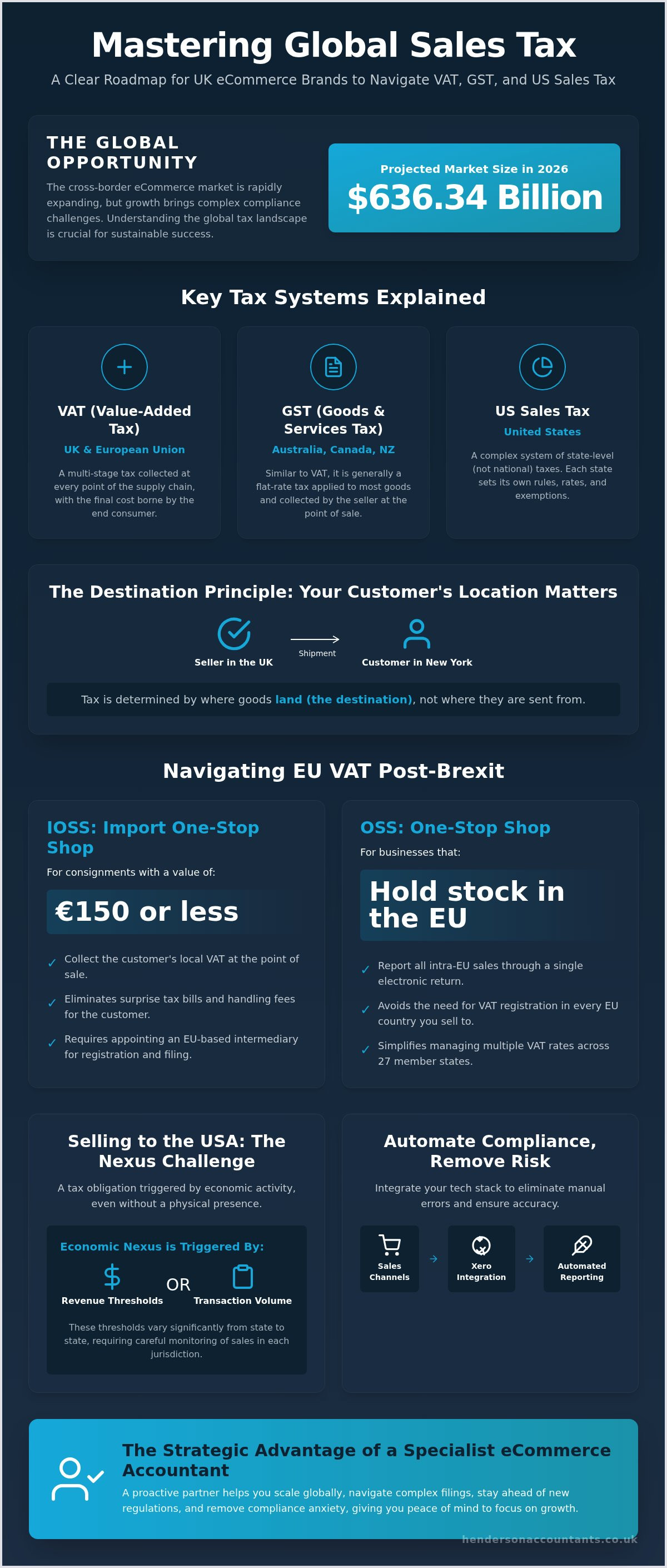
Most regions use one of three main systems. Understanding Value-Added Tax (VAT) is essential because it's the standard across the UK and the European Union. It's a multi-stage tax collected at every point of the supply chain. Goods and Services Tax (GST), used in Australia, New Zealand, and Canada, works very similarly to VAT. It's generally a flat rate applied to most goods whilst being collected by the seller at the point of sale.
The US system is entirely different. Instead of a national tax, you deal with state-level Sales Tax. There isn't a single "US tax rate." Each state sets its own rules, rates, and exemptions. This creates the "Nexus" challenge, where your obligation to collect tax depends on your connection to a specific state. This can be based on where you have staff or where your sales reach a certain volume.
The Destination Principle: Why Your Customers Location Matters
Modern eCommerce relies on the destination principle. This means tax is determined by where the goods land, not where they are sent from. If you ship a jumper from London to a customer in New York, the tax rules of New York apply. This shift makes tracking your sales by country and state non-negotiable. You need to know exactly how much you're selling in each jurisdiction to identify when you've triggered a registration requirement for international sales tax for uk ecommerce.
Economic nexus for a UK seller selling to the US is a tax obligation triggered by reaching a specific revenue or transaction volume within a particular state, regardless of whether you have a physical office or warehouse there.
Ignoring these rules carries heavy risks. Beyond the obvious threat of financial penalties from international tax authorities, non-compliance leads to logistical nightmares. Packages can be held at customs for weeks. Your customers might be hit with unexpected "handling fees" and tax bills upon delivery. This doesn't just hurt your bottom line; it destroys the trust you've worked hard to build with your global audience.
Navigating EU VAT: OSS, IOSS, and Post-Brexit Compliance
Brexit fundamentally shifted the goalposts for British brands. Before the split, you could rely on "distance selling" thresholds, only registering for VAT in an EU country once your sales hit a certain limit. Those days are gone. Now, the UK is treated as a "third country," which means every sale into the EU is an import. Understanding how UK VAT rules for overseas sellers mirror these international changes helps clarify why the EU now requires immediate compliance from British exporters.
Using IOSS to Streamline Customer Experience
The Import One-Stop Shop (IOSS) is a fantastic tool for consignments with a value of €150 or less. It allows you to collect the customer’s local VAT at the point of sale. This is a huge win for customer service because it removes those dreaded "surprise" tax bills and handling fees at the doorstep. Without IOSS, your customer becomes the "importer of record" and must pay VAT before the courier releases the parcel.
To use IOSS as a UK business, you must appoint an EU-established intermediary to handle your registration and filings. It's also vital to ensure your bookkeeping software is configured to record these transactions correctly. Each sale must show the specific VAT rate of the customer's country, making your monthly IOSS return a simple, automated process rather than a manual nightmare.
When OSS Becomes Necessary for UK Brands
The One-Stop Shop (OSS) comes into play if you hold stock within the EU, such as in a fulfilment centre in Poland or Spain. Once your goods are already inside the EU, sales to consumers in other member states are intra-community transactions. Instead of the headache of registering for VAT in every single country where you have a customer, OSS lets you report all these sales through one single electronic return.
Managing multiple VAT rates across 27 different member states is much simpler when you have a proactive partner. A specialist eCommerce accountant can help you navigate these filings whilst keeping you ahead of new regulations. For instance, as of July 2026, the €150 customs duty exemption has been removed, replaced by a €3 duty per line item on many imports. This makes your strategy for international sales tax for uk ecommerce even more critical for maintaining your profit margins.
Whilst these acronyms feel like "accountant-speak," they're actually the keys to a frictionless European expansion. By setting up the right EU VAT framework now, you protect your brand's reputation and ensure your global growth is built on a stable, compliant foundation.
Selling to the US and Beyond: Nexus and Global GST
Moving your focus across the Atlantic brings a shift in how you manage international sales tax for uk ecommerce. Unlike the EU VAT for e-commerce framework, which offers a relatively unified approach through IOSS, the United States operates as a patchwork of state-level rules. This means your tax obligations can change the moment your customer's parcel crosses a state line.
The US Sales Tax Maze: Economic Nexus for UK Sellers
For UK sellers, the biggest hurdle is "Economic Nexus." This is a legal link created between your business and a US state based purely on your sales volume. Most states trigger a registration requirement once you hit $100,000 in gross sales within a calendar year. While many states previously used a 200-transaction limit as a secondary trigger, a growing number, including Illinois and Utah, have recently removed this to simplify the process for remote sellers.
The Wayfair Decision was a landmark 2018 US Supreme Court ruling that gave states the legal authority to require remote sellers to collect sales tax once they meet specific economic thresholds, regardless of whether they have a physical office or warehouse in that state.
You must also be wary of "Physical Nexus." If you use a US-based fulfilment centre or store inventory in an Amazon FBA warehouse, you likely have a physical presence in that state. This often triggers a tax obligation immediately, even if your sales are well below the $100,000 mark. It's a common trap that can lead to significant back-tax liabilities if not identified early.
Beyond the US, Australia and New Zealand use a Goods and Services Tax (GST) system. In Australia, you must register if your annual turnover from sales to Australian consumers exceeds AUD $75,000. New Zealand has a similar requirement with a slightly lower threshold of NZD $60,000. If you sell primarily through marketplaces like eBay or Amazon, these platforms often act as "Marketplace Facilitators," collecting and remitting the tax on your behalf. However, you still need to monitor these sales figures as they contribute to your overall registration thresholds for other sales channels.
Micro-Influencer Tax Obligations and Social Commerce
A significant gap in many compliance strategies is the tax treatment of micro-influencers and social commerce. If you're a UK-based influencer selling digital products, presets, or branded merch to a global audience, you're essentially running an eCommerce business. The same "Nexus" and GST thresholds apply to you. Receiving "gifts" from international brands in exchange for promotion also carries risks; many jurisdictions treat high-value samples as taxable income rather than simple presents. Keeping your global sales data organised is the only way to stay ahead of these complex rules whilst protecting your personal and professional reputation.
Automating Compliance: Integrating Xero with Your Tech Stack
Manual data entry is the silent killer of eCommerce growth. When you're managing international sales tax for uk ecommerce, trying to track every transaction across different jurisdictions in a spreadsheet is a recipe for disaster. One missed decimal point or a forgotten tax rate can lead to significant HMRC penalties or issues with overseas authorities. Automation isn't just a luxury; it's the foundation of a scalable global brand. It replaces the anxiety of "getting it wrong" with a steady, predictable workflow.
Xero Cloud Accounting Setup for Global Sales
Xero is particularly powerful for international sellers because of its sophisticated multi-currency capabilities. By setting up specific tax rates for the EU, US, and Australia, you can ensure that every invoice reflects the correct local requirement. We recommend using tracking categories to segment your sales by region or country. This allows you to see at a glance which territories are performing well whilst keeping your tax liabilities organised. Automating the flow from Shopify or Amazon into your ledger ensures that your financial data is always current and ready for review.
Choosing the Right Tax Automation Tools
To truly bridge the gap between your sales channel and Xero, you need a specialised tax engine. Tools like TaxJar and Avalara are industry leaders for US Sales Tax, whilst Hellotax offers excellent support for EU VAT compliance. These platforms integrate directly with your store to calculate tax in real-time. They then push "filing-ready" reports into Xero, significantly reducing the manual workload for your team. This tech-led approach ensures you stay ahead of the curve, even as rules like the US economic nexus thresholds continue to shift.
Reconciling international sales is where the calm control of a good system really shows. Your bank feed must match your tax liabilities, but this is rarely straightforward due to exchange rate fluctuations and marketplace fees. Using a connector like A2X or LinkMyBooks is essential here. They break down messy Amazon or Shopify payouts into clean, summarised entries that match your Xero bank feed perfectly. This level of precision ensures you aren't just guessing your tax bill but paying exactly what is owed.
While the software does the heavy lifting, having a professional eye on your international sales tax for uk ecommerce ensures your tech stack is always working for you. If you're ready to move away from manual spreadsheets, our team can help you with a professional Xero Cloud Accounting Setup tailored for global eCommerce. This proactive guidance turns your accounting from a reactive chore into a strategic advantage for your business.
The Strategic Advantage of an eCommerce Specialist Accountant
High-street accountants often excel at supporting traditional local businesses, but they frequently struggle with the multi-layered complexity of global digital trade. Managing international sales tax for uk ecommerce requires a deep understanding of automated data flows and cross-border regulations that change almost monthly. A generalist might help with your annual accounts, but they rarely have the specialist knowledge to navigate the friction of IOSS or the intricacies of US state-level reporting. Choosing a partner who understands the digital landscape ensures you don't outgrow your financial support system.
Beyond Bookkeeping: Strategic Financial Oversight
An Outsourced Finance Director (FD) provides much more than standard bookkeeping. They act as a strategic partner, helping you model exactly how international tax will impact your profit margins before you enter a new market. For example, they can help you decide whether it's more tax-efficient to store inventory in a European fulfilment centre or continue shipping from the UK. This proactive planning replaces the "wait and see" approach with a stable foundation for growth. It gives you the peace of mind to focus on what you do best: developing products and building your brand.
Moving from reactive compliance to proactive tax planning is a game-changer for scaling brands. Instead of worrying about a surprise bill from an overseas authority, you'll have a clear roadmap. This includes identifying the most tax-efficient regions for your next expansion and understanding how local thresholds will affect your cash flow. This level of oversight turns a potential barrier into a clear path for success. Our team ensures your strategy for international sales tax for uk ecommerce is robust, scalable, and always ahead of the next regulatory shift.
Your Collaborative Ally in Global Growth
At Henderson & Co. Accountants, we pride ourselves on being a tech-savvy guide for modern entrepreneurs. We deliberately avoid the cold, intimidating formality of traditional firms. Instead, we focus on clear communication and transparency. By removing the "accountant-speak," we give you a clear view of your global finances without the usual confusion. Our goal is to replace your compliance anxiety with a sense of calm control, ensuring you feel supported as an ally rather than just another client on a list.
We stay ahead of the curve so you don't have to. We understand the specific hurdles of modern entrepreneurship and provide the stable foundation your business needs to flourish globally. If you're ready to turn your global tax obligations into a strategic growth lever, Speak to our eCommerce accounting experts today.
Scale Your Global Brand with Confidence
Growing a global brand is a significant achievement, but it shouldn't be overshadowed by compliance anxiety. By embracing automation and understanding regional nuances like US economic nexus, you're turning a complex hurdle into a stable foundation for growth. Managing international sales tax for uk ecommerce becomes much simpler when you move away from manual spreadsheets and towards a proactive, tech-led strategy.
Our team at Henderson & Co. acts as your collaborative ally in this journey. As specialist Xero Cloud Accounting partners, we offer the expertise in international VAT and global eCommerce scaling needed to protect your profit margins. Through our proactive Outsourced Finance Director services, we replace "accountant-speak" with clear, actionable insights that keep you ahead of regulatory shifts.
Ready to focus on your next product launch instead of tax thresholds? Book a discovery call with our eCommerce specialists today. The world is ready for your brand; let's ensure your finances are just as prepared.
Frequently Asked Questions
Do I need to register for VAT in every EU country I sell to?
You don't need multiple registrations if you use the EU's simplification schemes. The Import One-Stop Shop (IOSS) allows you to manage VAT for the entire EU through a single monthly return for consignments under €150. If you hold stock within the EU, the One-Stop Shop (OSS) provides a similar single-return solution. These schemes remove the need to register in every member state, provided you meet the specific criteria for each.
What is the UK VAT registration threshold for 2026?
The UK VAT registration threshold is £90,000 in a rolling 12-month period as of 2026. This threshold applies specifically to businesses resident in the UK. If your taxable turnover exceeds this amount, you must register with HMRC immediately. It's important to monitor your rolling turnover monthly rather than annually to avoid missing your registration window. For non-established sellers, there is no threshold, and registration is required from the first sale.
How does US Sales Tax work for a UK company with no physical presence?
You may still have a tax obligation in the US through "Economic Nexus" even without a physical office or warehouse. Most states trigger this requirement once your gross sales into that specific state reach $100,000 within a calendar year. While some states previously tracked transaction counts, many have shifted to this revenue-only model to simplify compliance. Managing international sales tax for uk ecommerce in the US requires tracking your sales state by state.
What is the difference between IOSS and OSS for UK eCommerce?
IOSS is designed for goods imported from outside the EU in consignments valued at €150 or less, where you collect VAT at the point of sale. OSS is used when you already hold stock within an EU country and sell to consumers in other member states. Whilst both simplify reporting into a single return, IOSS focuses on the import process, whereas OSS handles intra-EU trade. Both schemes require an EU-based intermediary for UK sellers.
Can Xero automatically calculate international sales tax for me?
Xero handles multi-currency reporting and records tax rates, but it doesn't automatically calculate real-time international rates for every global jurisdiction natively. To achieve full automation, you should integrate Xero with specialised tax engines like TaxJar or Avalara. These tools calculate the precise tax owed based on the customer's location and feed that data back into your ledger. This integration is the most reliable way to manage international sales tax for uk ecommerce without manual errors.
Do UK micro-influencers need to pay tax on international brand deals?
Yes, UK micro-influencers must account for tax on international deals, as digital products and promotional services are taxable. If you sell merch or presets globally, you are subject to the same VAT and GST thresholds as any other retailer. Even high-value gifts or samples sent by international brands can be viewed as taxable income by HMRC. Keeping organised records of all global income and brand collaborations is essential for staying compliant.
What happens if I sell internationally but do not register for sales tax?
Failing to register can lead to severe financial penalties, back-dated tax bills, and interest charges from international tax authorities. Beyond the financial cost, you risk significant reputational damage. Customs authorities may seize your parcels, leading to long delays and unexpected tax bills for your customers at the doorstep. This often results in negative reviews and a loss of trust, which can be far more damaging to your global expansion than the cost of compliance.
How much does it cost to hire an eCommerce accountant for international tax?
The cost of hiring a specialist eCommerce accountant varies based on the complexity of your global sales and the level of support you need. Instead of a flat fee, most specialist firms offer tailored packages that reflect your transaction volume and the number of tax jurisdictions you operate in. Investing in an expert ensures your systems are automated and compliant, which often saves you more in avoided penalties and recovered time than the service cost itself.


