

The old rule of thumb that you should incorporate as soon as you hit £30,000 in profit is officially dead. With the 2026/27 tax year bringing Making Tax Digital for Income Tax (MTD for ITSA) and frozen personal allowances, the sole trader vs limited company tax uk debate has become a strategic puzzle rather than a simple calculation. You've likely spent hours wondering if you're handing over too much to HMRC or if the administrative weight of Companies House is worth the potential tax savings.
It's completely normal to feel a sense of anxiety when comparing Corporation Tax rates against National Insurance thresholds. You want to focus on scaling your business, not get tangled in a web of compliance and filing dates. This guide promises to clarify your exact tax liabilities and provide a clear decision-making framework to help you choose the most fiscally efficient path for your future.
We'll break down the latest 2026/27 rates, show how Xero simplifies your bookkeeping, and help you identify the precise moment your business is ready to evolve into a limited company structure supported by a strategic finance department.
Key Takeaways
- Clarify the personal liability and control differences between structures to protect your personal assets as you scale.
- Evaluate the sole trader vs limited company tax uk differences for the 2026/27 tax year to ensure you aren't paying more than necessary to HMRC.
- Pinpoint the "tipping point" where incorporation becomes a savvy financial move rather than an administrative burden.
- See how Xero cloud accounting automates your reporting to ensure you stay ahead of the new Making Tax Digital (MTD) requirements.
- Access a step-by-step roadmap for transitioning to a limited company when your business is ready for a strategic finance department.
Sole Trader vs Limited Company: Which Structure Fits Your Ambition?
Choosing a business structure isn't just about ticking a box for HMRC; it's the foundation of your future growth. Whether you're launching a side hustle or building a full-scale eCommerce brand, the sole trader vs limited company tax uk decision dictates how you'll manage your money and your risks. It's the first major strategic choice you'll make, and it's one that evolves as your profits grow.
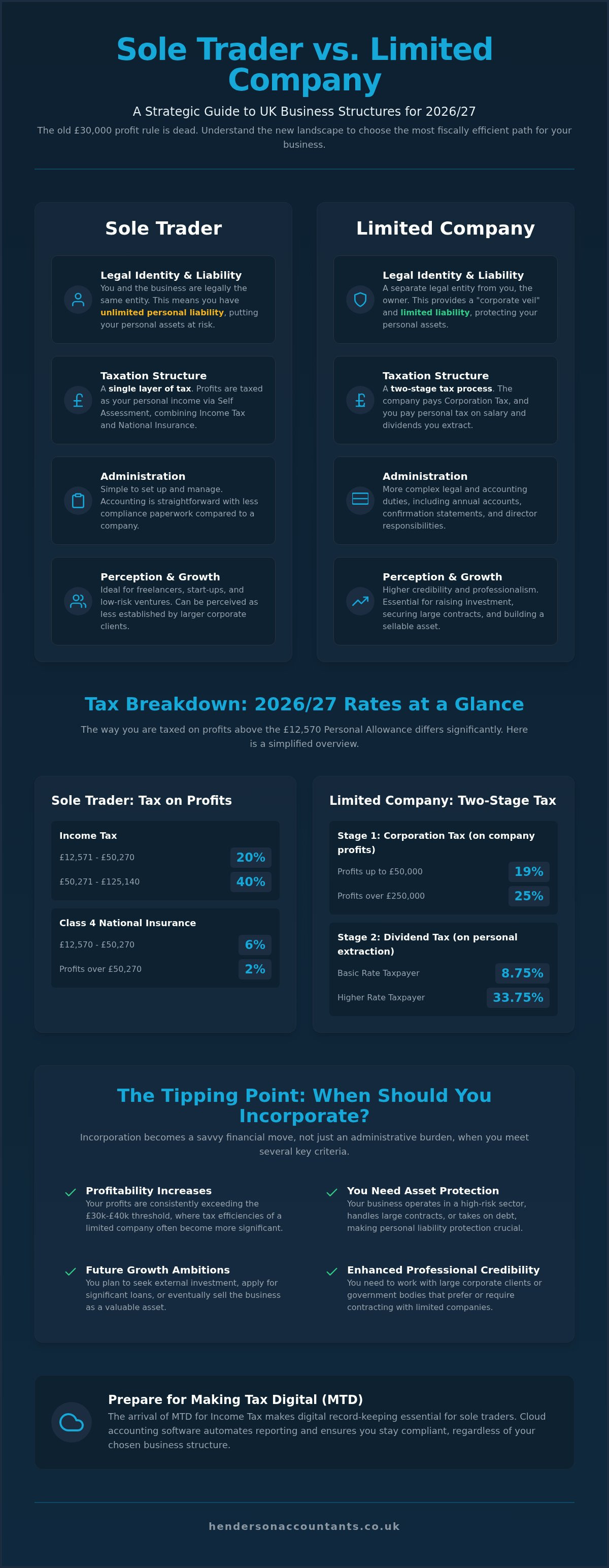
As a sole trader, you and your business are legally the same. It's the most common of all UK business structures because it's incredibly simple to set up. You have full control, and your accounting is straightforward. However, this simplicity comes with a trade-off: you are personally responsible for everything. In the early stages, sole trader accounting is often the best way to keep costs low whilst you find your feet and prove your business model.
A limited company is a separate legal person. It can own assets, enter contracts, and pay its own taxes. This separation offers credibility and makes it much easier to raise investment or sell the business later. Most investors or lenders won't engage with a sole trader because there's no distinct entity to "buy" or secure a loan against. If your ambition involves building an asset you can one day exit, incorporation is inevitable.
The Legal Reality of Personal Liability
As a sole trader, you have "unlimited liability." If your business can't pay its debts or faces a legal claim, your personal assets, including your home, car, and savings, are all on the line. It's a heavy burden to carry. A limited company provides a "corporate veil." This legal shield protects your personal wealth, as the company's liabilities generally stay within the company. If you work in a high-risk sector or handle large contracts, this protection is often more valuable than any potential tax saving.
Perception and Professionalism amongst Clients
Your structure sends a signal to the market. Many large corporate clients and recruitment agencies prefer, or even strictly require, working with limited companies to simplify their own compliance and IR35 risks. Operating through a company suggests a level of scale and stability that a "freelancer" profile might lack. It’s a psychological shift. Moving to a limited structure helps you transition from being the person doing the work to being a business owner who manages a strategic entity. It tells your clients that you're here for the long term.
The Tax Breakdown: Comparing Liabilities for 2026
Understanding the sole trader vs limited company tax uk landscape starts with one shared figure: the Personal Allowance. For the 2026/27 tax year, this remains frozen at £12,570. This means the first £12,570 of your income is tax-free, regardless of your structure. However, the way you pay tax on everything above that threshold differs significantly between the two paths. It isn't just about the percentage you pay; it’s about how many times HMRC takes a slice of your hard-earned profit.
Income Tax and National Insurance for Sole Traders
As a sole trader, your business profits are treated as your personal income. You pay Income Tax at the basic rate of 20% on earnings between £12,571 and £50,270. If you're successful enough to move into the higher rate band, that jumps to 40% on income up to £125,140. You also need to factor in Class 4 National Insurance (NI). For 2026/27, this is 6% on profits between £12,570 and £50,270, and 2% on anything above that. Since Class 2 NI was abolished, the calculation is simpler than it used to be. You can find more details on these obligations in the official guide to setting up as a sole trader. The main benefit here is simplicity; you report everything once a year via Self Assessment and pay your bill in one or two clear instalments.
Corporation Tax and Dividend Strategy
Limited companies face a two-stage tax process. First, the company pays Corporation Tax on its profits. In 2026, the small profits rate is 19% for companies with profits up to £50,000. If your profits exceed £250,000, you'll pay the main rate of 25%. For profits in between, a marginal relief calculation applies. After the company pays its tax, you then pay yourself. Most directors use a strategy of a small salary topped up by dividends.
Dividends are attractive because they don't attract National Insurance, though they do have their own tax rates. After your £500 dividend allowance, you'll pay 8.75% at the basic rate, 33.75% at the higher rate, or 39.35% at the additional rate. Some people call this "double taxation" because both the company and the individual pay tax. Whilst that's technically true, the overall tax bill is often lower because of the NI savings. If you're feeling overwhelmed by these calculations, our team can help you organise a tax-efficient remuneration plan that balances your salary and dividends perfectly.
The key to making this work is timing. By keeping profits inside the company, you can control when you take the income and, therefore, which tax year it falls into. This flexibility is something sole traders simply don't have, as they're taxed on all profit in the year it’s earned, whether they spend it or not.
Calculating the Tipping Point: Is It Time to Incorporate?
Deciding when to move from a self-employed setup to a corporate one is no longer a simple "yes" once you hit a certain income. The sole trader vs limited company tax uk landscape has shifted. Recent changes to dividend allowances and the introduction of the 19% small profits rate for Corporation Tax mean the financial benefits of incorporating appear later than they used to. You need to look beyond the tax percentages and consider the total cost of running your business.
The £30,000 to £50,000 Profit Debate
Many entrepreneurs still view £30,000 in profit as the magic number to incorporate. Whilst this was once true, the narrowing gap between dividend tax and National Insurance means the savings at this level are often negligible. For many, £50,000 is now the more realistic threshold where the benefits become clear. At this level, a sole trader is pushed into the higher rate tax band for any additional income, paying 40% tax plus 2% National Insurance. A limited company director can choose to keep those profits within the business, paying only 19% Corporation Tax and reinvesting the rest into growth or equipment. The incorporation tipping point is the moment your annual tax savings exceed the increased cost of compliance and professional overheads.
Reinvesting profits is where limited companies truly shine. If your business is capital-intensive and you need to buy stock or machinery, doing so through a company is far more efficient. You're effectively buying those assets with money that has only been taxed at 19%, rather than money that has been hit by your personal income tax rate. This allows your "war chest" for growth to build much faster than it would as a sole trader.
Hidden Costs: Accountancy and Software
It’s a reality that limited company accounting is more complex. You'll have to deal with statutory accounts, corporation tax returns, and company secretarial filings. Because of this increased workload, accountancy fees for companies are naturally higher than for sole traders. You also need to factor in the cost of professional tools. We find that a Xero Cloud Accounting Setup is essential for managing this transition. It automates much of the admin that would otherwise eat into your evening, providing a real-time view of your tax liabilities so there are no surprises in January.
When you weigh up these costs, don't just look at the price of the service; look at the return on investment. A strategic approach to your Annual Accounts and tax planning can save you thousands in the long run. The goal is to ensure that the time you spend on compliance is minimised, allowing you to focus on the high-value tasks that drive your profit toward that next milestone.
Once you move beyond the tax calculations, the reality of daily administration becomes your next hurdle. The sole trader vs limited company tax uk choice significantly changes your relationship with HMRC and Companies House. While one path offers a lighter touch, the other requires a more disciplined approach to record-keeping. However, with the right tools, the extra work doesn't have to be a burden.
Sole traders have historically enjoyed the simplest path, filing a single Self Assessment once a year. But the rules are changing. From 6 April 2026, Making Tax Digital (MTD) for ITSA will require those with qualifying income over £50,000 to keep digital records and submit quarterly updates. This narrows the "simplicity gap" between the two structures. For limited companies, the load is heavier. You must prepare Annual Accounts, submit Corporation Tax Returns, and file a Confirmation Statement. You also have a legal duty to maintain the Persons with Significant Control (PSC) register at Companies House to ensure your ownership structure is transparent.
For eCommerce businesses, these requirements often collide with multi-channel sales complexities. Whether you sell on Shopify, Amazon, or eBay, tracking VAT across different jurisdictions is a challenge regardless of your legal structure. Our VAT Return Preparation services ensure that these digital sales flows are captured accurately so you never fall foul of the rules.
The Director’s Responsibilities
Stepping into the role of a company director is a legal commitment. You have a fiduciary duty to act in the company's best interest and ensure all filings are on time. HMRC and Companies House aren't lenient with late submissions. Fines for late accounts can escalate quickly from £150 to over £1,500. It's an unnecessary stress that can be easily avoided. Our Company Secretarial Services take this weight off your shoulders, managing your filings and statutory books whilst you focus on building your brand.
Automation through Xero
Modern compliance shouldn't feel like a chore. By using Xero Cloud Accounting Setup, we can make limited company administration feel as straightforward as a sole trader's books. Cloud software allows us to integrate your eCommerce sales channels directly into your accounting flow. This provides real-time data, meaning you'll know your tax liability in August rather than facing a surprise bill in January. It transforms your accounts from a historical record into a forward-looking growth tool. If you're ready to automate your compliance, book a Xero setup consultation with our team today.
Strategic Financial Planning: How We Guide Your Growth
At Henderson & Co. Accountants, we believe your accounts should be a roadmap for the future, not just a record of the past. The sole trader vs limited company tax uk decision is often the first step in a much larger journey. We don't just "do the books"; we act as a strategic partner to ensure your business structure aligns with your long-term life goals and scaling ambitions. Our focus is on providing a stable foundation so you can build your success without fear of hidden complications.
Organising the move from a sole trader to a limited company requires more than just a registration at Companies House. It involves a methodical transition of your contracts, bank accounts, and assets. We manage this entire process for you, ensuring that your opening balances are correct and that you don't lose any momentum during the switch. Our goal is to replace the anxiety of "getting it wrong" with the calm control of a professionally managed entity.
Beyond Compliance: The Outsourced Finance Department
As you grow, your needs change. A basic bookkeeping service might keep you legal, but an Outsourced Finance Department helps you thrive. We take over the heavy lifting of Payroll and CIS Management, alongside your VAT Return Preparation. This level of support is particularly vital for eCommerce brands dealing with multi-channel sales and complex stock valuations. Our Xero specialists ensure your data is always clean, giving you the clarity needed to make bold business decisions whilst you focus on driving sales.
An Outsourced Finance Director provides a level of advisory that identifies tax-saving opportunities you might otherwise miss. Whether it's optimising your director's loan account or planning for future investment, we stay ahead of the curve so you don't have to. We focus on the strategic "why" behind the numbers, helping you understand how every pound can be better utilised for growth. This proactive guidance is what separates a reactive accountant from a true business ally.
Your Next Steps to Incorporation
If you've identified that you've reached your fiscal tipping point, it's time to take action. Transitioning doesn't have to be a hurdle if you follow a clear, organised sequence. You'll need to choose a unique company name, appoint your directors, and set up a dedicated business bank account that integrates with your accounting software. We recommend starting with a thorough review of your last six months of trading to confirm the exact tax benefit of incorporating now. To get started, speak with our experts to find the right path for your business and ensure your next step is the most efficient one.
Ready to Scale Your Business?
Deciding on the sole trader vs limited company tax uk framework is about more than just numbers; it's about choosing the right foundation for your ambition. We've seen that the 2026 tax landscape requires a strategic approach, particularly as the fiscal tipping point now often sits closer to £50,000 in profit. By integrating smart automation and protecting your personal assets, you can move away from the stress of manual admin and focus on what you do best: growing your brand.
As Xero Certified Gold Partners and specialist eCommerce accountants, we offer dedicated Outsourced Finance Director support to guide you through every stage of this transition. Our team is here to demystify the compliance process and ensure your business remains as efficient as possible whilst you scale. You don't have to manage these complex changes in isolation.
Book a consultation to discover your tax-efficient tipping point and start building a more secure financial future today. We look forward to helping you reach your next milestone with clarity and confidence.
Frequently Asked Questions
Is it cheaper to be a sole trader or a limited company in 2026?
It depends on your annual profit levels and administrative overheads. For profits below £50,000, the sole trader structure is often cheaper because you avoid the costs of statutory accounts and company secretarial filings. However, once you exceed this threshold, the savings on National Insurance through a limited company usually outweigh the higher accountancy fees. We recommend a bespoke calculation to find your specific sole trader vs limited company tax uk tipping point.
How much can a sole trader earn before paying tax in the UK?
You can earn up to £12,570 in the 2026/27 tax year before you start paying Income Tax. This is known as your Personal Allowance and it applies to both sole traders and company directors. Once your profits exceed this amount, you'll begin paying tax at the basic rate of 20%. Keep in mind that as a sole trader, you also pay Class 4 National Insurance on profits above this same threshold.
Can I switch from a sole trader to a limited company mid-way through the tax year?
Yes, you can transition to a limited company at any point during the year. You don't need to wait for the start of a new tax year on 6 April. The process involves closing your sole trader books, preparing a final Self Assessment, and registering your new entity with Companies House. We often help clients time this move to coincide with a VAT quarter to make the transition as smooth as possible.
What are the main tax benefits of a limited company?
The primary tax benefits include the ability to pay yourself through a combination of a low salary and dividends, which avoids National Insurance on a large portion of your income. You also benefit from the 19% small profits rate of Corporation Tax. This structure provides significant flexibility, allowing you to keep profits within the business to reinvest or to draw them in a future year when your personal tax rate might be lower.
Do limited companies pay more in accountancy fees?
Yes, accountancy fees for limited companies are generally higher because the reporting requirements are more complex. Unlike a sole trader who only needs a Self Assessment, a company director must file Annual Accounts and Corporation Tax Returns. You are also paying for the expertise needed to manage your statutory books and Companies House compliance. Many owners find that the tax savings and professional peace of mind easily justify these additional costs.
What happens to my VAT registration if I move from sole trader to limited company?
You have two main options when moving your VAT registration. You can either apply to transfer your existing VAT number to the new company through a process called a Transfer of a Going Concern (TOGC), or you can cancel your old registration and start fresh. Most businesses prefer to keep their existing number to maintain continuity with suppliers and customers. We can manage this administrative switch for you to ensure you remain fully compliant.
How does being a limited company affect my ability to claim business expenses?
Operating as a limited company offers more formalised ways to claim expenses, such as the £300 annual trivial benefits allowance or the £150 per head staff party exemption. While the core rule remains that expenses must be wholly and exclusively for business, the company structure allows for more strategic planning around pension contributions and equipment purchases. It's vital to keep digital records to ensure every claim is backed by a valid receipt or invoice.
Is a limited company better for eCommerce businesses selling on Amazon or Shopify?
For eCommerce sellers, a limited company is often the superior choice because it provides essential liability protection. If you're selling products on Amazon or Shopify, you face risks regarding product liability or intellectual property disputes. A corporate structure shields your personal assets from these claims. Additionally, having a registered company can improve your credibility when applying for brand registry or negotiating better terms with international suppliers and multi-channel sales platforms.


