

What if your year-end was the most insightful day of your business calendar instead of the most stressful? For many entrepreneurs, preparing annual accounts for limited company uk feels like a high-stakes race against HMRC and Companies House clocks. You're likely tired of second-guessing whether you need full or abridged accounts, whilst the fear of a £150 late filing penalty lingers in the back of your mind. It's a common frustration; you aren't alone in feeling that the financial terminology is often designed to confuse rather than clarify.
We're here to change that narrative by turning a mandatory chore into a strategic advantage. This guide promises to demystify the statutory filing process, ensuring you stay compliant whilst uncovering the growth stories hidden in your balance sheets. You'll learn the crucial differences between HMRC and Companies House submissions, how to navigate the updated 2026 accounting standards, and why modern tools like Xero make the entire process feel effortless. By the end, you'll have the calm control and clarity needed to lead your business toward its next big milestone with absolute confidence.
Key Takeaways
- Master the essential components of your filing, including the profit and loss statement and the balance sheet, to ensure your reporting is accurate and transparent.
- Clarify the specific deadlines for Companies House and HMRC to protect your business from automatic penalties and unnecessary stress.
- Learn how to prepare annual accounts for limited company uk using Xero cloud accounting to automate manual tasks and improve data accuracy.
- Transition from basic compliance to strategic growth by using your year-end data as a foundation for outsourced finance director insights.
- Gain peace of mind by understanding the dual role of your accounts in reporting to shareholders whilst meeting your legal obligations.
Demystifying Annual Accounts for UK Limited Companies
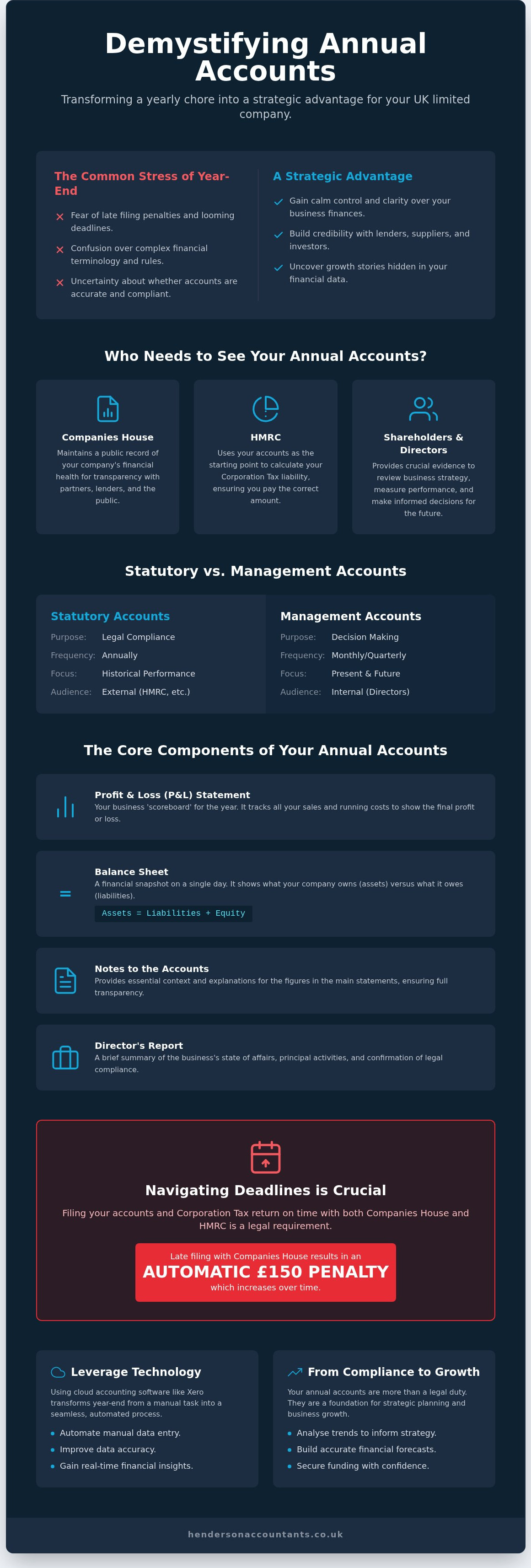
Annual accounts for limited company uk are essentially a financial story of your business over a twelve-month period. Instead of viewing them as a mountain of paperwork, think of them as a clear, structured summary of your trading activity. They show exactly what you've achieved, where your money went, and what your business is worth at a specific point in time. Every set of accounts must be prepared following specific rules known as UK Generally Accepted Accounting Practice (UK GAAP). This ensures every business speaks the same financial language, making it easier for outsiders to understand your performance. Whilst the process might seem heavy, staying organised throughout the year makes your "Year End" feel like a simple victory lap rather than a frantic dash.
Transparency isn't just about satisfying the law; it's a powerful tool for building credibility. When your accounts are organised and filed on time, you send a signal of stability to the outside world. Suppliers might offer better credit terms if they can see you're reliable. Banks and investors will look at these documents first before deciding to support your growth. By keeping your records clear, you're building a foundation of trust that helps your business scale without unnecessary barriers.
Who Needs to See Your Annual Accounts?
Three main groups rely on your financial data to understand how your company is faring:
- Companies House: They keep a public record of your business. This allows anyone, from potential partners to lenders, to verify your company's financial health.
- HMRC: Your accounts are the starting point for calculating how much Corporation Tax you owe. They ensure you're paying the right amount based on your actual profits.
- Shareholders and Directors: As the owners and leaders, you need these reports to see if your strategy is working. They provide the evidence you need to pivot or double down on specific projects.
Statutory Accounts vs. Management Accounts
It's easy to get these two confused, but they serve very different roles in your business life. Statutory accounts are the "official" version required by law. They look back at what has already happened to satisfy your legal obligations and are filed once a year. Management accounts, on the other hand, are produced more frequently for your internal use. They focus on the present and the future, helping you track KPIs and cash flow in real-time. While statutory accounts prove you are compliant, management accounts empower you to make the daily decisions that drive your business forward.
The Core Components: What Must Your Accounts Include?
Think of your annual accounts as a set of building blocks. Each piece provides a different perspective on your business, but they must fit together perfectly to create a compliant and useful report. When you prepare annual accounts for limited company uk, you're essentially creating four main documents: the Profit and Loss (P&L) statement, the Balance Sheet, the Notes to the accounts, and the Director's Report.
The P&L statement is your scoreboard. It tracks your sales, running costs, and the resulting profit or loss over the year. For eCommerce entrepreneurs, this is particularly vital for reconciling multi-channel sales from platforms like Shopify or Amazon. It's not just about the final number; it's about seeing where your margins are squeezed. The Director's Report adds a layer of accountability, providing a brief summary of the business's state and confirming that you've followed the necessary regulations. Finally, the Notes provide the essential context that explains the "why" behind the numbers, ensuring anyone reading the accounts has the full picture.
Understanding the Balance Sheet
Whilst the P&L shows what happened over time, the balance sheet is a snapshot of your company's health at a specific moment. It lists your assets, such as cash in the bank and inventory, against your liabilities, like unpaid supplier invoices or tax bills. In plain English, it's what you own versus what you owe. This document is often the first thing lenders look at when determining your company's credit score. A strong balance sheet with healthy "Shareholder Funds", which represent the money left in the business after all debts are paid, suggests a stable, growing entity. If you're looking to scale, professional annual accounts management ensures these figures are presented accurately to support your future funding goals.
Thresholds for Small Companies and Micro-entities
Not every limited company needs to file the same level of detail. The UK government categorises businesses as micro-entities, small, or medium-sized based on their turnover, balance sheet total, and employee count. For 2026, most smaller businesses fall into the micro-entity or small company brackets, which allows for simplified reporting. If you qualify, you can choose to file "filleted" or abridged accounts. This is a significant benefit for privacy. It allows you to omit the P&L statement from the public record at Companies House. Determining your category depends on meeting at least two of the three criteria for two consecutive years, ensuring your reporting remains proportional to your business size.
Navigating Deadlines and Statutory Obligations
Managing the calendar is one of the most critical tasks for any director. When you handle annual accounts for limited company uk, you aren't just dealing with one deadline; you're juggling several across two different government bodies. For most established companies, the Companies House deadline is exactly nine months after your financial year ends. However, the first year is where many founders stumble. Your first set of accounts is usually due 21 months after the date you registered the company. This "first year trap" can lead to unexpected stress if you haven't organised your bookkeeping from day one.
For busy eCommerce brands, keeping on top of these dates amongst daily order fulfilment and marketing can feel overwhelming. The key is to build a steady rhythm. Instead of a year-end scramble, treat your records as a living document. By reconciling your sales and expenses monthly, the final filing becomes a simple administrative step rather than a month-long crisis. This proactive approach ensures you have the data ready well before the clock runs out.
Companies House vs HMRC: Different Roles, Different Dates
It's vital to understand that Companies House and HMRC have different requirements and timelines. Whilst you file your accounts with Companies House to keep the public record updated, you deal with HMRC to settle your tax obligations. You have nine months and one day after your year-end to pay your Corporation Tax, but you actually have 12 months to file the Company Tax Return itself. This gap can be confusing. Most proactive business owners choose to file everything at once to get it out of the way. Since the joint filing service was discontinued on 31 March 2026, you must ensure both submissions are handled correctly through compatible software to stay compliant with both bodies.
The Cost of Delay: Penalties and Consequences
The penalties for missing these deadlines are strict and automatic. For a private company, being just one day late with Companies House triggers a £150 fine. This increases to £375 after one month, £750 after three months, and reaches £1,500 if you're more than six months late. If you miss the deadline two years in a row, these amounts are doubled. Beyond the financial cost, persistent failure to file can lead to your company being struck off the register. This effectively ends your business and can damage your professional reputation with suppliers and banks. Extensions are only granted for truly exceptional, unforeseen events; therefore, aiming for an early submission is always the safest strategy.
Leveraging Technology for Stress-Free Year-Ends
The days of handing over a shoebox of crumpled receipts are long gone. Modern entrepreneurs now use real-time data to prepare annual accounts for limited company uk, replacing year-end anxiety with a sense of calm control. This shift isn't just about speed; it's about the absolute accuracy that digital records provide. By moving away from manual spreadsheets, you eliminate the human errors that often lead to the HMRC penalties we discussed earlier. This "continuous accounting" approach means you aren't surprised by a tax bill nine months after your year ends. You'll know your position months in advance, allowing you to plan your cash flow with total confidence.
Integrating your eCommerce platforms, such as Shopify or Amazon, directly into your financial system ensures that every single sale is accounted for. This automation creates a steady, methodical flow of information that mirrors the orderly nature of a well-run business. When your data is live, you can make informed decisions in the moment rather than waiting for a historical report that might be months out of date. It transforms your accounts from a compliance burden into a stable foundation for your business growth.
The Power of Xero for Limited Companies
Xero is the stable foundation for this modern approach. Its automated bank feeds pull in every transaction daily, which reduces the manual stress of reconciliation at the end of the month. This digital record-keeping ensures you stay fully compliant with current Making Tax Digital (MTD) requirements without any extra effort. When your data is organised in the cloud, it allows your accountant to move beyond basic filing. They can provide proactive advice and strategic insights that help you stay ahead of the curve. If you want to simplify your financial life, our team can guide you through a Xero cloud accounting setup that prepares you for long-term success.
Automation in eCommerce Accounting
For multi-channel sellers, the complexity of international VAT and multi-currency sales can be a significant hurdle. Automation handles these nuances effortlessly, ensuring your annual accounts reflect the true state of your global trading. By reconciling payment gateways like Stripe and PayPal automatically, you ensure your balance sheet remains accurate without hours of manual checking. Automated inventory tracking also provides a real-world reflection of your company's value. This prevents the common mistake of over-reporting profits on stock that hasn't actually sold yet, ensuring you only pay the tax that is truly owed.
Strategic Support: Why Professional Management Matters
Managing your company's finances shouldn't feel like a solo mission. While many business owners view annual accounts for limited company uk as a simple box-ticking exercise, the reality is that these documents are the heartbeat of your strategic planning. There is a vast difference between a compliance-only accountant who merely files historical data and a strategic partner who looks through the windscreen instead of just the rearview mirror. When you treat your year-end as a baseline for growth, you turn a legal requirement into a powerful tool for your business's future.
At Henderson & Co. Accountants, we specialise in demystifying the entire filing process. We understand that as a modern entrepreneur, your focus needs to stay on your customers and your products. We don't just hand you a balance sheet; we explain what the numbers mean for your expansion plans. By translating "accountant-speak" into actionable business advice, we ensure you feel in total control of your financial narrative. This collaborative approach builds a stable foundation, allowing you to build your success without the fear of hidden barriers or confusing terminology.
Peace of Mind Through Outsourced Finance
One of the greatest benefits of professional management is the gift of time. By letting an expert team handle your annual accounts for limited company uk, you free yourself to focus on high-level marketing and product development. This is especially vital in 2026, as significant amendments to FRS 102 and FRS 105 bring new complexities to lease accounting and revenue recognition. Staying compliant amongst these shifting regulations requires a proactive guide who stays ahead of the curve. Having a dedicated team also means you have a shield if HMRC ever has enquiries. We handle the technical correspondence on your behalf, ensuring your peace of mind remains undisturbed.
Beyond Filing: Tax Planning and Business Strategy
A professional review of your accounts often uncovers tax-saving opportunities that DIY software or basic filing services might miss. We look for ways to improve your tax efficiency, ensuring you aren't paying a penny more than necessary. These records also become your most important asset if you decide to raise funding or prepare for a business sale. Investors look for clean, professionally managed accounts as a sign of a well-run company. Discover how our Outsourced Finance Department can transform your Year End by providing the clarity and support you need to scale with confidence.
Transform Your Year-End into a Strategic Advantage
Preparing annual accounts for limited company uk doesn't have to be a source of anxiety. By embracing cloud technology and staying ahead of statutory deadlines, you turn a mandatory filing into a clear roadmap for your business growth. You've seen how real-time data from platforms like Xero replaces guesswork with certainty, allowing you to plan your tax position and cash flow with absolute confidence. Compliance is the baseline; the real value lies in using those figures to make smarter decisions for your eCommerce brand.
As a Xero Certified Platinum Partner, we specialise in providing jargon-free support that helps UK directors move from basic bookkeeping to high-level strategy. We understand the unique hurdles of modern entrepreneurship and are here to act as your collaborative ally. Whether you need help with multi-channel reconciliation or want to explore the benefits of an outsourced finance department, we're ready to help you scale. Book a consultation with our Xero specialists today and discover the peace of mind that comes from professional management. Your next big milestone is within reach, and we're here to help you build it on a stable financial foundation.
Frequently Asked Questions
What is the difference between statutory accounts and annual accounts?
They are essentially the same thing. Statutory accounts are the formal annual accounts for limited company uk prepared at the end of a financial year. They must follow specific legal standards like UK GAAP or IFRS. These reports are what you file with Companies House and HMRC to meet your legal obligations as a director. They provide a transparent view of your performance for shareholders and lenders alike.
Can I file my own limited company accounts without an accountant?
Yes, you can legally file your own accounts, but it's often a false economy for growing brands. The process involves complex technical standards and specific software requirements for digital filing. Most directors find that the time spent navigating these regulations is better invested in their business strategy. A professional ensures you don't miss tax-saving opportunities or fall foul of automatic late-filing penalties that can quickly accumulate.
How long do I need to keep my financial records for a limited company?
You must keep your financial records for at least six years from the end of the last financial year they relate to. This includes all receipts, invoices, and bank statements. If you're using a cloud solution like Xero, these digital records are stored securely. This makes it much easier to retrieve them if HMRC ever requests a review of your annual accounts for limited company uk or your corporation tax position.
What happens if my limited company is dormant?
Even if your company hasn't traded, you still have a legal obligation to file with Companies House and HMRC. You can usually file simplified dormant accounts if there have been no significant financial transactions during the year. This ensures your company remains on the register and in good standing. Failing to file for a dormant company can still result in automatic penalties or the business being struck off the official register.
How much does it cost to file annual accounts in the UK?
Companies House charges specific administrative fees for certain filings. For example, the digital confirmation statement fee is £50 as of February 2026. However, there is no direct government fee for filing the annual accounts themselves. The cost usually comes from the professional fees you pay an accountant to prepare the documents. These vary based on your company's complexity, turnover, and the level of strategic support your business needs to scale effectively.
Can I change my company’s financial year-end date?
You can change your year-end date by applying to Companies House, but there are strict rules on how often you can do this. You can shorten your accounting period as many times as you like. However, you can only lengthen it once every five years, unless the company is in administration. Changing the date can be a useful strategic move to align your reporting with your industry's peak trading seasons or seasonal cycles.
What are abridged accounts and does my company qualify?
Abridged accounts are a simplified version of your financial statements that contain less detail than full accounts. To qualify, your business must meet at least two of the criteria for a small company or micro-entity. This typically involves staying below specific thresholds for turnover, balance sheet totals, and employee numbers. Filing abridged accounts helps protect your privacy by keeping your profit and loss statement off the public register at Companies House.
Do I need an audit for my small limited company accounts?
Most small limited companies in the UK are exempt from a statutory audit. Your company usually qualifies for this exemption if it meets at least two of the following criteria: an annual turnover of no more than £10.2 million, assets worth no more than £5.1 million, or 50 or fewer employees on average. This allows you to focus on growth and compliance without the added cost and disruption of a full audit process.


